
Born and based in Bulgaria, artist Stanislav Bojankov brings a deeply intuitive and culturally layered approach to contemporary art. Trained at the historic Krakow Academy of Fine Arts, Bojankov works fluidly across painting, drawing, collage, handmade paper and installation, blending classical techniques with existential reflection. Bojankov’s artworks can be found in more than 50 museums and many private collectors around the world, and he has exhibited in over 400 International group exhibitions.
In this Culturalee Emerging Artist Spotlight, he shares insights into his creative process, studio rituals, and how personal history, philosophy, music, and the rich cultural archetypes of Eastern Europe shape his evolving artistic language in a global, digital age.
How would you describe your artistic style and aesthetic, and how has it evolved since you began your creative journey?
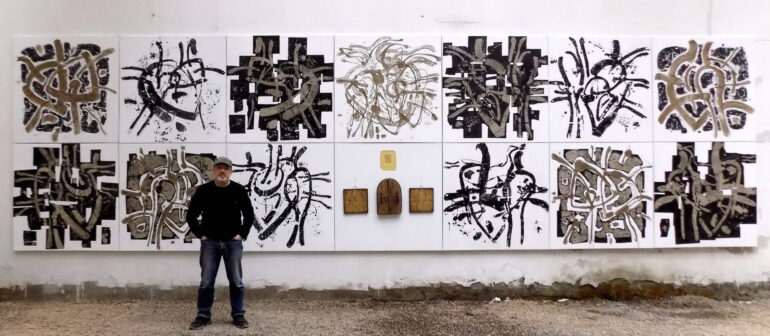
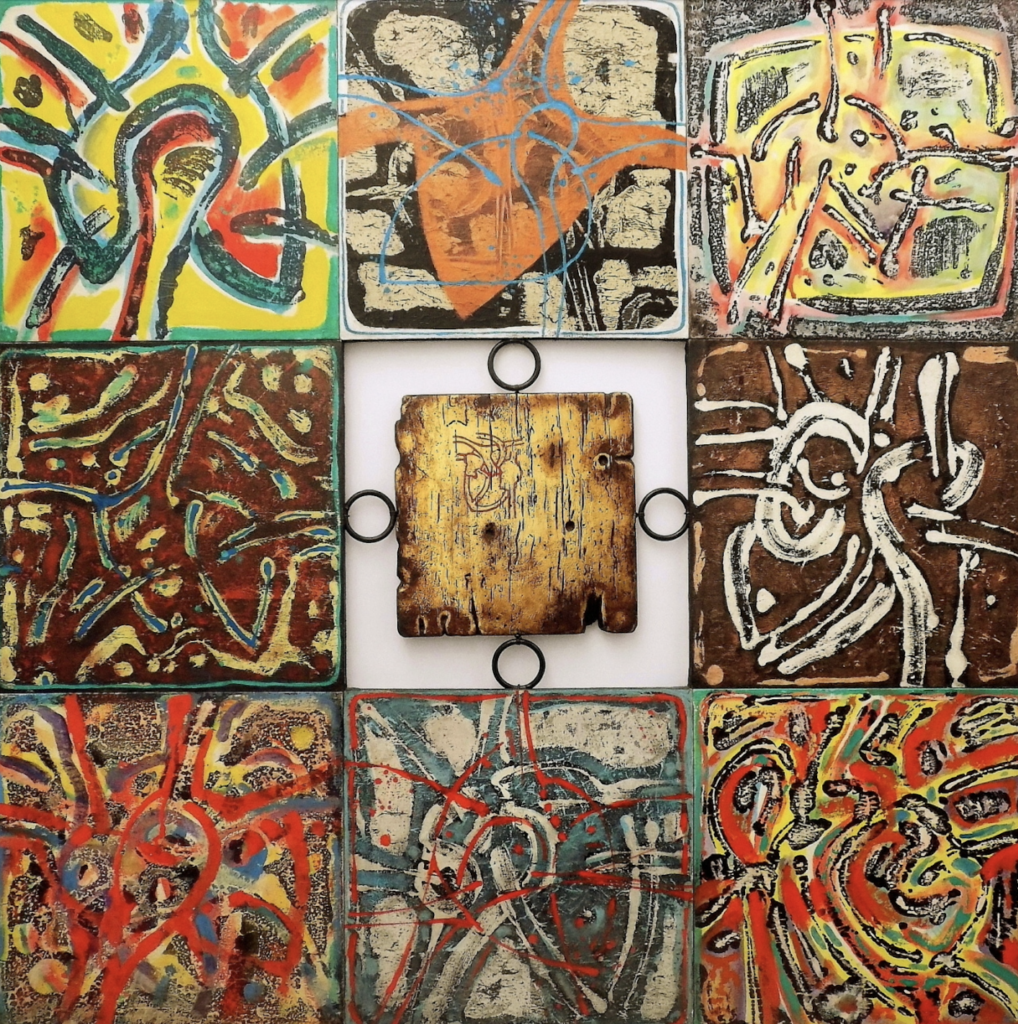
I was born in Bulgaria, Southern Europe, where I currently live. I completed my art education (MFA) in the mid-90s at the Krakow Academy of Fine Arts in Poland, one of the oldest schools in Europe, where I received a traditional education, studying the basic classical technologies. This gave me the opportunity to start working in many different fields – painting, graphics, drawing, collage, as well as making installations and objects. Gradually, in the process of working, solving various technological, creative and conceptual problems, I constantly had to educate myself. I also created my own handmade paper. And my works also developed in direct connection with the existential and purely human impulses of everyday life, emotions, thoughts, traces of living (here and now) in the context of my personal path.
We could say that art has a therapeutic effect not only for the viewer but also for its creator. Many of the greats I have learned from; Juan Miró, Picasso, Pollock, Christo, Cézanne, Van Gogh, Tapies, Kiefer, Richter and Henry Moore. As well as many writers, poets, composers such as Umberto Eco, T. S. Eliot, Chopin and Bach. Of course, we cannot do without the political and social context in which we live, as well as without constant social communication. Proof of this was the forced isolation and distancing during the covid crisis, as well as the difficult way of overcoming emotional and psychological tension and stress, as a consequence of the lack of natural communication and love.
In addition, social media has long since caused a revolution in the art world. Artists have become much more communicative, and we have reached our fans and collectors faster. It is also of great importance that we can receive assessments and opinions from the audience much more qualitatively and quickly. And all this has created a much better environment for development. Most galleries are now “hybrid”, stationary-virtual, you can work with your gallery or collectors from anywhere in the world. Except that you can’t have a drink together.
Looking at it from the current perspective, both because of the enormous possibilities and accessibility of new technologies, and because of the digitalization of our entire everyday life, a person can very easily “sink” into a pseudo “contemporary” approach and lose themselves and their root causes in the processes of creation, which, anyway, remain “magical” and “mystical” – some kind of spiritual practices and self-awareness. And it is precisely this balance that interests me at the moment – not only in my work, but also in the processes and works of others.
What does a typical day in your studio look like – from your creative rituals to how you develop and refine your work?
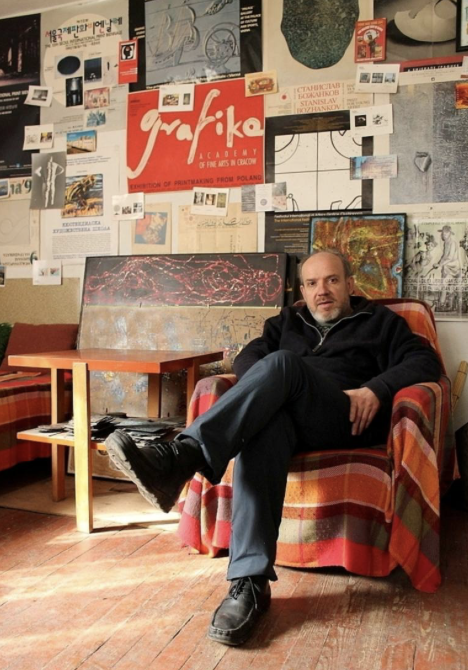
Actually, I’ve been a freelancer my whole life. I work daily in my studio. It pays my bills. I draw, read books, poetry, listen to a lot of different music – mostly jazz, classical and ethno-world, and this is the intellectual background of the creative process. Without my studio I feel nervous and often dissatisfied. And this is a special “hunger” and “addiction”, without which our work is doomed.
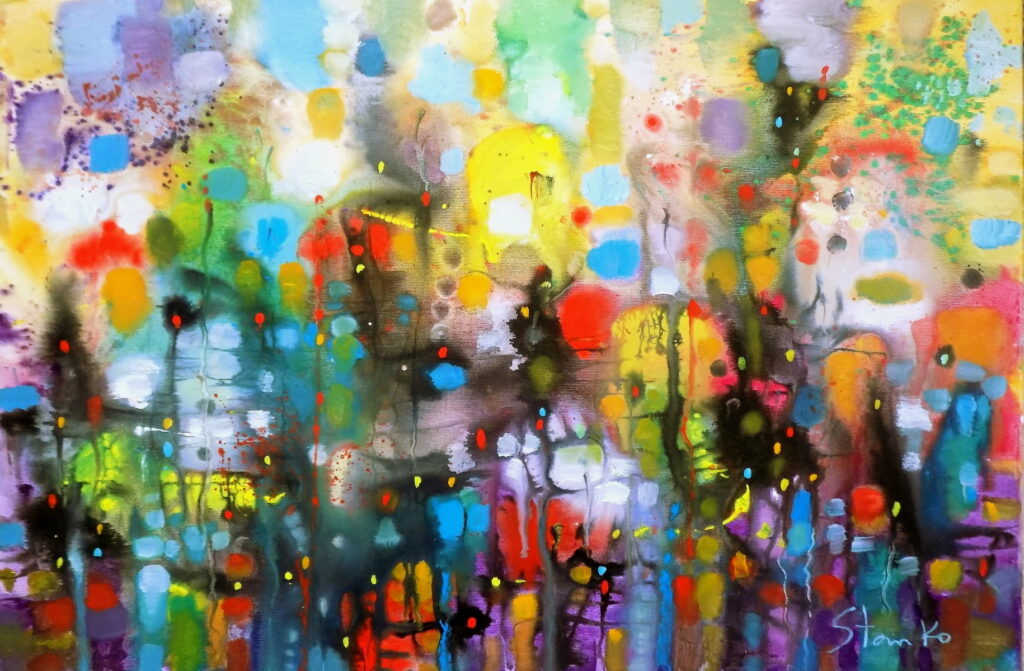
The city of Kyustendil is small and quiet place. I get up early in the morning, walk, drink coffee in one of the city cafes, get ready for work, plan tasks, and then go to the studio. In the afternoon I again walk around the city, cafes and return to the studio. I think best on my bike. And I usually don’t fix my works – I like them to turn out right the first time, to retain their original impulses and moods embedded in the gesture. In the same way that a Jazz musician improvises on his score, without fear of failure, following his momentary intuitions and feelings.
Usually the themes themselves appear somewhere “inside” the process. I just let them lead me and “insert” them into certain materials and technological features. You could say that I am an “intuitive” type of artist, for whom spontaneity is the main energy and tool of creativity. I have a lot of space around me – this is one of the pluses of life in the countryside – a graphic studio, a painting studio, a yard with plants and trees, closeness to nature and the symphony of the morning songs of the early birds, the cat that stalks them. Romantic, right? Of course, it also has its minuses, the distance from megacities and the cultural and social life of big cities. There is also a lack of contact with colleagues and with the guild.
The part of Europe where I live is very attractive with historical and cultural authenticity, but it is its poorest part, with a completely undeveloped art market – a result of the former Communist era. I sometimes travel to large cities and cultural centers. My work brings me into contact with gallery owners, collectors. I was recently in Krakow, Poland I was in London twice last year for two group exhibitions and I am already totally in love with this city.
Who or what are your biggest inspirations, and how do they influence the themes or techniques present in your art?
I am inspired by everything – art, philosophy, music, nature, mythologies. The beautiful and the ugly at the same time, the good and the bad. As is our life – a symbiosis, a kaleidoscope, a “game of glass beads” (according to Hermann Hesse) – a Utopia, a “puzzle-installation”, which for brevity we call “life”.
Art is the direct proof that there is real life on our suffering planet. Art has always been at the top of the value pyramid of values. The artifacts left by countless creative generations, carrying all the love, emotions and meaning for themselves, are the basis of our value accumulations.
I live in a beautiful province south of Sofia. Bulgaria is very endowed with natural resources and beauty – with mountains and the sea. Throughout its history, it has been at the crossroads of different civilizations, starting with primitive societies, cave art and the Neolithic, passing through the ancient Greek era and the Thracian civilization, the Roman Empire, Orthodox Byzantium, the Ottoman civilization and the Orient. Thanks to these cultures, a historical, intellectual, religious and mythological background of peculiar archetypes has been created.
My artistic attempts are related to giving an understanding, to be in modernity, using the codes of my traditional cultural layers and roots – a personal cultural DNA – and through them to be “contemporary” and relevant in my messages in a global aspect. The current state of visual forms is characterized by a special “hybridity” that cannot be defined – without dominant styles, or with countless such, with many and various techniques, multimedia, basic conceptuality. This is a vast ocean of values and pseudo-values in which an artist can very easily drown if he is not sure of both his messages and the depths of his own cultural layers and existential reasons to search right there – “within himself”.
This is the more honest path. And through this personal filter to be global and contemporary in the search for our common “puzzle” of values.
Follow Stanislav Bojankov here.
All images Courtesy of Stanislav Bojankov.