

By Culturalee Editor Lee Sharrock
The artisan practices are currently being re-cultured with the Generation Alpha, the first generation of entirely digital natives, beginning to turn their backs on the culture of apps in favour of the analogue experiences of entertainment, including vinyl records, vintage clothing, and books. This new appreciation has moved to more contemporary art in which textile work is actively being reevaluated. Textile art has been a long-standing disliked topic in the artworld, but currently it is being forecasted by most high-profile museums and institutions such as the Pompidou Centre in Paris and Fondation Cartier. These educational institutions are advocating textile practices as vital contemporary forms, which is consistent with a general drive towards touchiness, materiality, and embodied production in response to the overload of digitisation.
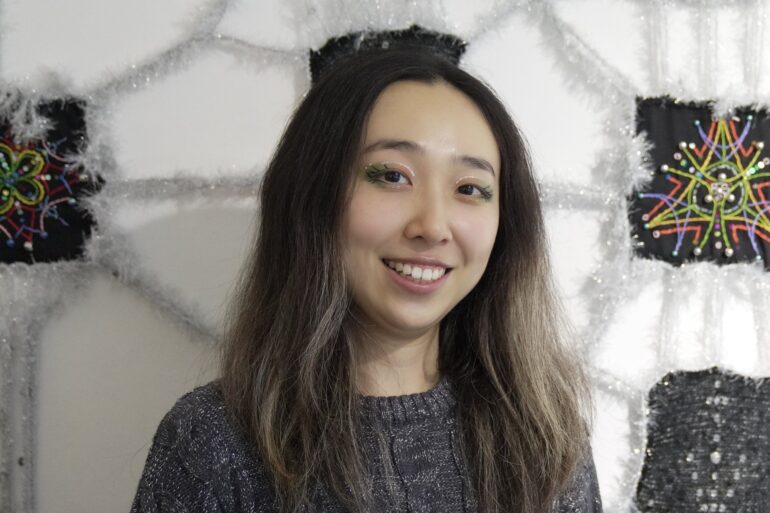
Shenlu Liu is an emerging contemporary artist whose artistic focus is multidisciplinary covering both hand-made and digital art. Born in Beijing, Liu descends from a long lineage of the textile artists, including Olga de Amaral, Magdalena Abakanowicz, Sheila Hicks, and Lee ShinJa, yet also reinvents the medium to another generation. Being a Gen Z artist, Liu is operating in a screen-based real world that is perceived as a space that does not challenge the past and traditions but uses textile practices as tools in order to challenge emotional experiences, embodiment, and perception.
The fiber art is a subversive art form which can be filled with a symbolism and cultural content on the structure itself. Textiles cease to be passive surfaces to Liu but are dynamic membranes, the site of encountering emotional, ritual, and material change. Woven Sigils: The Crystal Resonance Network, Phantom Erosion, Aether Apocalypse, and Organalux are her latest works, some of which represent a key direction in her search to discover novel ways of organising ornamental security, structured energy, and bodily-environment relations in the digitised era.
After graduating from the Royal College of Art with MA Textiles design in 2024, Liu located her practice in what she describes as a crisis of perception. The touch and the emotionality are normally diminished in a world where AI is intermediated through the assistance of digital interfaces. In response, Liu returns to the artisan techniques of the analogue art, including weaving, knitting, and embroidery. This re-emerging is not, however, nostalgic, but conceptual. Craft turns ritual by repetition and ornament becomes armour. Textile surfaces become places of intersection between the inner and outer reality.
Liu’s concept of ornamental energy shells is the most important point in her practice. These shells are composed of yarn, sequins, and systemic colour that is colourful, and functions as protective, though permeable skins. They are powerless and even setting boundaries. Ornament in the work of Liu is not a wasteful exhibition, but coded colourful cloth, and has the possibility to receive, store and transfer emotional and sensory information.
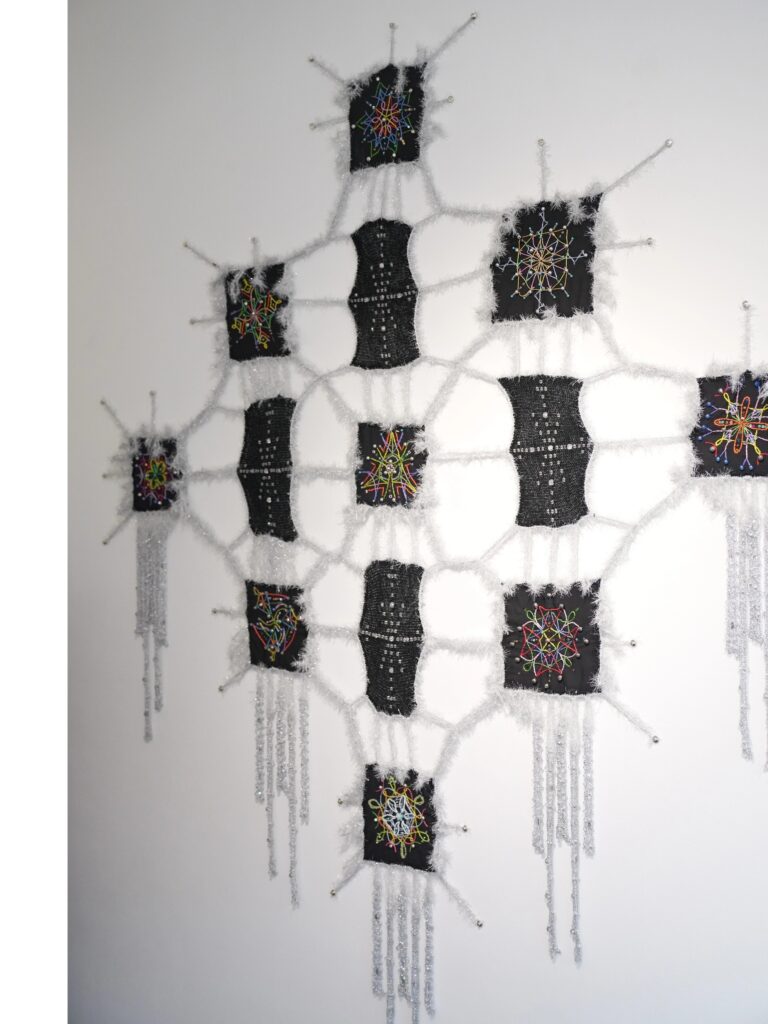
Woven Sigils: The Crystal Resonance Network is a good example of such an approach. In this text, Liu views textile surface as a place of symbolic writing. Weaving patterns are also part of the contemporary talismans and the marks of the sigils can be found in the threads. The light elements are also reflected by sequins, and this brings about the changes in viewship as individuals pass through the piece of work. The crystalline benchmark is metaphysical rather than geologic and the indication of memory refracted is through ornament. The work operates as screen, surface, and mirror and incorporates and reflects the emotional meaning. The connection between the fixed structure and the variable luminosity is suggestive of the manner in which Liu had been fascinated by nonlinear energy systems, which reintroduces the spiritual and geometrical acuity of Olga de Amaral.
Given that Woven Sigils: The Crystal Resonance Network definiens the symbolic language of Liu, Aether Apocalypse expounds it extensively. The installation has been imagined as a coupled work, responding to the each other with the help of grid constructions, which are traditionally attributed to rationality of the modernism tradition. Liu does not introduce grid as a fixed structure, but as a dynamic structure. Playing fibres and glowing parts interact in the two works to bring the vibration of a matrix in which the textile and light have an opportunity to merge and light does not just shine through it.
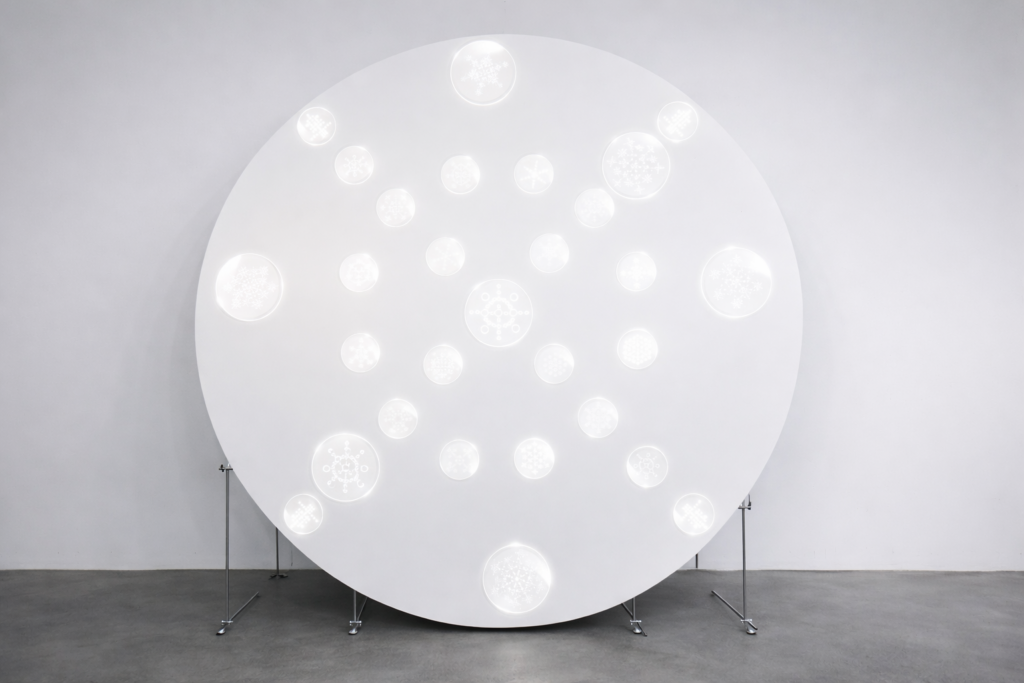
Aether Apocalypse’s dialogic structure constitutes its central meaning. Both components represent two complementing fields, one of them being more compact and earthy and the other one more permeable and radiant. They propose apocalypse, collectively, not as the annihilation, but as revelation, as finding forms invisible in accordance with which sensation and connection are to function. The grid is converted into a metaphysical drawing, following the lines of the invisible forces going through material, body, and space.
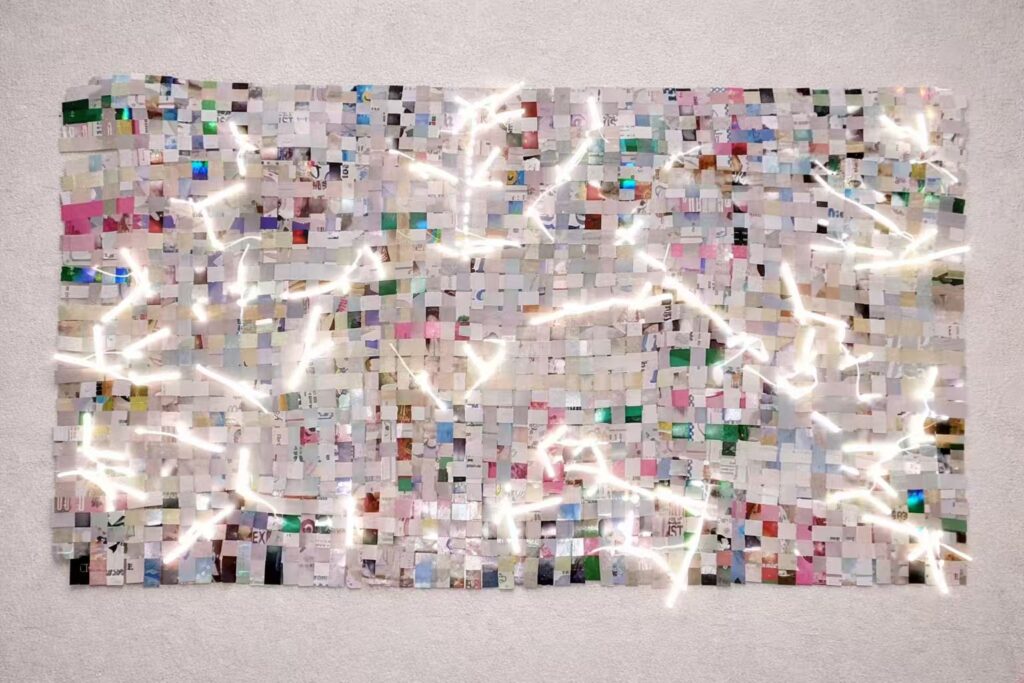
In the Phantom Erosion, Liu goes to the realm of consumerism, fragility of memory and material. It is created on reflective thread and glossy paper in relation to the South Korean photocard economy and the relationship that exists between this and over consumption. Whereas the focus in Aether Apocalypse is on structure, the focus in Phantom Erosion is on dissolution. The surfaces appear to be volatile and it means that memory can be destroyed too. The emphasis of Liu is on textile as a temporal media, where fibres store labour, tension, and emotional investments. The cloth surface is reposited in time and it is a site of production and decomposition.
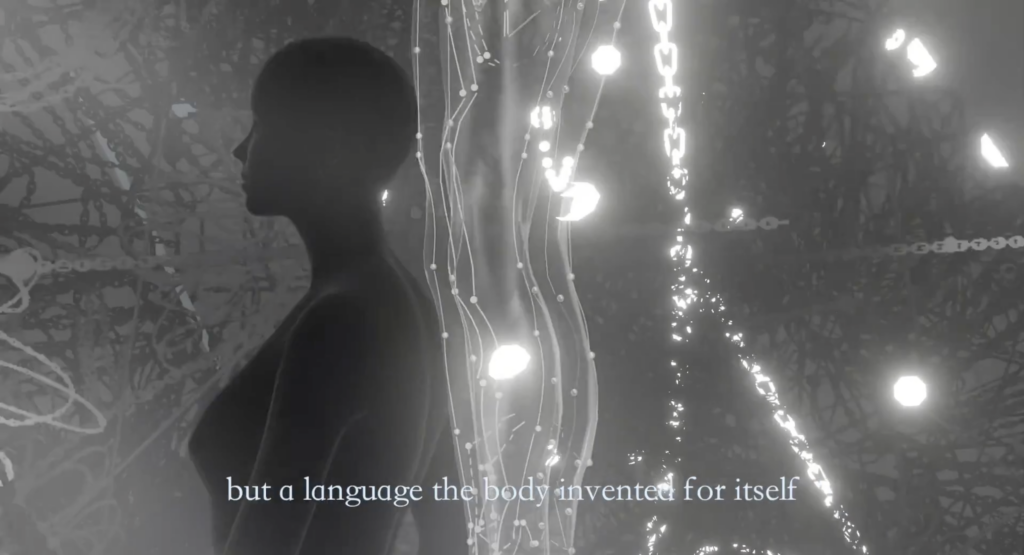
Moreover, Liu captures her textile research in form of animations in her video work, Organalux. The film depicts a biological radiance of a human figure in a tunnel of shifting geometric light. In addition, unlike most digital art, however, Organalux is handmaking conceptually based. Its visual language textile logic, repetition, pattern, and layering is reduced to motion. This mixture of traditional art and computerised animation suggests the more significant concern of Liu on the issue of perception in technologically mediated spaces.
The practice by Liu in these works transforms to an ornamental practice of being systematic. In the sympathetic writings of Woven Sigils: The Crystal Resonance Network all the way to the animated embodiment of Organalux, the corrosive matter of Phantom Erosion, and the action-packed combinations of Aether Apocalypse, Liu develops increasingly elaborate investigations of the interplay between energy, material, and perception.
The peculiarity of the work Liu adds to the existing textile art is that she does not believe that softness is the connotation of the weakness. Ornamentation as a practice that has been dismissed as an inconsequential entity becomes a form of resistance in her work. Liu is an opponent of the disembodiment of the digital by prefiguring repetition, touch, and bodily labour. Her fabrics do not sit back but are active points that can mediate the emotional and sensory experience.
Liu moves textile as protective and permeable in a manner in which rituals and material transformation are done. Light operates on thread, symbol on fibre and emotions on pattern. Her decorative shells of energy eventually begin to imply more than aesthetic newness, rather they hint at a new sensual morality, a new way of viewers perceiving their attitude toward perception, materiality, and embodiment in an increasingly intangible world.
Find out more about Shenlu Liu here.