

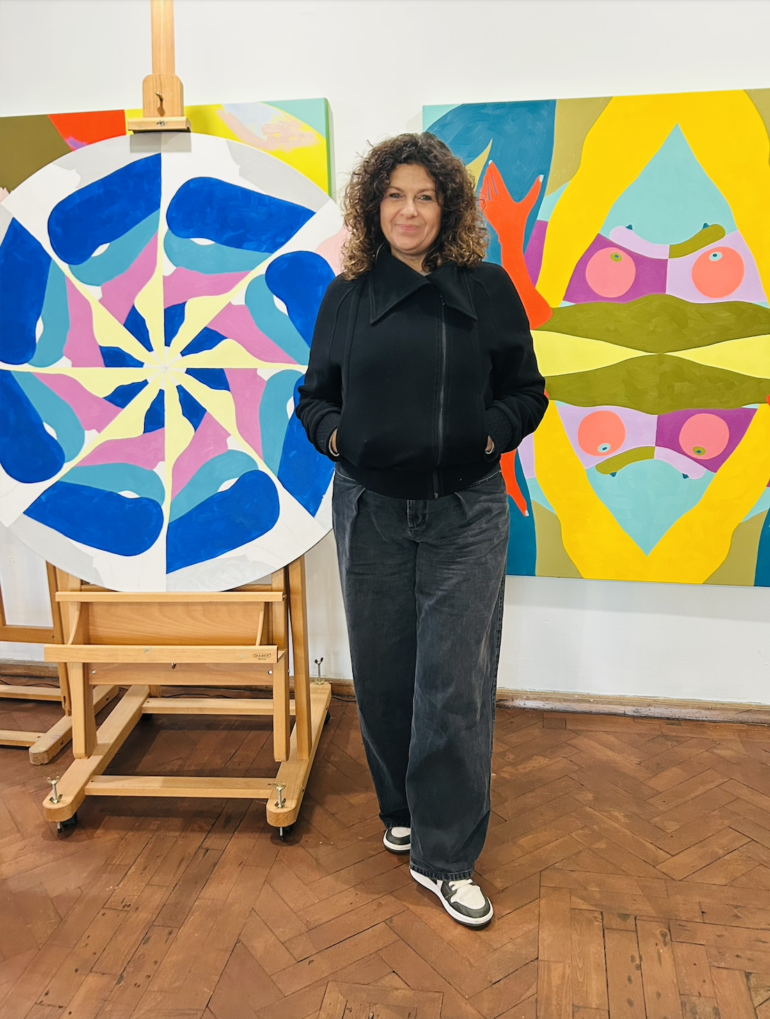
In this exclusive Culturalee interview, contemporary artist Helen Beard reflects on her vibrant, tactile practice and the ways film, craft and lived experience shape her exploration of intimacy and desire. Speaking from her Brighton studio, Beard discusses framing and movement, the emotional pull of paint, collage and needlepoint, and how chaos, tenderness and human connection are driving her work at this pivotal moment in her career.
Your work is celebrated for its fearless exploration of intimacy and the erotic, rendered through a distinctly vibrant and tactile visual language. During our visit to your Brighton studio, colour and movement felt almost kinetic. How do you think your background in film and art direction continues to inform the way you frame, crop and choreograph bodies on the canvas?
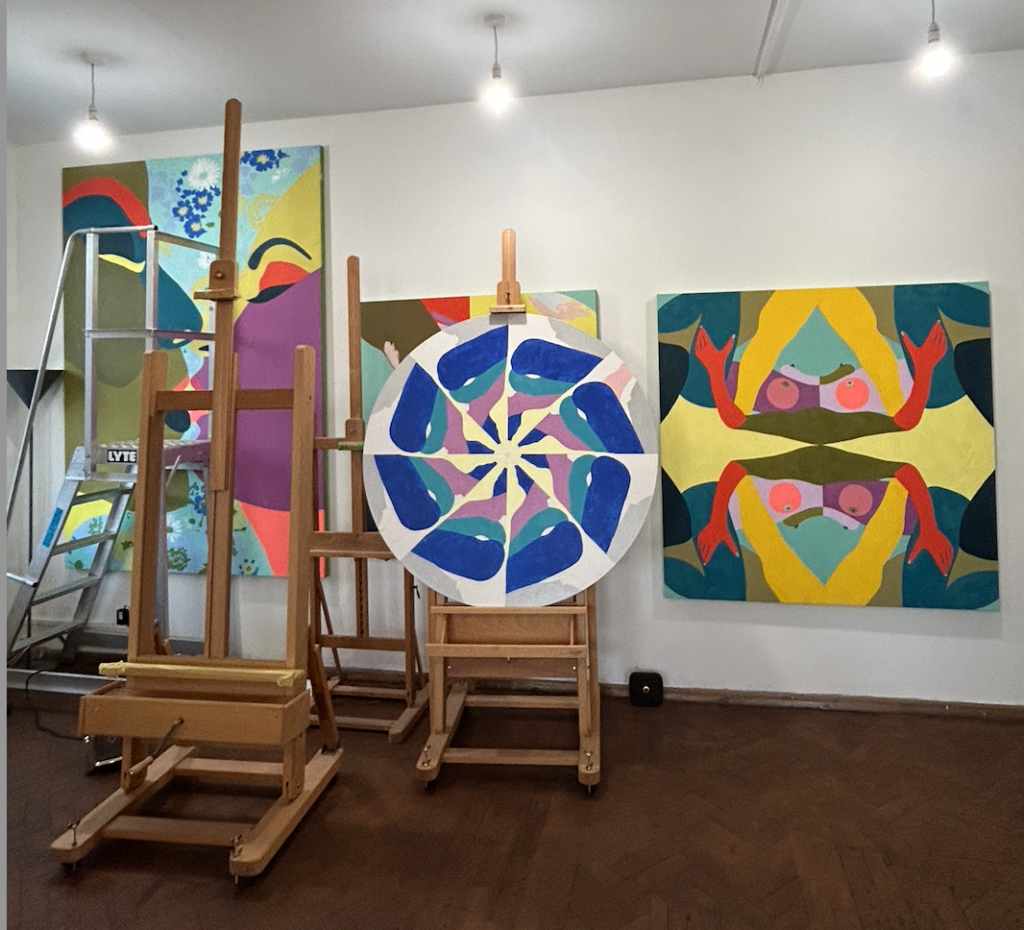
My work has always been informed by my beginnings in the film industry, and studying graphics at Bournemouth. Framing is an important part of my practice, and I continue to play with cropping and editing found images to come up with the most dynamic form for each new painting. As an artist, you always draw on experience. My new works in the studio are inspired by the chaos of my life recently, and they are kinetic and kaleidoscopic to reflect this. Playing with these reoccurring shapes and cycles to create patterns and order, is my way of navigating this period of uncertainty in my life.
You’ve worked across paint, collage and needlepoint, each with its own pace, rhythm and physicality. How does shifting between these mediums influence the emotional tone of your work, and what draws you to a particular material at a given moment?
I work across various mediums to allow me to interpret my subjects in different ways. Painting, for me, is more meditative. I am very neat, yet the brushstrokes are free-flowing, which is a bit of a contradiction in itself! It is like dancing and trying to move freely to the music, whilst staying within the choreographed lines. There’s a certain calmness to it, especially when working on large-scale paintings.
Collages, however, are much more free. They have an immediacy that allows me to experiment, rip things up, and leave things unfinished. This is a necessary discipline for me, when everything else I do is so obsessed with perfection. Needlepoint is more about warmth; it is more tactile and something that really makes me feel comforted. I am sure this harks back to when my Grandma was teaching me these techniques, and the unconditional love I felt. Her patience was just incredible.
Often craft is slow, repetitive work – a labour of love – and the process requires similar levels of patience to caring duties, this makes me reflect on why both practices are predominantly women’s work, and makes me question whether my fascination with this medium is related to my predisposition to care.
You’ve been both an artist and a curator, most notably co-curating Sensitive Content in 2022 with Maria Buszek and Alayo Akinkugbe. How has stepping into a curatorial role shaped your thinking about representation, eroticism and the politics of looking, especially in relation to your own practice?
It’s always so interesting to see other artists’ takes on the world, and in Sensitive Content, we focused on the body as a form of expression, and the ceaseless censorship of the images of the body on social media. Women particularly find this very limiting, and one of the criteria when researching for this project was that the artists had been directly affected by censorship, having had work taken down from social media platforms, and sometimes even having their accounts deleted due to their subjects.
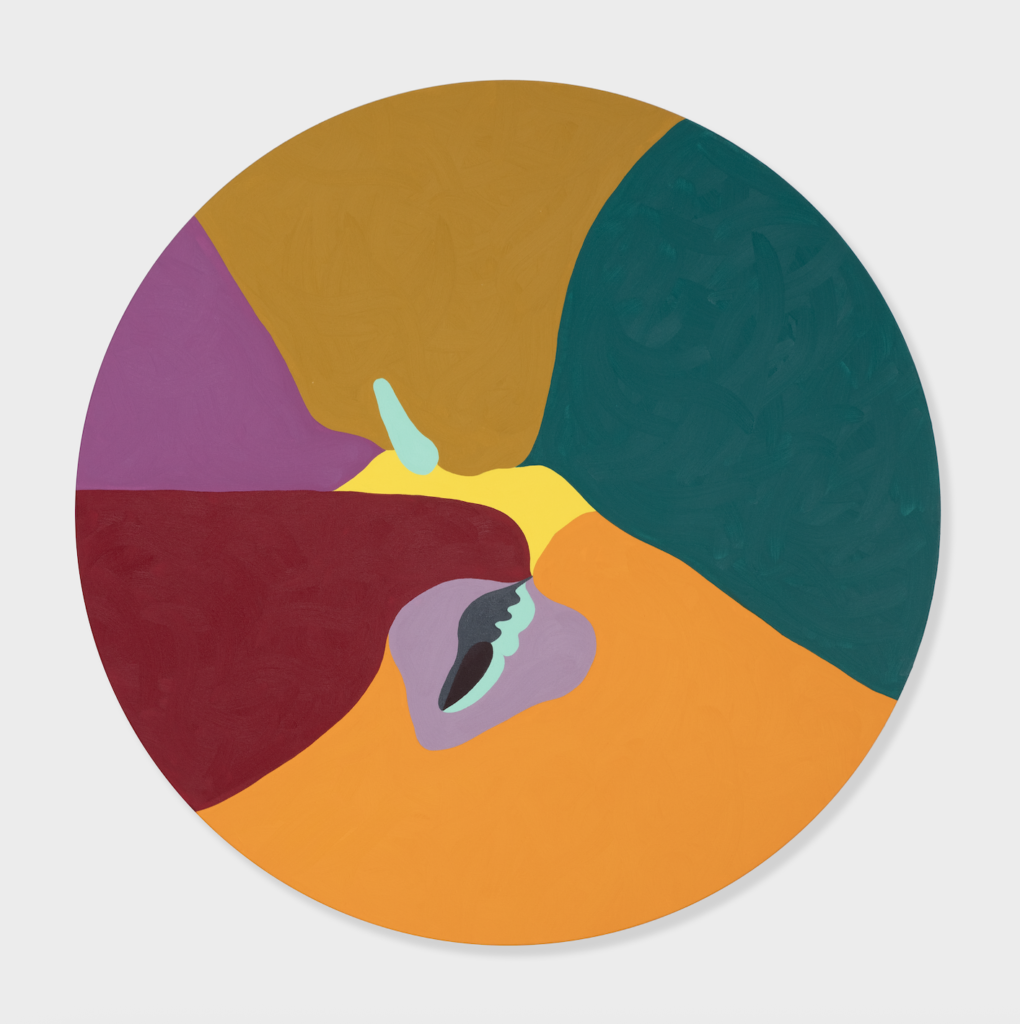
In my own practice, there was definitely a defiance that led me to making more overtly sexual paintings for a while. After this initial reaction, my paintings have tended to become much more about the tenderness of human connection, and have become softer and more emotive, and you can see this in the works included in Second Lives and the current show at Blain, Comfort and Joy.
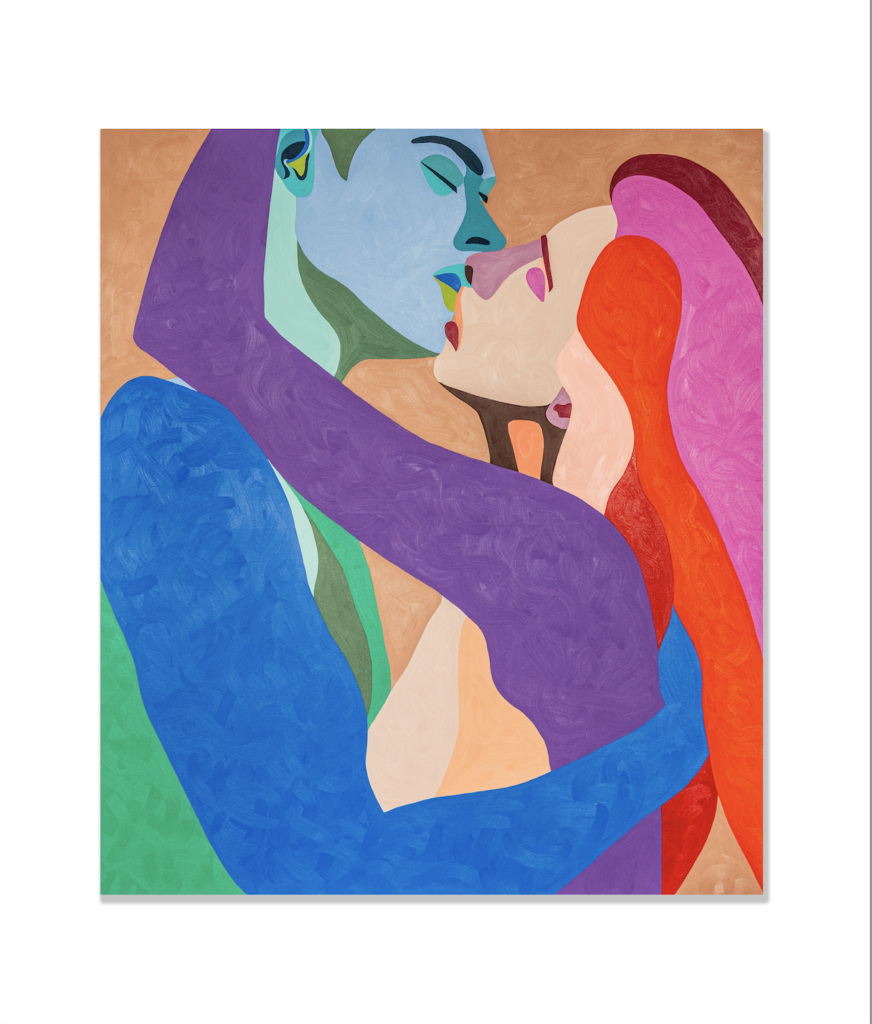
From Second Lives to Post Human VII, and now Comfort & Joy, you’re part of several exhibitions that examine humanity, vulnerability and desire from different angles. What conversations or tensions are you most interested in pushing forward at this moment in your career, as ideas of the body and identity continue to evolve culturally?
At present, I am interested in pushing forward the idea of chaos in my work. I feel like I am entering a period of experimentation, and I intend to give myself this year to explore and make sense of my world, which has been turned upside down in the last few years. As artists, all we can do is tell a story and hope that people can relate as we try and make sense of it all. With the world changing ever rapidly, I still believe in humanity, with all its vulnerabilities and desires, and the power of human connection.
Find out more about Helen Beard here.
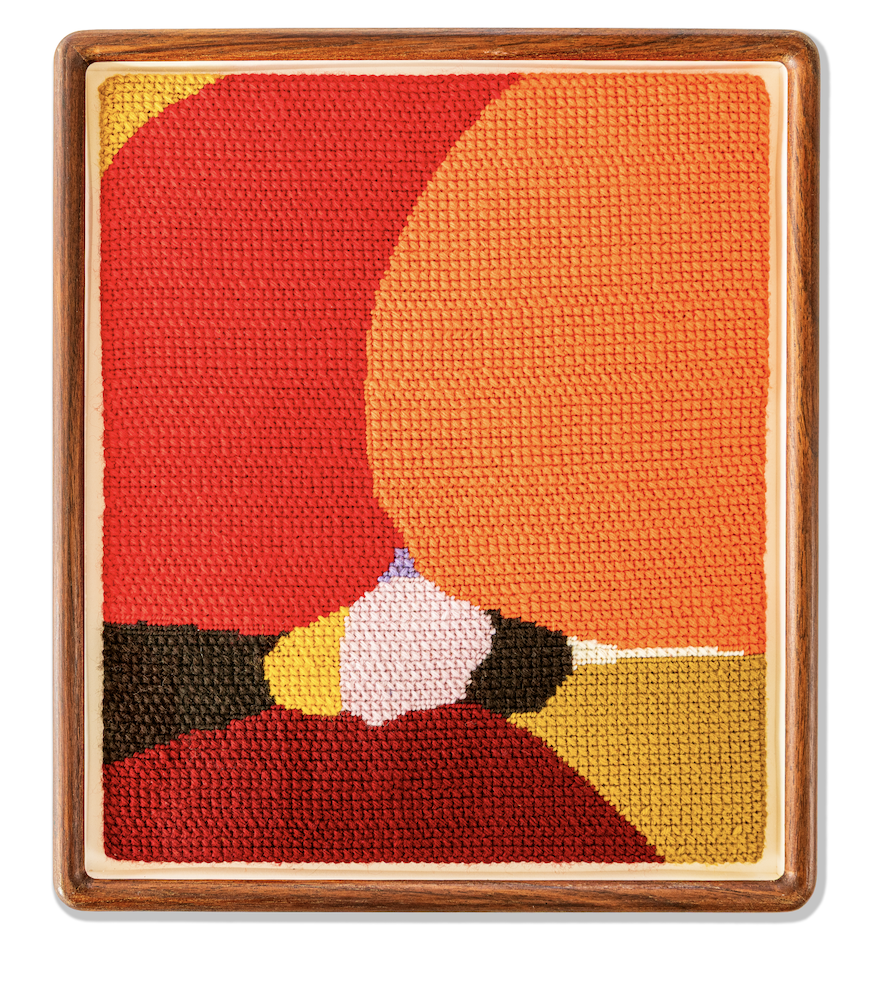
In my own practice, there was definitely a defiance that led me to making more overtly sexual paintings for a while. After this initial reaction, my paintings have tended to become much more about the tenderness of human connection, and have become softer and more emotive, and you can see this in the works included in Second Lives and the current show at Blain, Comfort and Joy.”
Helen Beard