

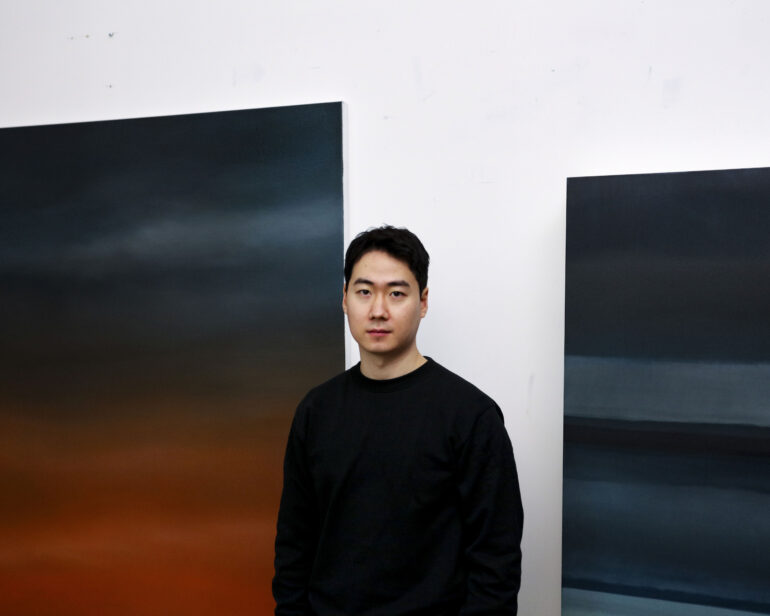
In this edition of Culturalee in Conversation, we speak with Min Woo Nam (b. 1994, South Korea), a London-based Korean artist whose practice navigates the subtle terrain between perception and abstraction. A graduate of the Royal College of Art and the London School of Economics, Nam brings a rare intellectual and experiential depth to his painting. His formative service with the United Nations peacekeeping force in South Sudan continues to inform his ongoing enquiry into consciousness, lived experience, and moments of meaningful coincidence that shape selfhood.
Through delicate tonal transitions and measured brushwork, Nam probes the spatial and psychological limits of abstraction, constructing immersive fields that hover between the known and the unknown. Following his artist residency at Vannucci Artist Residency in Umbria, supported by The Deighton Family Foundation, he now presents work in The Aftermath at LBF Contemporary, further expanding his contemplative visual language.
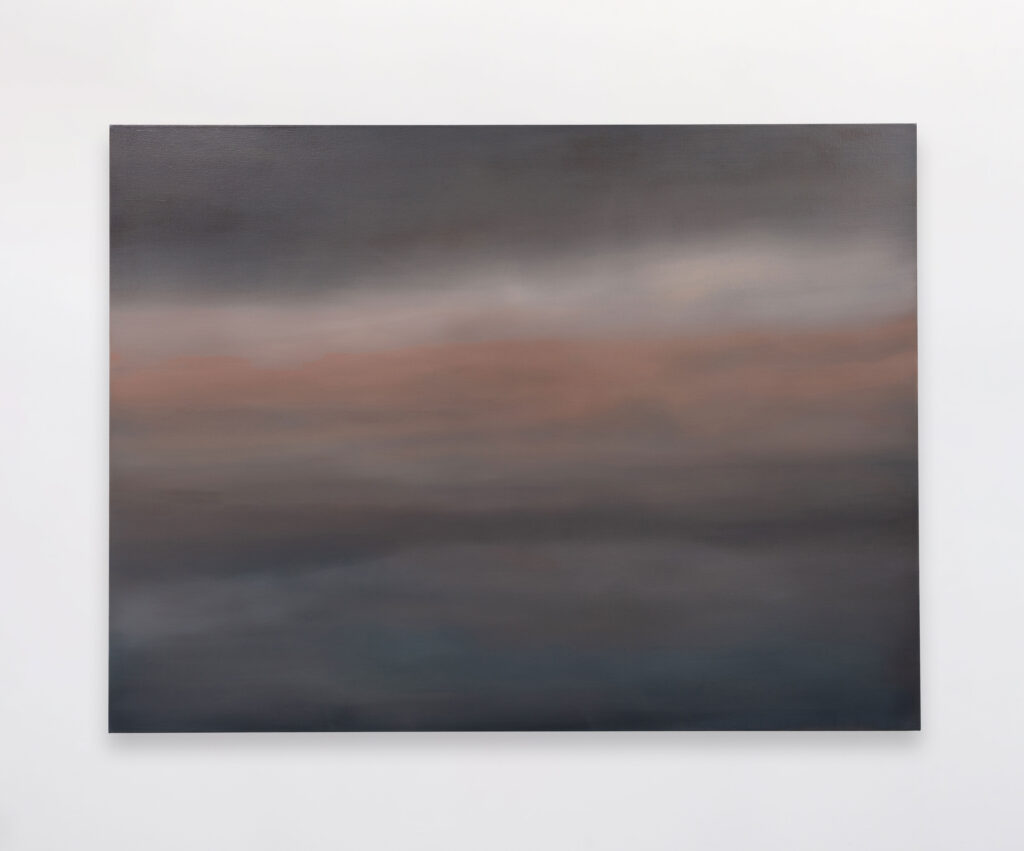
Your upcoming exhibition The Aftermath at LBF Contemporary Gallery presents a new body of abstract works that hover between storm and stillness, recognition and dissolution. What does “aftermath” signify for you conceptually, and how did this idea guide the emotional or atmospheric direction of the paintings?
I generally resist titling a body of work until the paintings are finished and I can see them as a collective whole. Looking at these works together, The Aftermath felt like the only intersection. I see the paintings as a visual residue of my own memories and perceptions.
Conceptually, I view the process as a negotiation of ‘will.’ While a painting begins with my personal intent and a vision I want to manifest, there is a pivotal moment where the work develops its own drive. I shift from being the creator to being a mediator, facilitating what the canvas demands. The Aftermath, then, is not just a title; it is the physical record of that tension between my initial ‘will’ and the painting’s eventual autonomy.
Your works evoke memories of landscapes, appearing like mental images drawn from the sea, sky, or a fading horizon. What personal experiences, memories or visual references inspire these imagined thresholds where inner and outer worlds briefly align?
The vision for my paintings often emerges from memories of specific places I have travelled to. Last year, I visited Da Nang in Vietnam and stayed near My Khe Beach. One morning, I got up quite early, around 5:00 AM and saw a beautiful sunrise from my balcony. I noticed the locals getting up early to gather at the beach for exercise and morning swims. I realised this was a deeply rooted part of their culture. Some people meditated along the seashore, fully indulging in that moment of experience.
I have always felt that as human beings, we are humbled (or ‘diminished’) in relation to nature. This is the root of the ‘sublime’ feeling. Those particular sceneries I am drawn to lasts for only five to ten minutes, and I felt a sharp frustration when the moment vanished. It felt like a once-in-a-lifetime experience. After returning to London, I recalled those memories and wanted to bring them back to life through my work.
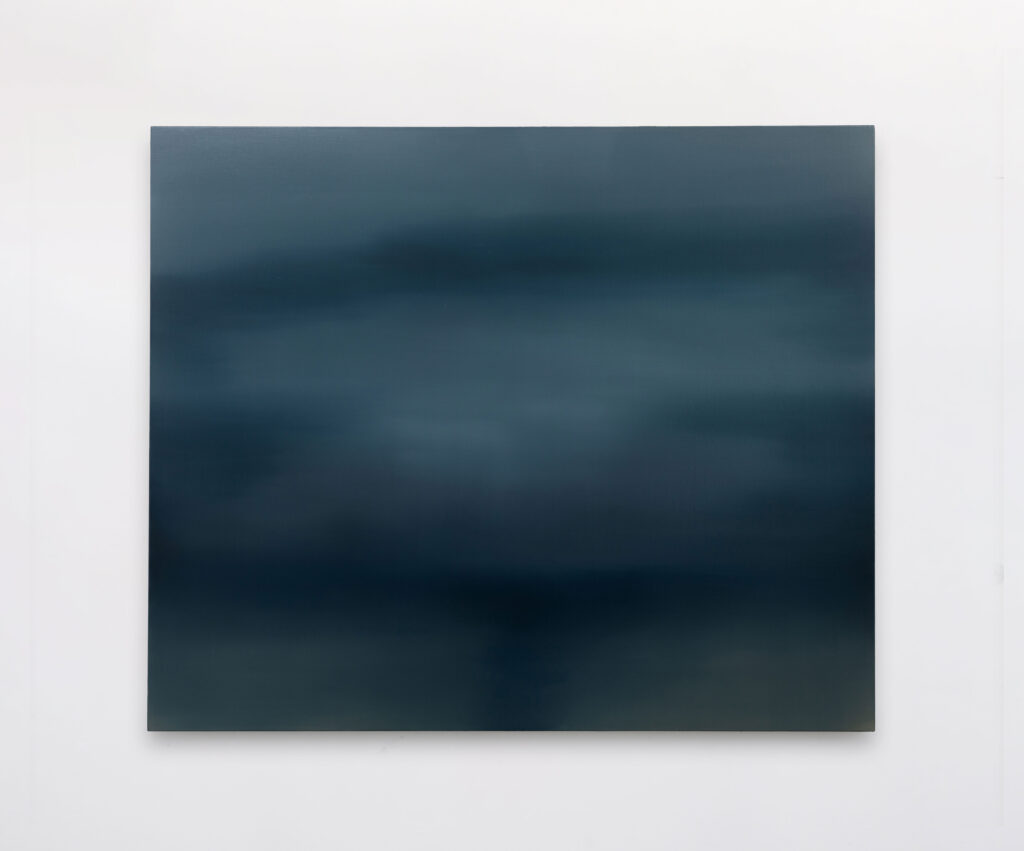
At first glance, your paintings recall the atmospheric pull of Gerhard Richter’s Sky paintings, particularly in their oscillation between the photographic and the painterly. How do you think about this tension between recognition and abstraction, and at what point does an image become sufficiently “subverted” for you?
Richter famously painted his Seascape and Sky series paintings because he wanted to ‘remove’ himself from the work. He wanted the paintings to be neutral and unemotional as possible – just like a photograph. I want my atmospheric paintings to be poignant. I want my paintings to evoke some sort of emotions within us.
I feel aggravated when a painting becomes too literal; it starts to feel banal – often to the point of wanting to destroy the piece. I ‘subvert’ the image, breaking it down until it becomes unrecognizable. It is only when the painting exists in this state of constant tension—neither fully seen nor fully hidden—that I feel it is truly ‘alive.’ At that threshold, the work possesses an infinite possibility of ‘things.’
Can you walk us through a typical day in your studio? From the first marks on the canvas to knowing when a work is finished, how intuitive versus deliberate is your process, and how do you sustain the meditative quality that runs through your practice?
Typical day starts with reading. Currently I am reading “Nausea” by Satre. For me, the act of painting alone is not sufficient to create a meaningful work. I require a series of ‘creative exercises’ to become attuned. This involves strolling through parks, meditating, and listening to music.
I know when the work is finished when the painting itself demands no more. At a certain point, the painting becomes ‘self -sufficient,’ existing and inspiring on its own.
While a piece starts with a vision, it eventually takes on its own accord, and I become merely a mediator for its completion. The meditative quality is partially rooted in my Eastern heritage. I was deeply drawn to Buddhist philosophy after reading “The Secret of the Golden Flower.” Being completely lost in the act of painting is a soul-fulfilling exercise that extends far beyond the canvas itself.
Follow Min Woo Nam here.