

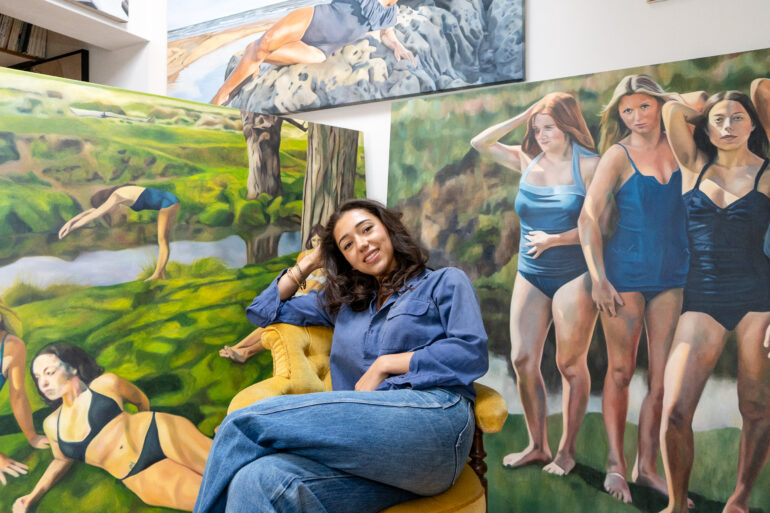
In her latest body of work, Bathers, Emilia Momen marks a pivotal evolution in her practice, turning from tailored interiors to open landscapes where bodies, water, and light converge. Presented as her second solo exhibition with Ronchini – now at their new Conduit Street space – the series situates itself within a rich art historical lineage spanning Titian, Cézanne, and Matisse, while firmly asserting a contemporary, British perspective.
Drawing inspiration from photography, painting, and lived encounters across England’s shores and riversides, Momen’s bathers occupy a nuanced space between intimacy and public ritual. In this instalment of Culturalee in Conversation, Momen reflects on the inspirations behind Bathers, her painterly process, and how vulnerability, strength, and collective experience shape her evolving vision of the female figure. Emilia Momen is a huge talent and her star is definitely in the ascendant.
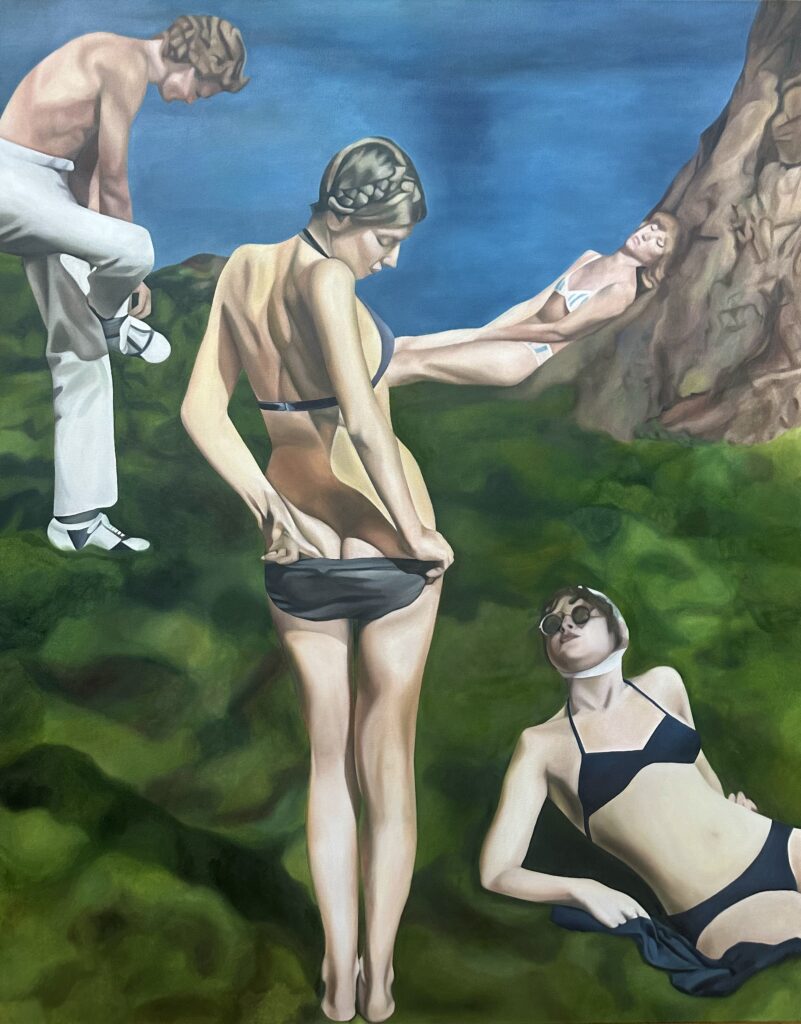
Bathers marks a decisive shift in your practice, from figures dressed in opulent tailoring to bodies in vintage swimwear, immersed in water and landscape. What drew you to bathing as a subject at this moment, and how did your inspirations and painterly process evolve in approaching skin, water, and movement so differently?
My mum bought me Arrested, a book of photographs by Jim Lee, and there was one called Bathers that I just fell in love with and had to recreate. Jim had died the previous year, so I got in touch with his son and he kindly gave me access to Jim’s archives. It turned out that Bathers was inspired by Seurat’s painting Bathers at Asnières – hanging in the National Gallery – which is one of my favourite paintings.
After I ran out of Jim Lee’s Bathers photographs I started recreating my own, it was hard to find grass next to water in London, so I ventured out to English beaches. Every model has a different colour tone, when I look at their skin some emanate green or others have much warmer tones. Leaning into this is one of the most exciting parts of the painting process.
Bathers is your second solo show with Ronchini, at their new space at 21 Conduit Street, and it reframes a lineage stretching from Titian and Cézanne to Matisse. How did you engage with this art historical tradition while consciously resisting or reimagining it through a contemporary, distinctly British lens?
I started researching historical bather’s paintings halfway through the series by going to lectures and talking to art historians. Without this knowledge I wouldn’t have seen the women in historical paintings as submissive and posing for the male gaze. In my paintings I try to capture the model’s character within the pose and show women as strong, independent and not sexualised in any way.
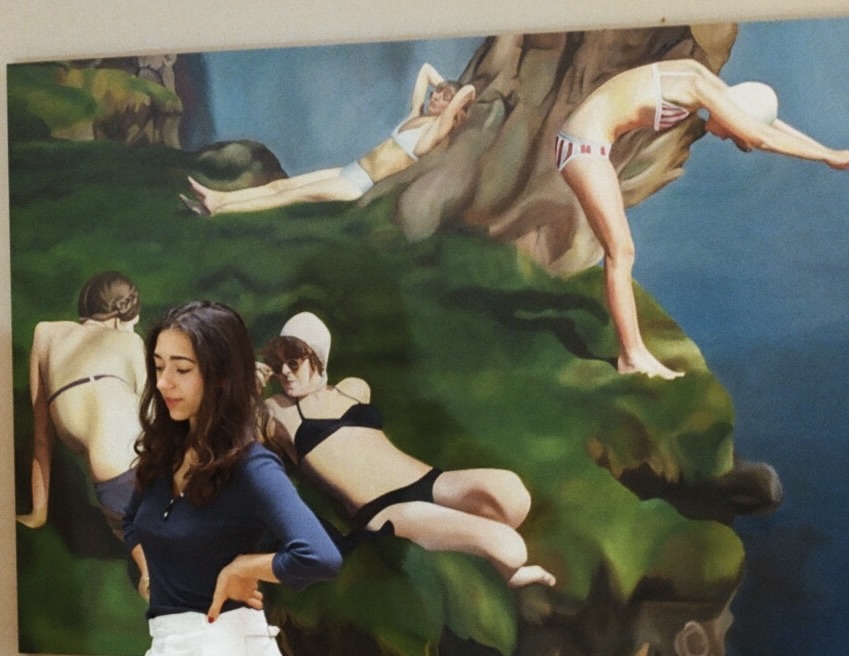
The figures in Bathers seem to occupy a charged space between private ritual and public leisure, negotiating intimacy, play, and collective experience. How do you think about the relationship between viewer and onlooker in these works, and what does bathing allow you to explore about vulnerability and shared social space?
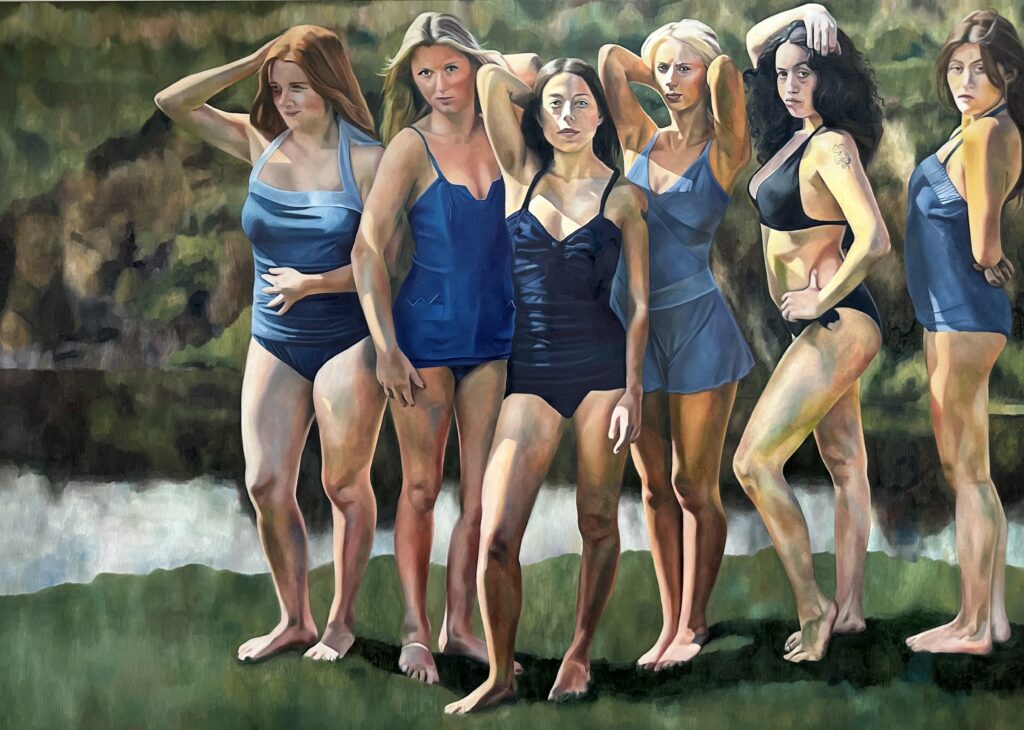
My best memory was the shoot for Ladies by the Lake & The Swimmers, which was a picnic in Richmond Park in early March. It was a sunny spring morning, the first warm day of the year, with 8 models, some were friends, but most didn’t know each other. I’d never done a shoot with more than four people before then, so there was more comparison. That was when I realised the difficulties women had been put through in terms of beauty and desirability, and I could see that from the way they were walking around in their swimsuits. It took a while for everyone to feel comfortable. When I look at Ladies by the Lake now I can see how each model feels about themselves just by the way they are standing.
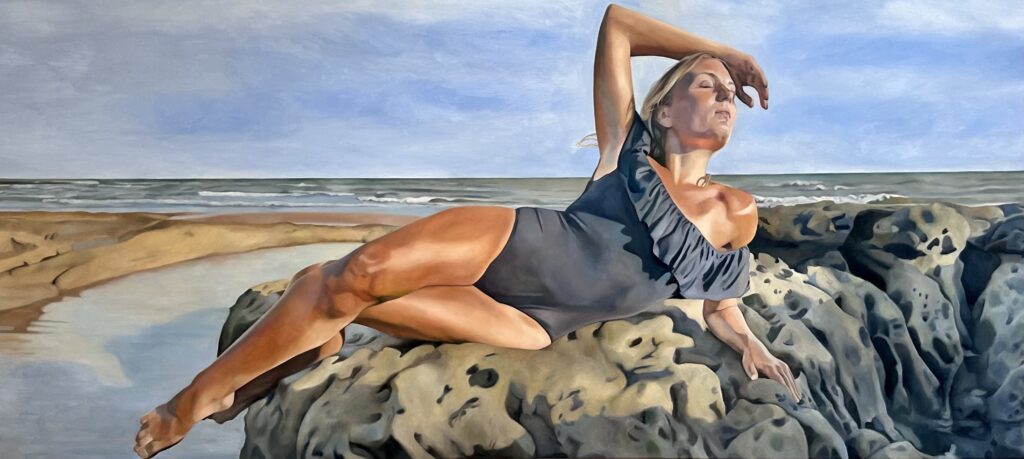
These ten new paintings map a British choreography of water and leisure, from Bexhill’s rocky shores to the Thames-side meadows of Richmond. What was the most difficult location to capture?
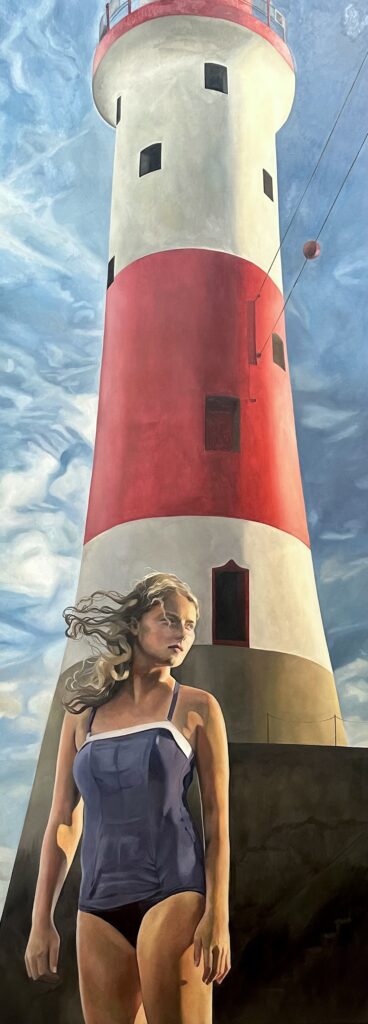
Beachy Head was my hardest shoot location where I did Daisy and The Lighthouse, because the Lighthouse gets cut off by water, so there’s only a small window of time plus the light has to be right. The shoot ended as it was getting dark and suddenly a storm came over and we had an hour’s hike ahead of us up a very steep cliff. It was pretty terrifying, and I had to crawl so as not to be blown away. Although we live on an island surrounded by beaches, it was surprisingly hard to find the one that I had created in my imagination.
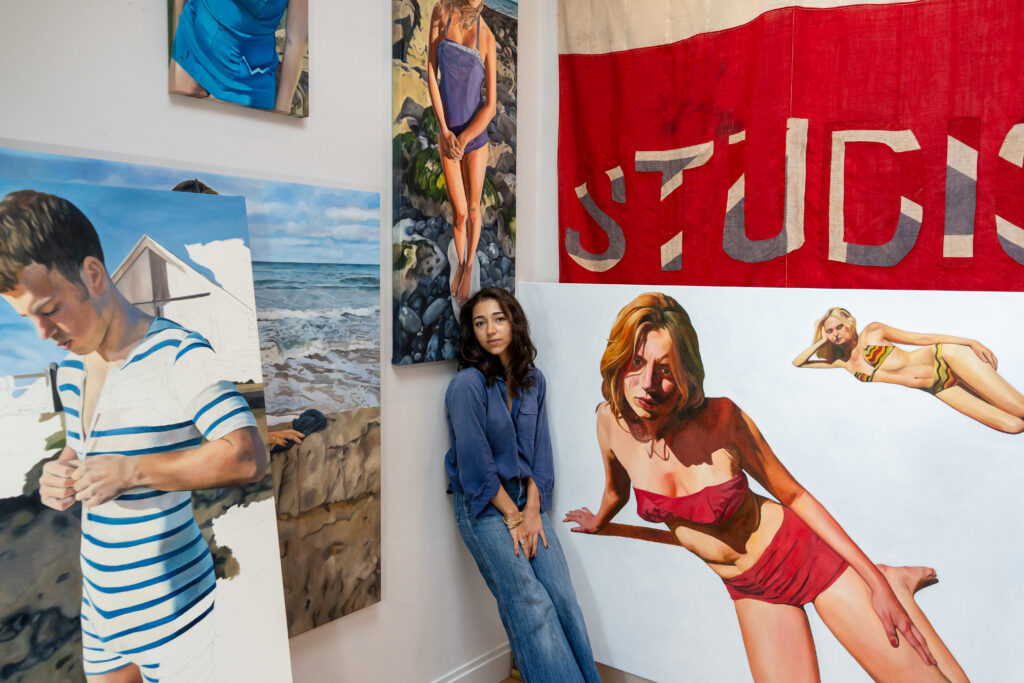
It’s often something within another’s painting or image, like the composition, the pose or the colours that spark an idea of my own. Like the way the poses in Picasso’s Les Demoiselles d’Avignon make the composition, but I find when I overly focus on what another artist has done, that doesn’t work as I’m thinking about them more than me. So I just use the spark, and if this goes well it turns into another idea, and then each of my paintings inspires the next one, as it did with Bathers. I haven’t quite come to the end of the cycle yet, though I can feel myself leaning into nudes now after just finishing my second.” Emilia Momen
All images Courtesy of Emilia Momen.
Find out more about Emilia Momen here.