
As digital art continues to redefine the boundaries of collecting and cultural heritage, the question of how we preserve it for future generations has never been more urgent. Bitcoin Art Society is a curator-led institution dedicated to shaping the cultural legacy of Bitcoin-native art, exploring how decentralised digital infrastructure can provide lasting frameworks for safeguarding artworks, archives and cultural memory.
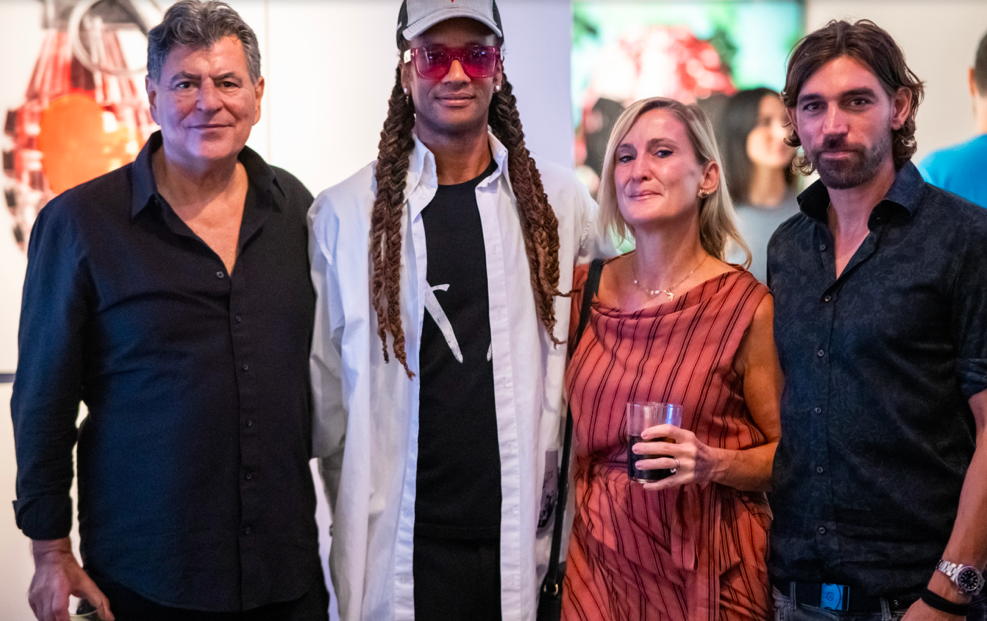
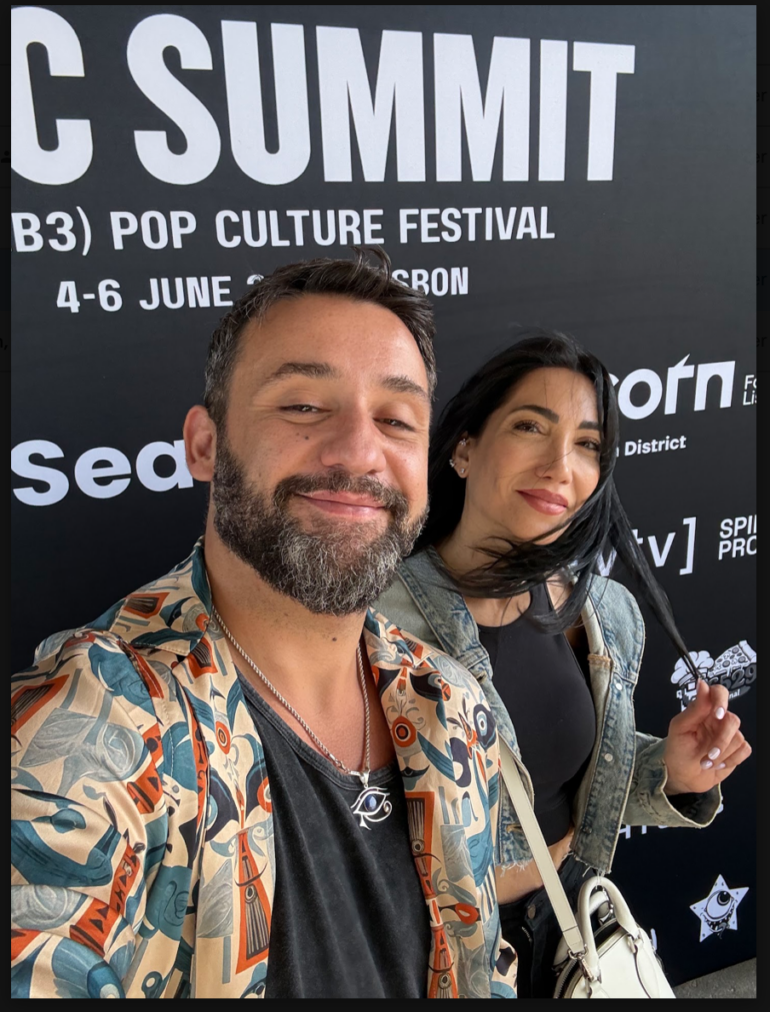
In this interview, Culturalee speaks with founders Serge Ajamian and curator Yara Al Chammaa, whose vision for the organisation was profoundly shaped by personal experience. After losing a gallery in the 2020 Beirut explosion, Al Chammaa witnessed first-hand the fragility of physical archives and the cultural histories they hold. Together, she and Ajamian discuss how Bitcoin Art Society is rethinking preservation beyond technology and speculation, placing artists, collectors and curators at the heart of a new approach to ensuring today’s digital culture endures for generations to come.
Serge, you founded Bitcoin Art Society to build bridges between the Bitcoin community and the broader institutional art world. Why do you think there is a gap and what can change by bridging it?
Serge: The gap exists because both worlds have been speaking different languages. The Bitcoin community speaks about security, scarcity and permanence. The art world speaks about context, provenance, history and cultural value. But at the deepest level, both care about the same thing. They care about what survives.
At Bitcoin Art Society, we are building that bridge. We are helping Bitcoin art move beyond speculation and into cultural memory. We are also helping institutions understand Bitcoin not only as financial technology, but as one of the most important archival layers humanity has ever created.
Yara, you lost your art gallery and artworks in the 2020 explosion in Beirut. Does this experience impact how you view curatorial and archival work in physical versus digital spaces?
Yara: Yes, very deeply. When you lose physical artworks, you understand that art is not only about beauty. It is also about vulnerability, memory and permanence.
I still believe physical spaces are sacred. A gallery, a museum, a studio, these places create human connection. But I also believe artists need stronger ways to protect their work, their history and their voice. Digital preservation does not replace the physical experience. It gives art another layer of permanence.
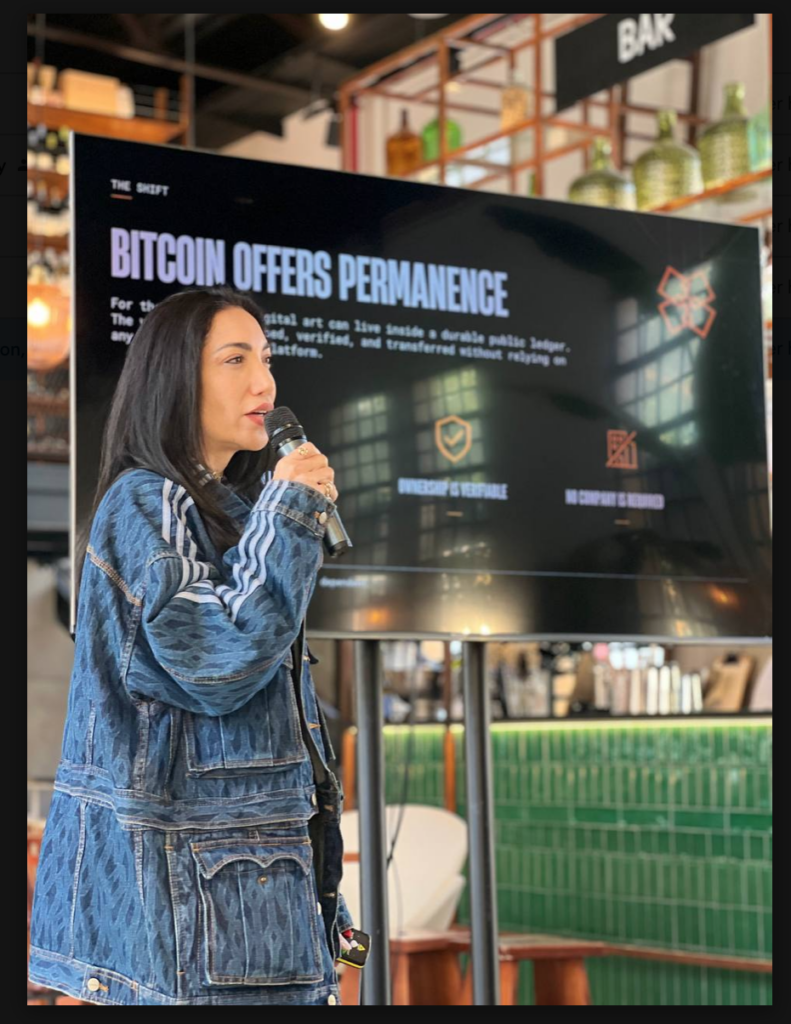
For those not as familiar, can you explain how on chain preservation benefits an artist?
Yara: For an artist, preservation is not only technical. It is personal. It means the work, the authorship and the story can remain accessible beyond one exhibition, one platform or one moment in the market.
On chain preservation gives artists a way to say, this existed, this mattered and this was mine. That is powerful.
Serge: It creates a permanent public record. Provenance, ownership and the existence of the work can be verified without depending on a private server, a platform or a company.
This strengthens the role of curators, historians and institutions. Bitcoin gives digital art a foundation of permanence that did not exist before.
Some artists are understandably hesitant about blockchain because of its association with speculation. What would you say to artists who are curious but unsure where to begin?
Yara: I would tell them not to begin with the market. Begin with the artwork. Begin with the question of what part of your practice deserves to live permanently.
The noise around blockchain can be overwhelming, but the technology itself can serve something very quiet and meaningful. Artists do not need to follow a trend. They need to protect their truth.
Serge: The speculation is loud, but it is not the story we are building. We separate the technology from the casino culture around it.
For the right artist, Bitcoin becomes a canvas, an archive and a historical record. The important thing is to work with people who respect the practice, not just the transaction. That is where real cultural value begins.
How do you envision BAS complementing artists who have traditionally grounded practices?
Yara: We are not asking painters to stop painting or sculptors to stop sculpting. We are expanding what can live around the work.
A painting can exist in a room while its process, story, studies or digital extension can live permanently on Bitcoin. To me, that is not a conflict. It is a beautiful expansion of the artist’s world.
Serge: Many important artists will always remain rooted in physical materials. Canvas, sculpture, installation and performance are essential languages of art.
BAS builds another cultural layer around that work. Provenance, archival context, digital editions, collector education and exhibitions can all strengthen the life of a traditional practice. We are not replacing the old world. We are helping it survive the new one.
What can you tell us about your artist residency program and the artists you are currently working with?
Yara: With BAS Residency, we wanted to explore something very specific. We wanted to support artists creating works that do not simply live on Bitcoin, but use Bitcoin as part of the artwork itself.
That means works shaped by Bitcoin’s architecture, its data, its permanence or its network behavior. The residency gives artists space to explore those possibilities with depth, care and curatorial support.
Serge: The residency is one of the clearest expressions of our mission. We are not only supporting artists who want to place work on Bitcoin. We are supporting artists who are expanding what Bitcoin can become as an artistic medium.
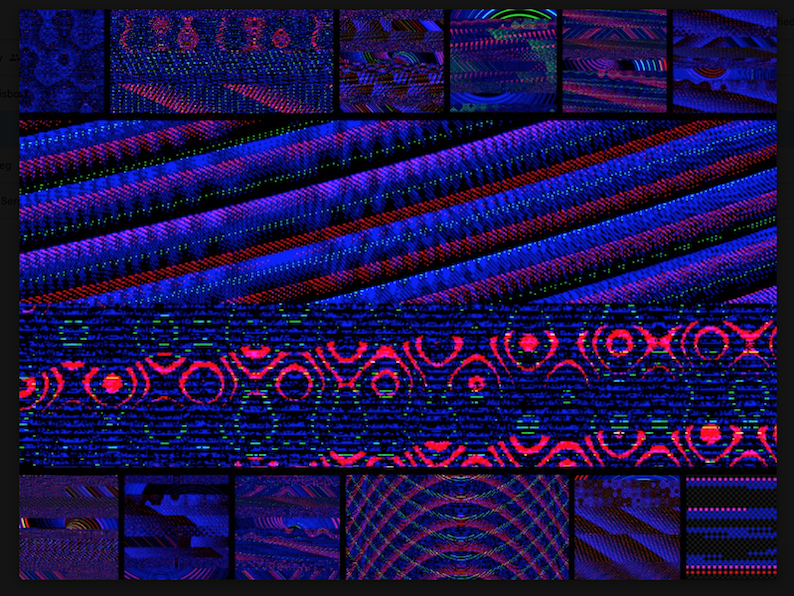
BitArt’s Mosaic and CyberSea’s Code Is Art are strong examples of that direction. They show how Bitcoin can become more than a place to store art. It can become part of the creative language itself. These are new cultural formats that expand what art on Bitcoin can become.
Many institutions are still developing strategies for collecting digital art. What conversations do you hope museums and archives begin having over the next five years?
Yara: Museums need to move beyond the question of whether digital art is real art. The important question now is how to care for it properly.
How do we preserve it? How do we display it? How do we explain it to future generations? How do we keep the human feeling inside something that lives digitally? These are the conversations that matter.
Serge: The conversation is moving from curiosity to responsibility. Institutions need to think seriously about digital provenance, permanent storage, public ledgers and how to preserve context around digital works.
Over the next five years, Bitcoin art will become part of serious acquisition conversations. It belongs in the cultural record of our time.
What opportunities does Bitcoin create for collectors that were not previously possible from the standpoint of provenance, preservation or patronage?
Yara: For collectors, Bitcoin creates a deeper form of patronage. You are not only buying an image. You are helping preserve a moment in cultural history.
That creates a different relationship between artist, collector and artwork. It feels closer to legacy than consumption.
Serge: Bitcoin gives collectors direct provenance, durable ownership history and participation in works that do not depend on a private platform to survive.
It also makes patronage more global and transparent. A collector can support an artist from anywhere in the world and become part of the public history of the work. That is new. It is powerful. It changes how future generations will understand collecting.
More information on BitCoin Art Society found HERE