
Javeria Salar’s multidisciplinary practice explores the relationship between light, space and perception, using sculpture, painting, installation and digital media to examine humanity’s place within the vastness of the cosmos. Drawing on natural science, geometry and philosophical thought, she creates immersive environments in which material form and optical illusion converge, challenging the boundaries between the tangible and intangible.
Born in Pakistan and based in Birmingham, Salar draws on Buddhist heritage, Sufi philosophy and metaphysical ideas of existence. Exploring the Nuqta as a symbol of origin and unity, works such as Cosmic Nuqta’s Ark and Celestial Orbitsexamine the relationship between the infinitely small and the vastness of the cosmos. Through geometric forms, projection and light sculpture, she transforms space into immersive experiences that blur the boundaries between the physical, the unseen and the infinite.
Your multidisciplinary practice explores the relationship between mathematical structure, geometry and the infinite using fluorescent colour, celestial imagery and light to transform abstract concepts into immersive visual experiences. How did your interest in mathematics and the natural sciences develop into an artistic language?
My fascination with the natural sciences comes from a very simple place: the more we discover about the universe, the more extraordinary it seems. I have always been drawn to questions about how things come into existence, the patterns that govern their formation, and the relationship between the smallest elements of matter and the immense structures we observe in the cosmos.
Mathematics and geometry offer a way of understanding some of these relationships. We find recurring patterns in nature, from the structure of a flower to the movement of celestial bodies, and I find something beautiful in the idea that such different forms of existence can be connected through underlying principles.
My training in sculpture at the National College of Arts gave me the opportunity to explore these interests through physical materials. My graduating thesis investigated the psychological effects of light and movement, and I became increasingly interested in how the same object could be experienced differently depending on its surroundings.
Over time, this developed into a practice involving fluorescent painting, illumination and digital projection. I began using light not simply to make a work visible, but to change its appearance and the way people encounter it.
I don’t see my work as an attempt to illustrate scientific theories. Science inspires the questions, while art gives me the freedom to explore their emotional and imaginative possibilities. What fascinates me is that a scientific discovery can deepen our knowledge of the universe while simultaneously making it feel even more mysterious.
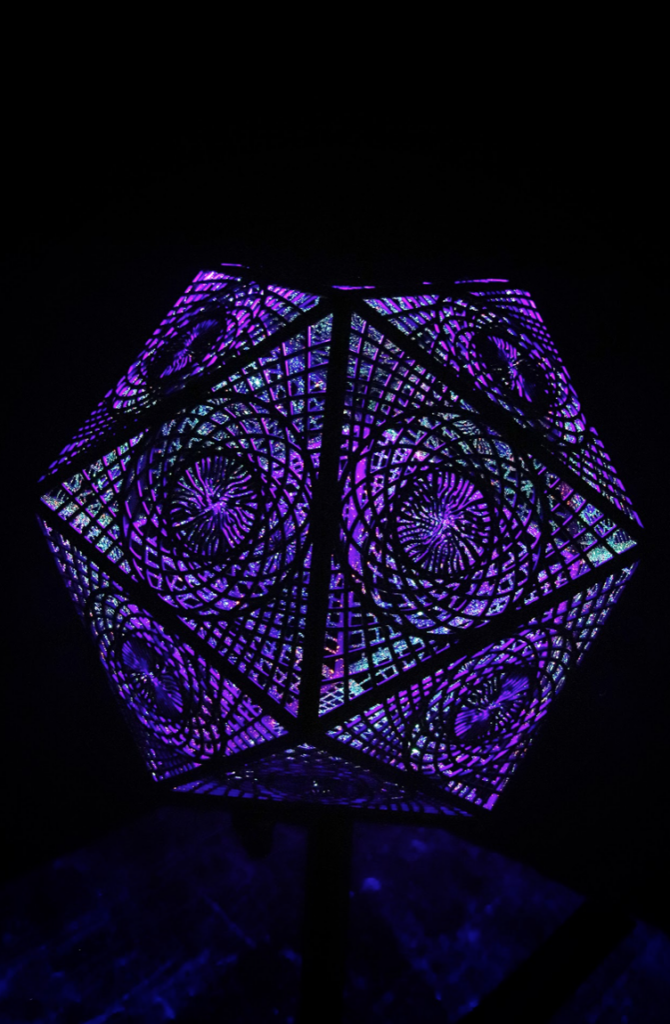
Your ancestral roots in Dir, north-west Pakistan, inform aspects of your relationship with geometry, while works such as Cosmic Nuqta’s Ark (2023) draw upon Sufi philosophy and the concept of the nuqta, the primordial point from which all creation emerges. Could you tell us more about the spiritual and philosophical thinking behind this work, and how you translate ideas of unity, multiplicity and the infinite into physical form?
The nuqta, or dot, has become an important recurring element in my work because I am fascinated by the amount of meaning that can exist within something so simple. A dot may appear insignificant, yet it can suggest a beginning, a centre, or the possibility of something much larger.
Within Sufi mystical traditions and philosophical thought, the point has often been understood as a symbol of origin and unity. What interests me is how these ideas can resonate with our scientific curiosity about the beginnings of the universe, even though they belong to different ways of understanding existence.
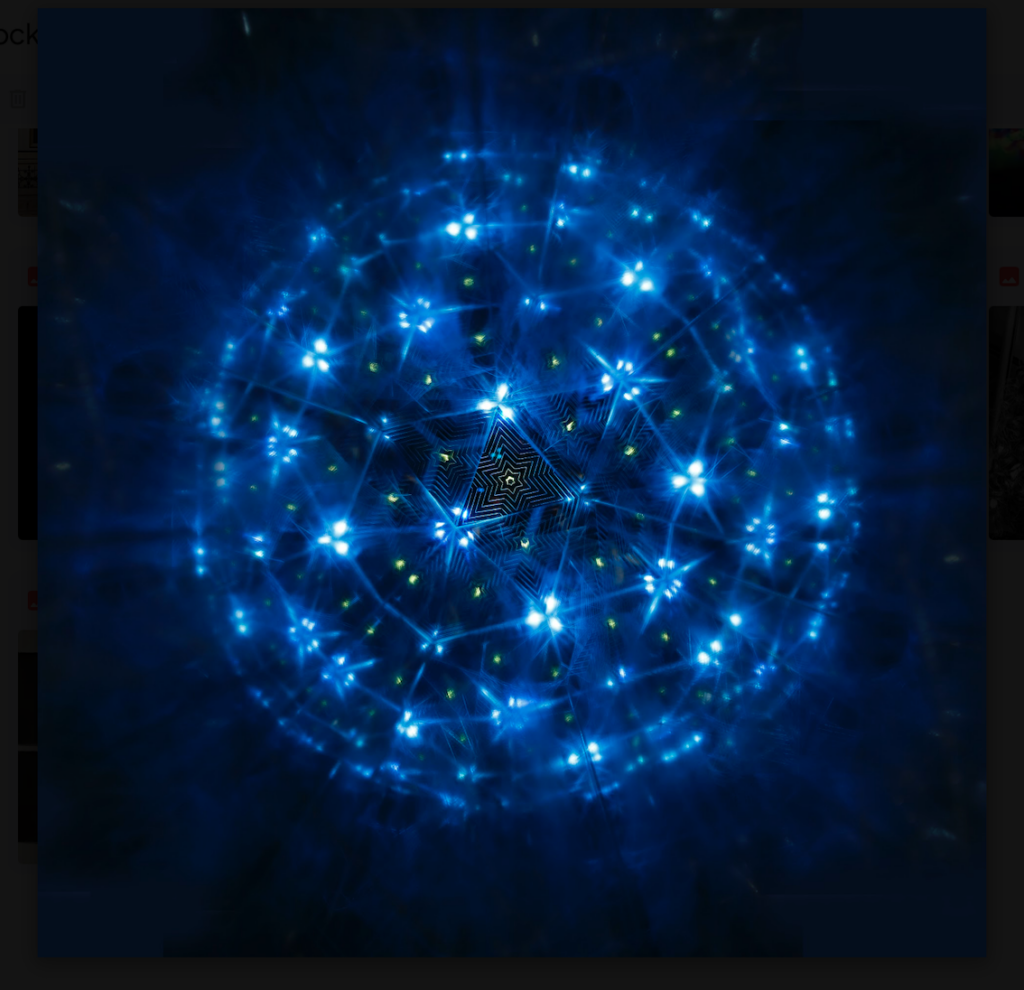
Cosmic Nuqta’s Ark developed from my interest in bringing these questions into physical form. I used the geometry of the icosahedron, a twenty-faced structure, and illumination to explore the relationship between unity and multiplicity. The individual geometric faces form a single object, while light changes how its surfaces, patterns and internal relationships are perceived.
My ancestral connection to Dir is part of a wider cultural inheritance that includes music, poetry, storytelling and spiritual traditions. And I see my work as equally shaped by scientific ideas and by my experiences of living and making art in different environments.
What I find compelling about the nuqta is that it allows these interests to meet. It is a very small form through which I can explore very large questions. I am interested in that apparent contradiction: how something seemingly simple can open our imagination towards infinity.
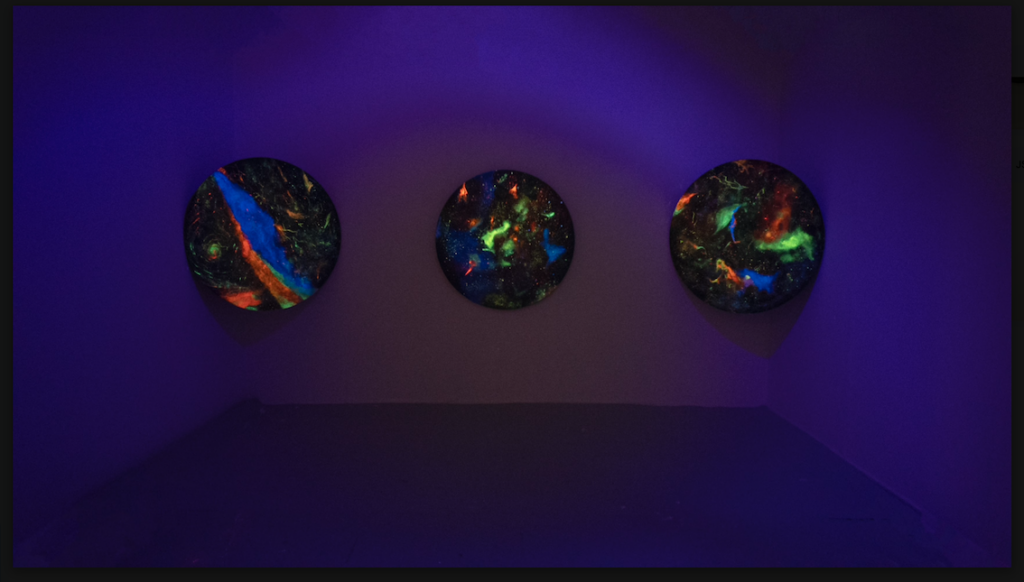
Your work engages with the history of contemporary light art, bringing to mind artists such as Dan Flavin, James Turrell, Olafur Eliasson and Chris Levine. However, your practice introduces a distinctive dialogue between light, mathematical abstraction, cosmology and philosophical traditions. Which artists, thinkers or scientific discoveries have most influenced your approach?
I admire artists who have challenged the idea that an artwork must remain a fixed object, particularly those who have explored the relationship between light, space and human perception. The work of James Turrell and Olafur Eliasson is especially interesting to consider because it demonstrates how an artistic experience can be shaped by something as intangible as illumination.
What draws me towards this broader tradition is the possibility of making viewers conscious of their own act of seeing. Light can alter our sense of depth, distance, colour and even the boundaries of a physical space. These are questions I have been exploring since my early work in sculpture.
At the same time, some of my strongest sources of inspiration come from outside the art world. Astronomy and cosmology continually offer new ways of imagining the universe. Images of nebulae, galaxies and stellar formations are visually extraordinary, and I am equally interested in the scientific ideas behind them: how light travels across enormous distances, how matter takes different forms, and how much of the universe remains beyond our direct observation.
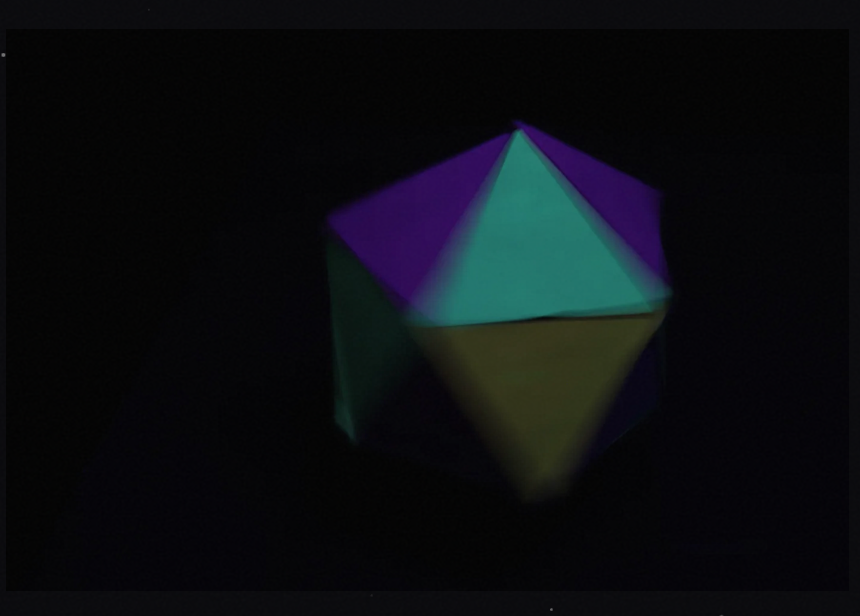
I also find inspiration in geometry and philosophical traditions that contemplate the relationship between the individual and the infinite. My interest in the nuqta is part of this.
I try not to separate these influences into rigid categories. A scientific image might suggest a composition, a geometric structure might become a sculpture, or a philosophical question might lead me towards an experiment with projected light. I am interested in what happens when these different ways of thinking inform one another.
Your six-part fluorescent painting series Stellar Odyssey was presented in Deviance & Difference, curated by Osman Yousefzada at Birmingham Museum & Art Gallery in 2024. Can you give an overview of the inspiration behind Stellar Odyssey series, and how it related to the exhibition’s theme?
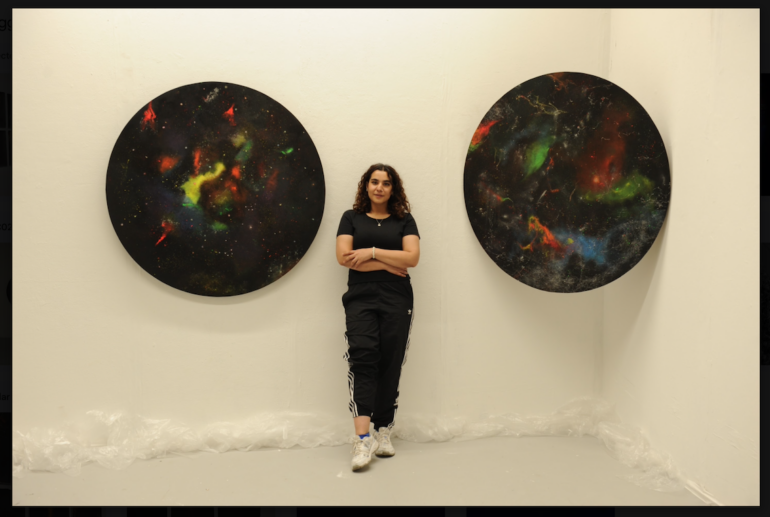
Stellar Odyssey grew out of my fascination with celestial phenomena and the extraordinary colours, patterns and structures that exist throughout the universe. I wanted to explore how these forms could be interpreted through painting, and also how the paintings themselves could change under different lighting conditions.
The series consists of six fluorescent paintings inspired by galaxies, nebulae and cosmic formations. Working with fluorescent pigments allowed me to create images whose appearance is influenced by ultraviolet illumination. Under changing conditions, details become more visible, colours intensify and the relationship between the painted surface and the viewer changes.
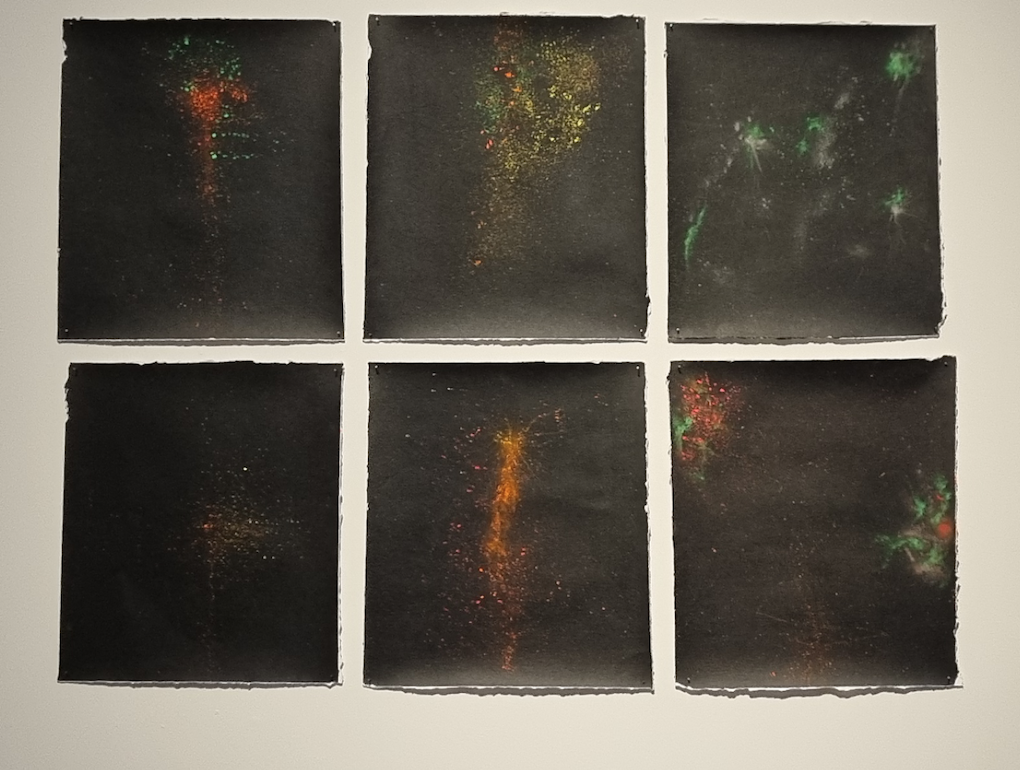
For me, this was an extension of my earlier sculptural investigations. I was still interested in the relationship between a physical artwork and the conditions through which it is experienced, and I was now exploring those questions through colour and painting.
Being part of Deviance & Difference at Birmingham Museum & Art Gallery was particularly meaningful. The exhibition, curated by Osman Yousefzada, brought contemporary artistic practices into conversation with works from Birmingham’s historic collections. It encouraged audiences to encounter different forms of expression and consider perspectives that might challenge familiar ways of seeing.
I felt that Stellar Odyssey had a natural place within that dialogue. The works invite viewers to look beyond the immediate appearance of a painting and discover something different as the conditions of illumination change. There is also an interesting relationship between the familiar and the unknown. We recognise celestial imagery, yet the universe remains something we can only partially comprehend.
I have always felt that art becomes most interesting when it allows us to question what we think we understand. That was an important part of what I hoped the series would communicate.
What exhibitions do you have coming up next?
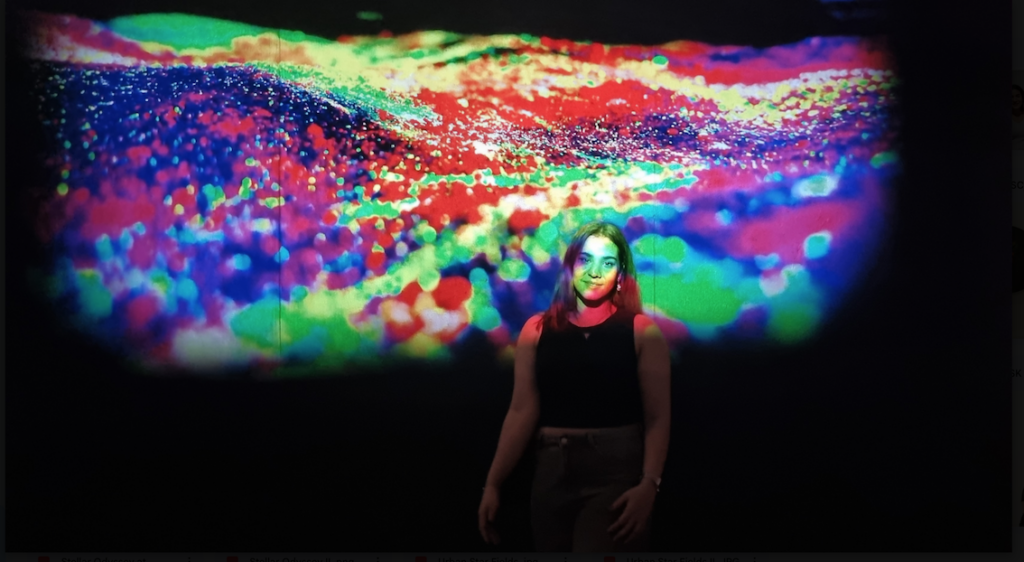
I have recently presented my solo exhibition, Where Everything Begins, at Studio BQ in Lahore, curated by Bin Qulander. The exhibition brought together digital projection, video installation, sound and other visual works, continuing my exploration of cosmology, geometry and the relationship between light and perception.
This exhibition represented an important stage in my artistic development because it allowed me to bring several different media together within a shared environment, rather than presenting the works simply as individual objects.
I have also recently participated in Autumn Salon 26 at Candid Gallery in London, where I exhibited four illuminated works from my Gaia’s Legation series.
Looking ahead, I am continuing to develop immersive and site-responsive installations that bring together sculpture, painting, projected imagery and moving light. I am particularly interested in collaborations involving artists, scientists and creative technologists, and in exploring how these works might be experienced in larger exhibition and public spaces.
Alongside this, I am developing an illustrated book, The First Point, which examines the symbolism of the dot across ancient civilisations, philosophical traditions, cosmology and contemporary art. It is closely connected to the ideas that have informed my practice for several years.
I see these activities as parts of the same continuing investigation. Whether I am working on an installation, a painting or a publication, I return to questions about the universe, perception and our relationship with something much greater than ourselves.
For More Information visit www.javeriasalar.com