

For 25 years, New York artist Justin Gignac has been turning street garbage into art, sealing discarded objects inside clear acrylic cubes and selling them as miniature portraits of the city.
What began as an experiment in the power of packaging has evolved into NYC Garbage, a cult art project examining what we throw away, what we value and what our rubbish reveals about the way we live.
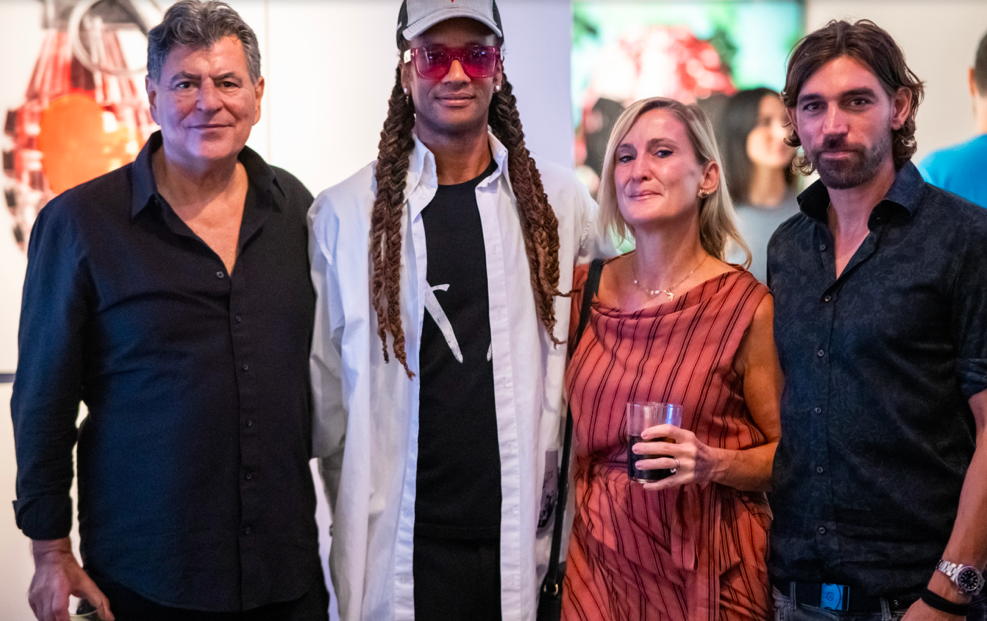
For its first international show, NYC Garbage recently came to Amsterdam with the cult Austin-born creative agency Preacher.
In this Culturalee in Conversation, Justin Gignac and Preacher founder Seth Gaffney discuss the origins of the project, the curious relationship between trash and desire, and what happens when the most overlooked objects in a city are presented as art.
JUSTIN GIGNAC
Let’s start with the central idea behind NYC Garbage. After 25 years of collecting and preserving discarded objects, what does the project ultimately say about contemporary culture? Is there a serious cultural critique beneath its humour and pop sensibility?
This whole project started after an offhand comment from a coworker: “Packaging design doesn’t matter.” I thought that was ridiculous, so I decided if I could package and sell something nobody would ever want to buy, I could prove them wrong. Staring out my office window down onto Times Square, the answer seemed obvious: garbage.
The heart of this is the meaning and value we impart on objects. That’s different for everyone who buys a cube. Someone might be drawn to the specific brands sealed inside. Someone else just loves New York and wants a piece of it, trash and all. Others see the excess, the byproduct of consumerism and capitalism. I’m not going to tell any of them they’re wrong.
You can tell everything about a culture by what it leaves behind. For me, it’s less an indictment and more a way of finding beauty and delight in what most people have already decided is worthless.
There is an obvious dialogue with consumption, waste and our throwaway culture, but you approach these subjects through humour, celebrity and everyday objects rather than the visual language we might associate with environmental art. How important is that sense of play to the work?
Play isn’t just a strategy here, it’s kind of the whole operating system. I was a professional mascot. My mom was a Class Clown, my dad was an actual clown. Making people laugh first and think second is just how I’m built.
The humor is also what gets people’s attention in the first place. A headline like “NYC Artist Sells Garbage for $100 a Box” is almost impossible not to click. Environmental art tends to lead with seriousness and condemnation, which can make it feel less approachable and do the cause a disservice.
You’ve said that what we throw away tells us something about who we are. Having now collected garbage in Amsterdam, what have you discovered about the city and its culture through what people leave behind?
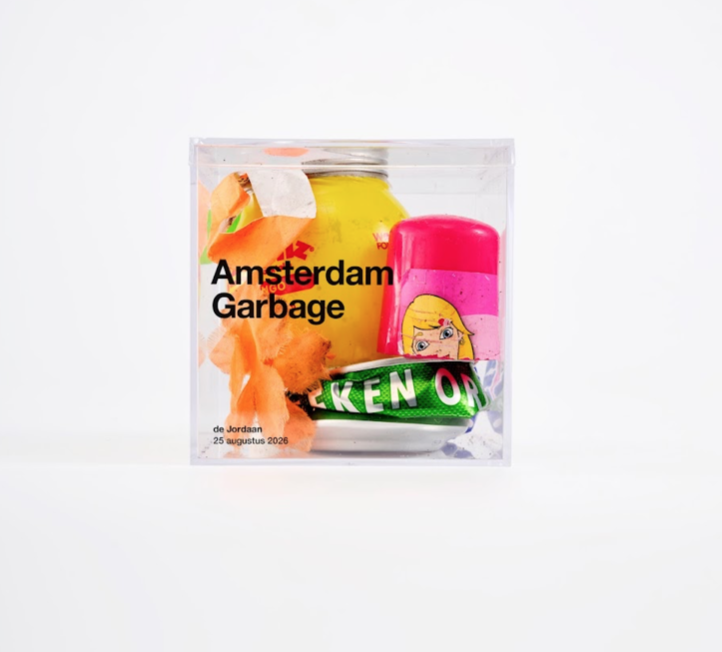
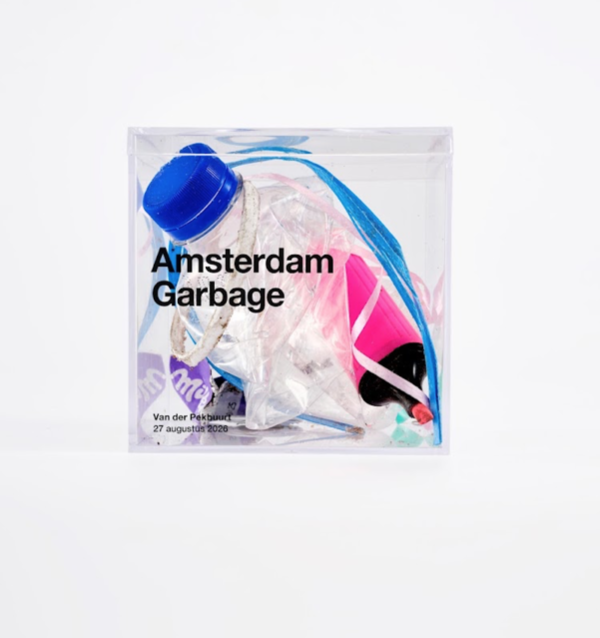
The neighborhoods in Amsterdam are just as distinct as New York’s, and that similarity was the real discovery. De Wallen versus De Jordaan versus Van der Pekbuurt is basically a personality test, the same way SoHo versus the Bronx would be here. Different city, same truth: a neighborhood’s trash is a self portrait whether it means to be or not.
Van der Pekbuurt was mostly Capri Sun packaging and broken kids’ toy parts, no beer bottle caps in sight, which tells you exactly what kind of family focused neighborhood it is. De Wallen skewed seedier, predictably, given the Red Light District. FEBO wrappers and Heineken bottle caps showed up everywhere, like collecting the city’s own branded merch. And an alarming amount of broken glass in the bike lanes. I don’t know if the Dutch bike tire industry is behind it, but if they are, it’s working.
At what point does an ordinary discarded object become an artwork? Is it your act of selection, the preservation and presentation of the object, the cultural story attached to it, or the viewer’s perception that transforms garbage into art?
To me, the art isn’t really in the execution. Yes, I put effort into each composition, but everything is in service of the original motivation: to prove that packaging matters. The art is in the transaction. Someone deciding a box of garbage is worth their money. That moment is the art. Transforming something worthless into something valuable.
Your work raises interesting questions about authorship and the readymade. Do you see a connection between NYC Garbage and the history of artists such as Marcel Duchamp, Robert Rauschenberg and Andy Warhol, who transformed everyday objects and popular culture into art?
Yes, of course. Selling people on buying garbage is difficult, but they primed people to entertain a box of garbage as art.
You have preserved garbage connected to significant cultural and political moments, from Obama’s inauguration and the passage of same-sex marriage legislation in New York to objects associated with Taylor Swift and Travis Kelce. Do you think of NYC Garbage as a form of alternative cultural archive, documenting history through the objects that official archives might overlook?
That’s basically the pitch. Official archives keep the speeches. I’ve got the confetti off the sidewalk after the speech. Obama’s inauguration, marriage equality passing in New York, championship parades. None of those are footnotes to me, they’re the actual texture of the day. And anywhere there are fans, the garbage becomes collectible. You can tell exactly where a cube came from just by looking at it, no label needed.
At the opening, you spoke about the idea that if you can make a living selling garbage as art, anything is possible. Do you see the project as challenging conventional ideas about value, both artistic and economic?
Things are worth what people are willing to pay for them. When I started, it was $10 a box. Couldn’t keep up with demand, so after a year I raised it to $25. Still sold. A couple of years after that, I raised it again: $50 for regular garbage, $100 for limited editions, trying to curb sales. Still sold.
What’s funny is how the price changed what people called it. At $10, it was a joke. At $25, it was a cool souvenir. At $50, people started calling it art. Same box of garbage the whole time. The price is what changed their perception of its value.
This is the first time NYC Garbage has travelled outside the United States. What does it mean to place the project within a different cultural context, and could Amsterdam change the way you think about the work?
It’s the first real stress test of whether the idea travels or whether it was just a New York thing. So far it travels. People in Amsterdam got it immediately, which tells me the thing I’m actually selling isn’t New York, it’s a way of looking at a city. I’ve been calling this the NYC Garbage World Tour, half-joking. I’m already in discussions with other cities, and I’d genuinely love to take it everywhere.
Where can NYC Garbage go from here? After 25 years of looking at what cities leave behind, what would you like the next chapter of the project to explore?
More cities for the World Tour, for one, and I’m already in discussions on a few. Sports feels like a whole new category. I’ve seen real success with previous sports editions, and there’s no reason to stop at arenas and parades. I’d love to capture garbage from championship locker rooms. This could work equally well with trash from TV and movie sets, backstage at fashion shows, and concerts. Anywhere there are fans.
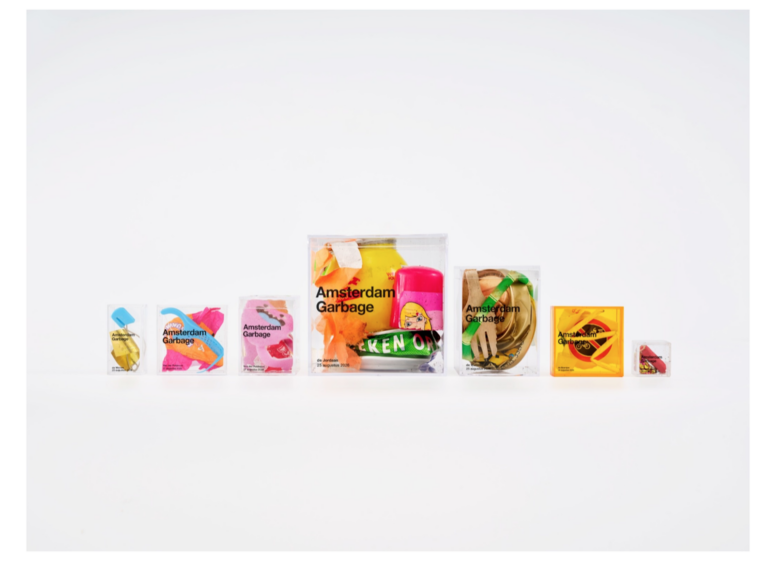
I’m also pushing the execution itself. Amsterdam Garbage introduced five new cube sizes I’d never done before. This week I’m working on a commission for a piece of furniture filled with garbage. Twenty-five years in and I’m still finding new ways to make garbage desirable and convince someone to pay for it. Still proving packaging matters, one box at a time.
SETH GAFFNEY
Preacher is a creative agency, but you recently transformed your Amsterdam storefront into an exhibition space for Justin’s NYC Garbage. What does it mean for Preacher to create a platform for contemporary art and artists?
From our founding in 2014 in Austin, we’ve put contributing to the creative community at our core. There we created Preacher Gallery (@preachergallery), which has hosted over 80 shows, and is curated by Jason Archer. When we launched this Mission in Amsterdam a bit over a year ago and opened our literal doors a couple of months ago, we have put that same intention into action.
Preacher was founded in Austin, a city with a strong independent creative and cultural identity. How has that environment shaped the agency’s relationship with art, culture and creative experimentation?
You’re absolutely right. Austin is a city of open-mindedness and a “don’t talk about it, make it” approach. It gave us literal, physical space and more mental, free space to experiment with what our company could be and do. It’s both expansive and intimate. You’re one to two degrees away from people doing interesting things across cultures and, often, who are very open to collaborating.
How do you see the relationship between advertising, contemporary art and popular culture today? Are the boundaries between these disciplines becoming increasingly fluid?
Since the beginning we’ve aimed to blur lines. First within the disciplines of an advertising agency, including writers, art directors, strategists, brand managers, designers and producers, all having their unique expertise but also there at the start to solve our clients’ problems creatively together. Then connecting creative people in different creative spaces like visual artists, musicians, illustrators, chefs, those in hospitality, fashion designers, poets and comedians, in our Preacher space and on projects. So, while I think there are boundaries, we aim to collide people’s specific crafts whenever possible.
Does engaging with artists and cultural projects such as NYC Garbage influence the way Preacher thinks about creativity and the work it makes for brands?
For sure. Engaging with passionate people, who are walking the walk, inspires us to do the same. To bring that energy and action-orientation to our work. You stay curious and see these moments as learning opportunities. Seeing Justin’s imagination and effort is infectious, for example. You see the value of real world interaction, in particular, and understand how to convey that value to our partner brands.
What was it about Justin and NYC Garbage that made you want to bring the project to Amsterdam for its first international presentation? Was it the conceptual idea, the humour, the cultural commentary, or something about the way the work connects with audiences?
I’ve known NYC Garbage for almost as long as it has existed. Having lived there for years, I was struck by how it captures New Yorkers’ relationship with the city. It’s hard and messy and completely invigorating. The “if you can make it here, you can make it anywhere” spirit is always present. NYC Garbage has always felt hopeful in its hustle, inventiveness, practicality, and personality. Preacher’s experience in Amsterdam is, of course, multi-dimensional yet it often comes back to what’s real and rewards those who make things.
Why do you think NYC Garbage feels particularly relevant to the cultural moment we are living through now? What does the work reveal about our relationship with consumption, celebrity, memory and value?
What I loved most about AMS Garbage is how Justin picked up trash across different neighborhoods and created his pieces by neighborhood. In a few weeks, he got to experience some of the differences between parts of Amsterdam by what he found. It’s a generous, rooted, and genuine perspective but it’s not overly sincere. I think the commitment and the levity co-exist in a way that’s really needed now.
What does Amsterdam contribute to the project? Is there something about the city’s creative culture or relationship with design and contemporary art that makes it an interesting setting for NYC Garbage?
There’s a Kusama exhibition at The Stedelijk as I answer this. Amsterdam has incredible art from the Straat to the Foam to the Moco to a bunch of places I’m just getting to know. Artists are also always in need of more spaces to exhibit work and welcome community. The fact that Preacher Amsterdam is in an old bike shop and pre-redesign also felt like a perfect fit for the project. Finally, it’s impossible to ignore Amsterdam’s trash issue, which led to initiatives like Cleansday last year.
Can an agency storefront become a genuine cultural space rather than simply an extension of a brand? What role do you want Preacher’s Amsterdam space to play within the city’s wider creative community?
We think so. In Austin, just as many people think of Preacher as an art gallery as an advertising agency. Here in Amsterdam, we’ve intentionally prioritized building bridges for the creative community, international and Dutch, marketing and music, etc. We’ve hosted events like The Good Word launch (our Amsterdam-focused art zine) at Oedipus Brewery, a First Supper in De Hollandsche Manege, a Dutch Brunch at Molen De Otter, and Speculaars (cowboy boot shaped ginger cookies with designer, Mr. Boonstra) at Luuks shoe shop. Now that we have our own space, I’m excited to explore how it gives a platform to creative talents and a gathering place.
Should we expect this exhibition to be the beginning of a wider programme of art, cultural events and collaborations at Preacher Amsterdam? What would you like the space to become over time?
Absolutely. It will happen organically and ad hoc for the rest of the year. The plan is to get our space a bit cleaned up (especially with the AMS Garbage out :)) and event-ready over the next few months and create a series of diverse exhibitions for 2027. Overall, Preacher will be a Creative Workshop, where we welcome people to make things with us and with brands. We’ll have a dedicated showroom to exhibit our collaborations, the first of which was with NYC Garbage’s first international pop-up: AMS Garbage.
Find more information below
Follow: