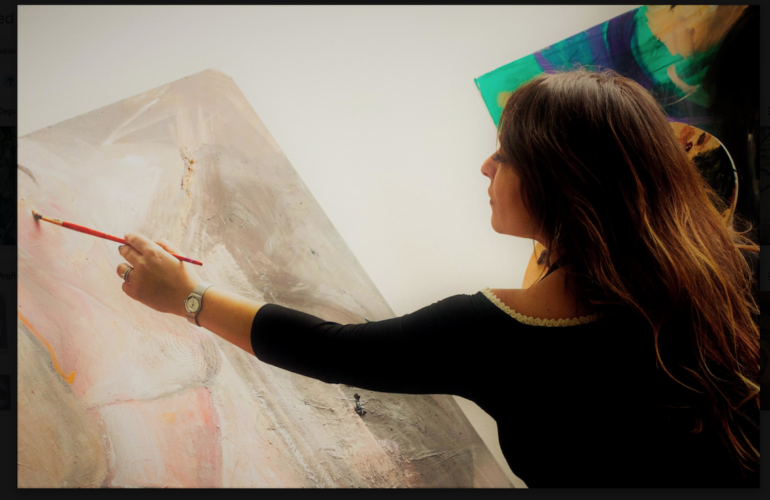
In conversation with Culturalee, Elissa Lieberman explores the fragile relationship between perception, memory and truth through a practice spanning figurative painting, portraiture, abstraction, surrealism and monumental charcoal drawing. Drawing on lived experience, art history, mythology and collective visual memory, she approaches the image as a site of psychological excavation. Her distinctive subtractive process of erasing, scraping and lifting pigment transforms absence into a means of revelation, allowing unexpected forms and presences to emerge. More recently, her engagement with AI-generated distortions of her own imagery has extended this inquiry into questions of identity, misrecognition and the instability of visual truth. Based in Chelsea, New York, Lieberman’s work examines who has the authority to represent us and how personal experience shapes our understanding of the self, bringing together vulnerability, psychological survival and the enduring search for an authentic image.
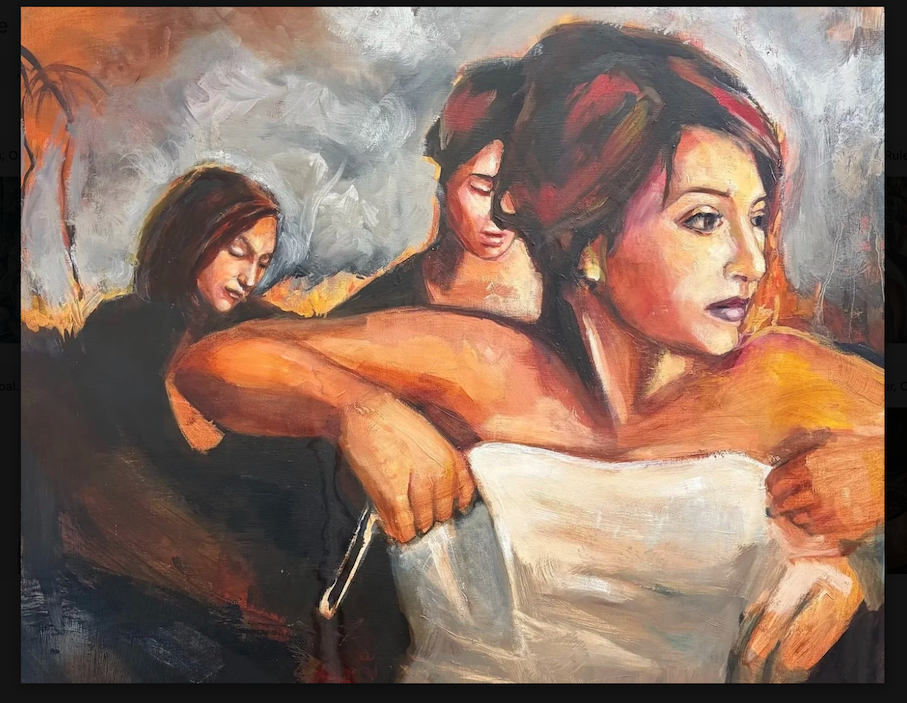
Your narrative paintings, drawing on Surrealism and symbolism, seem to occupy a space between the contemporary and the referential. How do you think about the relationship between these influences in your work?
I began collecting ARTnews magazines in the 1990s. Simultaneously, I was taking surveys of Western art class. There was no internet or computers. I would take a laundry basket to the library and lock myself in a room to study for the exams. Art, from history to the contemporary, was already forming who I was to be as an artist.
After close to 30 years of making, teaching, and immersing myself in art, the lines begin to blur between the referential and contemporary. I have a subconscious archive of imagery that exists with or without my permission, and the voices visit me in the studio, welcome or not. It would take a frontal lobotomy to excise them.
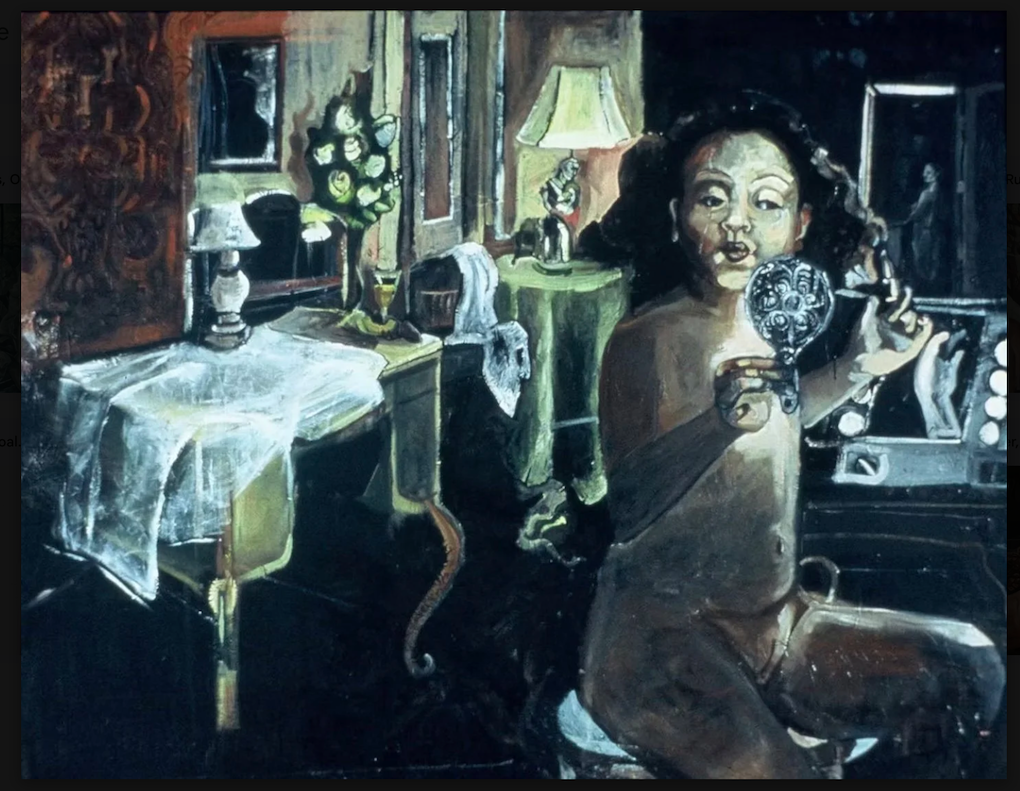
The content of my work is contemporary. I circle around themes of body image and dysmorphia, the male gaze, violence against women, existential pursuits, beauty myths, and painting itself. I never identified with the Surrealists simply because their images were often so well crafted, realistic, and detailed. I didn’t feel I was witnessing or part of the event of making. They are fully realized rather than emerging. However, the Surrealists adopt an inquiry into the subconscious that I absolutely identify with: automatism. In the studio, I can enter a flow state and seem to leave my body. I return to something stranger, unintended, sometimes more resonant. And the way I pull imagery from visual fields is an example of pareidolia. I see faces emerge everywhere and I can pull them through enough to breathe. Even with elaborate studio plans I leave room for the subconscious.
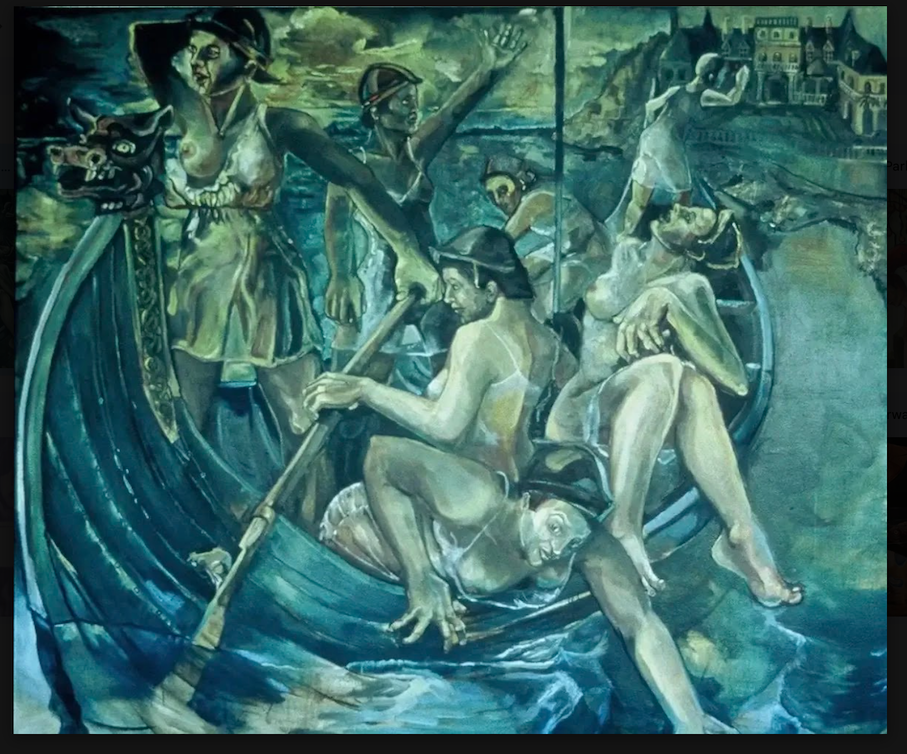
Symbolism is more of an ethos than a style or movement. There is an ennui, a nocturnal, melancholic mystery. Stories are suggested but not resolved. Mythology is present but not prescribed. I see that in my earlier, larger narrative work. Maurice Taplinger wrote in a review of my New York solo exhibition in 2005 that I have “peculiar poetry” and that I was “a convincing conjurer of dark personal myth.” My new work seems to land often between the haunted and the enchanted.
I never took mythology or studied the bible, so symbols are either informed by art history or what may be the collective unconscious, the repeated motifs and stories found across civilizations. But the stories aren’t fixed. I see a painting and swallow it whole without ever needing the story.
I have referred to images from art history. My version of Rape of the Sabine Women was done without knowing that painting. I later encountered the Poussin version. Then came the name. It was the first in a trilogy I would like to return to. In the following painting there are symbols and art historical references. The leading figure is dressed as in the Delacroix Liberty Leading the People.
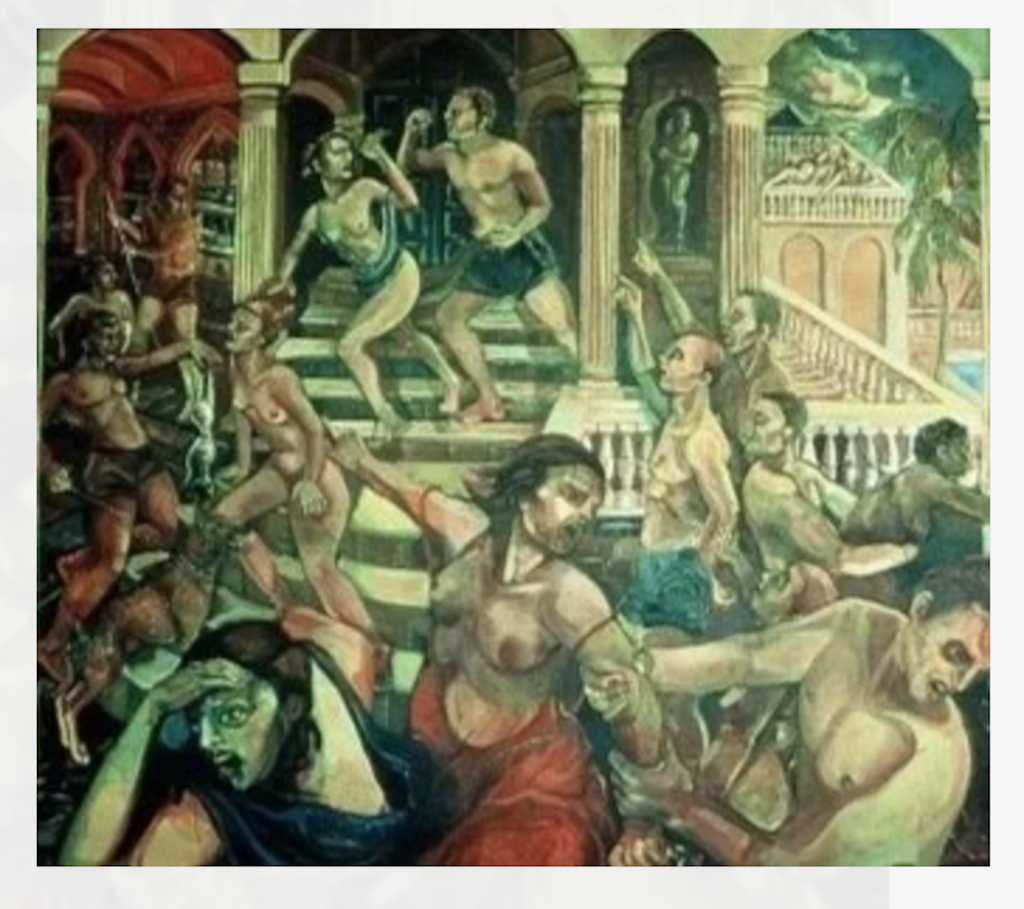
How do you arrive at the narratives that unfold in your paintings? Do they emerge from personal experience or do you draw on external sources?
I was writing and doodling throughout childhood. I entertained myself in class with drawings of bizarre creatures that made me laugh. I was also writing stories and was selected for a Young Authors Convention, so storytelling was in my blood. I was active in theater alongside my sister. I already had a lot of stories to tell. My childhood, adolescence, and adulthood were tumultuous. Memories and frozen images and a few surviving blown out pictures were the only witness.
I began painting at 14 and entered art school at 18 with very little painting or drawing skill. At Columbus College of Art and Design, observational drawing was fundamental. We drew from real objects; photographic references were not welcome. My sources became art history and a subconscious archive of doodles and imagery.
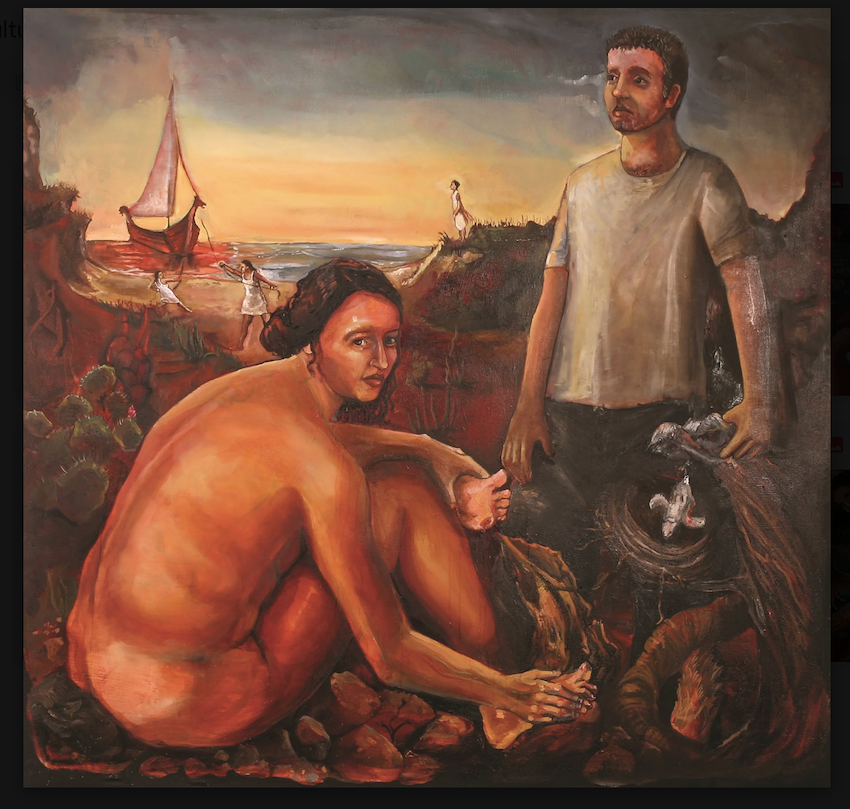
My early influences centered on faces and bodies, often expressively distorted: Alice Neel, Otto Dix, Max Beckmann, Oskar Kokoschka, Chaim Soutine, and Francis Bacon. These figures captured my imagination. My paintings had bodies and faces with little surrounding, They were clumsy and piled with paint. The painter Grace Hartigan. who ran the Hoffberger School of Painting at MICA Maryland Institute College of Art, nearly selected me the first year but I needed to give her a world.
I spent the following year trying to understand what she meant. I began constructing more pictorial spaces with foregrounds, middle grounds, and backgrounds. Rooms and environments appeared, summoned by my imagination just as the figures had been. When I finally entered the program, I was something of an expressionist wild child among a small group of realist narrative painters. We got great studios and ample working time. My first piece was from a doodle I had done while bored in an office job.
The stories I’ve painted have always been personal, even when their imagery is invented or allegorical. Over time those recognizable environments gave way to more symbolic, atmospheric, and painterly spaces. More recently, Wedding Wildfire marked a return to a more literal narrative. It used an image from my wedding album from the day of the San Diego Wildfire in 2007 that destroyed my wedding.
I often discover the meaning of a piece after I make it. In some cases, I’m still discovering what those paintings mean.
I have not seen my work since the pandemic. It has been locked in storage since and after a post-pandemic studio flood. The condition of the work is unknown. We are about to ship the 30 year archive and I am to re-encounter the work here in New York, a teary homecoming and possible new perspective to old work.
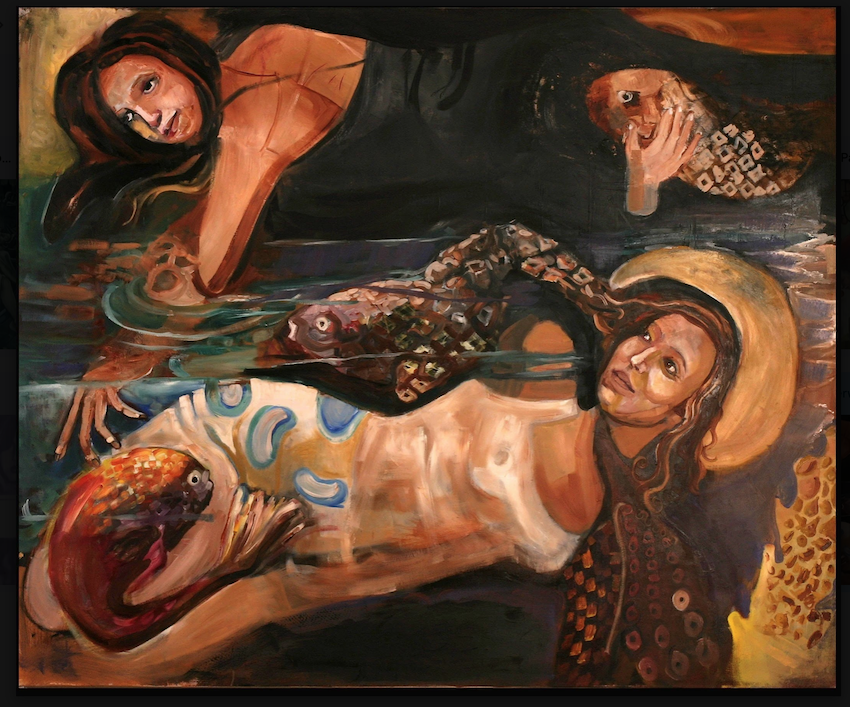
You’ve likened your art-making process to accessing a “big Book of Truth in the sky.” Could you elaborate on this idea and how it informs your approach to painting?
As a young child, I was deeply scolded after I told a lie. I became so terrified of being dishonest that I didn’t know when I was answering a question whether I was lying, even when it came to my own opinions. I imagined a literal book floating in the sky that held the truth, but I didn’t have access to it. Years later, during a difficult period, the clouds parted and that book appeared again, almost like a cartoon. What is true and not somebody else’s distortion or projection?
I’ve struggled with body weight and image throughout my life. I ask how we know what we look like? We have never seen our own selves except through some reflection: mirrors, photographs, other people, society and culture. Does it feel accurate? Making art gives me the brush, pencil, or charcoal to author the truth.
Observational drawing is part of that inquiry. It is about investigating what is real and tangible in real space and time and analyzing how it exists in the world, but it is still subject to the viewer’s perspective. When I teach, I ask a student to step away from the easel so I can stand exactly where they stood. Two inches changes the information. What is there from this position? Who gets to decide?
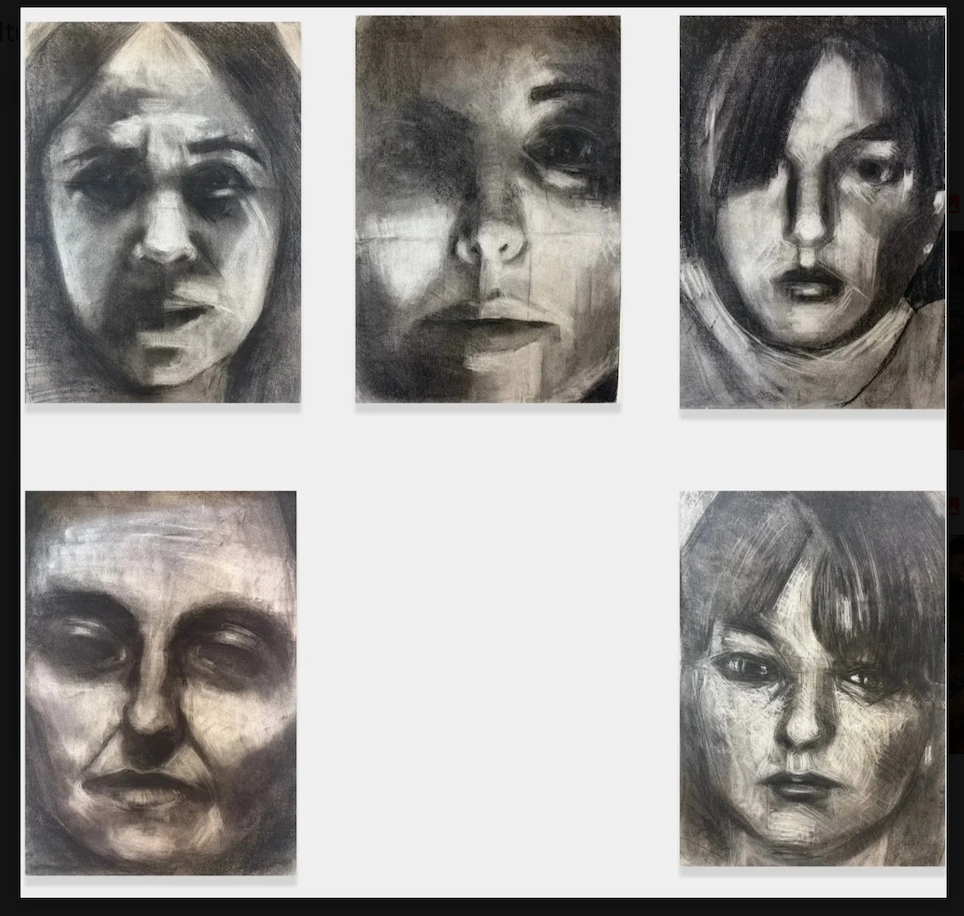
The questions have followed me from stories of real events, direct or symbolic, to the Profiled series, in which I used portraits of family members as specimens to examine facial proportions in relation to Nazi racial classification, and now to my newest work I call False Witness. It begins with images misinterpreted by AI that badly hallucinates images from my life and work. The new work has given meaning to the old work. I keep asking what the truth is, and who gets to bear witness to it.
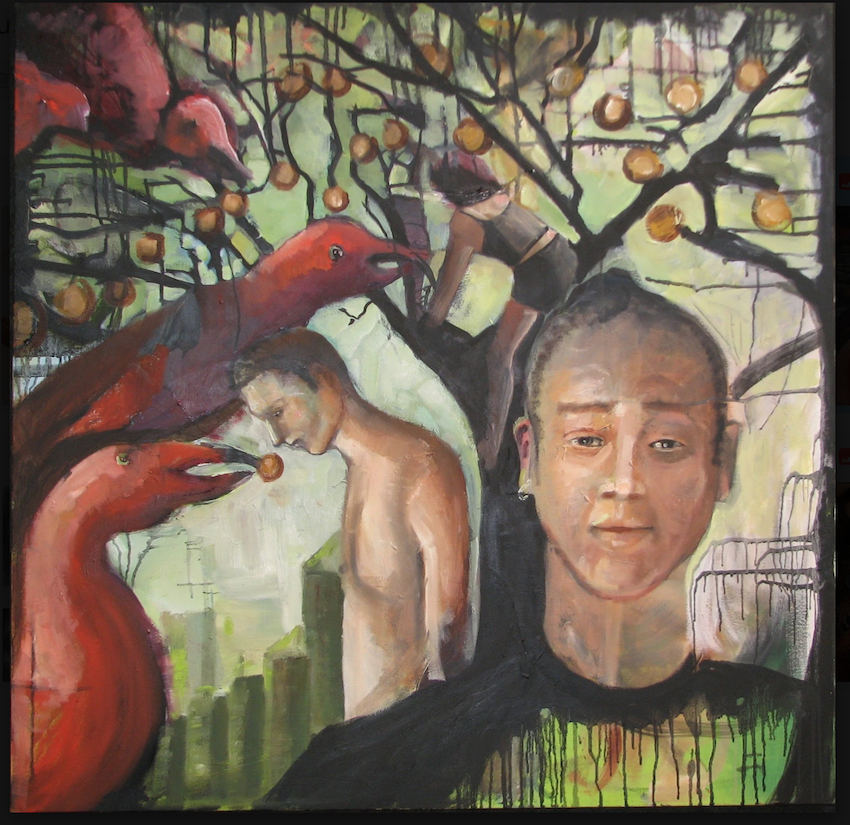
You’ve described your work as a way of “excavating light from fields of darkness.” How does this idea of uncovering something through the act of making shape your work?
When I teach painting, one of the most important exercises is the wipe-out: laying down a ground, wiping out the light shapes, pushing back darks with opaque paint, until there is a simple monochromatic three-value depiction. The light comes from the white of the canvas. Putting white paint over that can be a problem.
Beginning in 2019, I experienced a succession of traumatic events. There was an assault, the pandemic, closure of the Art Loft (the art school I owned), a resulting flood and forced eviction from the school, divorce, multiple moves, friends and family leaving, then the loss of my dear dog, then the loss of my interest in and ability to create. Decades of paintings and drawings, my art library, school equipment, and belongings from my former home were hastily thrown into storage pods in San Diego.
My world went dark. My hand was a useless appendage. I had always told students that if they learned to see, they could draw anything. Suddenly, I could see but I couldn’t orchestrate my hand. Stacks of plastic-shrink wrapped art magazines accumulated, and I wasn’t even interested in opening them. After years of the blackest darkness.
In 2025, I cleaned out the studio. I tried to paint faces, my favorite thing to do. But my proportions and scale were off. I dragged a rag through a portrait that wasn’t working, leaving an ugly smear of color. A few days later I returned to that smear and began pulling light shapes out of it with a turpenoid-soaked rag, Q-tips, and other materials, then pushed the darks. A face emerged with lowered lids and a simple black line for the mouth. Very little information, yet it carried the surrender and fatigue I’d been living with, it was a face that felt so aligned with my experience it was reflecting me. I felt I was releasing something from the canvas that was already alive in there, a reflection of my own aliveness.
The next day, another face materialized. I began doing wipe-outs every day. Revealing light from darkness is an obvious metaphor, the fact that it was a complete return to my own hand opened the possibilities of resuming life as an artist.
Within a month, I was to visit my sister for Thanksgiving in New York City. During my visit, a great apartment and art studio materialized and I had to make a quick decision. I chose to take the leap. It has been almost a year and I am now actively creating in my New York studio, a vision that I never thought I would realize.
I have continued wiping out in the studio, often using alternative materials to excavate the light. After completing my charcoal profiled series I have been working, subtracting light from charcoal. I am now working primarily in charcoal, subtracting the lights to reveal forms. Charcoal is responsive to touch; it can be loud or soft. It’s a burnt stick, primal, a material of survival and economy of means. I began with the material and only afterward researched its use for portraiture under extreme circumstances.
I have been almost religious about avoiding opaque paint, choosing the light from the canvas to pass beneath washes or glazes of color. And with charcoal there is a floor. You arrive quickly at an image and no more can be done. I have not opened a tube of paint in a long time although a tube of white arrived in an Amazon box, probably a late night purchase.
You ran the art school at the San Diego Museum of Art and founded the San Diego Art Loft, which was nominated as one of the top five art schools in San Diego in 2017. How has teaching impacted and informed your personal practice?
I knew that I wanted to teach college level art and that an MFA was required for that. I enjoyed being a TA in graduate school. The second year I was a TA for an amazing older professor in a figure painting class. He was stepping down from a teaching position at the Delaware College of Art and Design in Wilmington, Delaware, and offered me the position. It was an amazing opportunity. However, I was the only one of my cohort dividing time between studio and teaching life. The curriculum was excellent and I took on many of the lessons and assignments into my own teaching practice which I continued after graduate school. Although my plan was to move to NYC, I was in a new relationship and followed somebody to California, where I continued teaching and maintaining a studio. I eventually left to manage the Art School at the San Diego Museum of Art. It was a great position, but the politics were beyond me. I had a few more difficult teaching situations before we moved to Portland, where I could find no teaching and instead worked with adults with developmental disabilities. There were many factors that led to a dark depression in Portland. A group therapy prompt was, “What would make life worth living?” and I wrote out my plans for the San Diego Art Loft.
We returned to San Diego and within years had opened my studio as a small art school. It was a success. No advertising, all word of mouth. I also hosted the San Diego Life drawing meet-up group attracting talented artists across the city. My teaching methods were increasingly nonconventional and almost theatrical. I had transplant surgeons, army generals, homemakers, eager teenagers all participating in conversations. The last class before the shutdown was Monday Teen Painting. A tray of black and white cookies were in the kitchen. I could not contain myself and ended up serving the white half to my students. The students loved that and the next day the world shut down. A month later the studio flooded and a very tormenting landlord evicted us all. What had not been thrown into storage was disposed of, the space boarded up while I watched. I never got to say goodbye. The Art Loft was my life, my identity. This was not simply a professional setback. It was part of a much larger rupture. A series of personal losses followed closely and as soon as I could stand, another wave would knock me over until the last straw, the passing of my beloved dog, Joey. That’s when it all went black and it took years to resuscitate.
You recently moved your studio to New York. Has the change of environment affected your practice?
I have had a fantasy of living in New York since childhood. My sister lived here on and off and we had visited Broadway Productions in our youth. I always had a voyeuristic relationship to the New York art world. I would be mistaken for a New Yorker my whole life. Maybe we all have an inner New Yorker.
After the Art Loft closed I was asked what was next for me. My answer was, “There’s New York and then everything else.” I had regretted not going in my twenties and the thought of going meant confronting insurmountable obstacles.
During Thanksgiving in 2025, I was visiting my sister, and through a serendipitous turn of events, an apartment and a studio appeared. It was either jump now or go back to dark still waters. I jumped. I landed in the nucleus of Chelsea, with my studio in an iconic studio building surrounded by art. I am fully immersed in a world I had largely been a voyeur to, from the galleries to the Metropolitan Museum of Art. I’m more alive artistically than I’ve ever been. New York always felt like the home I never had. Now that my feet have touched the ground, I don’t see myself ever leaving, no matter what happens to my career.
I see New York City as an Island of the misfits where I fit in quite well. It has a history of dark traumatic losses and had resiliently risen between these catastrophes. I resonate with that. As a storyteller, I can’t leave my apartment without walking right into human interest stories. There are stories unfolding around me all day long
There is a lot of big thinking, big ambitions, and big dreams packed in a small footprint. The intellectual and creative energy is palpable. Some people get crushed under the weight of their own ambitions. Many artists I have met have grown tired and weary of the constant rejection.
Being an artist in New York City can be brutal. It was no surprise to learn that there is an unspoken rule. Never pitch yourself. Don’t send emails, don’t even look our way. We will find you. I even spoke to a dealer on a panel and he admitted the truth, “You have to know somebody.” But I am so grateful to be in proximity to the best art in the world. I can be at a gallery and enjoy my favorite artists’ work in my pajamas on the way to the bodega for a snack.
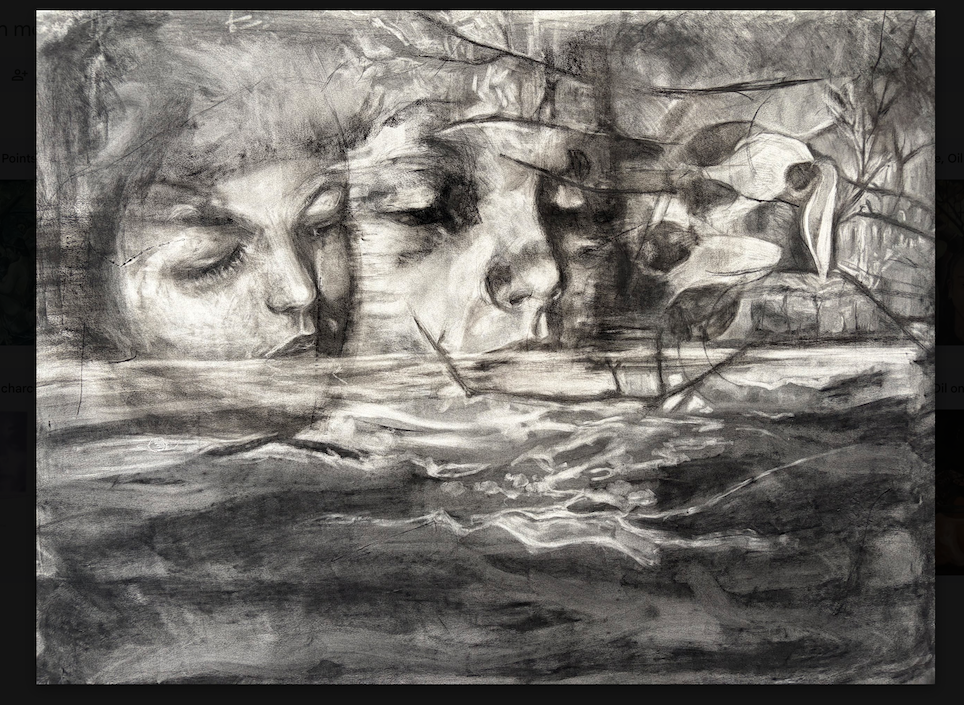
What are you currently exploring in the studio and are there any new directions or ideas you’re excited to pursue?
A varied archive of work lies between those earlier narratives and my current work. I worked through faces, self-portraits, beauty myths, eroticism, sexuality, and abstraction. Now AI is my way in.
Moving to NYC, I used AI to help get around, find my way, and act as a sort of journal. I began returning to old art historical digital filters on simple photo editing apps for entertainment’s sake like I used to. When I tried that again, I did not realize the technology had changed. I am very analogue. Calendars on paper, editing documents off the printer, antagonistic with technology as it often leads me to a ball of tears. But this simple app stylizes an image in the spirit of a number of artists and movements. What had changed is that AI took over the filter and rather than applying a style, it was interpreting images that were remarkably nonsensical and deformed. I was often hysterically laughing at the impossible creatures, deranged anatomy, tangled fingers, and absurd results, just as I had laughed at my own goofy doodles in childhood. I was deeply entertained and began an AI blunders folder.
I asked ChatGPT what a childhood photograph of me might look like in charcoal, to see if I wanted to draw from it. The image it gave me was plausible but wasn’t me. My face had been homogenized, the dog was not my dog, and the whole world in that image seemed to belong to somebody else. Sometimes the AI interpretation isn’t grotesque at all; it simply arrives as a fiction. I find that a juicy vein to investigate.
False Witness: How the Machine Misremembers Us is now an umbrella for multiple chapters of investigation. It’s a trojan horse using AI blunders to examine what is true and what it means to be human. It journeys through important personal topics: girlhood, adolescence, sisterhood, identity, the body, memory, and the authority of the witness. It is not just about AI hallucinated childhood photographs, although that is the way into the work for me. I am also interested in the way AI accidentally changes my own artwork when I ask for something as ordinary as a gallery or studio mock-up. What has the machine recognized? What did it invent? And how does it interpret art historical styles? I don’t want to harvest or dictate anything but rather create conditions for the accidental blunders to surface. I want an entry. Whatever unconsciously unfolds is another story. That other form of intelligence when the hand takes over can lead to imagery I had not imagined.
There is sometimes a disconnect between the intellectual inquiry and what actually appears on charcoal paper. I have to remain elastic and hospitable to what arrives there, because between the idea and execution is another world for an artist. The drawings can become haunted or enchanted presences that don’t immediately announce their digital source.
I am not making an argument for or against AI. I’m fascinated by the fallibility, limitations, and mistakes of a machine that gets representation so wrong, and how it performs human apology and shame. What human neuroses have we programmed it to perform? What does that say for the stability of humanness, memory, identity, and truth. Why do we look for our own validation in the eyes of the other, culture, and technology when it is so subject to distortion? How do we identify the truth of our own humanness?
For more Information visit https://www.elissalieberman.com