

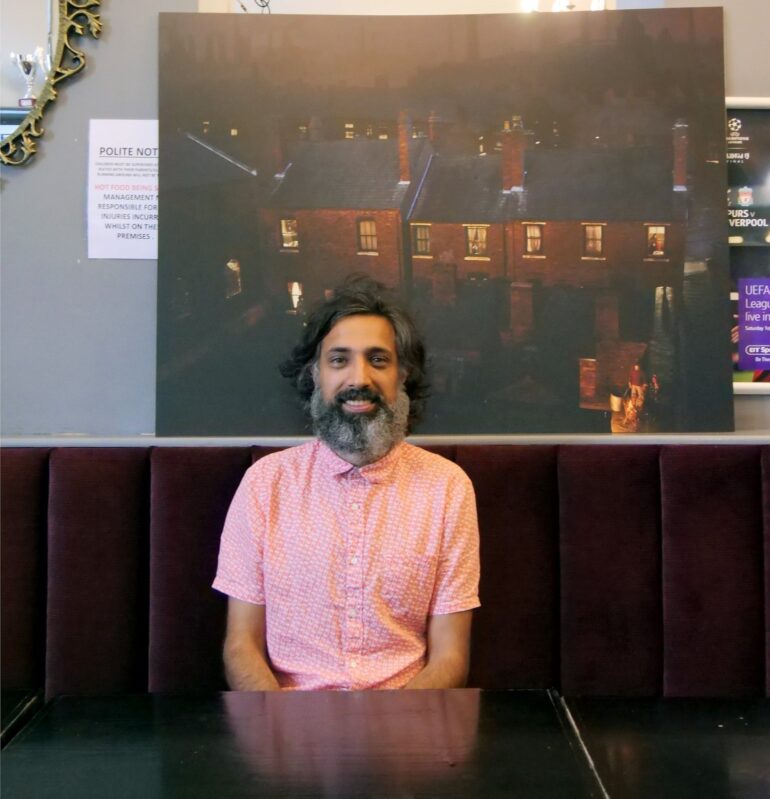
In his powerful new exhibition Paths You Walk, acclaimed photographer and filmmaker Billy Dosanjh turns his lens towards the men and women whose labour helped shape the industrial heart of the Black Country. Described by The Guardian as “the Edward Hopper of the Black Country,” Dosanjh creates cinematic, meticulously staged photographs that explore migration, memory, race and belonging through deeply personal and collective histories. Drawing on oral testimonies, family archives and the experiences of South Asian communities in Sandwell, Walsall and Smethwick, his images illuminate overlooked narratives of resilience, solidarity and quiet dignity. In this exclusive Culturalee in Conversation interview, Dosanjh reflects on the legacy of empire, the responsibility of documenting community histories, and why photography remains a uniquely powerful medium for placing untold stories into Britain’s national consciousness.
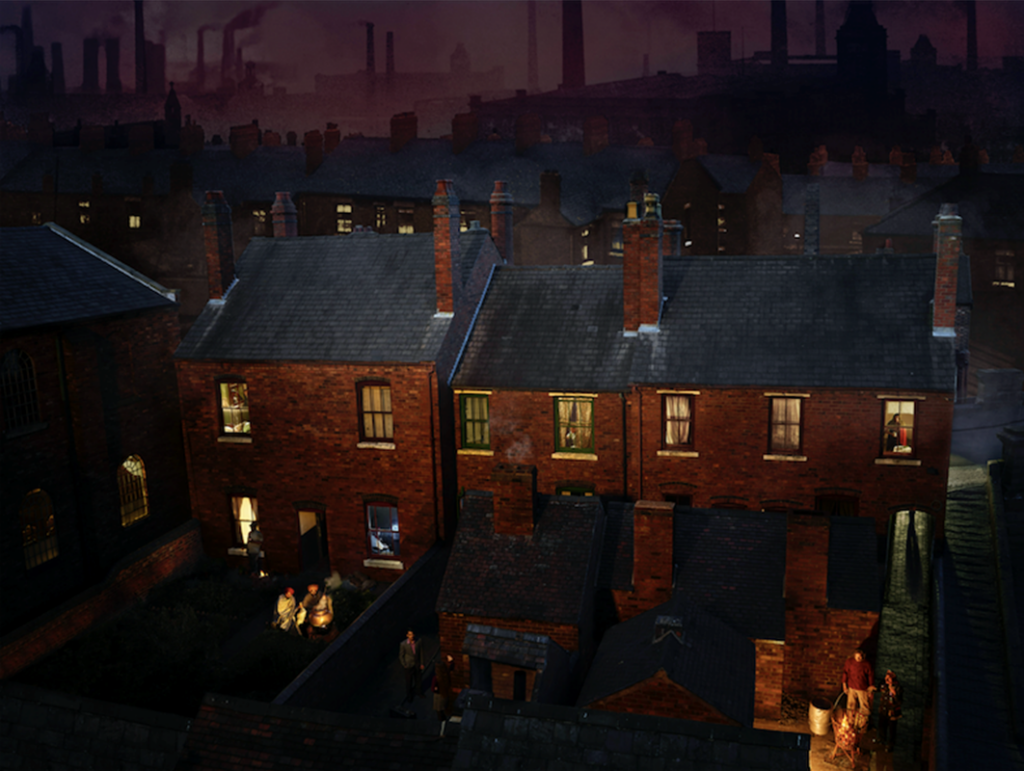
Dayshift by Billy Dosanjh
The Guardian described you as “the Edward Hopper of the Black Country.” How did you feel when you first heard that comparison, and do you see any parallels between Hopper’s portrayal of solitude and the sense of alienation, resilience, and quiet dignity that emerges in your own photographs?
The Guardian called me the Edward Hopper of the Black Country, and I will be honest, my first feeling was flattery chased by suspicion. It is a generous line, and the overlap is real. The held moment, the charged stillness, the painterly light. I do build what I think of as single shot movies, where one frame is meant to carry a whole film the way a Hopper diner carries a whole evening. But a comparison like that can flatten the work, so I hold it lightly.
Because Hopper’s solitude is not mine. His is the loneliness of the modern American city, the individual adrift. Mine is solitude inside community. In Dayshift, four men share a back garden under a sky that burns like Mars, and they are distant from each other and from themselves at the same time. Alone together, not alone instead.
If I am honest about the company I actually keep, it is not only Hopper. It is the settler painters. Tracey Moffatt and her Up in the Sky. Frederick McCubbin’s The Pioneer, that triptych of a couple making a life in the Australian bush. This is what some have called newfoundland and settler art, the work that comes out of arriving somewhere and trying to make it home, and my pictures move toward that tradition, only relocated to a terraced street in Sandwell.
What people often read as melancholy in the light, I think of differently. In Dayshift I work in the deep gold of the Dutch masters and Caravaggio, because I want the image to carry these men with the gravity that history painting always reserved for the powerful. After the Storm does it in the cold instead: a lone figure on Butts Road in the Big Freeze of 1962, standing in the snow and looking up to the heavens, on the very street where this community first dug in. These were foundry men, and I have read that in the moulding shops the average life expectancy was around thirty-four. So the weight in the pictures is not a mood I am chasing for effect. It is the real weight of those lives.
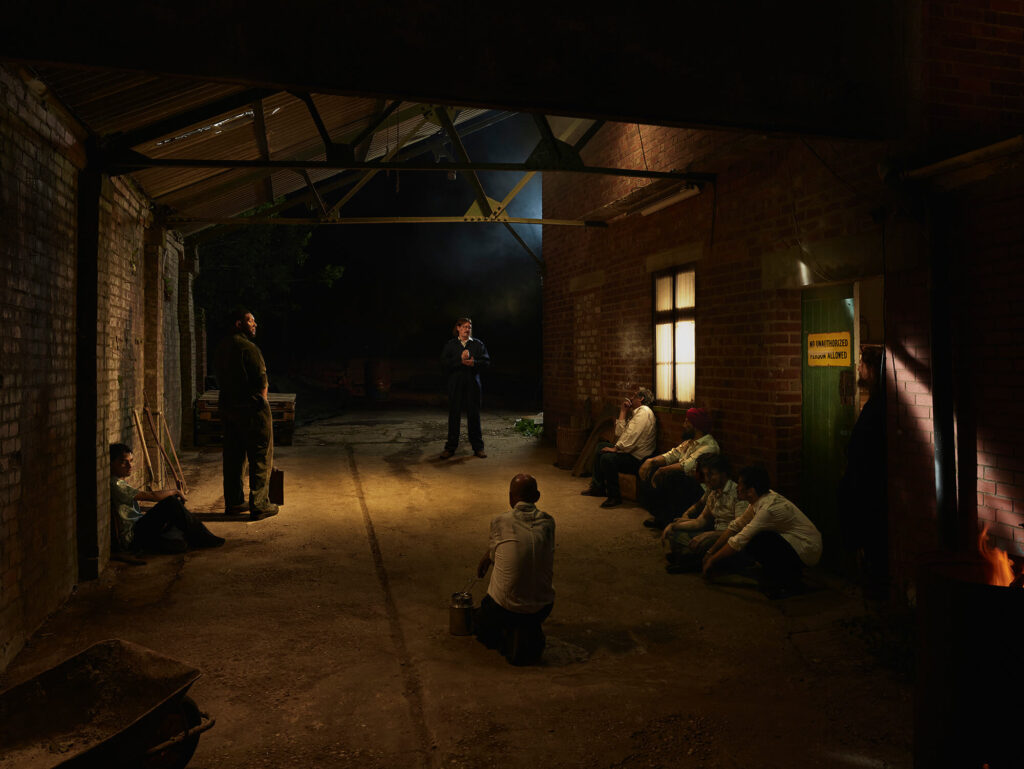
Furnace by Billy Dosanjh
Your exhibition “Paths You Walk” explores race, identity, empire, and the lives of the men who kept the furnaces of the Black Country glowing. What inspired you to photograph this subject, and what conversations are you hoping it sparks among audiences today?
It started at home, and it started with my father. He came in 1964, fourteen years old and on his own, eight thousand miles to remake a life in a place he had never seen. That is the seed of it, and I work with the idea that a generation’s upheaval can scar the one that follows, the way trauma is said to mark the DNA.
But the project did not really come from nostalgia, or from him alone. It came from a method I built in Sandwell, a way of elevating experiences that sit at the fringe by gathering the stories directly from the community, from the children of that time and from the newcomers arriving today, and then staging them with people who can psychologically inhabit the moment. I am after a psychological veracity rather than a documentary record. The truth of how it felt, rebuilt, not a photograph of how it looked.
I want to complicate one thing, because people often call me a Sikh storyteller and, honestly, I find that label confusing. Culturally I am Punjabi by origin, and Punjabi is a far broader church than Sikh. When I reflect on the lives I actually grew up among, it was a polyphony. A rich mosaic of different South Asian worlds converging on the same few streets, different castes, different religions, different regions and languages, all of them drawn to the Black Country to do the same manual work. My early teen summers in West Bromwich were astonishing for exactly that, houses that have since been knocked down, an abundance of this emergent culture overlapping inside terraced front rooms. I can never shake the complexity of that time, and I have no wish to flatten it into one faith or one tidy story. The current work bears that out. The testimonies run from Mirpuri men who arrived as teenagers and have lived in a permanent in-between ever since, to an Egyptian couple who came via Abu Dhabi and retrained as dentists while stacking shelves in Sainsbury’s, to a man whose father ran a Smethwick taxi firm and once drove Harold Macmillan around the region during his 1959 campaign. Caldmore, where much of it was gathered, has the most diverse primary school in Britain.
Empire is the machinery underneath all of it, and I mean that literally. Birmid Foundry in Smethwick recruited straight from farms in the Punjab. Britain built the Mangla Dam in Kashmir, flooded out a poor community, and handed them passports in return. These men were summoned by empire and then held at its edge: the colour bar, the barber who flipped his sign to closed as an Indian reached the door, Smethwick’s 1964 election that is still remembered as the most racist in British history, Malcolm X coming to the town in 1965, Enoch Powell just down the road.
But I refuse to make it only a story of suffering. There was the Cooth, a savings club where the men pooled their wages so that the one in most need could buy the first house, because no bank would lend to a newcomer. The pub became the new courtyard. There was comradeship, and there was a great deal of humour. What I want the work to do now, in a country sliding back into the same rhetoric, sometimes from the mouths of politicians whose own parents made this exact journey, is to put people inside the arrival and let them feel it as a founding British story rather than a grievance. You cannot settle the future until you have settled the past.
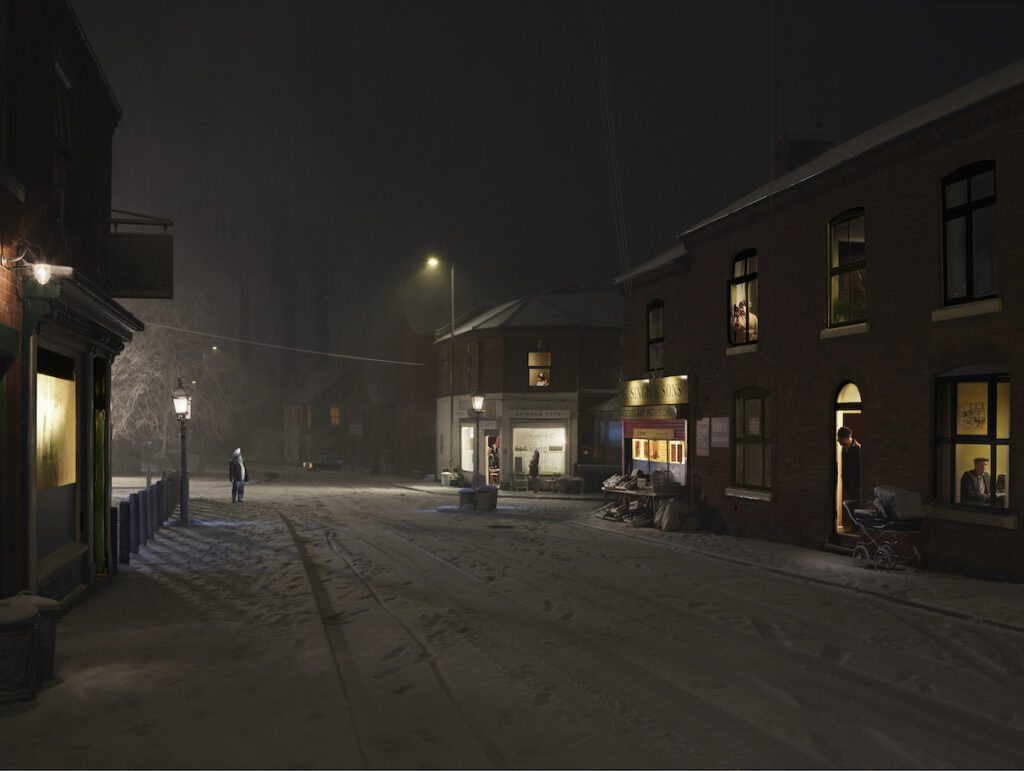
After the Storm by Billy Dosanjh
You have spent decades documenting Sikh life in Walsall and the wider Black Country, often finding extraordinary beauty in everyday moments. How has your relationship with the community evolved over the years, and what responsibility do you feel as both an artist and a chronicler of its history?
It began as family and turned into a practice. Year Zero: Black Country started with me sitting my Punjabi elders down in front of a hundred hours of 1960s archive and letting their memories rise to the surface. That film is the mother dough; everything I have made since has been baked from it. So this was never a subject I chose. It is blood.
Over the years the relationship has become reciprocal rather than extractive. I cast and crew from the community, including people who have only just arrived, so that today’s migrants end up re-enacting the arrival of the last generation. History on a loop. I love that circularity, and I think it keeps me honest, because the people in the pictures are collaborators, not specimens. It is also why I tie the work to a community interest company, to oral history archives, to a legacy film, so that the community keeps hold of its own history after the show comes down.
The responsibility I feel is to dignity over spectacle, and to truth over flattery. And the truth is not all warmth. Some of the hardest stories sit right at the centre of the new work. Stage Exit came from a story that surfaced again and again in the testimony, and in my own wider family: suicide driven by forbidden love, cultural and caste lines crossed, the held breath in the instant before a decision that cannot be undone. Ambush reaches further back. Kiran, a Punjabi builder from the area, plays the eldest of six brothers who came to work at Barton’s factory and left the youngest behind in the Punjab, and that youngest brother was murdered in an ambush over a land dispute in the wake of Partition. The survivors carried that ghost their whole lives, the grief logged in a stack of blue airmail letters. I stage it as solitude: a rented room, a suitcase, a pair of shoes on a bare floor, a doorway that is almost a summons back to the ancestral farm. There is also a line I will not cross for the sake of a picture. One image we made was too raw to hang, and we held it back. Knowing when to show a thing, and when to keep it aside, is part of the responsibility too.
If you ask where I still owe a debt, it is to the women, and I will say that plainly. Seamstress is one woman lifted out of the factory crowd by a shaft of light, wearing her late mother’s clothes, her eyes on a picture of Guru Nanak. But the fuller truth is that these women were never passive. In 1982, Sikh women went on strike at Supreme Quiltings and Raindi Textiles in Smethwick, fighting for fair pay and for their union to be recognised. That is the picture I most want to make next.
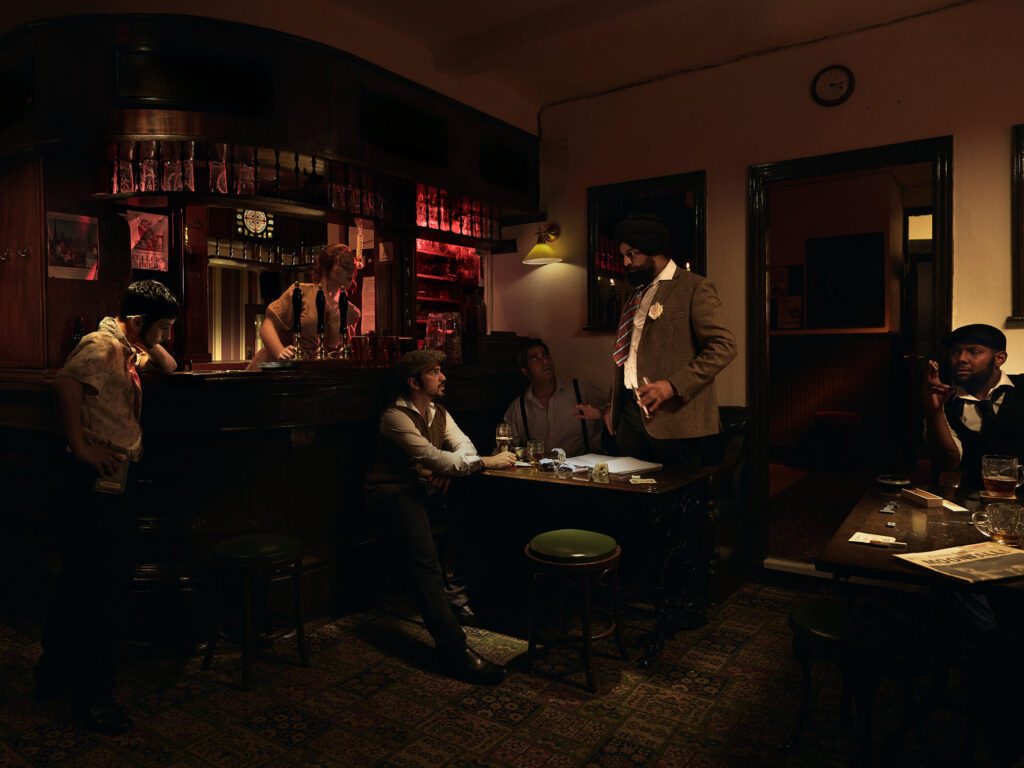
Payday – by Billy Dosanjh
Many of the images in “Paths You Walk” capture people and places that have often been overlooked in mainstream narratives. In an era when questions of belonging and identity remain central to public debate, what do you think photography can reveal that other forms of storytelling sometimes cannot?
I came to this through film, not photography. I trained at the National Film and Television School, and then ran into an industry that told me, more or less, that you get to make the film you actually want once every three or four years, and in between you take whatever work you can get. A Channel 4 commissioner said that to me. After years spent finding a voice, that was a hard thing to hear, and working in television began to feel like the wrong room. So I went looking for another way into the worlds I wanted to see, and photography turned out to be a far purer one. It lets me evoke the feeling I carry about the point of origin into this country more directly than any multimillion-pound budget, or a drama series with too many cooks, ever could.
There is a principle I have always held to, from the film-maker Kim Longinotto: that there is nothing more political than where you point the camera. She meant it about who you choose to put in front of the lens, and why. That choice is the whole act. It also troubles me that you barely see documentary in this country any more that is longitudinal, that sits with people across years and is deeply studied. The form has been thinned out. What my way of building a world does, slowly and with deep history and its resonances at its core, is the kind of work that documentary used to do. It just arrives as a single constructed image rather than an hour of television.
And I have always loved the enigma of a single image. The candid capture. Not knowing, in time, what came a second before or a second after. Just the mystery of the suggestion. A film resolves things; a photograph withholds, and that withholding is where the feeling lives.
That is the heart of what the medium can do that an article or a policy paper cannot. It stops time and makes you stay with one charged second, looking at a face you were taught to look past. It also moves the private onto the public record. These stories were only ever kept within families, and a photograph lifts them into the national album and says, plainly, we were here, we built this, we belong. It makes that argument before a word is read. I print at roughly a metre by a metre and a half and light it like an old master, so the form itself insists these people matter.
A single frame can also hold contradictions that prose has to put in order. Like a South Asian miniature, one image carries inside and outside at once, labour and tenderness, the letter from home and the swan being prepared for the pot in the yard. In a debate this defended, that matters, because a paragraph is read as a position and the shutters come down, whereas an image is felt before anyone decides whose side they are on.
In the end the whole thing is about belonging. I once wrote that it is what we all battle for, isn’t it, a sense of belonging. A good photograph can hold both the dignity and the cost of that fight in the same breath. And the radical part is the ordinariness. Finding something grand in a foundry break or a back garden at dusk is a way of saying these lives always deserved the grand treatment and were simply never given it.
Find out more about Billy Dosanjh here.