
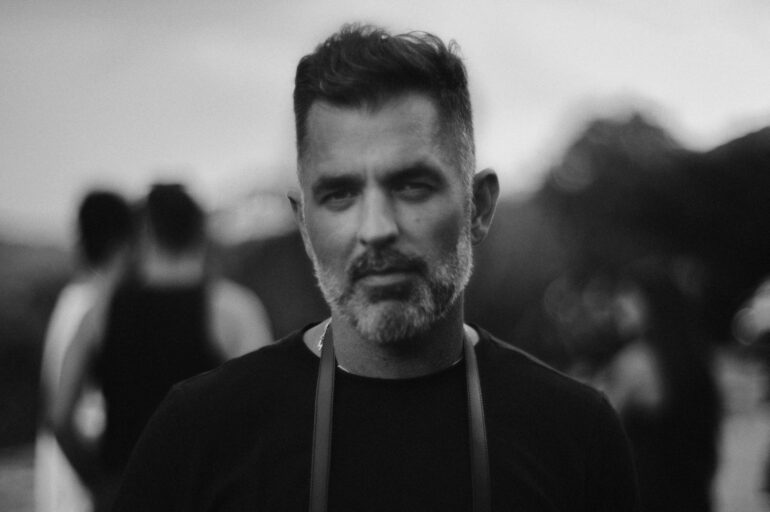
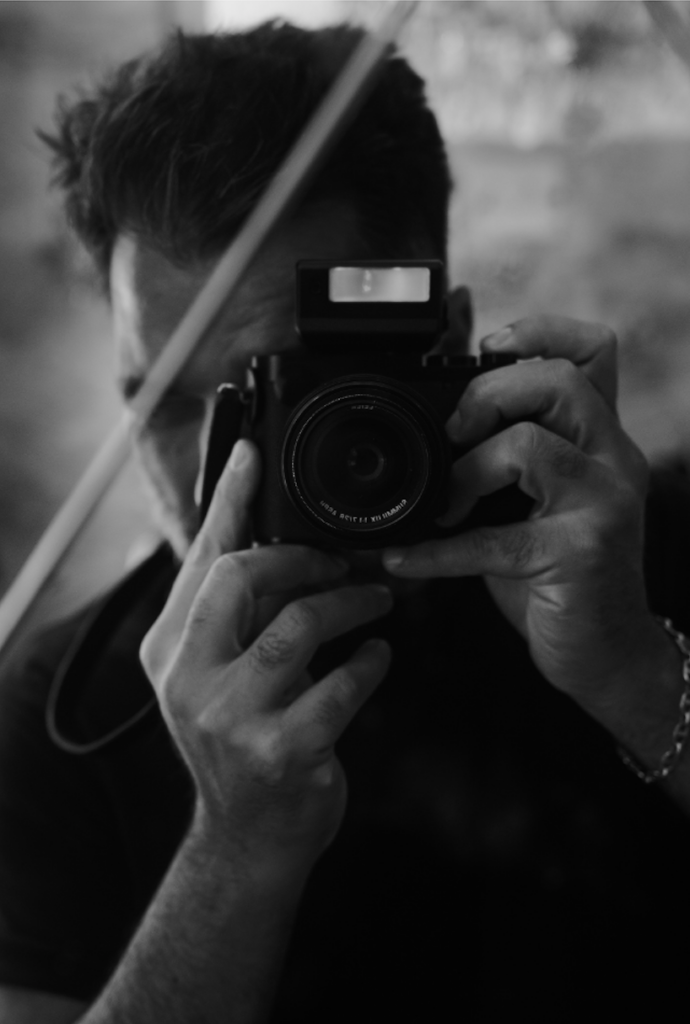
Manuel Nogueira is a prolific Brazilian filmmaker, photographer and CEO of Matter + Energy, a global creative Powerhouse with roots in Brazil. His work moves fluidly between advertising, film, photography and visual culture. He came into leadership through making rather than management, shaped by years of hands-on photography and film work, from editorial commissions for Vogue, Elle and Nowness to directing campaigns for brands including Spotify, Netflix and Dove. He’s also worked closely with artists, including across music videos and visual projects. He brings that same sensibility into how he runs a company. His approach is instinctive, shaped by time spent in the edit and on set, among the slower, more uncertain parts of the process where ideas take form.
Manuel has also developed a distinct voice as a writer. His essays are reflective and relevant, often circling questions of the importance of taste and judgment in a moment where creative work is reshaped by AI, facing pressure to produce more and faster. He truly writes from inside his work, drawing on past experiences and ongoing experimentation.
In the latest edition of ‘Cultural Innovators’, we talk to Nogueira about his career trajectory from photography and film-making, directing campaigns for world-famous brands to becoming CEO of Matter+Energy, an innovative agency at the cutting edge of creativity.
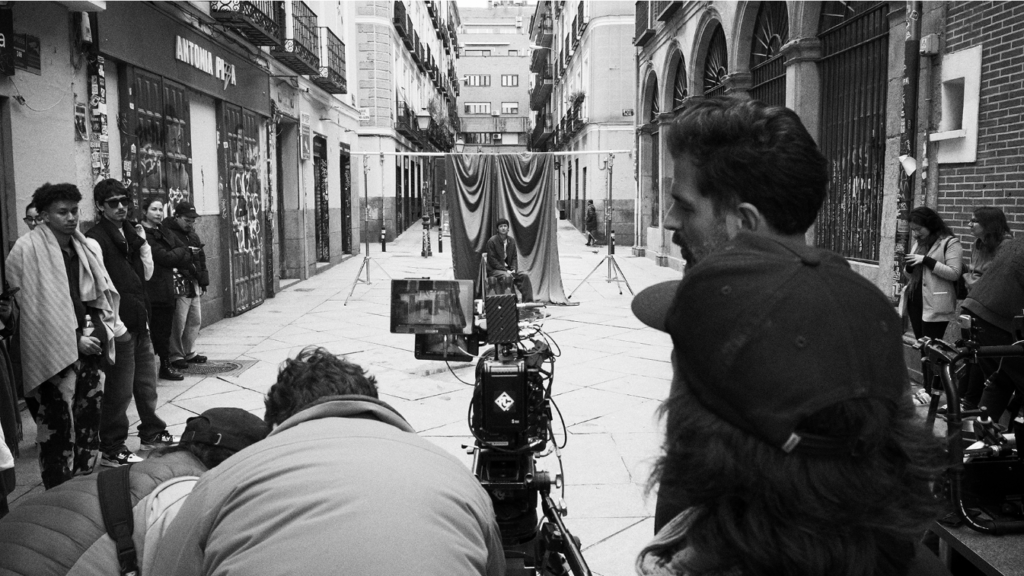
How has your background in photography and filmmaking shaped the way you work and lead, and how do you connect that creative experience to your role as a CEO?
The moment under the red light, as a photograph appears in front of you, is something you never forget. It is magical. Hands in the water, the sour tang of fixer, no sleep. You’d watch an image take longer than you wanted, and you’d learn the only useful thing: how to stay in a room when you don’t yet know what you have and at the same time you trust that magic is about to happen. That training wasn’t called leadership at the time. It wasn’t called anything.
Business leaders with administration backgrounds got handed a different muscle. They got taught how to compress decisions. The artist’s training is the opposite. You learn to wait for the image, you learn to notice what’s actually happening on the surface (the surface always tells the truth about what happened underneath, you develop a tolerance for not-knowing that turns out to be the thing the job actually needs.
I came into this role at Matter through the side door. No business pedigree. My partners saw it before I did. It still feels like a strange sentence to write. But the connection between making something with your hands and running a creative organization isn’t a metaphor for me. They’re the same gesture, just at different scales. You set the conditions, you control the variables you can, and the chemistry comes out with its own opinion. The CEO part is just the darkroom at a different size.
What that means in practice: I try to not intervene in the work anymore. I intervene in the conditions for the work. That’s a different muscle from being the photographer, director or artist in the room. Most leaders forget this and become the bottleneck. I’m trying not to, by creating a team with special skills. Sometimes I fail in keeping the right people and sometimes I miss the bottleneck.
What drew you to the creative field at the beginning of your career. Were your studies art-related, and how did that shape your worldview?
Short answer: no. I didn’t study anything art-related, formally. I studied advertising, communication and went really early into the fields of image creation.
The longer answer, if you want it: I learned from the photography world. As a photographer and as an assistant for other photographers. Then film sets. These combined taught me a lot about commitment, building teams fast and making them work, hierarchy, compound effort, asking the right questions, going one extra mile, keeping the silent preserved as a sacred thing, respecting others, and knowing that the work has to exist by Friday whether or not you know what it is yet. I think. There’s no school for that. Or maybe there is, but I didn’t go.
What drew me wasn’t the field. It was the act. Photography was the first thing that made me discover the magic of creating – one thing that was not there becomes real. Philosophy, psychology and all the physics of being an author. Then it became film, then music, then creativity as a business.
That’s still my worldview, basically. I want to create and I see magic in it.
Can you tell us the story behind the name Matter + Energy, what it represents, and how it reflects the agency’s focus, specialties and approach?
The name is inspired by physics and we never explain, because explaining it makes it less true. Matter is the thing in the world. Energy is what moves through it. Without both you don’t have anything. You have either inert form or pure activity. The work we care about needs to be both. Solid enough to hold and alive enough to move.
We don’t usually call it an agency, internally. We call it an operating organism. Different units inside, each with its own leadership duo and its own register: Beauty, Entertainment, Tech, Branding. They function as small agencies with full autonomy. My job with my partners is the conditions, structure, the culture, the weight class of the clients we say yes to, and the leaders who hold each unit. I intervene, of course, because it’s something on going. I’m committed to intervene less and less, as we evolve. Resources get reallocated between units when something needs more oxygen.
The thesis underneath all of it: in this market, ideas are not the scarcity. Speed is infinite. Clarity is rare. We exist to give that back to brands that have lost it. The promise is simple, almost embarrassingly simple. Clarity, then creativity, then confidence. In that order.
A lot of the field operates in the opposite order. They start with confidence, work backwards into creativity, never get to clarity. You can spot it in the deck.
In a world of constant content and noise, what role does ‘taste’ play, and why does it matter more than ever?
Average is free now. You can produce average copy, average design, average music, average decks, in seconds (and it is good, it raised the floor). So the only premium left is the thing that average can’t touch. And that is taste. By which I don’t mean preference. Anyone has preference. Taste is the judgment forged through thousands of hours of friction with material that resists you. It lives in the body before it reaches the mind. You can’t shortcut it, you can’t extract it into a framework, you can’t prompt for it.
The half I had wrong: taste alone doesn’t build reputation anymore. Not at the speed that matters. AI made execution abundant, and it also made good work, on its own, quietly insufficient. You can produce careful, beautiful, quiet work and still disappear. Welcome to 2026.
What builds reputation now is authored work. Work that’s visibly made by someone, whose authorship is recognized in public. The work, and the author of the work, in the same frame.
There’s an etymology I really like, in Portuguese and English the same. Autoridade vem de autor. Authority comes from the author. Same root. The author is the one who generates the thing, gives it life, cares for it to exist. Authority is a residue of authorship. It’s what’s left in the room after you’ve signed enough things that held.
The authority we’re trying to build at MATTER is the authority of the work’s authors. Leaders who appear because their work made them visible. Not because they had a take. The work speaks first. The reputation follows the work, in that order.
Strange thing is, the category already exists. The agencies the world actually talks about, the small undeniable shops, are agencies whose work is unmistakably authored. You can feel it before you read the credits. We’re moving in that direction with more intention than before. Comparing ourselves to the right reference set.
A lot of the conversation right now is about authenticity. I find most of it embarrassing. The word has been emptied. Taste is the harder version of the same idea, because taste demands you actually know what’s good, not just what’s “real.” Authorship is harder still. Taste can stay private. Authorship is the moment you put your name on it and let the room decide.
I’m not always sure I have either. I think anyone who claims certainty about their own taste should be eyed with suspicion. But I trust the way I look at things, and I trust the people I’ve built MATTER with to tell me when I’m wrong. The signature is mostly what survives the corrections of our group.
How does craft and your personal creative signature connect to the business side of what you do?
Signature is what’s left over after you remove everything that could have been made by anyone. That’s how I think about it. In photography or film direction, you learn this fast. It’s hard to survive or get better work without that. Your way, your pursuit, your attempt to achieve something, the mistakes you make, the ones you live with, etc.. That accumulation is the signature. Nobody can reverse-engineer it from the outside, because half of it is the things you refused to do.
The business connection is direct, for me. MATTER is built as an experiment in whether you can keep that signature, that grain, at the scale of an actual company. Most agencies erode the grain on the way to scale. They start with three founders who care, end up with two hundred people, and the signature is gone. The work could have been made anywhere. We’ve been deliberate about the opposite, which is why we’re built as smaller units that hold their own register, with leaders who care more about their thing than about the org chart.
A lot of the daily work is just refusing to optimize the wrong things. Refusing to make a deck that’s correct but cold. Refusing to send an email that performs warmth instead of being warm. Refusing to onboard a client who doesn’t want any friction in the work. That’s the signature, weirdly. It’s mostly a series of refusals.
Which artists, photographers or filmmakers inspire you most, and how do those influences show up in your own work?
A lot of them, and I try to keep the list moving so it doesn’t calcify. And I think today I’m more inspired by thinkers. People that express in public, that create echo. I read a lot of philosophy, and try to keep things updated. My friends are solid inspirations as well, people struggling to find and respect a voice. My partners, my business and artistic partners. We all discuss references and knowing the ones that came before us is a basic thing. But I’m not sure I can name one unique famous inspiration in a way that would really make sense. I think the process, methods and the victories of artists who made things is always an awesome thing for me. Then, of course, the apex of it is when things are done breaking all the logics of structures and redefining what it means.
Riuchi Sakamato, Byung Chul Han, Petra Collins, Michael Jordan, Soulwax, Ailton Krenak, Jeff Mills, Miles Aldridge, Andrei Tarkovski, Sebastião Salgado, Peter Lindbergh, Bob Wolfenson, my sister Isabel, Oscar Niemeyer, my friend Martini, Sergio Rodrigues, some folks playing capoeira in Bahia… The list is endless, the world is full of magic.
What is your personal philosophy, and how does it shape the way you work, live, and lead?
I believe in strangeness as a life strategy. Not a brand strategy. Life. The world will try to flatten you, edit you, iron out your weird, and I think your weird is the thread that holds the soul of your work together. So: stay strange, on purpose. Most things that mattered to me started as too quiet, too slow, too tender, too much. I’ve never trusted the people who showed up already polished.
I hold contradictions, maybe on purpose. Taste is an asset and stubbornness. Speed matters and patience is the discipline. AI is extraordinary and it can’t be noticed. The people I trust most in my life are the ones who refuse to resolve those contradictions for me.
In leadership specifically: I try now to lead through the leaders. I don’t go around them. I don’t intervene in the work directly. I intervene in the conditions, the hires, the framing, the no’s. I give credit specifically and constantly, because credit is one of the few currencies that hasn’t been inflated yet. I tell people when something’s not landing in the same breath as I tell them when it is. Most leadership advice is performance. The actual thing is mostly attention. But I’m not always gentle-zen like I’m saying here. The connection with and between people has to be real, otherwise it affects the whole system and It doesn’t work.
Many companies seem to be losing the human element. How do you approach working with people, and how do your creative and craft sensibilities shape that side?
Open any agency Slack right now, scroll for ten minutes, and you can see what’s being optimized away. The middle layer of human connection. The unscripted thread. The sit-down that wasn’t on the calendar. The note that takes ten minutes longer than it should because someone wanted to get it right. All of that is being replaced by smoother, faster, less specific surfaces. And then everyone wonders why their team feels fragile.
The way I push back is unglamorous. I write specific notes when I see specific work. Not “great job, team.” The specific thing. Which decision was hard, which moment I saw them sit with the discomfort, what it cost them. The currency that holds is the level of attention you pay. Generic praise is corrosive. People know the difference instantly. And I celebrate. I write messages, I take photos of everyone and our moments, I celebrate victories and the uniqueness of being together living.
Internally, our cadence is mostly written and mostly informal. Slack, voice notes, the occasional 5am email when something won’t let go. In person whenever possible, but I’ve stopped pretending that geography is the issue. The issue is whether you actually pay attention.
Craft sensibility helps here, weirdly. If you’ve spent a decade noticing the difference between an image that’s correct and an image that holds, you can tell pretty fast whether a meeting was real or whether everybody just performed. You walk out and you know. That’s not magical. It’s a trained eye, applied to a different material.
The piece we are still figuring out: how to scale that without diluting it. I think we haven’t solved it. I have suspicions, mostly about smaller units, slower hiring, leaders who actually care. But I’m (we are ) watching it.
How important is it to stay close to the craft and still make things today?
It’s not optional for me. If I stop making things, I start hallucinating. I still photograph, direct music videos, films, I have a music project, I write, etc.. These aren’t hobbies. They’re the same impulse as the company, processed through different materials. They’re how I keep the muscles honest. If you stop sitting with material that resists you, you forget what resistance feels like, and then you start treating ideas the way managers do. As things to push through. They’re not. They’re things to wait with.
My son is Ten years old. He’s learning piano. He went from Einaudi to Aerosmith to the Zelda theme without telling himself he had to pick a register. I watch him do that and I think the only useful thing I have to offer him as a father is to never become the kind of person who would tell him to pick.
The work I’m still proudest of is mostly small. A portrait of someone. An incredible song that almost no one knows, one scene inside a commercial that carries the excellence of the whole team, a presentation one person of the team performed really well. The habits. The moments held with intention and excellence. That’s the bar.
Find out more about Matter+Energy here.