

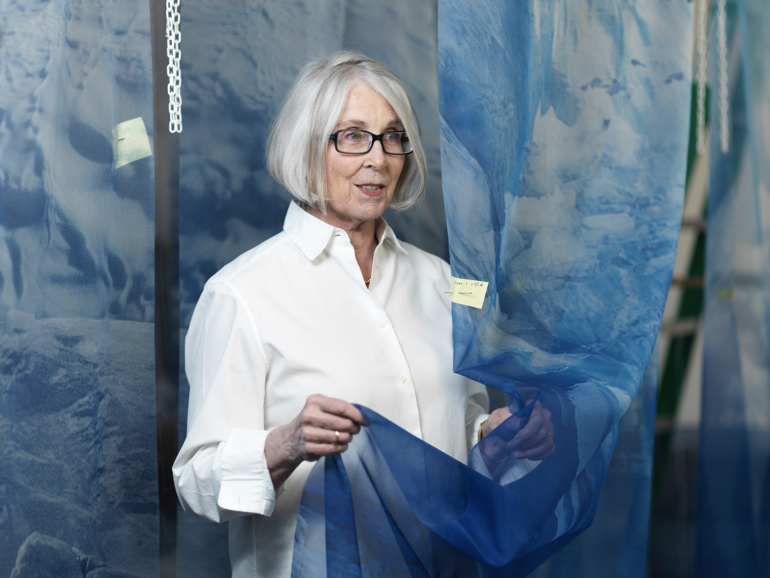
Your project i love you don’t leave me spans more than a decade of photographing glaciers in Antarctica and Greenland. How did your long-term relationship with these landscapes evolve emotionally and artistically over the years? And how did the landscapes evolve (or have been destroyed) through climate change?
My first journey to Antarctica began with curiosity and a little trepidation, as I expected several days of seasickness during the crossing of the Drake Passage. As we were on our way, I went on deck, wrapped my arms around a post, and began photographing the turbulent sea. Luckily, an experienced deckhand informed me that holding on was a fantasy and I would be flung overboard, which prompted me to retire to my bunk and spend the rest of the crossing eating saltines and sipping tea until we reached calmer water. I had no idea this was the beginning of a new and important part of my life.
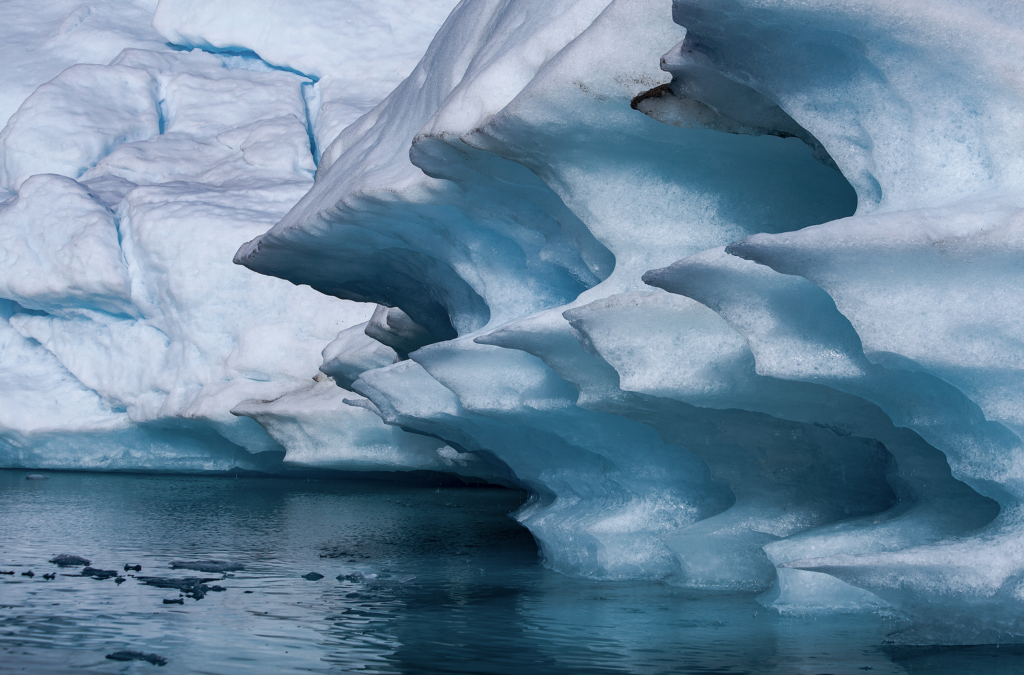
Since that first trip, over a decade ago at this point, my relationship with these landscapes has shifted from awe to intimacy, and, eventually, to grief. I continue to be enticed by glaciers’ mythic presence, and the work continually becomes more personal. Reflecting my feelings, it frequently focuses on small details and over time has become more fragmented and abstracted to express not just how they look, but how it feels to witness their fragility. The floating icebergs, the tumble of black moraine, the mass and fragments of blue are all evidence of the constant, ever increasing, unstoppable motion of the glaciers.
On my last trip to Antarctica, I was surprised by the sparse snow on the peninsula and the visible progression of small black cliffs. However, it is the science that documents our warming planet, and my experience is only anecdotal. It is my belief in science and its observations, measurements, and reporting that informs my continuing expression of their disappearance.
You’ve spoken about the overwhelming “vast unending whiteness” of Antarctica and the sense of both danger and sublime beauty. Can you share a moment from the field, perhaps in the inflatable boat, when you felt this duality most intensely?
There were two of us in an inflatable boat in a small Antarctic cove, surrounded by whiteness, sky, and water. The engine was cut, the ship was not in sight, our boat was motionless, and the stillness felt safe and comforting, even though its vastness emphasized our fragility. Then two humpback whales surfaced nearby, gently breaking the surface with powerful bodies moving with a grace that created only a ripple and was completely at odds with their powerful size. In this peaceful moment, I was part of this vast, ancient landscape. The glaciers, the humpback whale, myself, and you are all threatened by warming oceans.
Much of your work grapples with memory, loss, and the fragility of what we love. How did these themes guide your transition from photographing ice realistically to experimenting with abstraction, materiality, and installation?
You’re right that much of my work has been about attachment, impermanence, loving something while knowing it is disappearing, loving something that is no longer, and how we structure our reality.
In the series Reality is a Good Likeness, for instance, images are created by adding layers of information, much like how we construct our personal reality by gathering experiences to build a whole. The reverse of this is to examine the parts and deconstruct the reality. My photographs capture a single moment, and I treasure them because my imperfect, conflated memories would lose that definitive record.
In the Arctic regions, I take many photographs of small, beautiful details of moraine and tumbling, broken ice to document and remember the fragile beauty that exists in the formidable vastness. My camera has converted my chosen scene into digital signals so I have an accurate record, but to fully express the reality of thoughts and feelings, I must take it apart. The title of this series, I love you, don’t leave me, is a wish: the works are memories and predictions. The original photographs reflect what I saw and they can be what I want to keep forever, but what I want to say is, “I’m frightened, angry, and very sad,” and this is the future I see, so I’m distorting, defacing with coal and carbon, allowing time to destroy them, and causing them to drip into unrecognizable images from an imagined future.
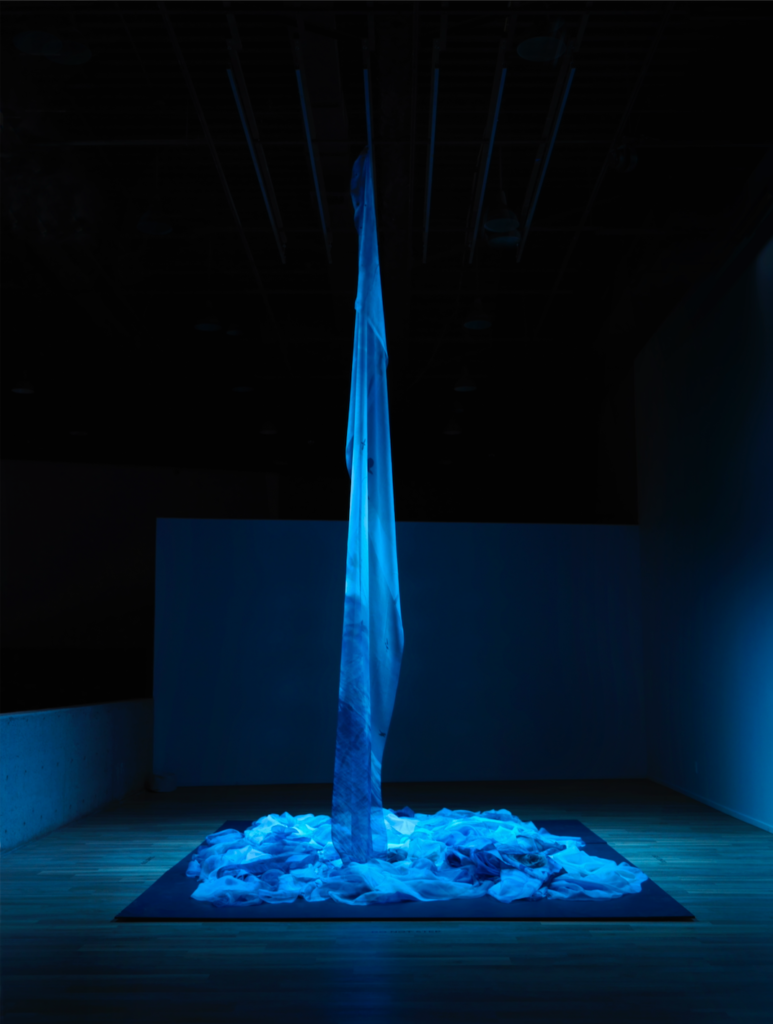
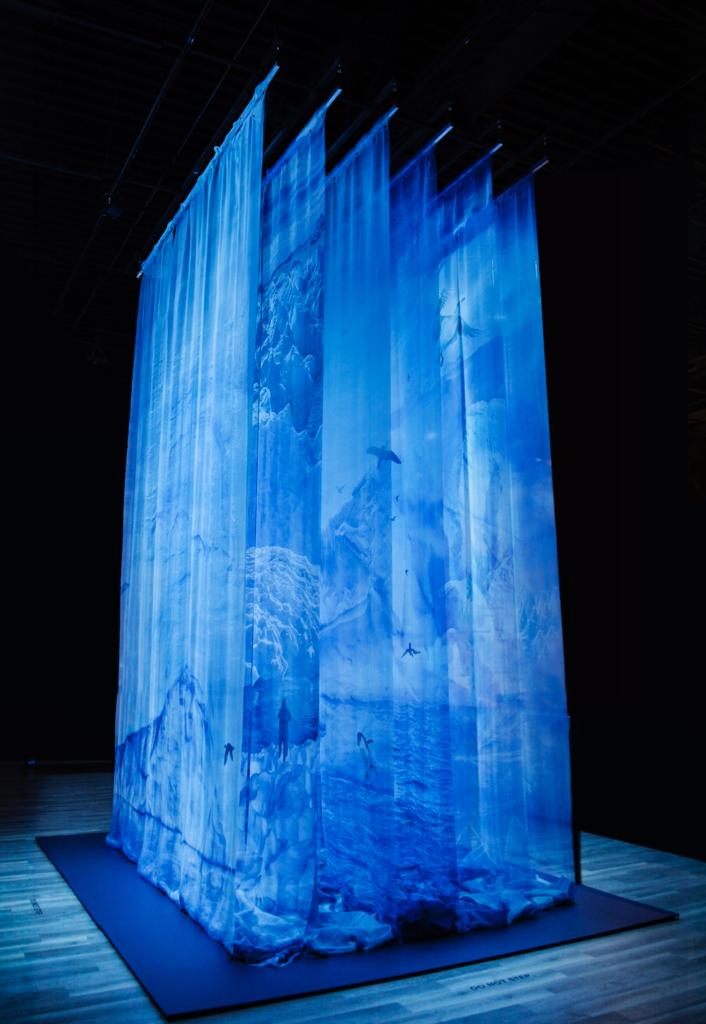
Installations are powerful because they involve the viewer physically, which prompts heightened awareness and emotional involvement. When viewing Blue Tears, one must walk around, look up seventeen-foot-tall veils, and peer between them to see arctic landscapes and wildlife. Looking up, glacier images rise to the ceiling, and below, veils have fallen into an expanding tumble. It is all disappearing, and the sound of the clock continues.
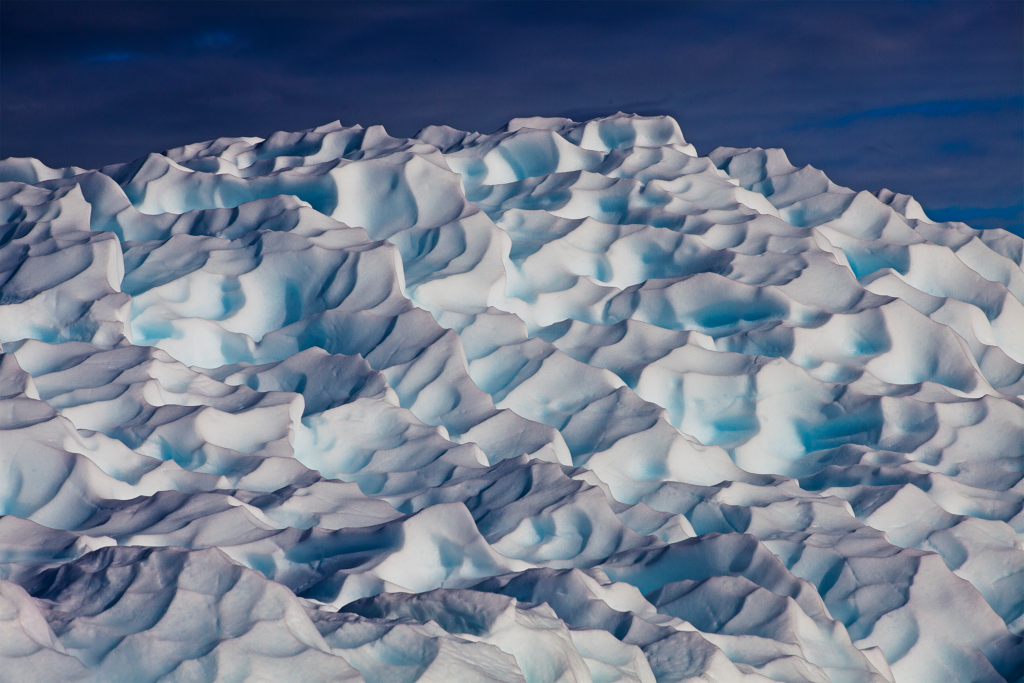
In this project, you focus not on monumental icebergs but on sculptural, fractured forms – microcosms of a much larger crisis. What did these intimate details reveal to you about the broader story of climate change and our relationship to the planet?
The intimate details are evidence of change. Every arrangement of moraine, icebergs, or the tumble of brash ice is because of movement and change in the glacier. The moraine has been scraped and collected from rock above and below, and the beautiful, deep blues are from the oldest, deepest ice of the glacier, which has been compressed for hundreds of years. “Intimate details” is the perfect description as these are the glaciers’ pathology report. They carry specimens of microorganisms and minerals from centuries past, gathered from destabilized glaciers, and are evidence of our systemic failure to alter the path of our warming atmosphere.
Viewing the vast expanse of the Arctic regions can lead us to see them as uninhabited and unrelated to us and our lives; these details are more personal and evoke a sense of vulnerability. Each small rupture is not only evidence of larger changes, but each fissure, eroded edge, or exposed rock is a clue to significant change. These are also the ways we encounter the climate crisis in our own lives…one small disruption and discomfort at a time.
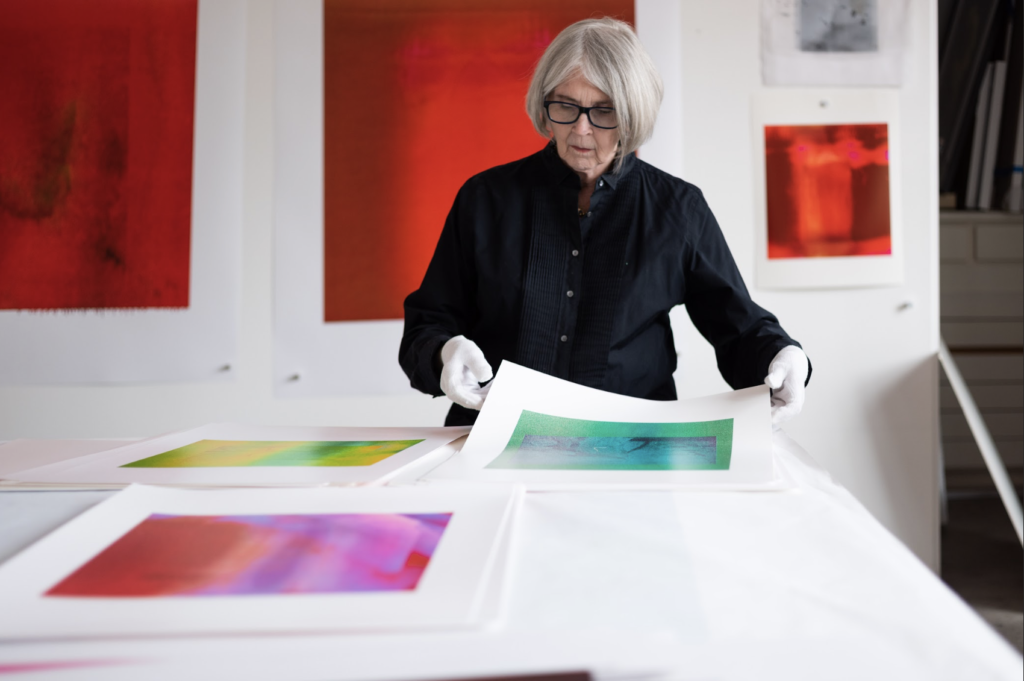
Your installation work encourages viewers to feel the impending loss rather than just observe it. What do you hope audiences understand, or even reckon with, when immersed in your vision of a world where glacier ice is disappearing?
I hope that when viewers encounter the two-dimensional works or step near the installation, they experience the loss of glaciers not as a distant environmental issue, but as something personal—an intimate world we share. The disappearance of glacier ice is often framed as remote, yet it directly affects our most fundamental needs for food and water. Blue Tears symbolizes impermanence, inviting viewers to feel their own physical presence within a fragile, interconnected system. The quiet ticking of the clock and the subtle movement of translucent glacier images on silk organza create a sense of proximity and vulnerability, building an emotional connection rather than mere observation. In a time when climate change is frequently explained with statistics and detached imagery, I seek to move beyond the intellectual and foster a deeply personal relationship with the planet—one that might ultimately translate into care, responsibility, and civic action.
Find more information about Patricia Carr Morgan here.