

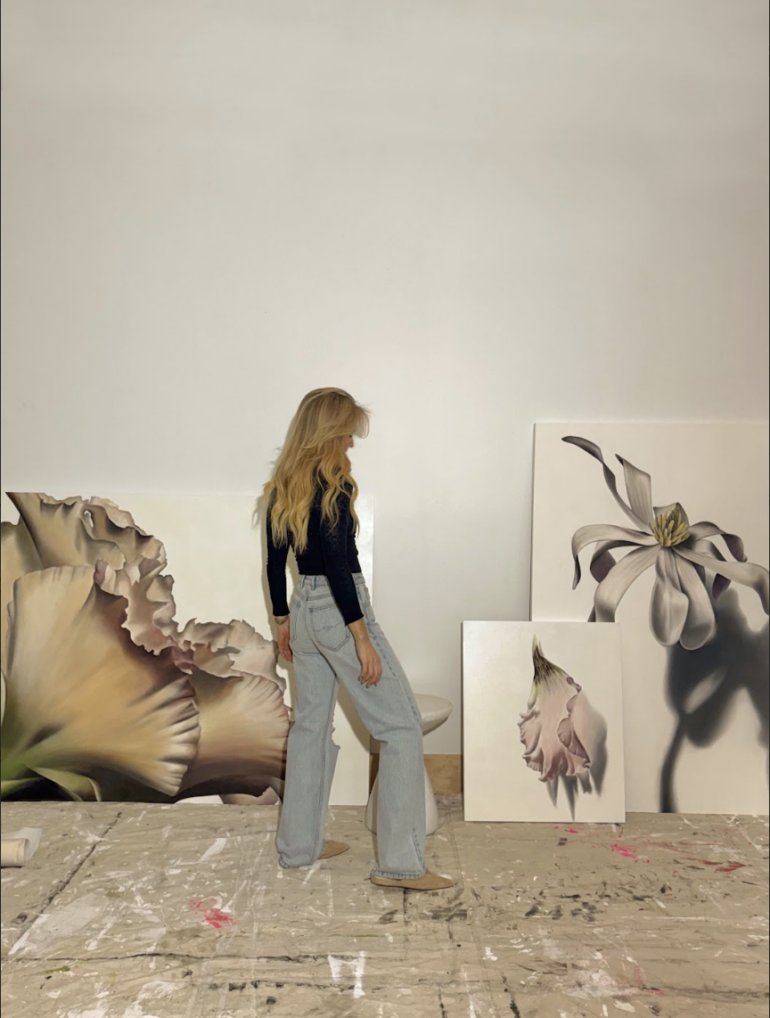
In conversation with Culturalee, contemporary painter Renée Levin discusses her distinctive photorealistic practice, which transforms overlooked natural objects into meditative, large-scale works of art. Drawing inspiration from organic forms, her Eastern European heritage and a lifelong appreciation for nature’s subtle details, Levin creates paintings that invite stillness, contemplation and emotional connection.
In this interview, Levin reflects on the difference between photorealism and hyperrealism, her meticulous creative process, and how light, scale and minimalism allow ordinary objects, from seashells to flower petals, to take on an almost sacred presence. Looking ahead, Levin also reveals her plans to move beyond realism and explore new possibilities through abstraction.
Do you view your work as hyperrealistic or photoreal? Does that change the nature of how someone might view your work?
I view my work as photorealistic rather than hyperrealistic. The paintings are grounded in observation and restraint, with an intentional focus on presence rather than exaggeration. Because the work is rendered realistically, there is very little stylistic distraction, which allows the subject matter itself to be honored and celebrated. I think this approach creates a quieter, more meditative experience. I want the viewer to spend time with the work—to sit with it, to become vulnerable and to allow personal feelings, memories, or triggers to surface. The goal is not simply to replicate reality, but to create a reflective space where the subject can carry emotional weight and resonance.
What are your inspirations? Are there particular artists, movements, or other experiences that have shaped your practice?
I am inspired by the beauty that surrounds us in the day to day, mundane objects and quiet moments that often go unnoticed yet hold immense captivating beauty. I’m drawn to nuances, patterns, imperfections, and textures: the small details that reveal the masterpieces created by Mother Nature herself. This connection to nature feels deeply grounding to me because it is something universal that connects us all.
My Eastern European upbringing and being raised by immigrant parents has also profoundly shaped both my life and practice. I was raised with a deep respect for nature, resourcefulness, and discipline, alongside a strong work ethic that continues to inform the way I approach painting. Those values influence not only the subject matter I’m drawn to, but also the patience, observation, and care that realism demands.
I think my work exists somewhere between still life and minimalism, though it doesn’t fully belong to either. I’m drawn to the quiet attention that still life demands, closely observing ordinary objects while being less interested in symbolism and more focused on how color, space, texture, and form can carry emotional weight. Minimalism influences the way I simplify and reduce visual information, but the objects themselves remain important, acting as points of entry and connection. Ultimately, the work is less about narrative and more about creating a space for contemplation and emotional resonance.
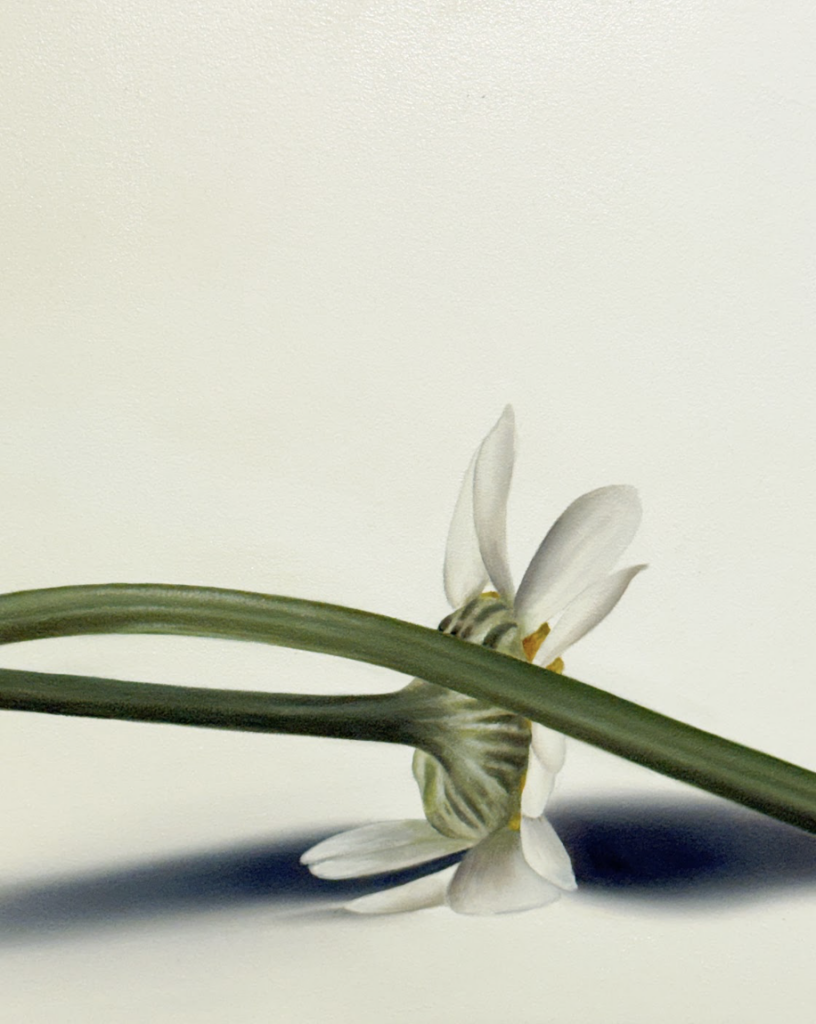
Can you walk us through your process from start to finish? Do you begin with sketches, studies, or is the painting itself where most of the exploration happens?
Most of the exploration happens before the brush ever touches the surface. It begins with mental exploration and sketching, which lead to a careful selection of subject matter. Over the years, I’ve built vast collections of objects and images that have inspired me, and I return to this personal library often, discovering something new each time depending on my state of mind. The object I choose must bring me joy, whether through its pattern, an imperfection, its form, or the way it takes up space. I then photograph the object with a light source to cast dramatic shadows and create strong compositions. I am careful in how I arrange the object(s), noting the negative space and movement created within the frame. This is often a meticulous and time-intensive process adjusting the object and light until I arrive at a place that seems balanced. Once resolved, I sketch this composition on wood panel and use the physical object as a reference while painting.
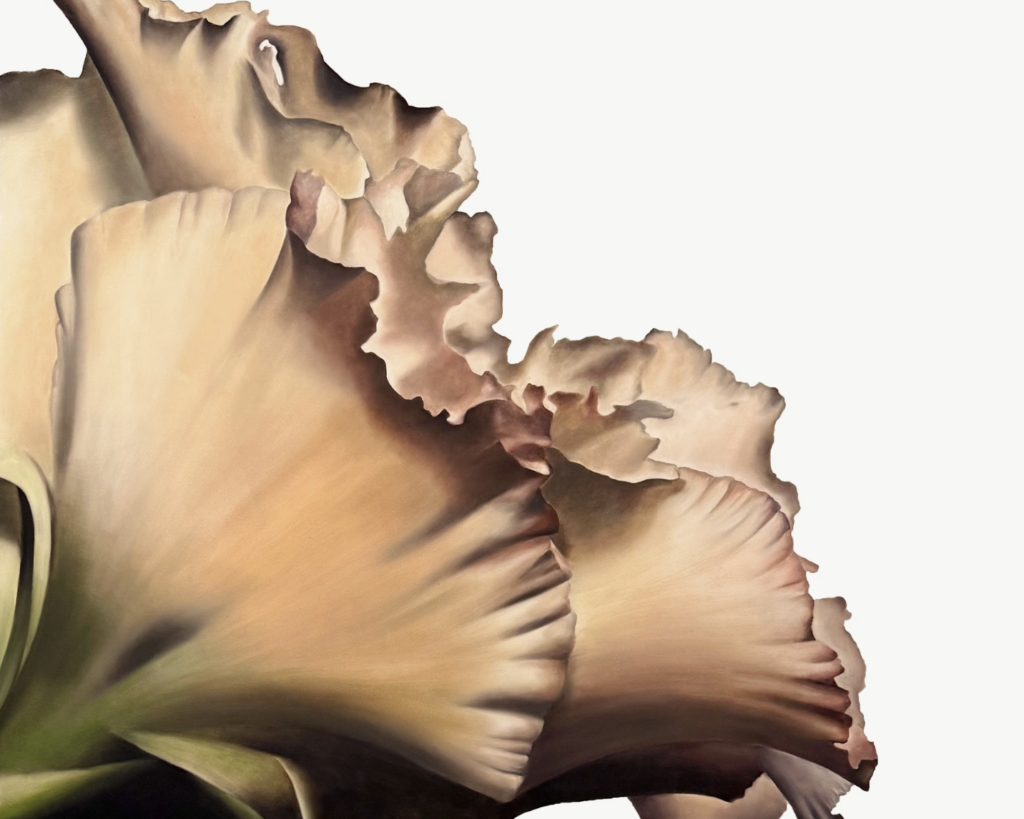
Your paintings focus on organic materials and found objects, often isolating them against minimal backgrounds. What draws you to these kinds of subjects, and how do you go about selecting them?
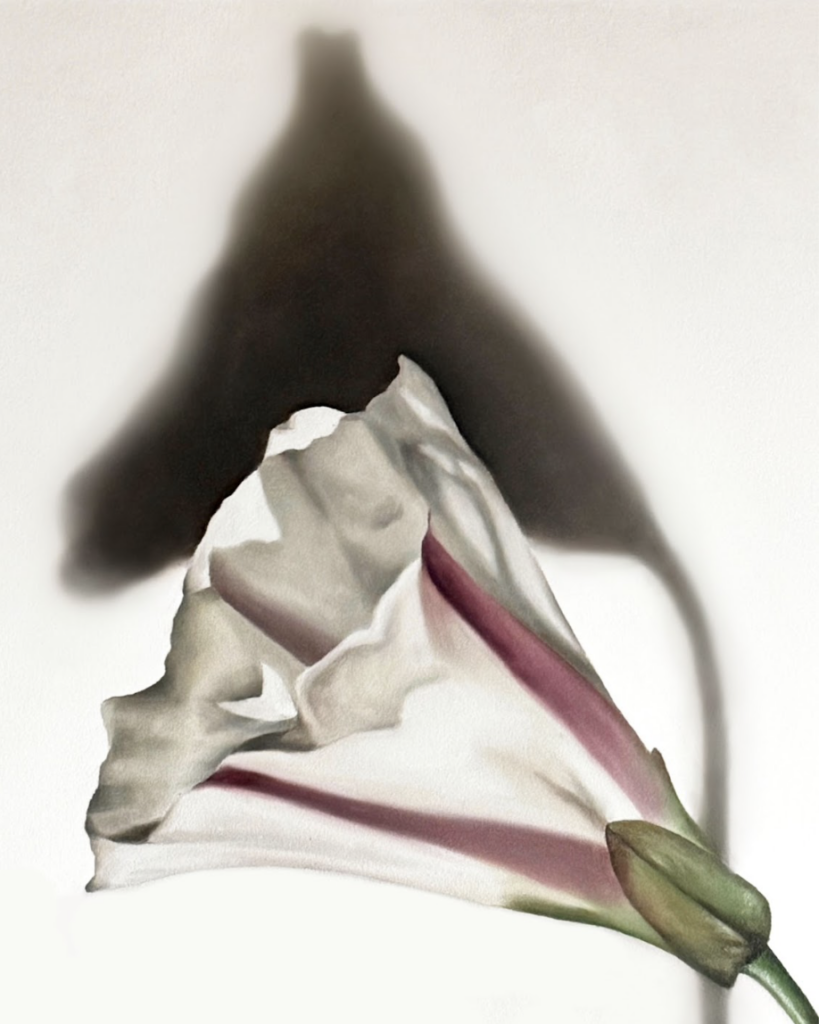
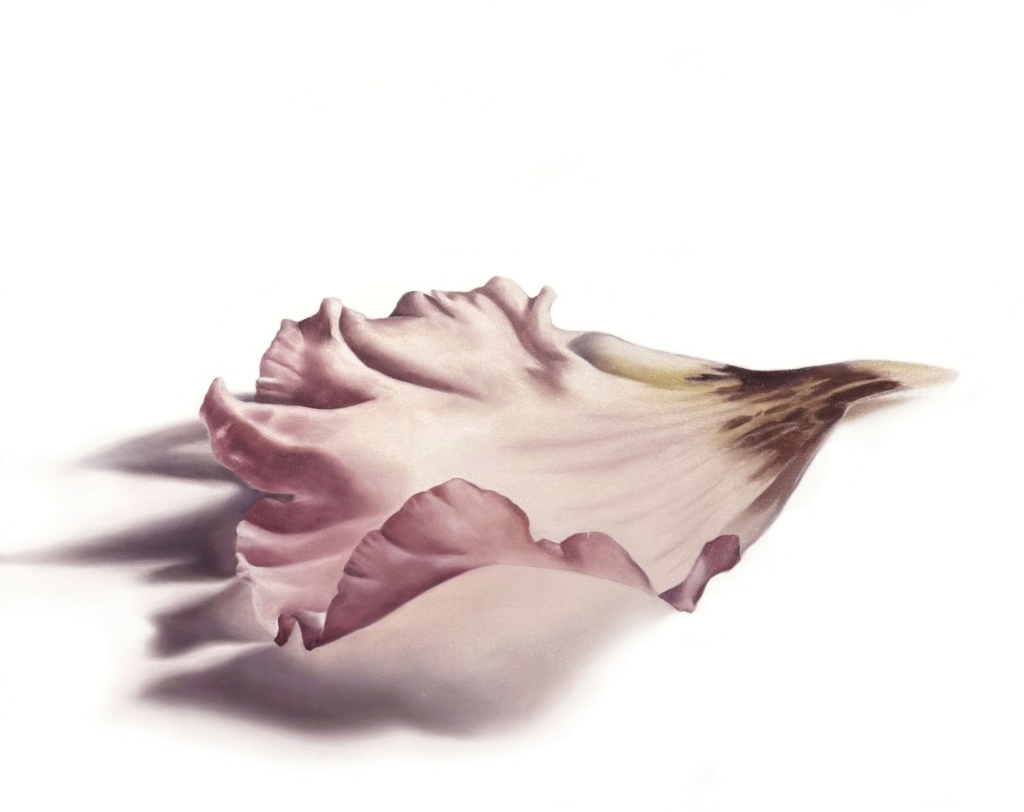
I’m drawn to organic materials and found objects because of the quiet beauty they hold—their textures, imperfections, patterns, and the way they naturally occupy space. The selection process is deeply intuitive; the object has to spark curiosity or create an emotional response that makes me want to spend time with it through painting. Stylistically, I balance these organic, textured forms against minimal, crisp, and consistent backgrounds, creating a tension between opposites. Whether it’s the fragility of a wilted flower petal, the reflective surface of a pearl, or the layered textures of a seashell, I’m interested in the dialogue between softness and structure, imperfection and control. That conversation between opposing elements becomes a way of finding balance within the work.
Your use of color is often restrained, allowing form and contrast to take center stage. How do you think about color when you begin a painting?
Keeping my pallet neutral keeps the focus on stillness, allowing my subjects to be painted with quiet intensity. It is deliberate in hopes of evoking emotions. Rather than using bold color, I substitute with scale, contrasts, exaggerated shadows, and the use of negative space. I focus on lines and curves and carefully composed compositions. These techniques balance the minimal color, creating calmness, keeping the work tender and sacred even on such a large scale. Perhaps it’s what I’m seeking, and that ultimately is beautiful to me.
Scale plays an important role in your compositions, particularly in the way everyday objects are enlarged and recontextualized. What does working at a larger scale allow you to explore?
Working at a larger scale allows the work to envelop the viewer. In a world that often feels increasingly disconnected from emotional presence, I hope my work offers a moment for vulnerability and slowness, and an opportunity to engage with something internal and honest. The scale also explores the sense of reverence toward the natural world, inviting reflection on ideas of creation, divinity, and the almost sacred quality found in organic forms, a true marvel. I want the work to encourage a quiet questioning of what we consider natural, intentional, or beyond us.
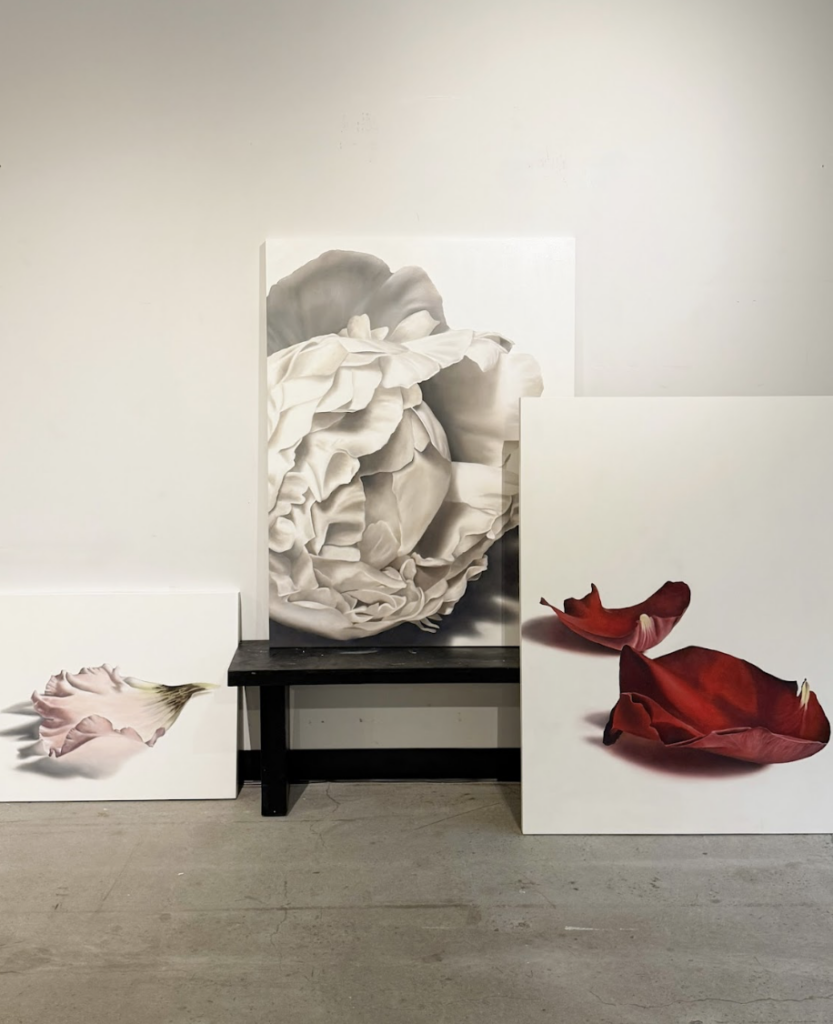
Your work often contrasts things like soft and hard or organic and manmade. What do you hope to communicate through these kinds of oppositions?
I think balance is only achieved through opposition. I seek this unintentionally in many outlets of my life, whether it is my personal style, my home, wellness rituals, lifestyle choices, which then continues into my practice – the way I compose my work and choose subject matter. I seek tensions: the softness of organic forms set against structured or minimal backgrounds, or the unexpected imperfection within something otherwise beautiful, like a smooth shell interrupted by a hole, or the quiet collapse of a flower’s drooping form. These details shift perception and ask the viewer to sit with both fragility and strength at once. I am not looking to resolve these oppositions but hold them in balance. This coexistence is a vehicle for grounding.
Are there any tools or techniques that have become essential to your work over time?
Over time, a few approaches have become essential to my practice. Light plays a dual role for me as both a literal and perceptual element. I study how light reveals form, texture, and atmosphere within objects while also using physical lighting to create mood and guide attention during the photographic and compositional stages. Deep examination of objects is also central to my process. I spend time closely studying their surfaces, flaws, and spatial presence, allowing those details to inform how I eventually translate them onto the canvas.
Equally important is the way I approach compositions, creating arrangements that feel dynamic yet calm, that allow space and create flow. Often this involves reduction, removing anything unnecessary so that what remains feels intentional and quiet. For me, that quietness becomes its own kind of presence.
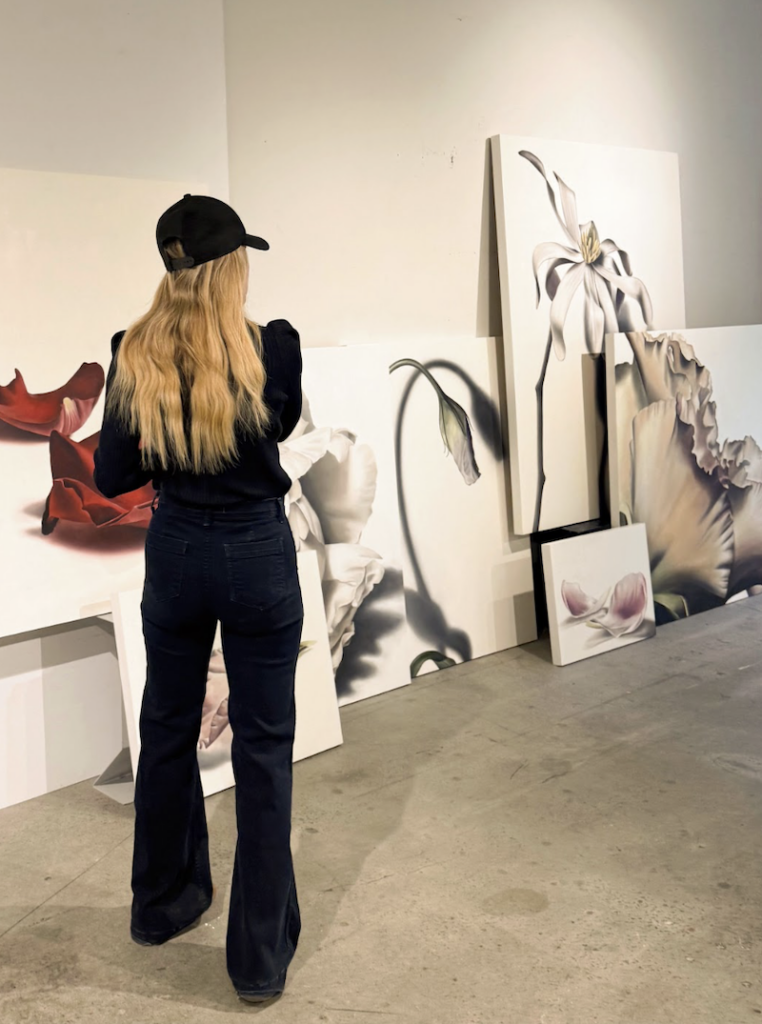
I am looking to further explore form, space, movement and light but through a more abstracted lens. I feel a constant need to challenge myself and this feels like a natural next step, a new chapter in my practice. I intend to take everything I have studied from my practice thus far painting realistically and translate this into abstraction, a new language. Something larger is unfolding and I’m excited to see where it leads.”
Renée Levin
Find out more about Renée Levin here.