


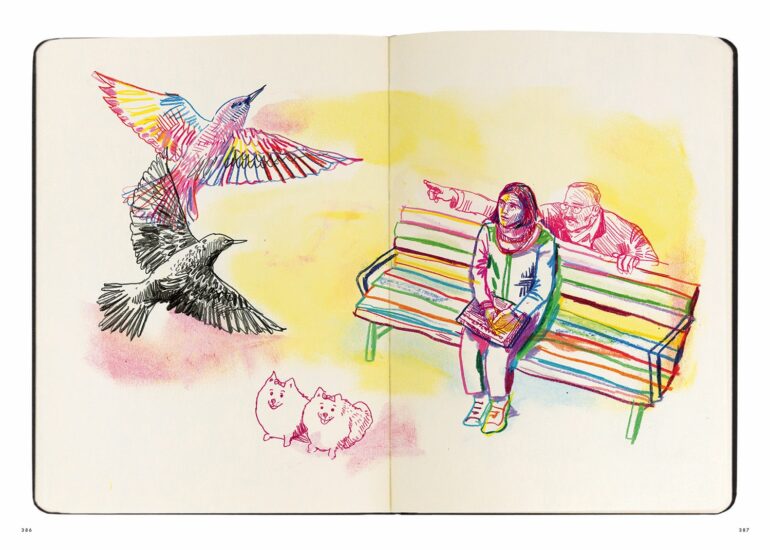
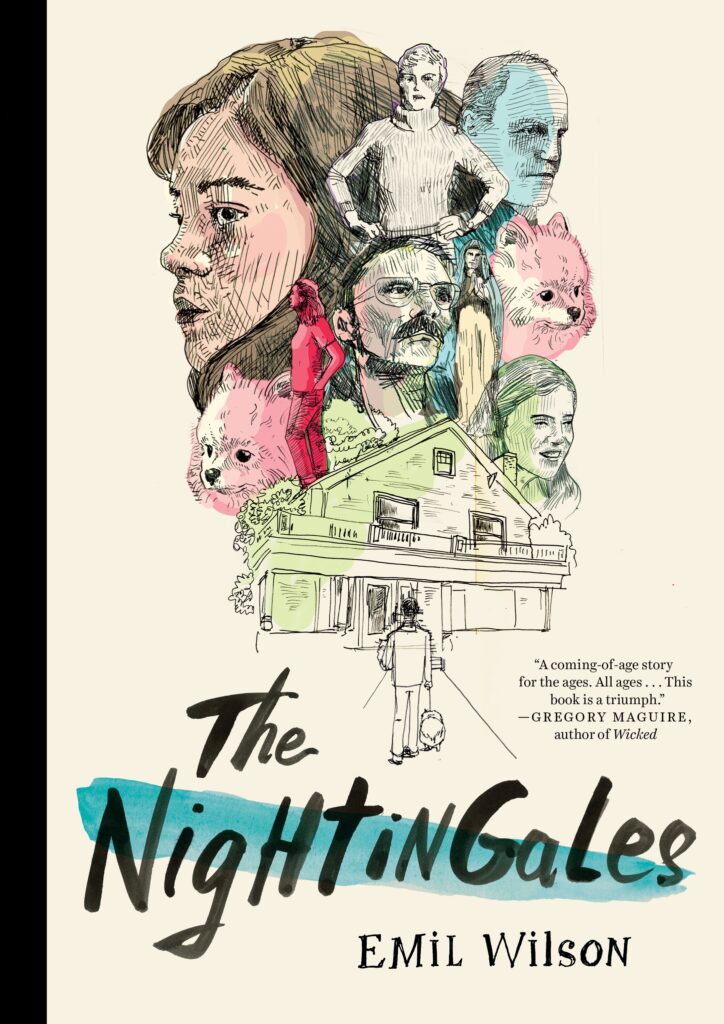
Emil Wilson’s The Nightingales is a beautifully drawn graphic novel about an unlikely friendship between a teenage girl and a dying stranger, exploring family, mortality, compassion and the courage to imagine a life beyond the familiar.
Set in small-town Oregon in the spring of 1985, The Nightingales begins with an unsettling disruption to family life. Seventeen-year-old Lou Miller is approaching the end of high school when her father, Donald, invites his coworker Jim to move into the family home. Jim arrives with his two dogs, Henny and Penny, apparently because he has been evicted and fallen on difficult times.
But there is considerably more to Jim’s circumstances than Lou and her mother, Annemarie, initially understand. His arrival changes the atmosphere of the household. For Annemarie, having a stranger suddenly become part of the family home brings fear, resentment and uncertainty. For Lou, however, Jim’s presence opens up an unexpected relationship that gradually becomes the emotional centre of the story. What begins as an uncomfortable intrusion develops into an extraordinary friendship.
A Friendship Across Generations
At the heart of The Nightingales is the relationship between Lou and Jim. Their friendship crosses an obvious generational divide, yet Wilson avoids making it sentimental or simplistic. Lou is at an important threshold in her own life. With graduation approaching, she is beginning to contemplate what might exist beyond her hometown. Jim, meanwhile, is confronting the limits of his own future.
Their circumstances are radically different, but their connection gives both characters something they need. For Jim, Lou’s friendship offers companionship during the most difficult period of his life. For Lou, knowing Jim encourages her to look beyond the expectations and limitations of her immediate surroundings.
It is this reciprocity that gives the novel much of its emotional power. Neither character simply ‘saves’ the other. Instead, their encounter changes the way each sees the possibilities of life.
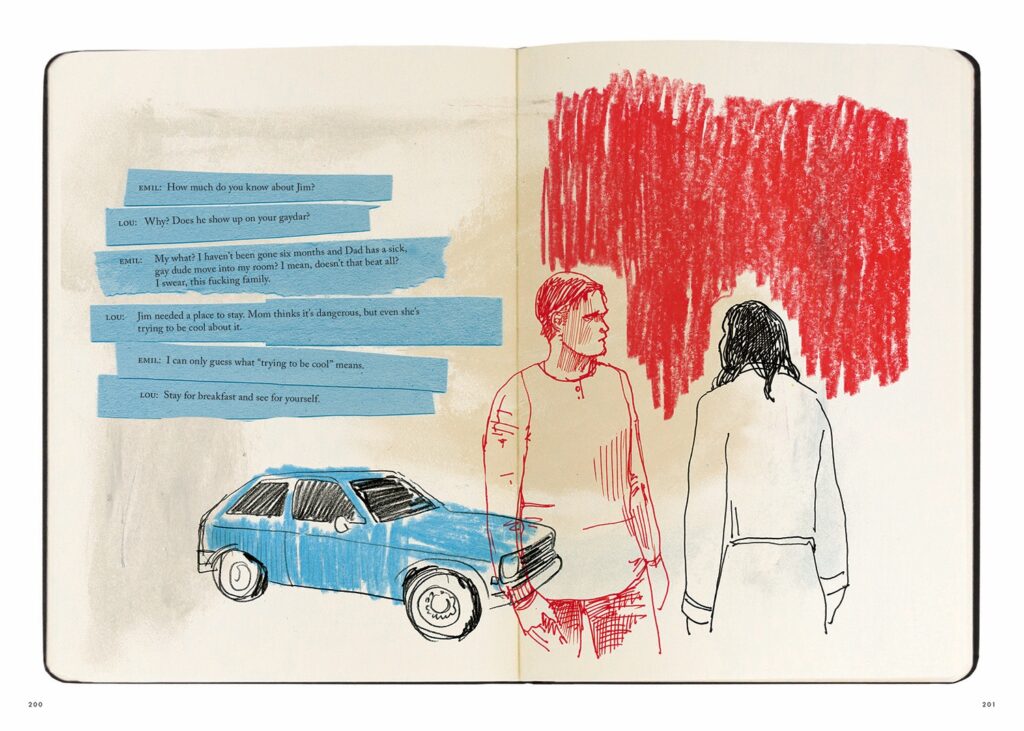
Wilson’s visual language is one of the most distinctive elements of The Nightingales. Rather than relying on a highly polished or digitally uniform graphic style, the book embraces the feeling of an artist’s sketchbook. Almost every page contains multiple drawings, with imagery created using a range of media including watercolour and charcoal. The result is intimate and tactile.
There is a sense that we are looking directly into Wilson’s visual memory rather than simply following a conventional sequence of comic-book panels. The looseness of the drawings allows emotion to emerge through gesture, expression, atmosphere and detail.
That approach is particularly effective for a story concerned with memory and personal experience. The imperfections of the marks on the page become part of the narrative language, reinforcing the humanity of the characters.
The dogs, Henny and Penny, also become important presences within the visual world of the book, providing moments of warmth and companionship amid the more difficult circumstances of the story.
An Imperfect Family
Although Lou and Jim’s relationship is central, The Nightingales is also a portrait of a family confronted with circumstances it cannot easily control.
Donald makes the decision to invite Jim into the home, but the consequences of that decision are experienced by everyone. Annemarie’s growing resentment is particularly important because it prevents the story from becoming an uncomplicated celebration of altruism.
Wilson allows space for conflicting emotions: generosity can coexist with frustration; compassion can exist alongside fear; and helping someone can place unexpected pressures on those doing the helping. That complexity makes the Miller family feel convincingly human.
The novel’s emotional impact comes not from presenting its characters as perfect people responding perfectly to extraordinary circumstances, but from showing how difficult it can be to navigate another person’s vulnerability when it enters your own life.
The personal dimension of The Nightingales is heightened by the fact that the story is inspired by true events from Wilson’s own life. That autobiographical foundation gives the novel an additional sense of intimacy. Rather than treating its themes of illness, friendship and mortality as abstract ideas, Wilson approaches them through the small details of domestic life and human connection.
The story ultimately becomes less about death than about what people can give one another while they are alive. It is also a coming-of-age story. Lou’s friendship with Jim gradually gives her the confidence to consider a larger life beyond her hometown, suggesting that growing up is not simply about leaving somewhere behind. Sometimes it is about encountering people and experiences that make you see the world differently.
A Quietly Powerful Debut
The Nightingales is an impressive debut because of the confidence with which Emil Wilson brings together literary storytelling and visual art. Its emotional register is quiet rather than melodramatic, and its greatest strengths lie in observation: the atmosphere of a family home, the uncertainty surrounding a stranger, the companionship of animals, and the gradual formation of a friendship that neither Lou nor Jim could have anticipated.
There is also something particularly resonant about its central idea. We rarely know in advance which encounters will alter the course of our lives. Sometimes the people who enter our worlds unexpectedly become the people who teach us the most about ourselves.
Wilson’s graphic novel is ultimately a story about that kind of encounter, and about meeting the unknown with curiosity rather than fear. Tender, visually distinctive and deeply human, The Nightingales is a moving exploration of friendship, loss and growing up, and an accomplished first book from an artist with a distinctive visual and literary voice.
The Nightingales is an impressive debut because of the confidence with which Emil Wilson brings together literary storytelling and visual art. Its emotional register is quiet rather than melodramatic, and its greatest strengths lie in observation: the atmosphere of a family home, the uncertainty surrounding a stranger, the companionship of animals, and the gradual formation of a friendship that neither Lou nor Jim could have anticipated.” Lee Sharrock, Culturalee Editor
About Emil Wilson
Emil Wilson is an award-winning art director, illustrator and artist whose work has appeared in magazines and newspapers, as well as on NPR, the Oscars and during the Super Bowl. A graduate of The Center for Cartoon Studies, he is based in San Francisco. The Nightingales is his first book.
The Nightingales by Emil Wilson
Avid Reader Press / Simon & Schuster
Hardcover | 416 pages
Published 4 August 2026
ISBN: 9781668217771
$38.00
Also available as an e-book