

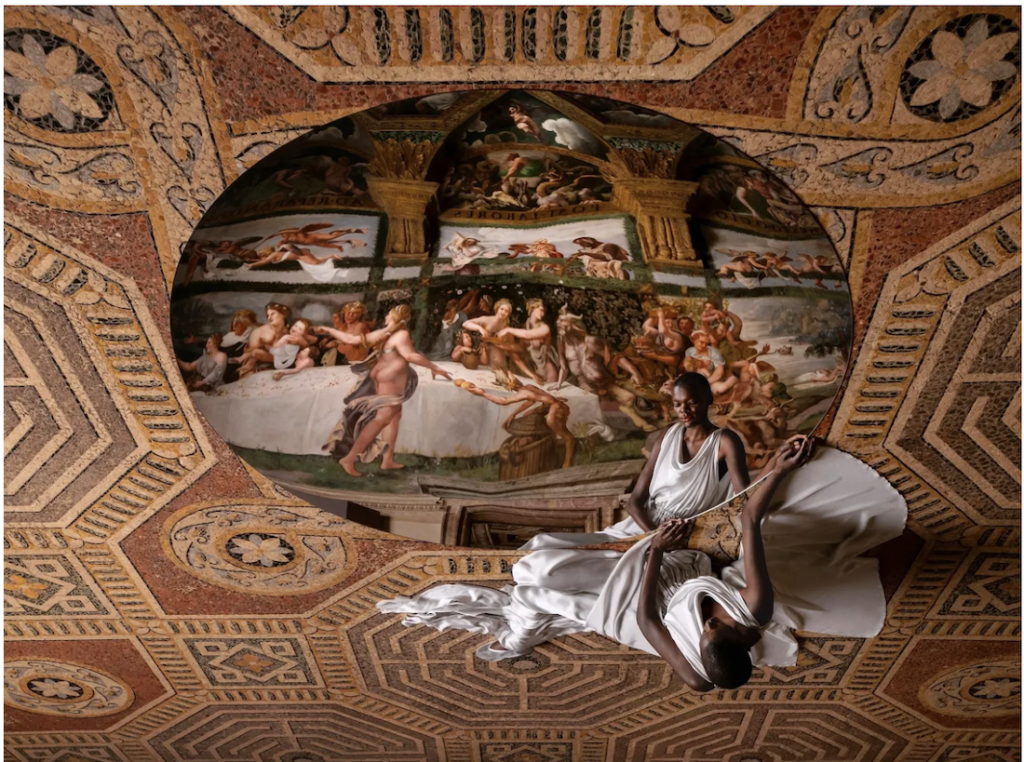
Sir Isaac Julien’s breathtaking film installation commissioned in celebration of the 500th anniversary of Palazzo Te in Mantua in 2025, bridges Renaissance myth with contemporary visions of ecology, identity, and technology. Giulio Romano’s architectural masterpiece provided a rich tapestry of inspiration for Julien’s cinematic symphony All That Changes You. Metamorphosis fuses, which transformed the storied “Abode of the Gods” into a futuristic temple of metamorphosis. Sir Isaac Julien directed a veritable cinematic wonder, fusing Greek mythology with science fiction and environmentalism.
Mantua itself, sometimes described as a “mini-Florence,” is a city steeped in architectural and artistic splendour. The Basilica of Sant’Andrea houses a relic of the blood of Christ, and within its sister church lie exquisite frescoes by Giulio Romano, Raphael’s most gifted assistant and collaborator, who became one of the great masters of Mannerism. Romano’s artistic relationship with Federico II Gonzaga, Duke of Mantua, resulted in one of the most extraordinary architectural achievements of the sixteenth century: Palazzo Te, known in its time as “the Abode of the Gods.”
Following its critically acclaimed world premiere in Mantua, All That Changes You. Metamorphosis arrives in London where it can be viewed at Victoria Miro gallery until 21st March, 2026.
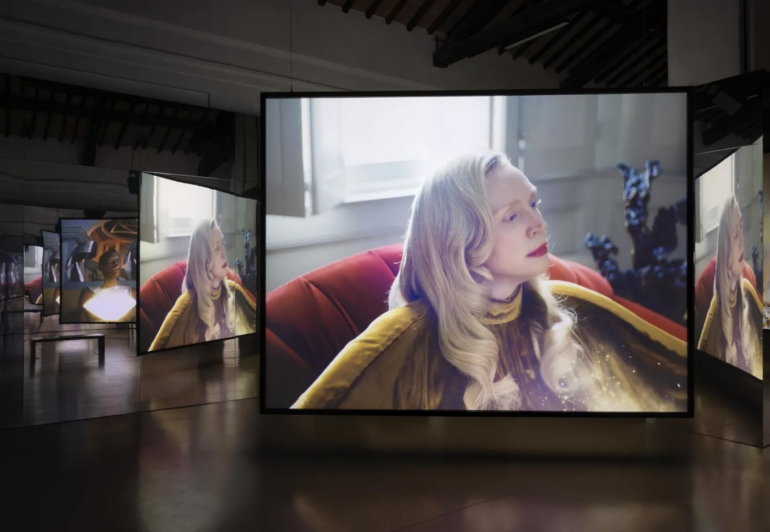
The ten-screen film installation constructs an oppositional and self-sustaining repertoire of images generating its own poetics. By reconfiguring the presentation through an architectural choreography, the language of images disrupts the narrative telos that shapes perception. The film offers an alternative visual grammar reclaiming nature’s agency where memory, poetry, and imagination converge in an act of resistance against the planetary destruction by visually reconfiguring the present and future, creating what Judith Butler calls the counter-imaginary.”
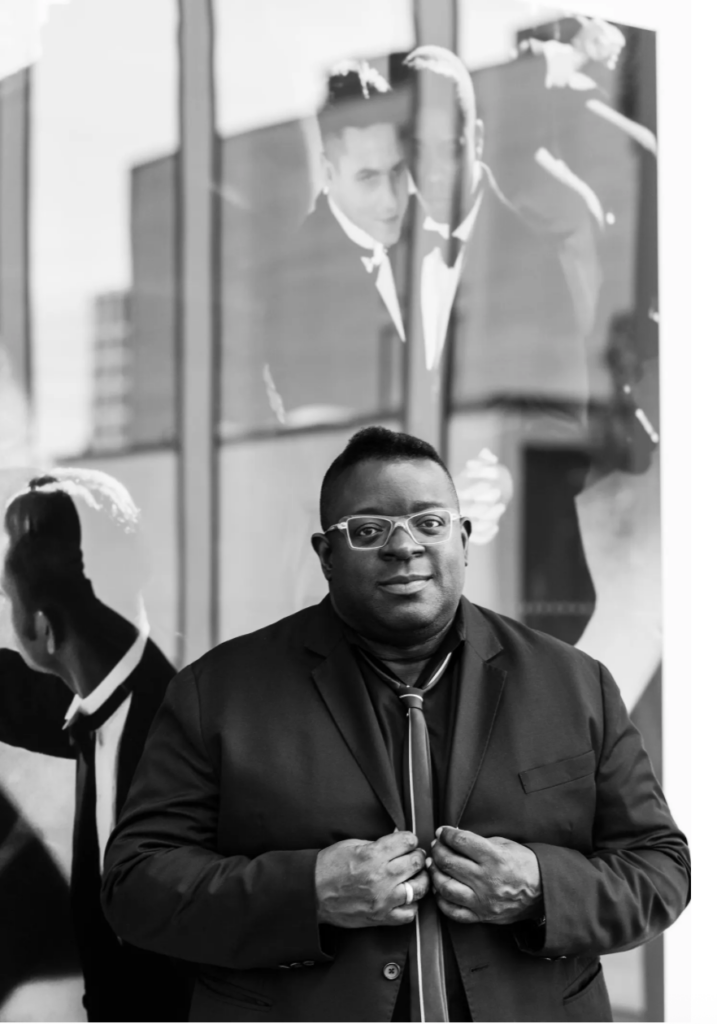
Sir Isaac Julien
A Renaissance Dreamscape
Built between 1525 and 1535, Palazzo Te was conceived as both an earthly pleasure villa and a mythological cosmos. Vasari’s Lives of the Artists recounts how Gonzaga and Romano collaborated to create a space that could rival the classical villas of ancient Rome. The palace’s vast square courtyard, framed by ashlar walls and Doric semi-columns, opens onto loggias and gardens that once stretched across the now-drained lake of Mantua. Inside, every surface bears Romano’s hand–stuccoes, ceilings, fireplaces, floors–and above all, the frescoes that make the palace a true gesamtkunstwerk of the Renaissance imagination.
Ovid’s Metamorphoses provided the narrative spine for these fresco cycles, which depict mythological transformations from the loves of Venus and Mars and Bacchus and Ariadne, to the apocalyptic “Room of the Giants,” where Olympian deities tumble from their thrones amid collapsing architecture in an incredible three-dimensional fresco. The effect remains overwhelming: a theatre of creation and destruction, a vision of divine chaos rendered in pigment and plaster.
Enter Sir Isaac Julien
To create a new work within this storied environment is an audacious undertaking. Yet Sir Isaac Julien, one of Britain’s most celebrated moving-image artists, has never shied from dialogue with history. Known for his expansive multi-screen installations, including Ten Thousand Waves (2010) and Lessons of the Hour (2019), Julien fuses cinema, sculpture, and architecture into immersive poetic environments.
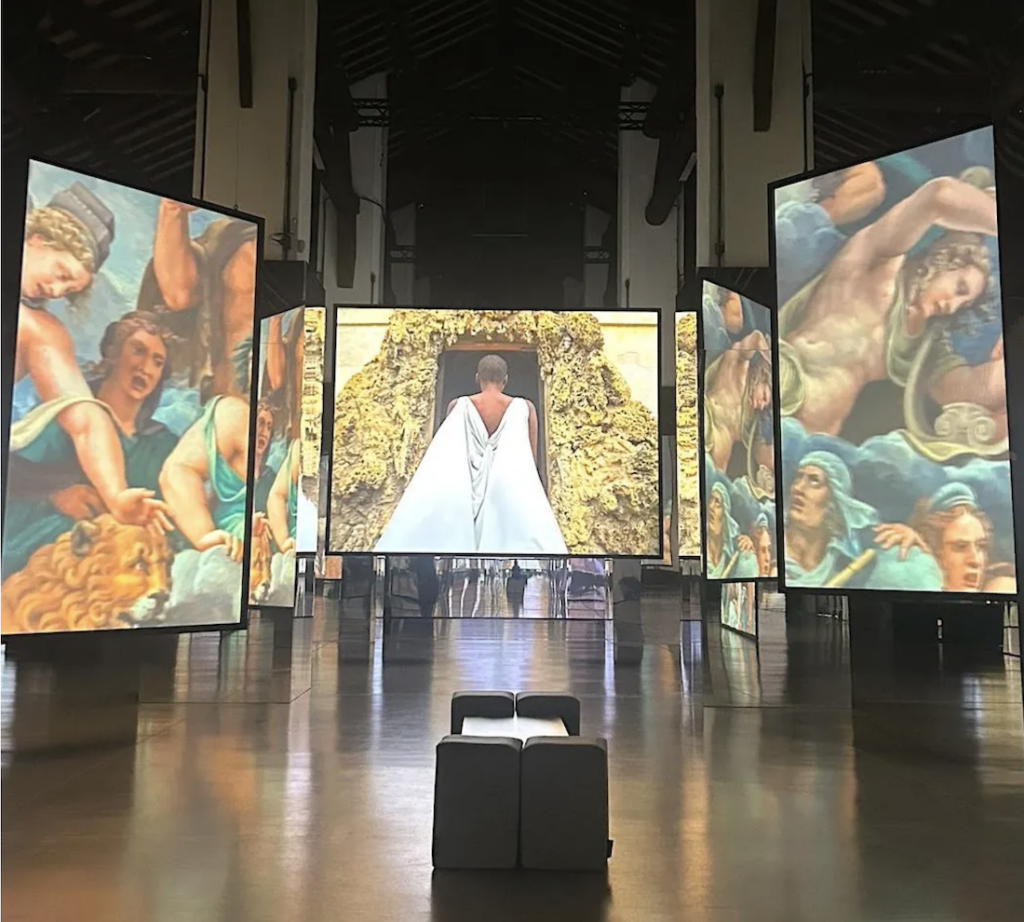
With All That Changes You. Metamorphosis, Julien takes Romano’s frescoes and Ovid’s text as starting points, weaving them into a meditation on myth, ecology, and technology. The result is an ambitious ten-screen installation that stretches across the newly renovated Fruttiere galleries of Palazzo Te, with the screens multiplied through a series of mirrors.
Produced by Palazzo Te in collaboration with the Rosenkranz Foundation, the Linda Pace Foundation, and others, the project is curated by Lorenzo Giusti and supported by a host of Italian cultural institutions. The exhibition was born out of a dialogue between Palazzo Te director Stefano Baia Curioni, Lorenzo Giusti, Isaac Julien and Mark Nash.
Julien’s ambition here is as intellectual as it is visual: to subvert the visual hegemony that dominates the technological regimes of representation. Working with long-time collaborator Mark Nash, he constructs a cinematic architecture that is both homage and critique–a reinterpretation of the classical notion of metamorphosis through the lens of contemporary crises.
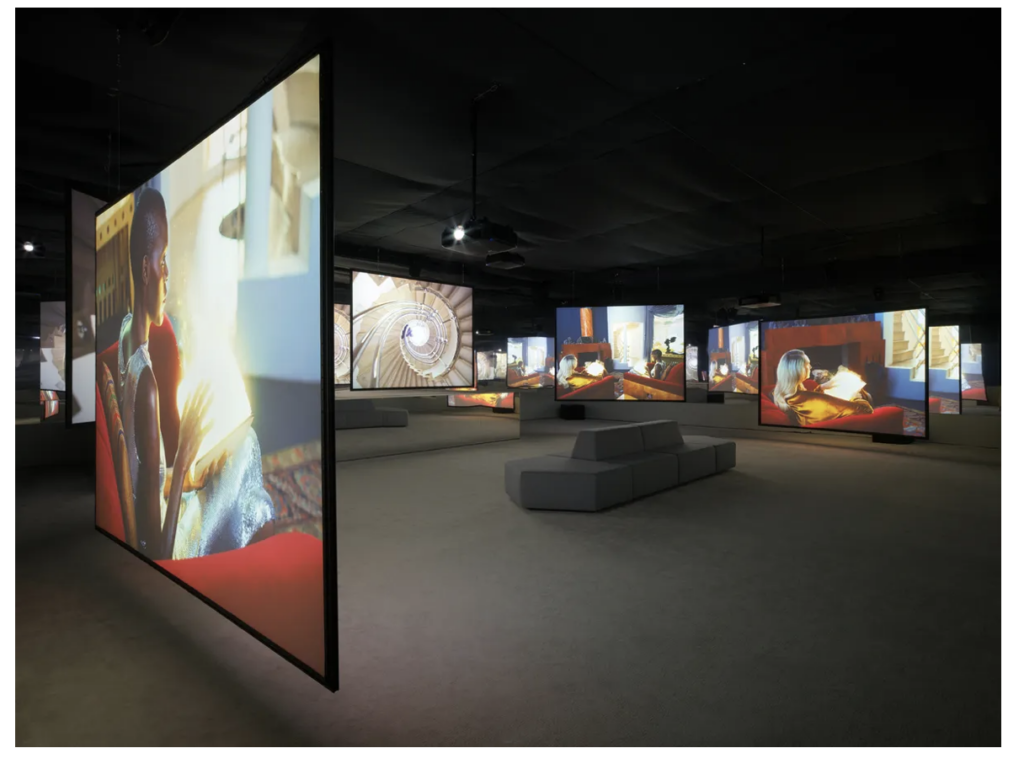
Why choose Isaac Julien for Palazzo Te? The answer seems simple: one of the world’s most acclaimed artists decided to draw inspiration from the architecture and frescoes of one of the masterpieces of late Italian Renaissance. An honour for the palazzo and the Fondazione that manages it, and a significant challenge for the artist. In actual fact, the idea to commission Sir Isaac Julien was not based on reasons of comparison or preconception. Rather, it emerged quite naturally, as a consequence, or even better, as a convergence of conditions and opportunities.”
Palazzo Te director Stefano Baia Curioni
Time Travellers and Deities
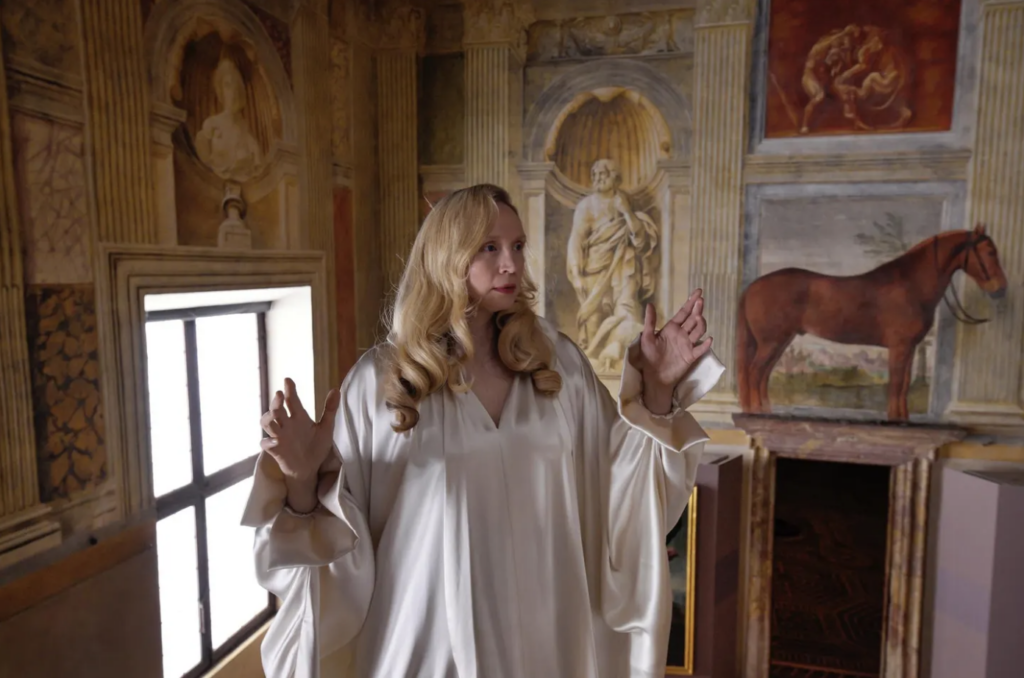
The film stars Gwendoline Christie and Sheila Atim as two goddesses who traverse eras, architectures, and identities. Their journey takes them from the frescoed halls of Palazzo Te to Charles Jencks’s postmodernist Cosmic House in London, to a futuristic glass “spaceship” designed by Richard Found in the English countryside, and even to the Herzog & de Meuron pavilion created for the Kramlich Collection of media art. Each location functions not merely as backdrop but as a sentient character, its architecture embodying distinct temporalities–Renaissance, postmodern, and speculative future.
As the protagonists move between these realms, their metamorphoses reflect shifting understandings of being and belonging. Atim’s character, inspired by Octavia E. Butler’s Parable of the Sower (1993), inhabits a post-apocalyptic landscape scarred by climate collapse and social inequality. Christie’s goddess recalls Naomi Mitchison’s Memoirs of a Spacewoman (1962), a scientist and traveller who communicates across species and planets. Threaded throughout are echoes of philosopher Donna Haraway’s Staying with the Trouble (2016), which urges kinship with nonhuman life forms and resistance to apocalyptic fatalism.
Together these figures form a polyphonic chorus–part myth, part manifesto. They speak across centuries about the possibility of co-existence in a damaged world, their dialogue shifting between poetry, philosophy, and lament.
The Poetics of image
Visually, All That Changes You is pure Julien: visually lavish, choreographed, operatic and theatrical. The ten-screen format allows him to fragment and recombine space, creating a kind of architectural counterpoint to Romano’s fresco cycles. Images bleed across frames, frescoed ceilings dissolve into burning Californian forests, marble columns morph into glass and steel, human bodies appear mirrored by geological forms.
Julien’s editing defies conventional narrative. Instead of linear progression, the installation offers what he calls a “grammar of metamorphosis”–a syntax of transformation, memory, and resistance. Time folds in on itself, as mythic past and speculative future converge.
The effect is immersive and disorienting, recalling the experience of standing in Romano’s “Room of the Giants,” where the viewer feels dwarfed by a world on the brink of collapse. Julien achieves a similar vertigo through moving images, inviting the audience to inhabit a shifting field of perception where human and nonhuman perspectives coexist.
Ovid for the Anthropocene
Ovid’s Metamorphoses chronicled a world of perpetual transformation, where Gods, humans, and nature are bound by shared mutability. Julien updates this idea for the Anthropocene, an era defined by ecological upheaval and technological domination. The classical myths of hubris and punishment take on new urgency when reframed through footage of the devastating wildfires in California, their orange glow mirrored against frescoed infernos in Mantua.
Here, metamorphosis is not merely a poetic trope but an existential condition. The deities’ shifting forms become metaphors for adaptation, resilience, and the necessity of change. Julien’s film refuses the apocalyptic finality that dominates much climate discourse; instead, it gestures toward regeneration and interconnectedness. “All That Changes You. Metamorphosis” is Julien’s clarion call to conscience–a resonant appeal for humanity to learn from its past, protect the planet, and end its wars against one another before it’s too late.
As Gwendoline Christie’s character in the film prophetically warns: “We can stop denying reality or hoping it will go away by magic. When the power of stability disintegrates, as it must. People give into fear and depression. To need and greed. When no influence is strong enough to unify people, they divide, they struggle. One against one. Group against group. For survival, position, power.”
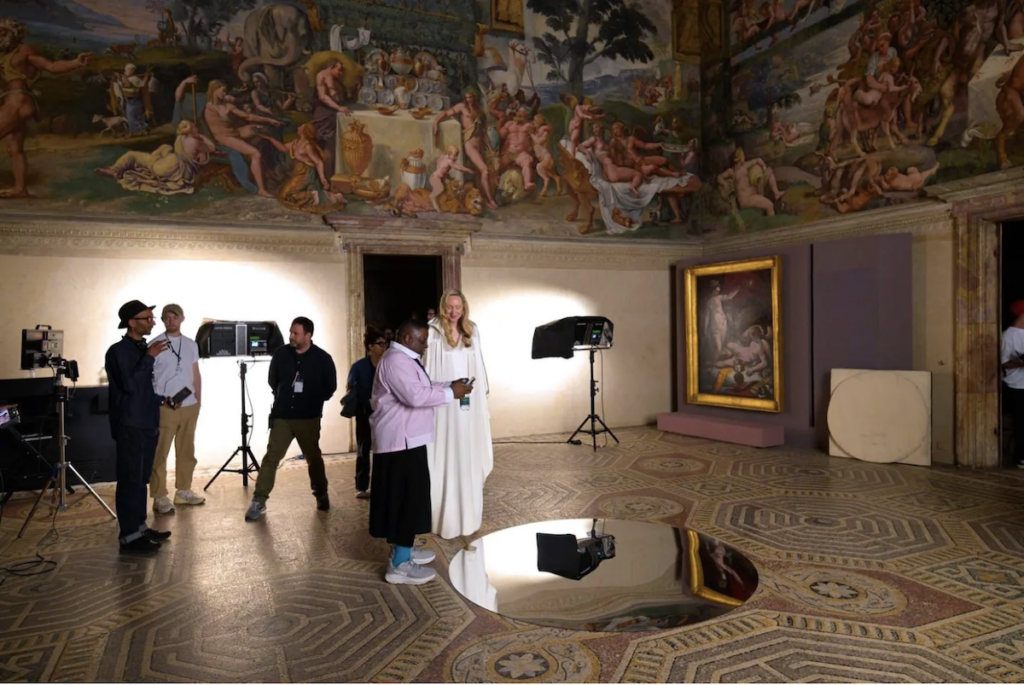
One of the triumphs of All That Changes You lies in its dialogue with architecture. Palazzo Te is not simply the site of projection but a living participant in the work. The installation activates the building’s mythic history, transforming Romano’s villa into a time-machine of sorts, a palimpsest of human imagination.
The film’s movement through diverse architectural spaces underscores how each era constructs its own cosmology. The ornate classicism of Palazzo Te contrasts with the intellectual playfulness of Jencks’s Cosmic House, while Found’s glass pavilion evokes the fragile transparency of a future civilization. Julien orchestrates these transitions with an eye for rhythm and resonance, his camera gliding like a spirit through corridors of history.
Collaboration and creation
The film’s intellectual depth owes much to the contributions of Mark Nash and Vladimir Seput, who helped develop the screenplay and visual structure. The result is a dense weave of references–from feminist theory to science fiction–that nonetheless retains the sensual power of cinema.
Julien’s use of sound is particularly striking: voices echo through chambers, overlapping with ambient music and the rustle of wind or flame. The auditory experience enhances the sense of dislocation, as if we, too, are travelling across dimensions.
Ultimately, All That Changes You. Metamorphosis is an act of resistance, against the destruction of the planet, against the tyranny of human-centred narratives, against the homogenizing force of contemporary media. By constructing what Judith Butler calls an “alternative imaginary,” Julien invites viewers to see metamorphosis not as chaos but as potential. Memory, poetry, and imagination become tools for re-envisioning the present and future.
That this visionary work unfolds within Palazzo Te feels nothing short of poetic justice. Giulio Romano once redefined the language of the Renaissance by distorting classical harmony. Five centuries later, Isaac Julien continues that project through moving images, stretching cinema into a new, spatial form of painting. Both artists, in their respective ages, challenged the boundaries between myth and reality, art and architecture, human and divine.
As visitors wander through the Fruttiere halls, surrounded by ten vast screens, the experience is immersive and contemplative–an encounter with transformation itself. The past speaks to the future, and the myth of metamorphosis continues, renewed through light, sound, and vision. All That Changes You. Metamorphosis is a monumental work–part homage, part prophecy–that reminds us that art, like life, is forever in flux.
Isaac Julien All That Changes You. Metamorphosis at Palazzo Te, Mantua from 31st May, 2026. Find more information here.
Isaac Julien All That Changes You. Metamorphosis at Victoria Miro Gallery, London from 13th February to 21st March, 2026. Find more information here.