


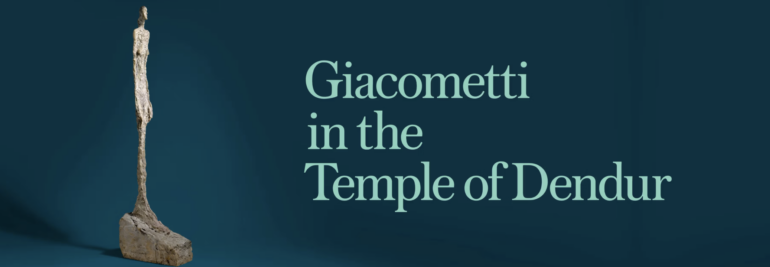
Giacometti in the Temple of Dendur is a striking new exhibition opening in June at The Metropolitan Museum of Art in New York City. The exhibition presents the work of celebrated modern artist Alberto Giacometti into dialogue with one of New York’s most iconic architectural spaces. Featuring 17 sculptures – including rare loans from the Fondation Giacometti – this unique installation explores the profound influence of ancient Egyptian art on Giacometti’s vision. Set within and around the Temple of Dendur, the exhibition offers visitors an immersive experience that bridges millennia, highlighting how themes of human presence, spirituality, and form continue to resonate across time.
Set against the luminous backdrop of Temple of Dendur, a new exhibition at The Metropolitan Museum of Art reimagines the work of Alberto Giacometti through the lens of antiquity. Co-organized with the Fondation Giacometti, the presentation brings together 17 sculptures – many rarely seen – including painted plasters and bronze figures installed in and around the temple’s monumental stone architecture. The result is less a conventional exhibition than a quiet encounter across time, where modern sculpture absorbs the weight and stillness of the ancient world.
Giacometti’s attenuated figures, long associated with existential solitude and Post war anxiety, take on new resonance here. Their fragility feels amplified against the temple’s enduring mass, yet their presence is equally insistent. For an artist preoccupied with distilling the human figure to its barest emotional and physical essence, ancient Egyptian art offered both a formal language and a philosophical anchor. Its frontality, restraint, and spiritual charge echo unmistakably in his mature work.
As museum director Max Hollein suggests, the exhibition underscores the power of context as much as content. By placing Giacometti within one of the museum’s most iconic spaces, The Met not only reframes his sculpture but also foregrounds its own curatorial ethos: that meaning emerges through dialogue – between objects, histories, and cultures. This cross-temporal exchange also gestures toward the institution’s future, including its forthcoming Tang Wing for Modern and Contemporary Art.
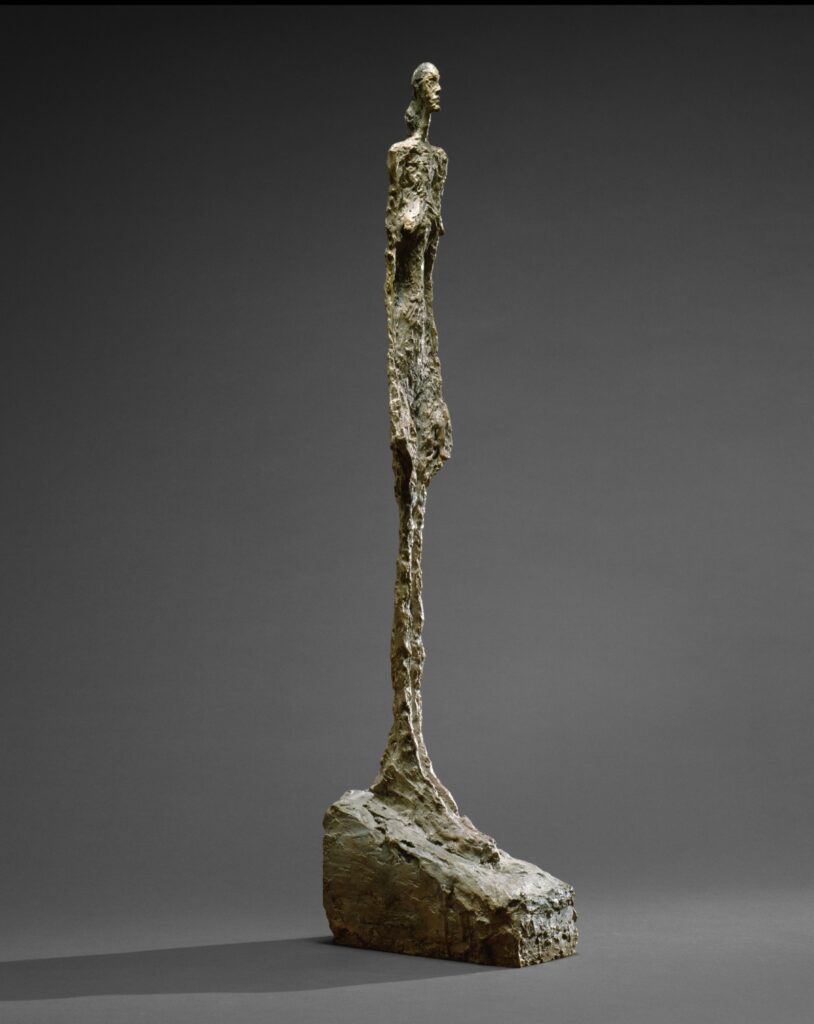
For curator Stephanie D’Alessandro, the installation sharpens our understanding of Giacometti’s lifelong pursuit: how to make sculpture feel alive to the experience of being human. Egyptian art, with its paradoxical stillness and intensity, provided a model. Seen within the temple, his figures seem to hover between presence and absence, their elongated forms both rooted and transient.
That tension is heightened by the setting itself. As Aude Semat notes, ancient Egyptian temples were not static monuments but active, ritual spaces—sites of encounter between the divine and the everyday. Installed here, Giacometti’s sculptures reactivate that sense of movement and mediation. They stand not as isolated artworks, but as participants in a spatial and symbolic choreography that stretches back millennia.
The artist’s fascination with Egyptian art began early. Encounters in Florence, Rome, and later at the Louvre Museum left a lasting imprint, shaping his understanding of proportion, stillness, and symbolic form. As Emilie Bouvard explains, Egyptian sculpture’s ability to balance naturalism with abstraction resonated deeply with Giacometti’s own search for monumentality and humanity. His drawings and studies from the 1920s and 1930s reveal a sustained engagement with these ancient models, ultimately informing works like Walking Woman (I) (1932), where motion and stasis coexist in delicate equilibrium.
Within the temple, that work takes on a near-sacred dimension. Positioned in the offering hall, it recalls the placement of divine statuary, evoking a moment suspended between concealment and revelation. Elsewhere, figures gather in sparse constellations across the platform, echoing the terraces where ancient rituals once unfolded. Pieces such as Women of Venice (1956) suggest both procession and pause, reinforcing Giacometti’s enduring meditation on time, mortality, and the human condition.
The temple itself – completed around 10 BCE and dedicated to Isis and the deified brothers Pedesi and Pihor – anchors the exhibition in a deeper historical continuum. Gifted to the United States in 1965 and installed at The Met in 1978, it has long stood as a site of passage and encounter. In this context, Giacometti’s sculptures appear both contemporary and ancient, their precarious forms set against a structure built for permanence.
What emerges is not simply a dialogue between past and present, but a shared inquiry into how sculpture mediates presence – how it occupies space, holds attention, and channels belief. In bringing Giacometti into the Temple of Dendur, The Met offers a compelling reminder that the questions at the heart of art – about humanity, spirituality, and form are never confined to a single era.
Giacometti in the Temple of Dendur is at The Met, New York City from 12 June until 8 September, 2026. Find more information here.