
In this edition of Culturalee in Conversation, we speak with artist Pei-Yi Tsai about upcoming solo exhibition [Insert] at SLQS Gallery, curated by Senem Cagla Bilgin-Keys. Tsai’s practice navigates the subtle intersections of visibility, embodied presence, and interiority, tracing how identity is shaped through tension, memory, and lived experience.
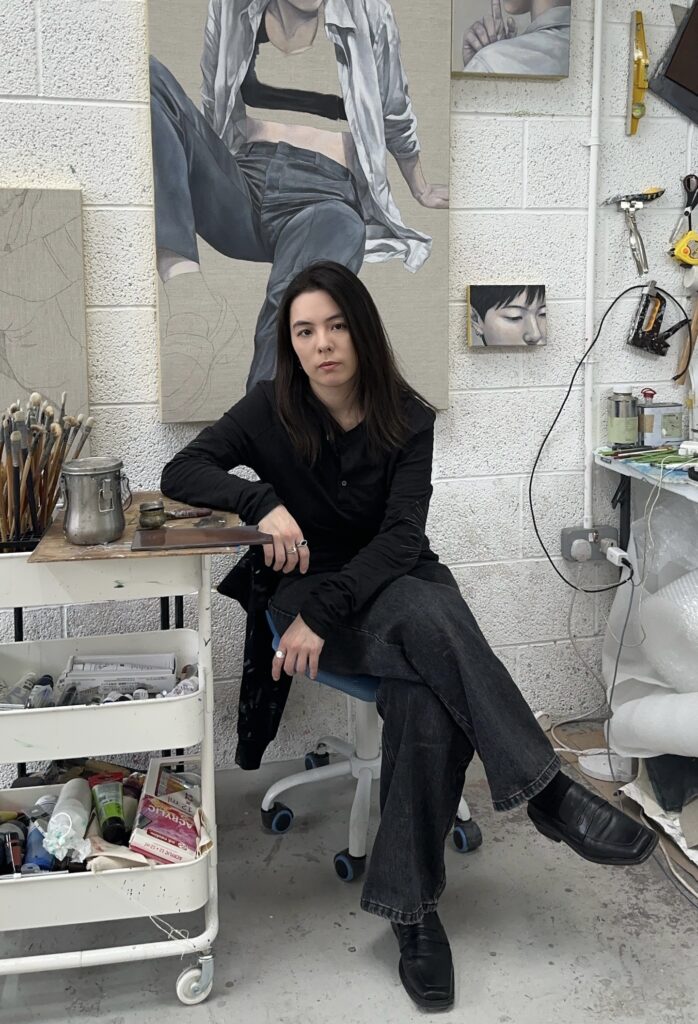
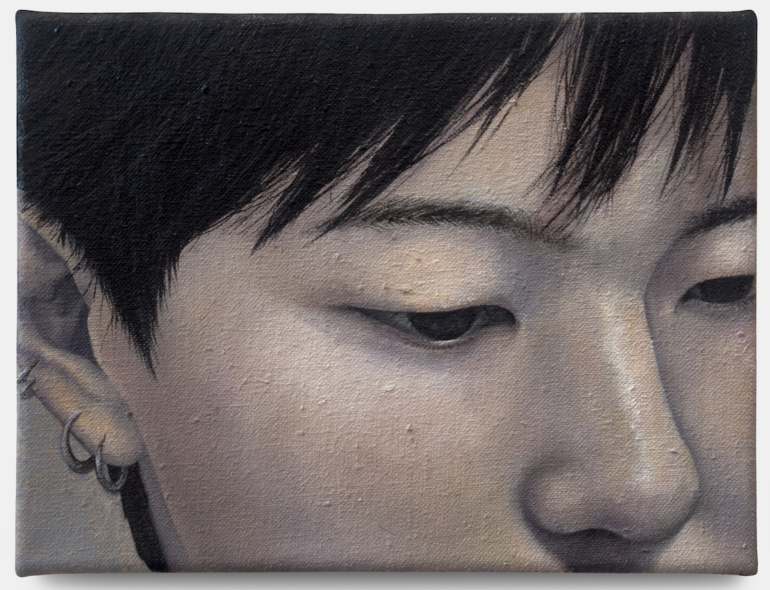
Working between Taiwan and London, Tsai challenges the conventions of portraiture through fragmented figures – cropped faces, suspended gestures, and bodies that dissolve into shadow. Her paintings resist fixed or legible representation, instead embracing ambiguity as a way to explore queer subjectivity, belonging, and the pressures of social expectation. In this conversation, she reflects on the role of fragmentation as both a formal strategy and a lived condition, revealing how painting can hold the fluid, contingent nature of identity in a world that often demands clarity.
Your figures often appear partial – cropped, dissolving, or suspended. How do you see fragmentation as a way of resisting fixed or normative ideas of identity within portrait painting?
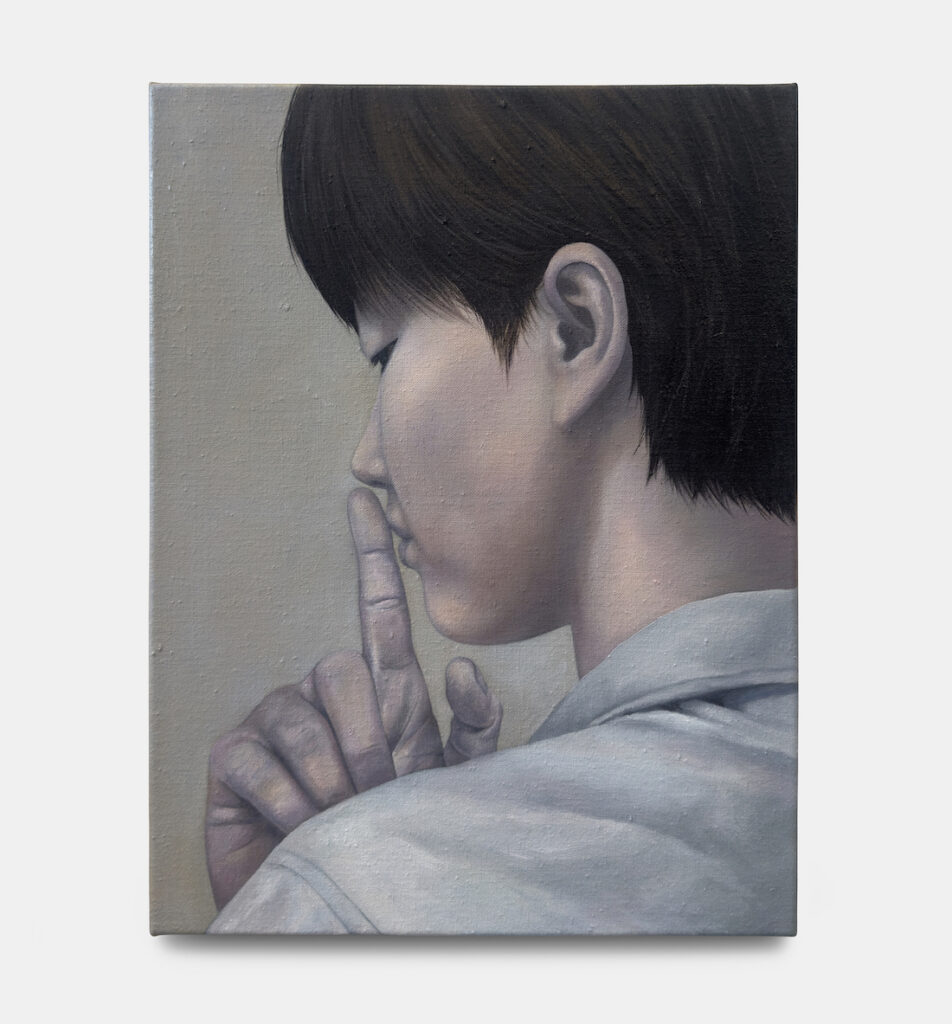
When I work with the human figure as a narrative subject, I do not approach it as portraiture in the traditional sense. Instead, I construct the image through cropping, concealment, or by depicting only fragments of the body. This approach allows me to more precisely convey the deeper meanings within my work.
My practice revolves around the theme of identity, which, for me, is constituted through fragmented personal experiences. In this sense, fragmentation is not only a formal strategy, but also a way of responding to—and resisting—fixed or stable notions of identity.
This way of working may also stem from my own lived experience. I grew up in an environment where it was not easy to openly articulate one’s sense of identity—whether in terms of queer identity or political subjectivity. These aspects often had to be concealed, translated, or expressed in more indirect ways. To some extent, this experience has unconsciously shaped how I approach the body and the image, leading to forms that appear fragmented, obscured, or incomplete.
Through this sense of incompleteness and ambiguity, I aim to preserve an openness of meaning, allowing viewers to actively engage with the work and generate their own layered interpretations.
Your work engages deeply with queer identity, particularly in relation to social expectations. How do you negotiate the tension between the desire to be seen and the need to remain partially obscured?
This question is closely related to what I mentioned earlier regarding incompleteness. In my work, I tend to maintain a sense of ambiguity and partial concealment, seeking a subtle balance between disclosure and non-disclosure.
For me, this approach also reflects my own background. I was raised in a context where queer identity was not always something that could be directly or fully expressed. As such, visibility itself carries both a desire to be seen and an element of risk and unease.
The ambiguity and obscuration I retain in my work, to some extent, embody this tension: a simultaneous desire to be understood and a need to maintain distance. This visual language allows viewers to sense a subjectivity that is constantly negotiating and adjusting within the constraints of social norms.
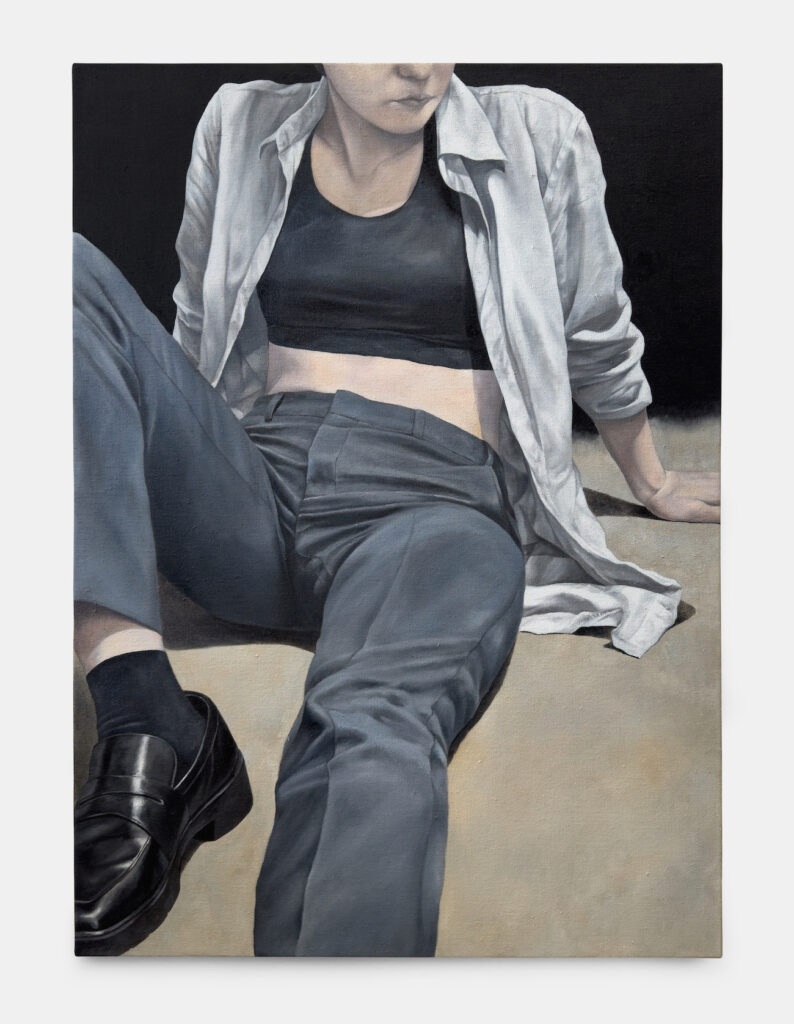
For instance, in my new works such as A Storybook Long Forgotten, What Remains Unsaid, and Gazing Toward an Unseen Anchor, the figures appear with an ambiguous or indeterminate sense of gender. I have lived in a similar state, where I was unable to freely express my own gender identity or sexual orientation.
In the social context I grew up in, traditional values often imposed relatively fixed and singular expectations of what it means to be “female”—from wearing skirts, to maintaining certain hairstyles, to conforming to a recognizably “feminine” appearance. These implicit norms, to some extent, constrained how I could present myself. As such, these works function both as a form of self-expression and as a subtle form of resistance.
Drawing from your experience between Taiwan and London, how do East Asian cultural contexts shape your understanding of belonging, and how does this translate into your visual language?
As I have only been living in the UK for a relatively short period—just over two years—my ways of thinking and perceiving are still deeply shaped by East Asian cultural contexts. Even while situated within a Western environment, I continue to inhabit an East Asian cultural identity and sensibility, while also attempting to absorb different values and gradually find a balance between the two.
For me, “belonging” is not a fixed position, but rather a fluid condition. It is rooted in the cultural context in which I was raised, while also being continuously reinterpreted and reconstructed within new environments. Although I am currently based in the UK, I remain strongly aware of myself as an East Asian woman navigating and negotiating my position within a Western society.
At the same time, “belonging” for me operates on multiple levels—it relates not only to my connection to my place of origin, but also to my sense of attachment to family. In my work, I often express a sense of longing for my upbringing and cultural environment in a subtle and indirect way. At times, I incorporate specific objects into the paintings, such as Buddhist prayer beads. This object was given to me by my mother as a form of protection, and it carries personal memory while also functioning as a point of connection to a broader sense of cultural and emotional belonging.
This cultural experience extends into my practice. While my training is grounded in Western painting materials and techniques, I approach and employ them through an East Asian way of seeing. For instance, I tend to retain a sense of subtlety and restraint within the image, alongside a careful attention to detail and a controlled approach to technique. As a result, even when working within a Western visual language, my work continues to embody an underlying East Asian sensibility and rhythm.
You work with textile substrates that carry traces of erasure and repetition. How does this material choice connect to ideas of memory, embodiment, and the instability of identity?
Throughout my creative process, I have been thinking about whether the materials I use can form an intrinsic connection with the themes of my work. This is not an easy task, and it required a period of experimentation and adjustment in the early stages. At the same time, I try to maintain a certain openness in my practice, allowing for elements of chance, as these unpredictable traces often come closer to the states I aim to explore.
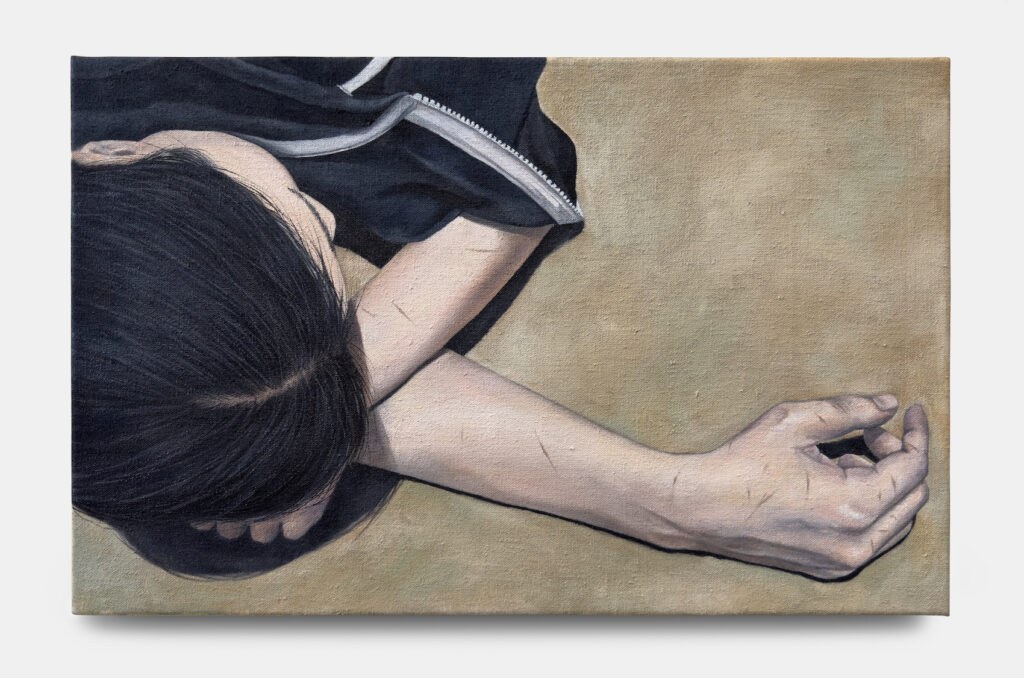
From 2024 to early 2026, I primarily used a type of cotton fabric called calico as the painting ground. Due to its lightweight quality and relatively loose fibers, paint and gesso can easily penetrate the surface. I usually stretch or pin the fabric directly onto the wall to apply gesso, and once it dries, I remove it. This process causes the surface to wrinkle, resulting in a fragile and unstable texture resembling crumpled cotton paper.
For me, this kind of material—susceptible to change, marked by traces and deformation—corresponds to the nature of memory. Memory is not something fixed, but rather something that is continuously overwritten, faded, and reconstructed. In this sense, the fragility and instability of the material also echo my ongoing interest in the fluidity and uncertainty of identity.
In the new works presented in this solo exhibition, I have shifted to using linen as the painting ground. This transition is, in part, an attempt to return the work more directly to painting itself, allowing the material’s associative meanings to recede, so that viewers can focus more on the image and the language of painting.
You’ve described representation not as affirmation but as something fluid and contingent. In a contemporary context where identity is often politicised, what possibilities does painting offer for holding ambiguity and complexity?
I believe that painting inherently possesses a quality of not being fully explicit; unlike language, it does not need to point clearly toward a specific position or conclusion. However, painting ultimately depends on the choices made by the artist. Some artists may choose to let their work respond to explicit political agendas, or use imagery to reinforce certain identity labels, making their positions clearly legible.
For me, I am more inclined to preserve a sense of uncertainty and openness within the image. I do not attempt to affirm a stable identity within the work; rather, through cropping, concealment, and the depiction of incomplete bodies, I allow the figure to remain in a state of flux and incompletion.
In a contemporary context where identity is often simplified and reduced to labels, this approach to painting, for me, creates a space in which complexity can exist. It does not offer definitive answers, but instead holds the viewer within ambiguity and contradiction, allowing identity to be experienced as an ongoing, shifting process rather than a fixed outcome.
As for the relationship between context and practice, I am inclined to think that it is not the context that directly shapes painting, but rather that cultural and social environments shape the position and perception of the artist—and it is these experiences that are ultimately translated into painterly expression.
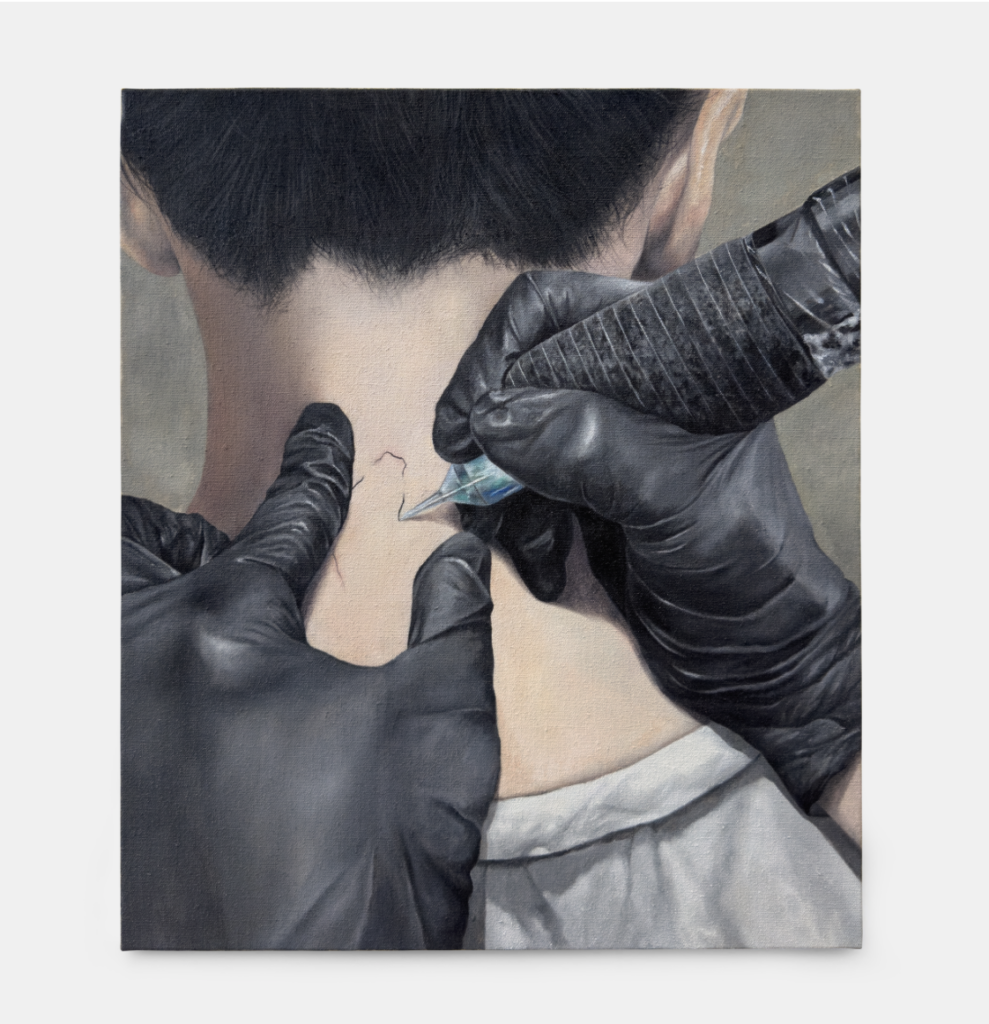
For example, in my recent work Memory, Symbol, or Who We Are, the tattoo depicted in the image is derived from the outline of the island of Taiwan, where I come from. However, this boundary appears to gradually dissolve within the painting, reflecting a deeper sense of uncertainty shaped by my own experience. Growing up, I was shaped by a sense of Taiwan as a nation; however, this understanding has continually been unsettled by its ambiguous standing in the global context. Its territorial boundaries appear both present and elusive—recognised in practice, yet never entirely affirmed, existing in a space that resists clear definition.
At times, such a boundary may appear clearly delineated, yet it simultaneously remains unstable and uncertain—it can be understood as a concrete division, but also as something constructed, contingent, and subject to reinterpretation. Across different contexts and perspectives, it is continually renamed, translated, and blurred.
In this sense, the dissolving boundary becomes, for me, a condition in flux—one that relates to identity, memory, and belonging, yet cannot be fixed or fully resolved.
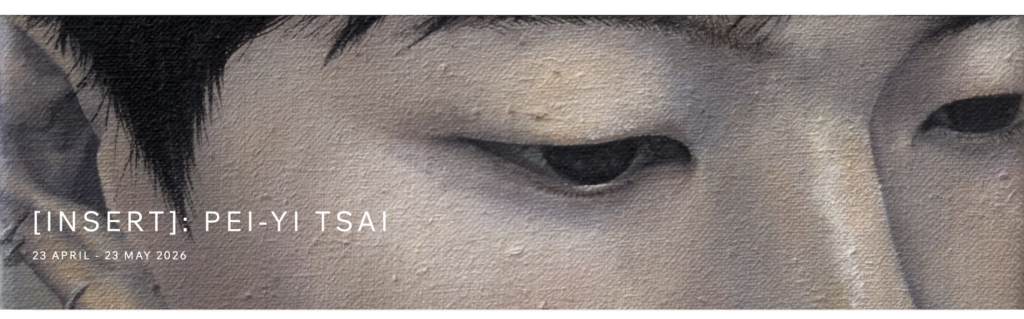
[insert], a solo exhibition by Pei-Yi Tsai is at SLQS Gallery from 24 April to 23 May, 2026. Find more exhibition here.