

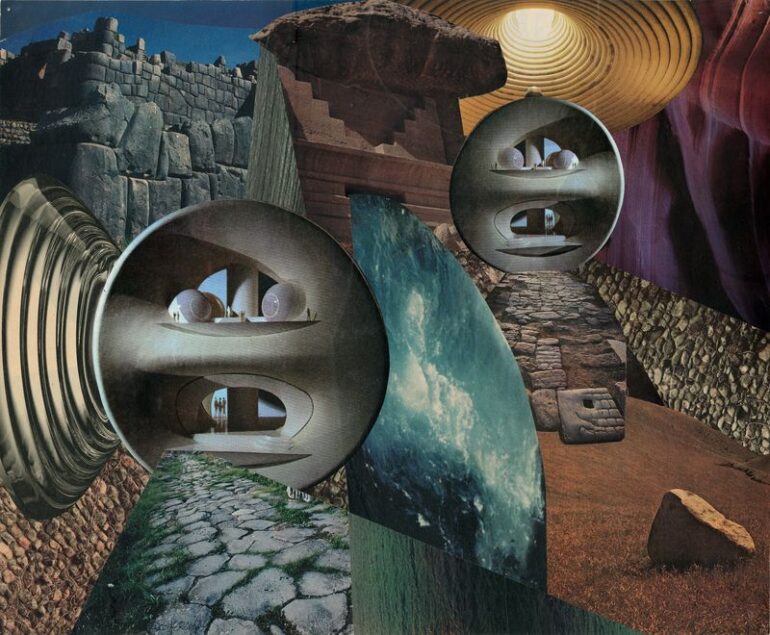
This summer Tate St Ives presents the first UK museum exhibition of the work of Lithuanian American artist Aleksandra Kasuba (1923-2019). The show covers seven decades of Kasuba’s wide-ranging career, from her early paintings and mosaics to her later sculptures and public artworks, including her innovative spatial environments
Kasuba was a visionary artist, often inspired by forms found in nature, such as shells, rocks, vegetation and marine life. Driven by a desire to forge a deeper connection between humanity and the natural world, Kasuba created art that imagined alternative ways of living. Kasuba’s work drew on different disciplines, and in the late 1960s, she collaborated with the Experiments in Art and Technology (EAT) group, made up of artists, engineers and scientists.In 1944, because of successive occupations by the Soviet Union and Nazi Germany, Kasuba fled Lithuania.
Tate St Ives, 2026. Photo © Tate (Kathleen Arundel)
After living in a displaced persons camp in Germany, she emigrated to America in 1947, first settling in New York, before moving to New Mexico later in life. During her time in New York, she designed large-scale mosaics and murals in brick, marble and granite for the interiors and exteriors of public buildings. Among these were a pavement at the Old Post Office Plaza on Pennsylvania Avenue in Washington DC, the mosaic at the Container Corp Headquarters in Chicago and the relief at Lexington Avenue in New York, and a 4,000 square feet wall in etched granite at the World Trade Centre, which was destroyed in the 9/11 terrorist attacks.
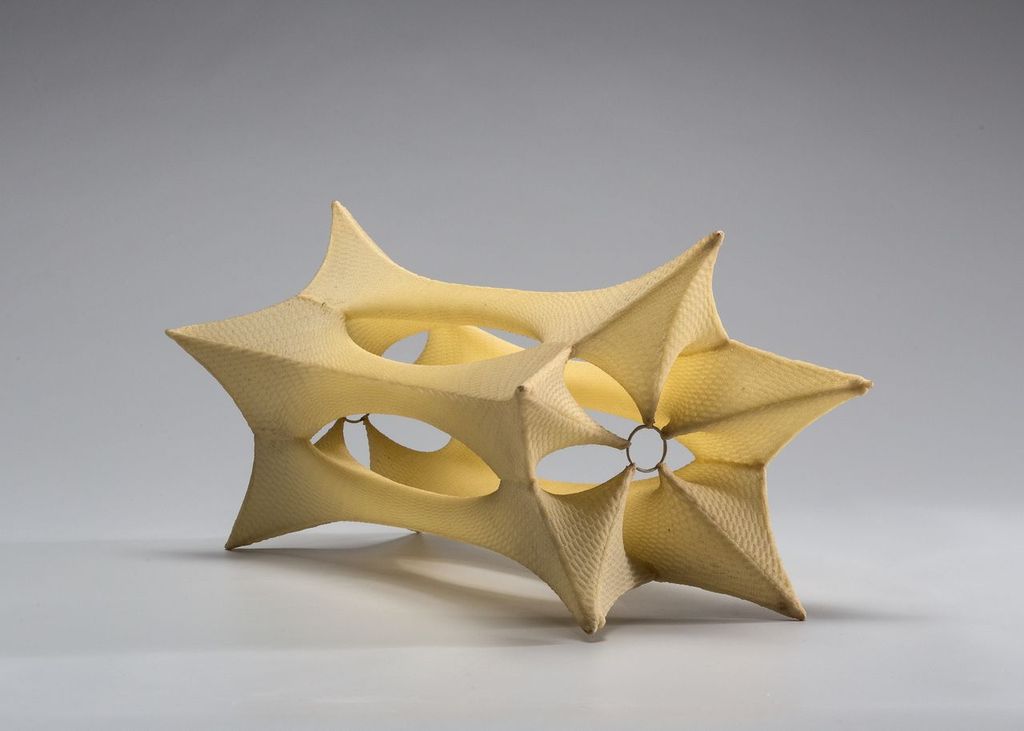
This exhibition at Tate St Ives will show a range of Kasuba’s sculptures, models, mosaics, paintings, drawings and collages from the collection of the Lithuanian National Museum of Art, where the artist donated her works, including her spatial environments. Made of tensile fabrics and without right angles, these immersive spaces imagined a more harmonious and peaceful way of living.
Museum of Art. Photo by Antanas Luksenas
The artist famously told The New Yorker in 1971 that she wanted to
‘kill the square. Conventional rooms with four walls dictate too much to the people in them. Relationships are different here. People who come here find themselves behaving differently.’
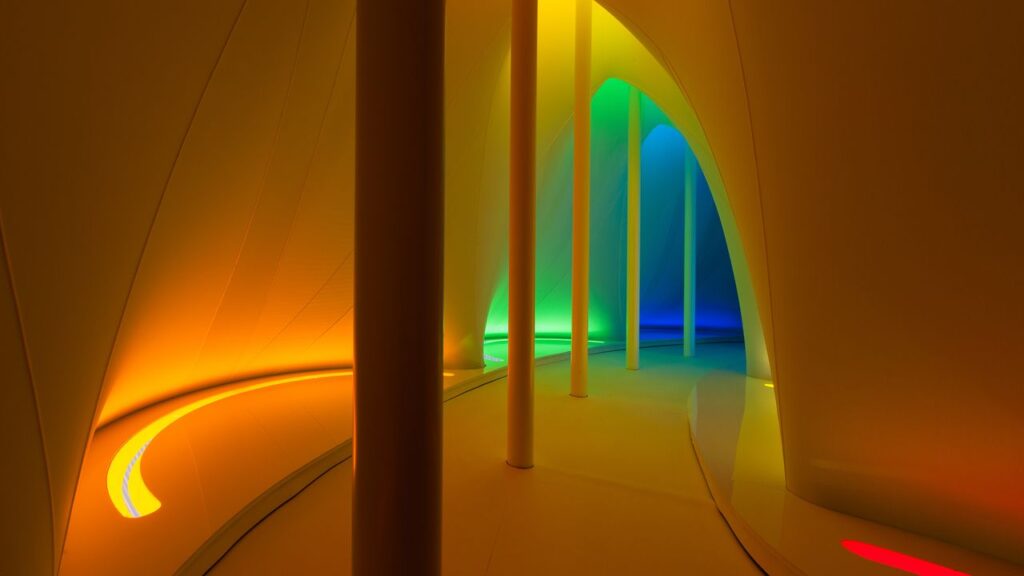
Spectrum: An Afterthought, 1975, one of Kasuba’s most significant spatial environments, will be displayed in its entirety. The work is a passageway comprising brightly lit, different coloured zones and is made of aluminium, neon, plastic, plywood, steel and tensile fabric. It is accompanied by the sounds of cosmic wind arranged by composer Paulius Kilbauskas, as well as a selection of scents created by perfumer Danutė Pajaujis Anonis, which mirror the different colours of the sculpture, reflecting Kasuba’s interest in synaesthesia.
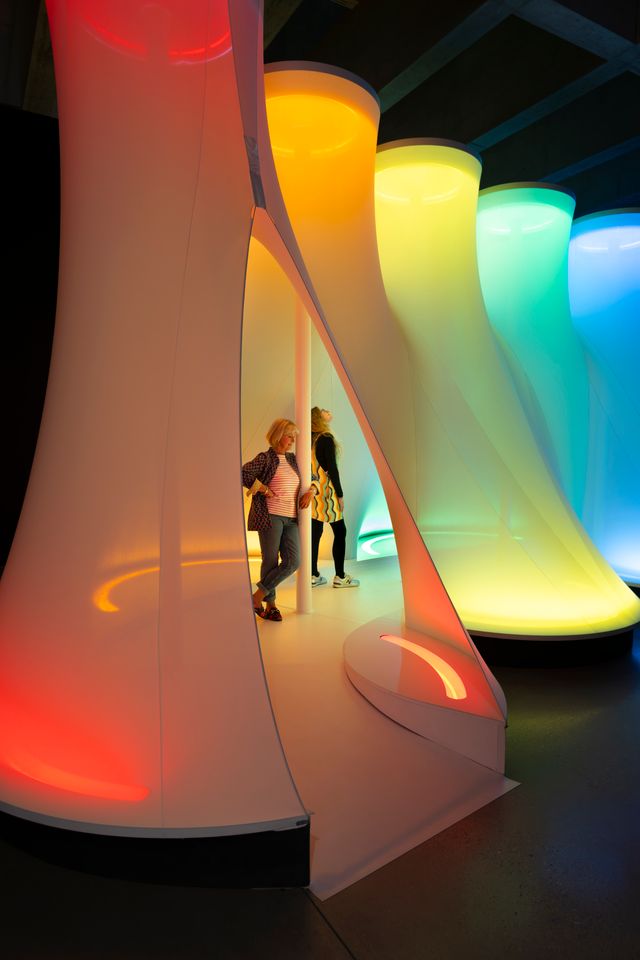
Tate St Ives, 2026. Photo © Tate (Kathleen Arundell)
Also on show will be Three-dimensional Rug, designed and made by Urban Jupena in 1971, originally installed in Kasuba’s Live-In Environment, part of which will be recreated at Tate St Ives as it was in her New York apartment. In making these ‘environments’, Kasuba created immersive, contemplative spaces, no longer connected to aspects of Western architecture, which she considered too rigid or dehumanising.
Kasuba’s later projects included her own home, Rock Hill House, which she designed and built in the New Mexico desert in 2001.This major exhibition at Tate St Ives will showcase Kasuba’s revolutionary ideas and experiments, highlighting her interest in utopian architecture for creating social harmony. The breath of work and ideas on display underpin Kasuba as a great force in art across her seven-decade career.
Aleksandra Kasuba: Shelters for Senses2 May – 4 October 2026
Tate St Ives, Porthmeor Beach, St Ives TR26 1TG
Open daily 10.00–17.20
Tickets available at tate.org.uk and +44(0)20 7887 8888
Free for Members. Join at tate.org.uk/members
Follow @Tatestives