
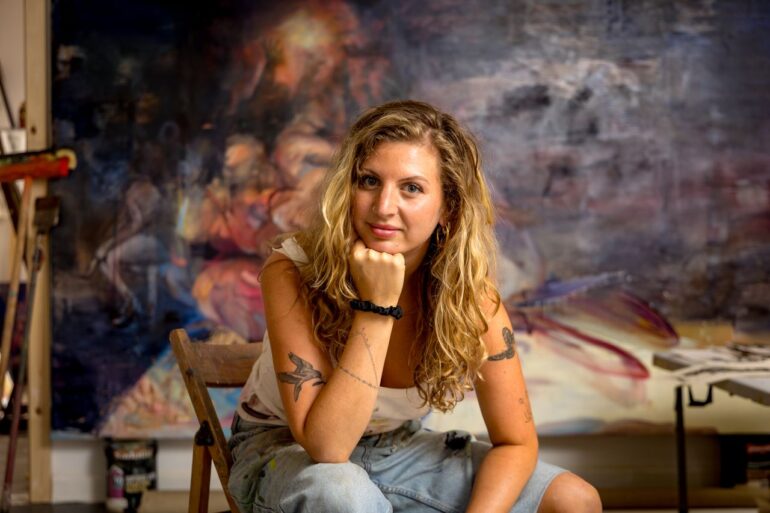
For emerging British artist Hattie Quigley, painting is a visceral language through which to explore the body, desire, appetite and the contradictions of contemporary beauty culture. Her richly physical paintings combine gestural abstraction with fleshy, figurative forms, using pours, smears and layers of sumptuous colour to create works that feel simultaneously seductive, excessive and unsettling.
In this Culturalee in Conversation, Quigley discusses how personal experiences, social media and the increasingly complex cultural obsession with body image have shaped her practice. She reflects on food as a recurring motif, the influence of artists including Rubens, Caravaggio, Francis Bacon and Jenny Saville, and her fascination with the tension between consumption and restriction in the era of Ozempic and filtered digital perfection. She also reveals how a seven-week trip to Brazil and the spectacle of Carnival have influenced her forthcoming solo exhibition at Refusés, as she prepares to begin her MA at the Royal College of Art.
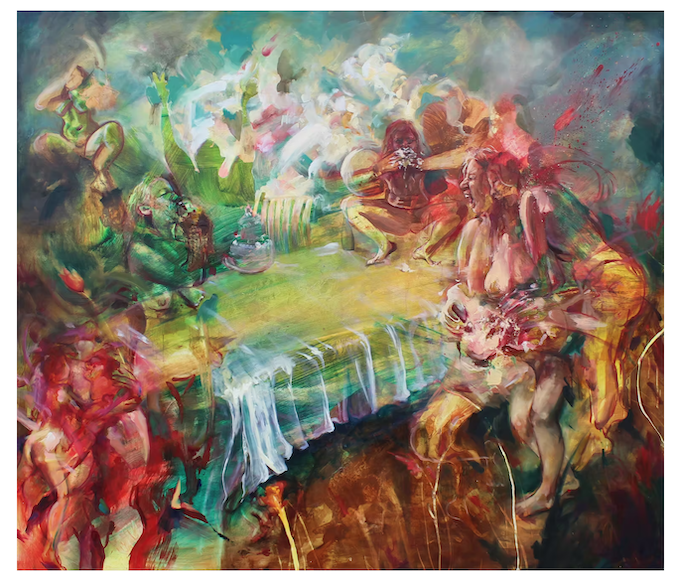
Following her success at the 2025 Affordable Art Fair Graduate Exhibition, where she won the JM Finn Bursary Award, Quigley is entering an exciting new chapter. Her ambitious paintings challenge the flatness and perfection of the digital image through something physical, messy, emotional and unapologetically human.
How did your experience of taking part in the Affordable Art Fair Graduate show in 2025 – and winning the prize – open opportunities for you?
Taking part in the Affordable Art Fair Graduate Exhibition last year was a really valuable experience, both in terms of exposure and confidence. It gave me the opportunity to talk to people about my work in a way I hadn’t experienced before, and winning the JM Finn Bursary Award was particularly significant. It allowed me to invest in materials and be much more ambitious with the scale and time I could dedicate to the work, which directly helped me create the pieces for my first solo show in London. At the start of your career, that kind of support can mean so much. Being an artist is incredibly personal, so having that encouragement from Affordable Art Fair felt like a real vote of confidence and gave me the push to keep developing my practice. I’m now starting at the RCA in September, which I’m really excited about, and I’m looking forward to seeing where the next chapter takes my work.
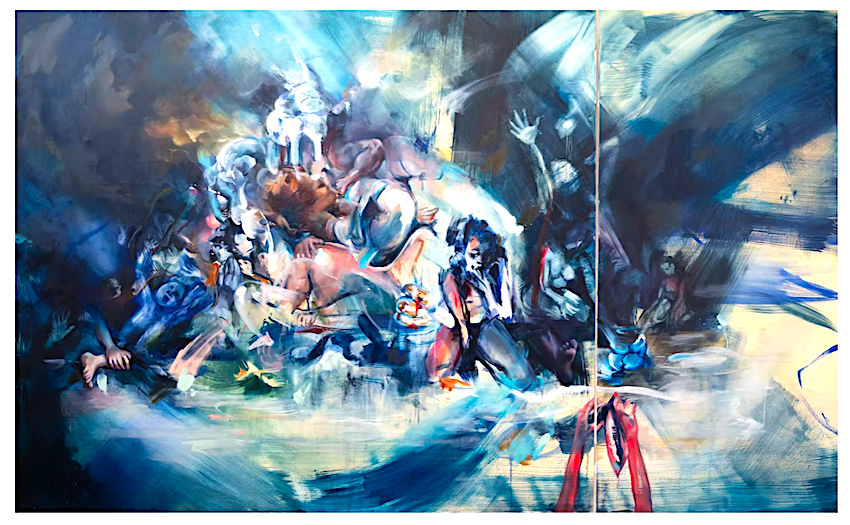
Your paintings explore extremes including feminine desire, Ozempic culture and filtered social media images of perfection. What cultural influences or personal experiences have shaped the way you approach these themes?
My mum says I used to love playing with butter when I was younger? For as long as I can remember I’ve had two deep obsessions – my art, and my body. Like many people, but especially girls, I was always paranoid about the size of it and how that affected the way I was treated in the world (our worth historically being tied to beauty rather than substance). I lost a friend in my last years of school and I’d never really experienced grief before, so it sent me to an even more complicated place with food. But it was also the biggest turning point in my practice, and I think where I realised the urgency of me needing to paint, as if it was as important as eating.
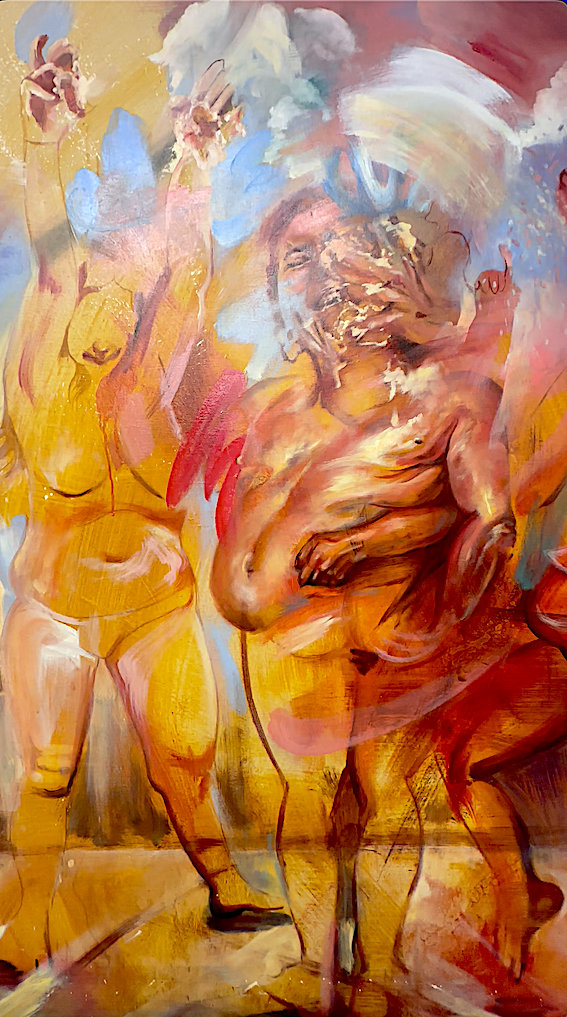
I think as artists we are observers, and a lot of my work comes from observing the culture around me. I grew up alongside the genesis of social media, watching this increasingly intense obsession with our bodies, filtered images and the idea of perfection. Now we’re seeing that evolve through things like Ozempic culture. What interests me is the contradiction in all of this: we seem to live in a culture of incredible consumption and gluttony, while simultaneously becoming obsessed with restriction, thinness and taking up less space.
All of these things seem to tie together somehow for me. I’m fascinated by excess and paint itself feels like such an appropriate material for exploring that. It’s gloopy, viscous, fleshy, almost edible. It can look like fat, butter, food or bodily matter. I want the paintings to feel excessive in the same way that the subjects I’m thinking about are excessive.
If I were to psychoanalyse myself, I’d say the scale of the paintings also comes from something about wanting to feel small – being completely consumed by them, in the same way I can feel consumed by my own emotions. That’s where the gestural abstraction becomes particularly important to me. For me, it’s about the body and emotion, and about rebelling against the flatness and perfection of the digital image through something messy, physical and completely human. Emotion is hugely important to me. I think we live in a time that is increasingly afraid of it, and I want the paintings to be the opposite of that: excessive, emotional, bodily and unapologetically alive.
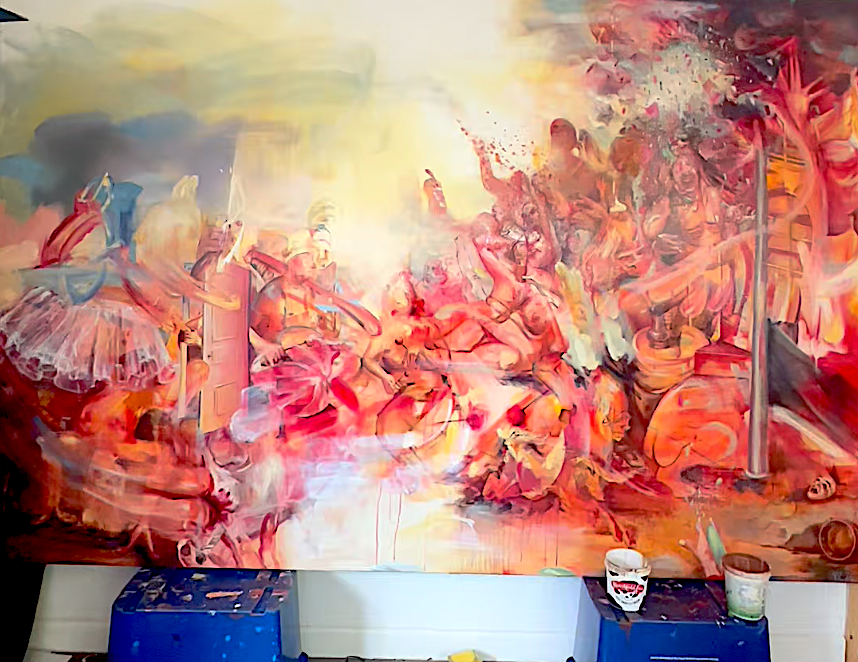
Your forthcoming solo exhibition at Refusés, inspired in part by your seven-week trip to Brazil and the spectacle of Carnival, comes at an exciting moment in your practice, alongside your upcoming MA at the Royal College of Art. How has Brazil and Carnival influenced this new body of work, and where do you see your painting moving next?
Well, as I’ve said my paintings are just sort of a regurgitation of my experiences, how I see the world. I am a person of extremes. And carnival to me is a complete encapsulation of extremities. I was so intrigued by this idea of the innate human need of the feast and the fast, an explosion of liberation, abundance and excess. I was particularly fascinated by the way bodies existed within that environment. There was a real sense of liberation in seeing bodies of all forms taking up space, moving, sweating, dancing and celebrating without necessarily being subjected to the same restrictions we often place on the body in everyday life. But I was also interested in the historical and cultural complexity underneath that spectacle, and what these cycles of excess and restraint reveal about us as humans.
Going into my MA at the Royal Collage, I have absolutely no idea where the work will go and I’m very excited by that. Hopefully it will surprise me. I just want to create. I want my paintings to be so unapologetically mine, and be authentic and with integrity.
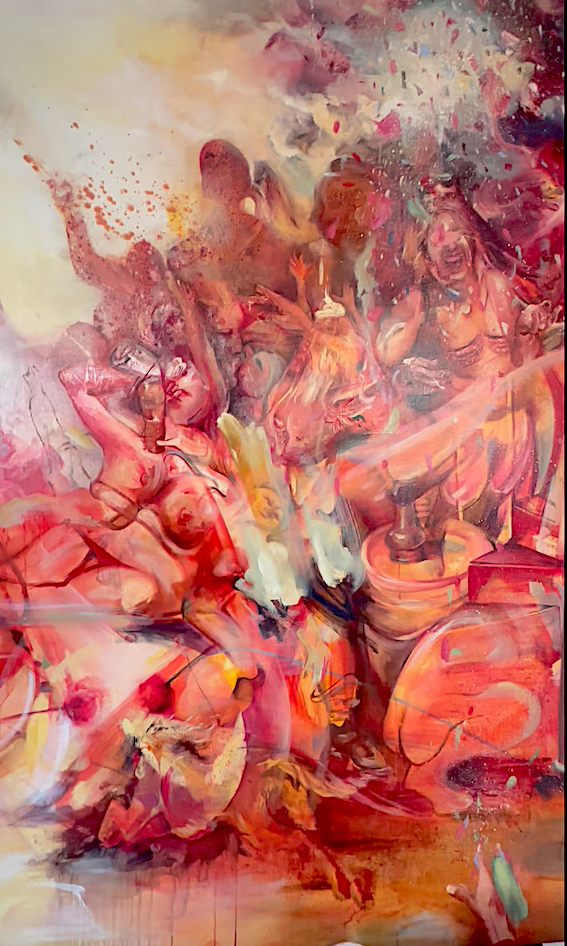
How do artists such as Rubens, Jenny Saville and Francis Bacon inform your visual language?
I’ve been looking to Bacon only recently, mostly for the idea of getting across a sensation of forces that aren’t visibly felt. Using colour, scale and gesture to produce a bodily sensation of excess rather than simply representing it. As with my love for the Old Masters, such as Rubens or Caravaggio, I think its rather beautiful to look to the limited images of the past, to learn how to engage with the present, in a world where the over-saturation with flat images is continuously expanding. But I will always remember seeing his work for the first time, seeing these folds of flesh and women’s bellies depicted in such a sumptuous, buttery and soft way, it genuinely changed the way I looked at my own body. In regards to Jenny Saville, it was formative seeing a female artist being successful in her life-time, being so raw and brave, using her own body to challenge the way we look at bodies. I respect her skill a lot as a painter and draftswoman.
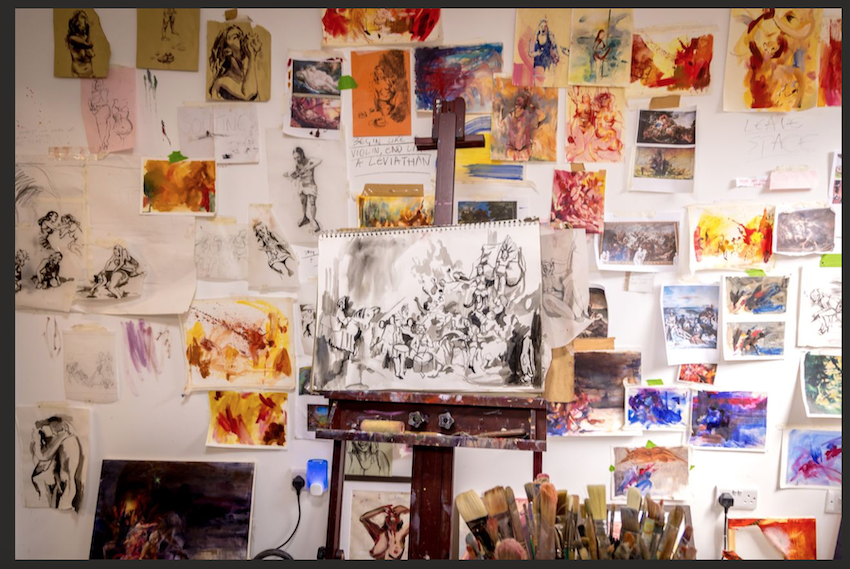
Your paintings have a remarkable physicality, with figures emerging from abstract pours, smears and energetic marks. Could you take us through your technical process, from the initial gesture on the canvas to the development of the figure, colour, texture and final composition? And do you work from photos, life or imagination?
So for this show in particular, I actually had a period of time without a studio and then was travelling so there was months and months worth of pure research and thinking. I have a big archive of images, whether that’s from postcards from museums, the internet, my personal camera roll. The first few weeks is spent mainly with ink or sketching, kind of making characters in a play. At the same time I’m also playing around with little colour studies I can use later. Then for each painting I think a long time about the composition, which is normally useless as the painting will go wherever it wants to. I digitally collage in photoshop a bit too. I build, stretch and prime all my own canvases, which is a very lengthy process and physically demanding. Once I have a rough idea of the direction of a painting, I will start very abstractly mixing diluted pigment in big bowls and pouring it on, sweeping it with large brooms or creating marks in other ways. From here on it’s kind of hard to describe the process as it’s just very responsive to what the painting is telling me so its different for each. I work on lots at the same time, but being in the thick of them is a very turbulent time and extremely high stakes, I know it sounds ridiculous but it can control my mood completely. I also have to listen to different types of music during different parts of the process.
Food is a recurring motif in your work, connecting ideas of appetite, pleasure, sexuality, power andconsumerism. What does food allow you to express about the female body and desire that perhaps amore conventional portrait or figure painting cannot?
It’s hard to put into words, which I guess is why I use painting as my language. All I know is that I’ve always seen the world through figures, but I grew sick of realism. I wanted the paint itself to be pleasurable, almost appetising to look at, seducing the viewer in only to hit them in the gut of their stomach with something more uncomfortable to digest. Paint as food and flesh allows the female body to become something active rather than something being looked at.
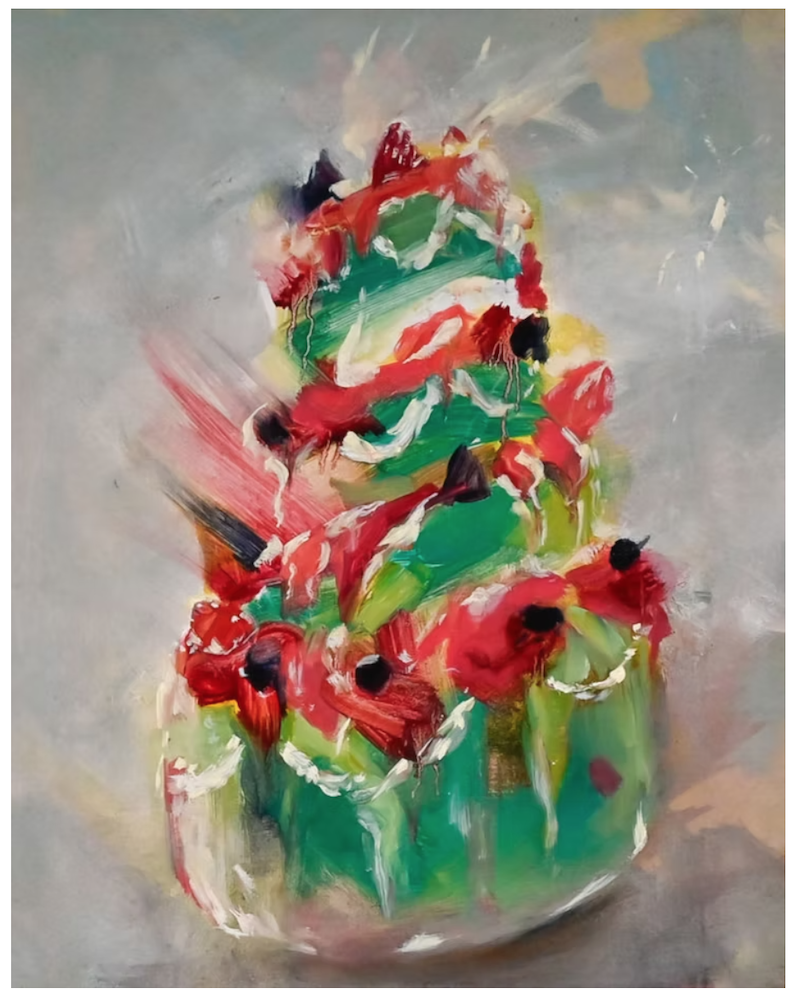
I never paint portraits of particular women, just bodies. The body becomes an enormous, excessive physical presence, something hungry, sensual and powerful. I think food gives me a way of talking about desire as something physical and messy, rather than something that can be contained within a conventional portrait.” Hattie Quigley
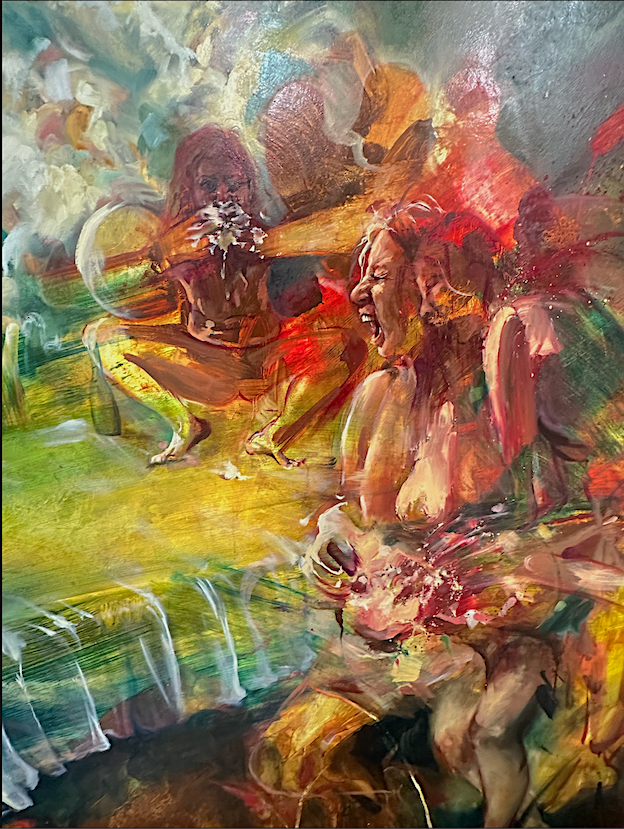
We are currently surrounded by highly curated images of the body through Instagram, TikTok and other social platforms, and conversations around Ozempic and the return of ultra-thin beauty ideals including the rise of “SkinnyTok” are reshaping ideas of what the desirable body should look like. How does this contemporary obsession with body shape enter your work?
I don’t want this to be the only lens through which my work is understood, but I think it’s inevitable that the world we live in finds its way into what I make. Creativity has always been a way for me to express things I can’t necessarily articulate verbally, so growing up surrounded by such intense and constantly shifting ideas about the body, beauty and desirability has inevitably influenced my work. I’m interested in how those ideas sit beneath the surface, what we absorb without even realising it, and how they can find their way into an artistic practice.
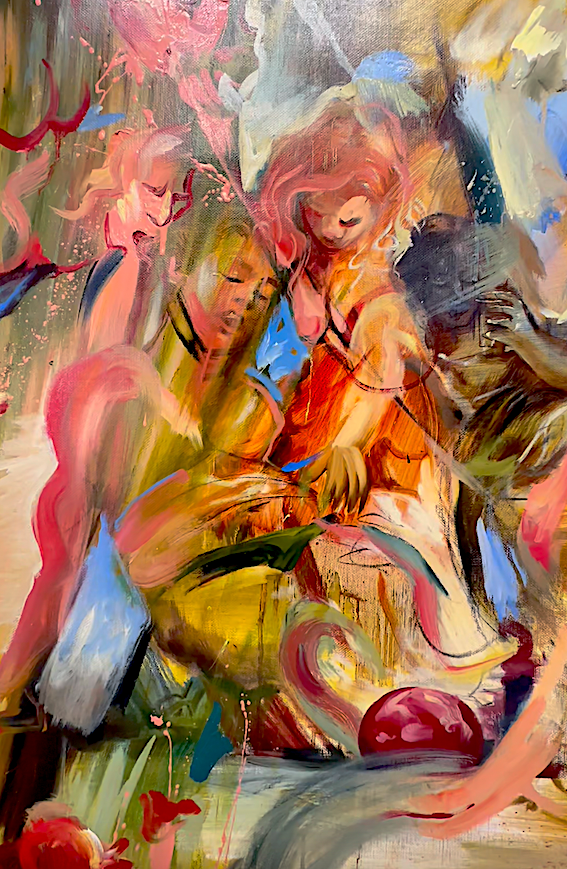
There is an interesting tension between the classically idealised body and the fleshy, imperfect bodies celebrated throughout art history. Do you see your paintings as a form of resistance to contemporary beauty culture, and what do you hope viewers might reconsider about their own relationship with the body when they encounter your work?
I wouldn’t want to prescribe what anyone should take from the paintings, or suggest that they are intended as a direct response to contemporary beauty culture. They are much more personal than that, really just my way of making sense of and seeing the world. They’re very emotional to make, and I’m interested in the physical experience of looking at them: perhaps the viewer might recognise something bodily or instinctive in them, rather than necessarily taking away a particular message. Ultimately, I hope the work can exist on its own terms. I like to think I would keep making these paintings even if nobody else liked them.
Find more Information about Hattie Quigley HERE
Tickets available here for the Affordable Art Fair (Wednesday 14 October 2026 – Sunday 18 October 2026).