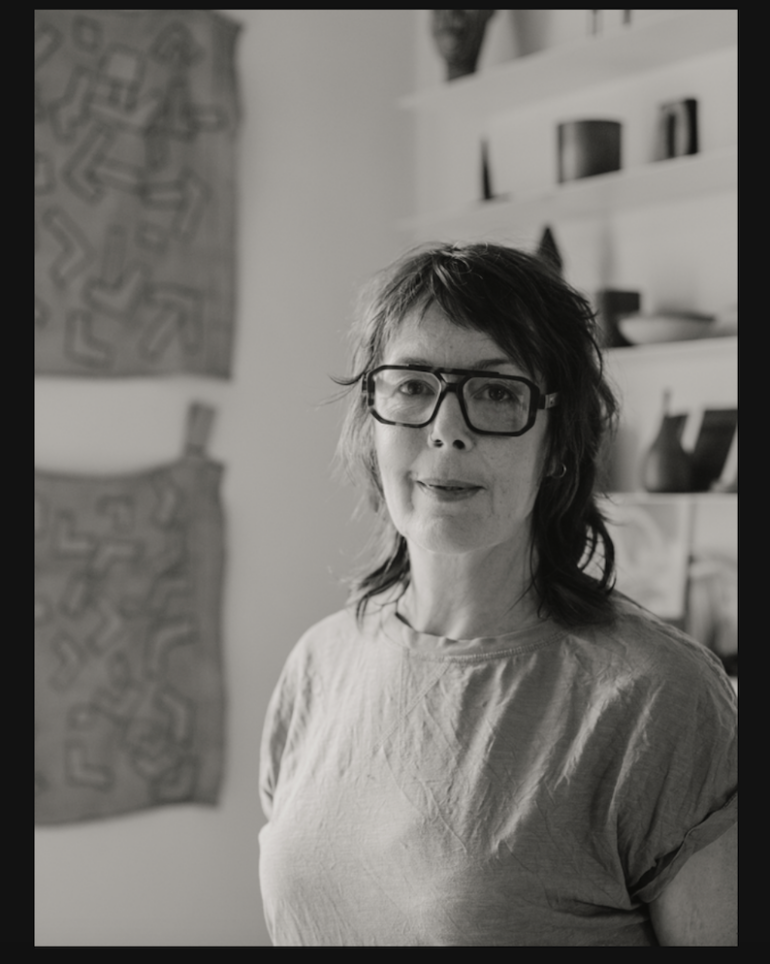
Kate Williams’ multidisciplinary practice spans sculpture, textiles and installation, examining the seductive relationship between illusion, comfort and self-estrangement. In her forthcoming solo exhibition, Our Own Device, Williams brings together two interconnected bodies of work, Pool (2024) and Soft (2025), exploring the psychological and material dimensions of surrender. Through quilted architectural fantasies, trompe-l’œil perspectives and tactile, padded forms, she creates environments that oscillate between pleasure and unease, intimacy and disorientation. Materiality becomes a vehicle for psychological enquiry, as the allure of softness and the artifice of imagined spaces expose the tensions between desire, agency and escapism. Across the exhibition, Williams considers how willingly we inhabit illusions of our own making, and the complex price of seeking refuge in comfort.
Our Own Device brings together two bodies of work, Pool (2024) and Soft (2025), which explore illusion and material seduction respectively. How have these distinct strands of your practice evolved, and what led you to bring them together in this first solo exhibition?
The two strands of my work have always had something in common – the idea that we can be completely aware we’re being seduced, and still want to give ourselves over to it. Perhaps that awareness actually makes the seduction more powerful because there’s a peculiar pleasure in that complicity. There’s something so alluring about surrendering to a world we know is imaginary.
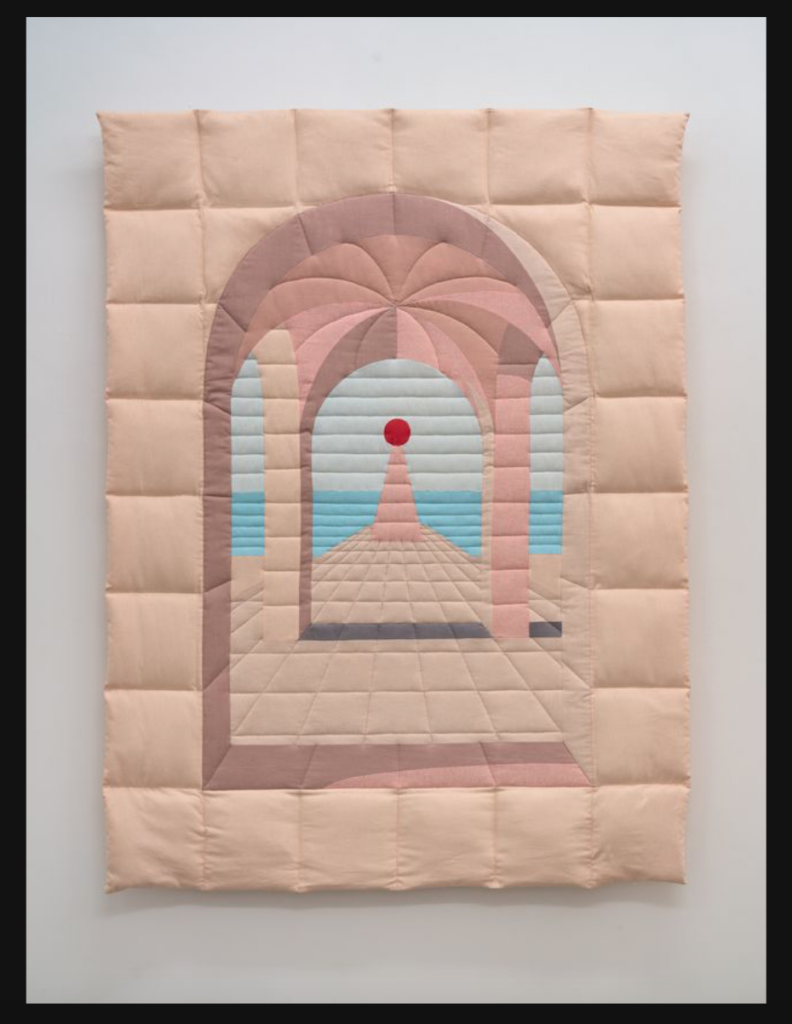
In terms of their evolution, Pool came first. It’s a series of quilted works depicting imaginary architectural spaces, constructed through exaggerated perspective and trompe-l’œil. They feel dreamlike, playful and slightly unsettling, and explore those pleasures of artifice and illusion.
Soft is a series of sculptural works using quilting, padding and bodily forms to explore comfort, self-soothing and our desire to retreat from the friction of everyday life.
What connects the two is a kind of willing self-estrangement – the attraction of getting lost in an experience, even if there’s a possibility we won’t find our way back.
In Our Own Device I’ve brought these two strands together in an exhibition, and in the installation The Cruel Optimists they meet within a single work.
At the heart of the exhibition is The Cruel Optimists, your first site-specific installation. What was the starting point for this ambitious work, and how did you approach transforming the gallery space into an immersive environment?
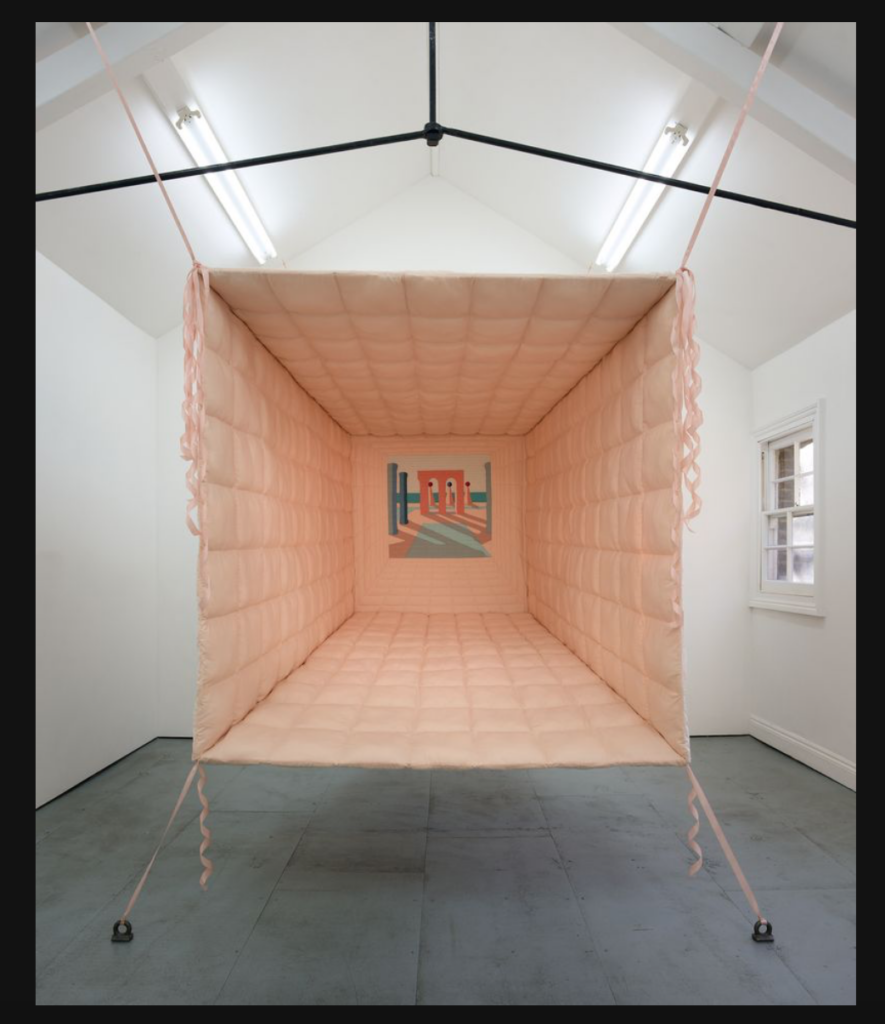
I wanted to bring the illusionist architecture of Pool together with the tactile, padded forms of Soft, and to make something that occupied real space rather than simply representing it.
It’s a suspended, quilted architectural structure, with an exaggerated perspective which draws you towards a landscape at its far end. It’s unclear whether we’re looking at a decorative trompe-l’œil, or through an aperture into another world. I don’t really want to resolve that.
And it’s deliberately difficult to place as an object. It could be a viewing device, a miniature puppet theatre, a jewellery box, or a conveyance – perhaps Cinderella’s coach. I like the way it seems to belong to several different worlds at once.
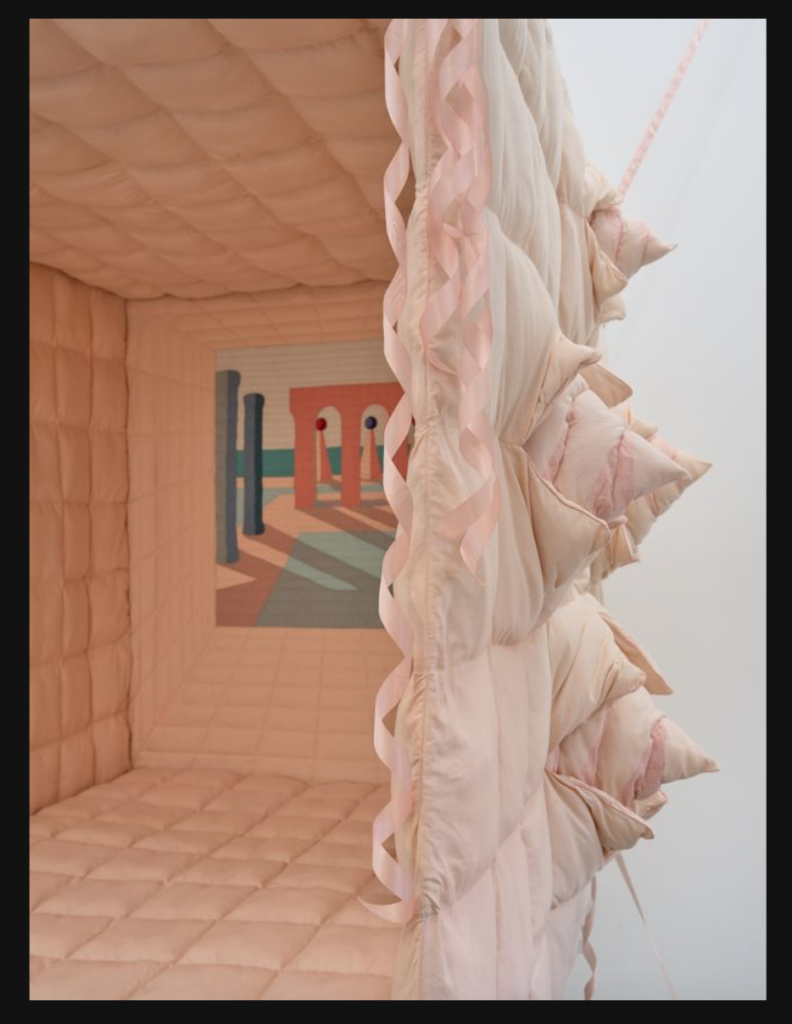
The ribbons make it seem almost weightless, but they also tether and restrain it. And the padding is luxurious and inviting, but there’s also something of the padded cell about it.
Then there are these excessive, ice-cream-like forms pushing through the outer surfaces of the architecture, as though something inside is swelling and forcing its way out. They’re delicious and slightly grotesque. I love the tension between the carefully controlled perspective and these unruly, bodily forms, where ornament starts to overwhelm the structure it’s supposed to embellish.
There’s a sense of suspension running through the work, literally and figuratively. It offers the prospect of another world, but keeps us in a state of anticipation, never quite allowing the promise to be fulfilled.
Your work seems to celebrate artifice rather than try to expose it. What interests you about the pleasure of knowingly entering an illusion, and how might that relationship be changing in the age of AI?
I’m fascinated by the pleasure we take in things we know to be artificial. I don’t see illusion as something inherently deceptive or dangerous – the opposite, in fact. Our capacity to enter worlds we know to be constructed is fundamental to imaginative life.
So I’ve always been captivated by the Rococo, for example, even though I’m the least frou-frou person in real life. I love its theatricality, sensuality and unapologetic decorative excess. There’s no pretence that what we’re experiencing is natural or authentic. The artifice is an intrinsic part of the pleasure.
But of course our relationship with artificiality is changing. AI increasingly shapes how we encounter images and each other, but the boundary between the real and the constructed – the frame around the illusion – is much harder to recognise.
So it’s not so much whether something is real or artificial that matters to me, it’s whether we recognise what kind of experience we’re having. Who or what is shaping it, and how much agency do we retain within it? What happens to our inner lives when that frame becomes harder to locate?
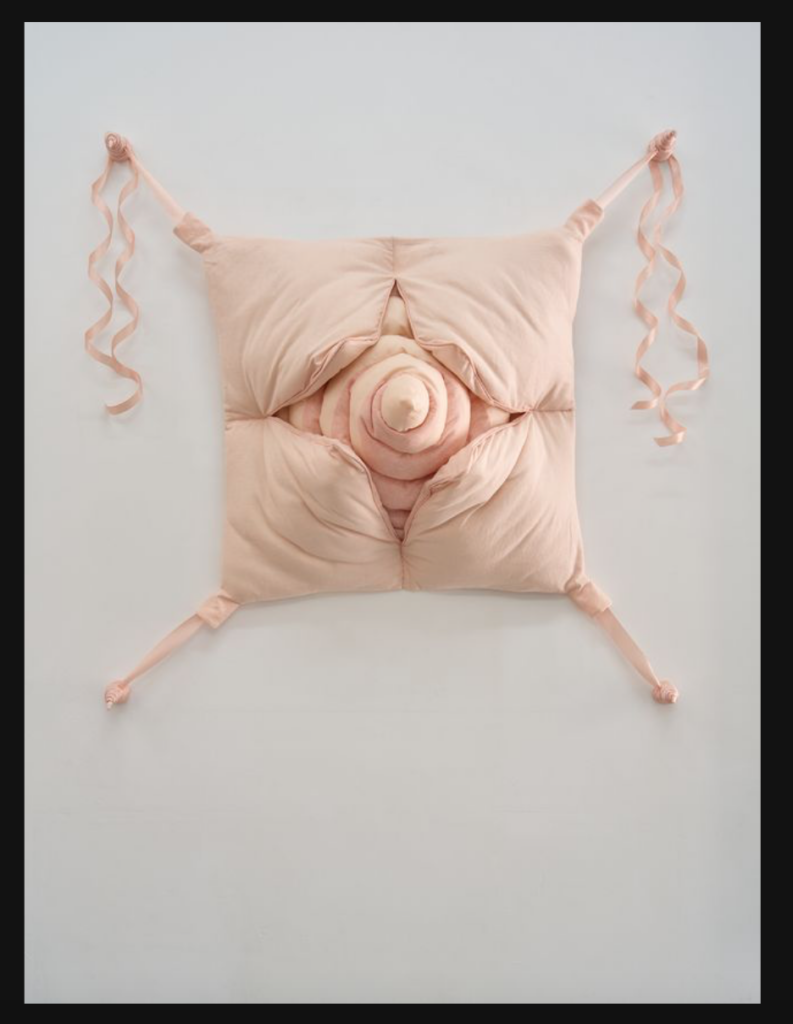
Soft series – Kate Williams
Before turning to sculpture and textiles, you made documentary films exploring pornography, surveillance, consumption and representation. Do you see a continuity between that work and what you’re making now?
Yes, though obviously the work itself is very different.
My films explored some of the ways images, desire and power can become tangled. Those concerns haven’t disappeared, but rather than examining the mechanisms of representation directly, I’m now making objects and environments that I hope invite a more immediate, physical response. So the viewer becomes implicated in the very thing the work is exploring, which I like.
There’s something about quilting that really meshes with that. The stitching pulls fabric over padding, creating dimples, hollows and swelling surfaces. Something that initially appears to be an image turns out to have volume, softness and a bodily presence of its own.
I’ve always been drawn to psychoanalytic ideas about desire, fantasy and the unconscious, and underwent an analysis myself a few years ago. I think some of that thinking inevitably finds its way into the work, even if I’m not consciously setting out to put it there.
So those surfaces invite touch, or at least the fantasy of it. They provoke an almost erotic reflex, a desire to press into them, and when that impulse can’t be fulfilled, the physical energy has nowhere to go. It rebounds back into the viewer’s awareness of their own response, producing a slightly uncomfortable mixture of attraction, frustration and unease.
And there’s something slightly absurd about using a medium so associated with warmth and comfort to construct these elaborate, improbable, empty architectural spaces. That incongruity is part of the pleasure for me.
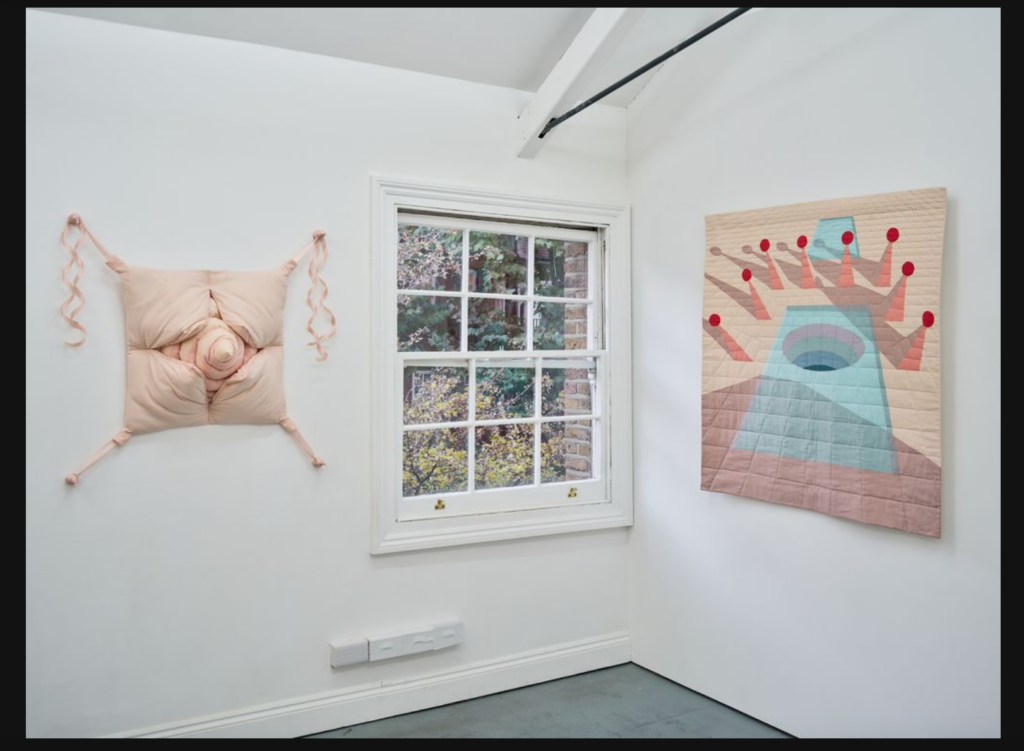
The title The Cruel Optimists playfully references Lauren Berlant’s concept of ‘cruel optimism’, in which the things we desire can also become the things that hold us back. Your work often explores the relationship between comfort, self-soothing and dependence. How do these psychological ideas inform your practice?
It was actually the title that first grabbed me – the gorgeous paradox of Cruel Optimism. It has an almost theatrical, allegorical quality that appealed to me. It could be the title of a Rococo painting.
But Berlant’s ideas do resonate with the work, particularly the thought that it’s precisely our attachment to things that promise happiness or fulfilment that can obstruct our flourishing. Those attachments aren’t personal failings – they’re functions of the social conditions we live within.
There’s a contemporary impulse to be soothed that I find fascinating – a desire for comfort, protection, perhaps a kind of weightlessness, without gravity or friction. I can understand that desire completely. But perhaps we need friction, gravity, to know that we’re here.
Soft actually began with the idea of the padded cell, which has found its way into The Cruel Optimists too. It’s another delicious paradox – that something associated with confinement and loss of freedom might also be experienced as a seductive retreat, somewhere we might willingly choose to withdraw into.
I like that The Cruel Optimists doesn’t resolve any of these contradictions. Who are the cruel optimists? The makers of seductive worlds, or those of us who willingly enter them? And where does the cruelty lie – in the seduction itself, or in the conditions that make us desire it?
All photos by Tim Crocker
For More Information Visit https://katewilliamsstudio.com