
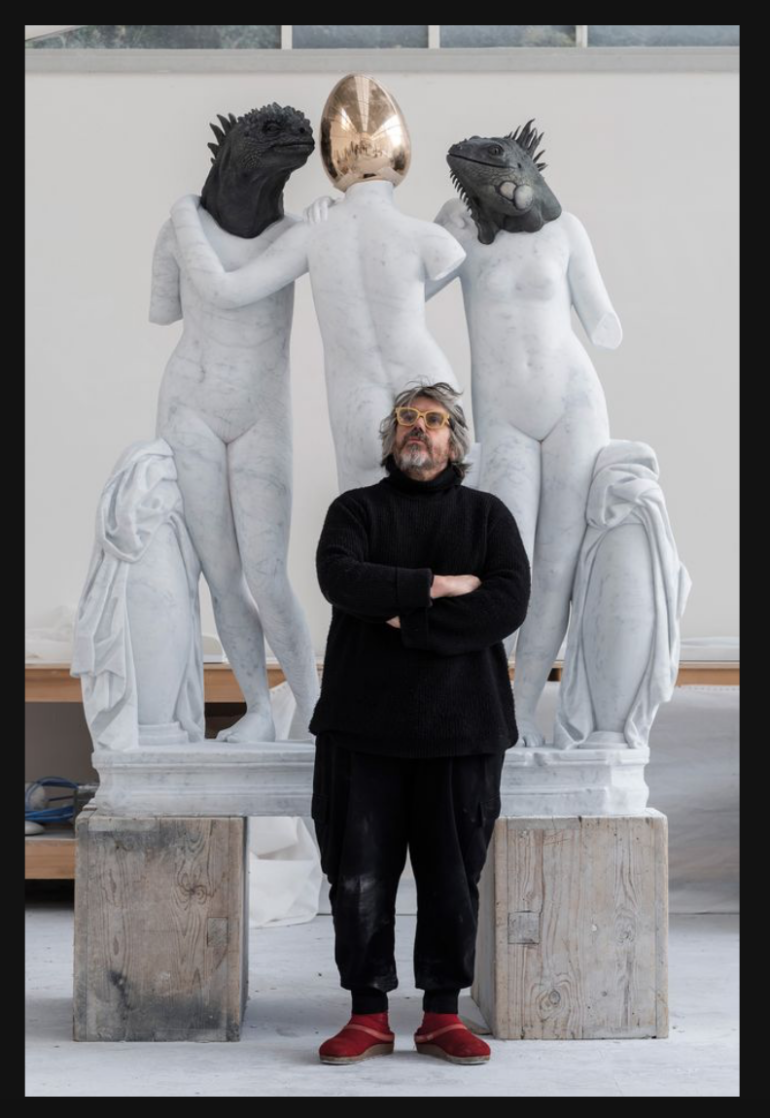
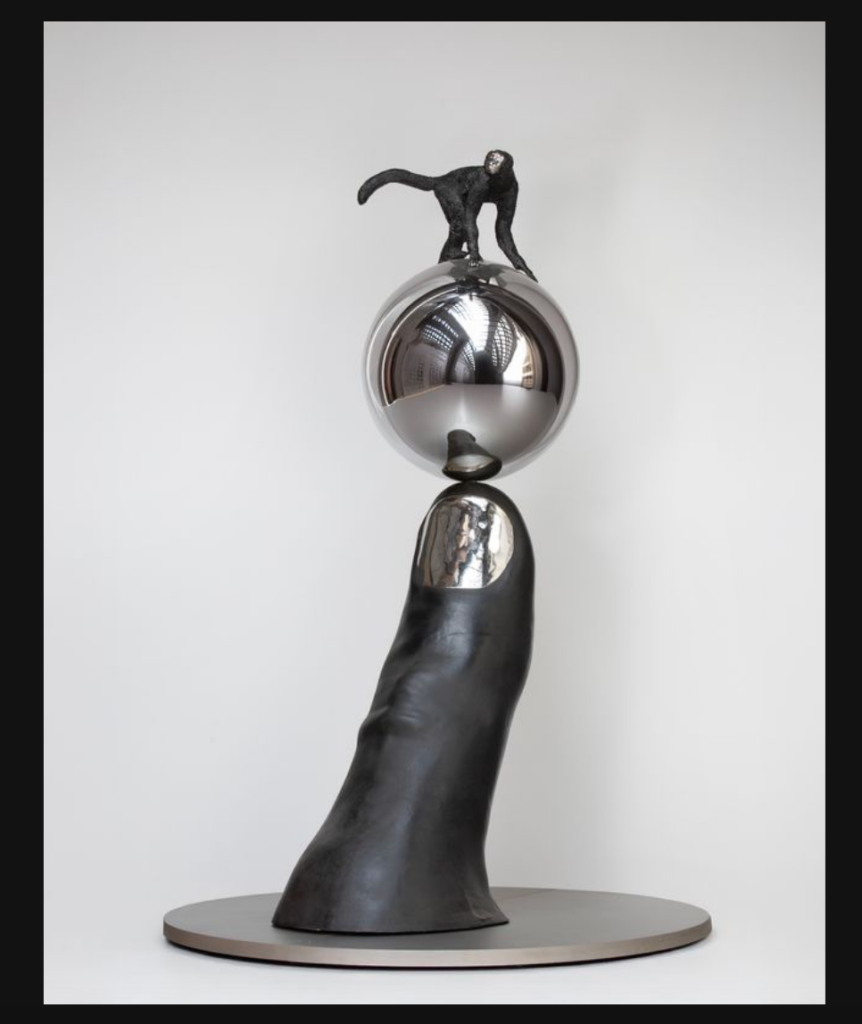
At COP31 in Antalya, Belgian artist Koen Vanmechelen brings the climate crisis into sharp sculptural focus, exploring humanity’s fragile relationship with the natural world and the interconnectedness of all living things. Presented as part of the official COP-ART programme, Still Possible, his monumental stainless-steel sculpture We Thought We Were Alonedepicts an ape poised on a mirrored sphere, balanced precariously on a human thumb. A potent meditation on coexistence, vulnerability and shared responsibility, the work challenges the illusion of human exceptionalism, suggesting that our future is inseparable from that of every other species.
ANTALYA – COP31 opened with little prospect of major climate agreements. In the conference’s Green Zone, however, the official art programme COP-ART is showing work under the motto ‘Still Possible’. “I firmly believe that a future exists, and that artists can show the way to it,” Belgian artist Koen Vanmechelen told CNN Arabic in an interview. He is exhibiting two sculptures at the summit.
The wars in Ukraine and Iran are driving up energy prices. The United States has withdrawn from the Paris Agreement, and global warming is approaching 1.5 degrees. Observers expect, at best, modest agreements between groups of countries in Antalya. Artists, however, have a place in the summit’s official programme. In 2009, Vanmechelen spoke on the fringes of COP15 in Copenhagen. In Antalya, COP-ART has selected work by 70 international and 120 Turkish artists.
Not Alone
COP-ART curator Nagihan Ozel explains why Vanmechelen was invited. “We invited Koen Vanmechelen because his art has long been ahead of the debate taking place at this conference. His work tells a truth that lies at the heart of the climate crisis.”
“There is a future, and several paths lead to it,” says Vanmechelen. “The task is to find the right one. That is what artists and writers are for. They can make those possible paths visible, both to the people negotiating in the Blue Zone and to those walking around here in the Green Zone.”
“The future is a cosmopolitan renaissance,” he says. “In it, humankind redefines its relationship with nature, with diversity as a precondition for survival.” He draws on his Cosmopolitan Chicken Project, in which he has been crossbreeding chickens from different countries since 1999. The project now spans
31 generations. In We Thought We Were Alone, his exhibition during the Venice Biennale, he sketches that future. At the Palazzo Rota Ivancich, visitors descend into a world of hybrids and shamans, as if entering a prehistoric cave. Here, the boundary between human and animal keeps shifting. In the accompanying book, evolutionary biologist Menno Schilthuizen and cosmologist Thomas Hertog, among others, explore what that world might look like.
A thumbs-up
At COP31, Vanmechelen gives these ideas sculptural form. The title work We Thought We Were Alone is a stainless-steel sculpture almost three metres tall. It depicts an ape on a mirrored sphere balanced on a human thumb. On Sunday, a class of Turkish schoolchildren stood in front of the sculpture. Vanmechelen watched them gaze at the globe and see their own reflections, distorted by the curve of a world resting
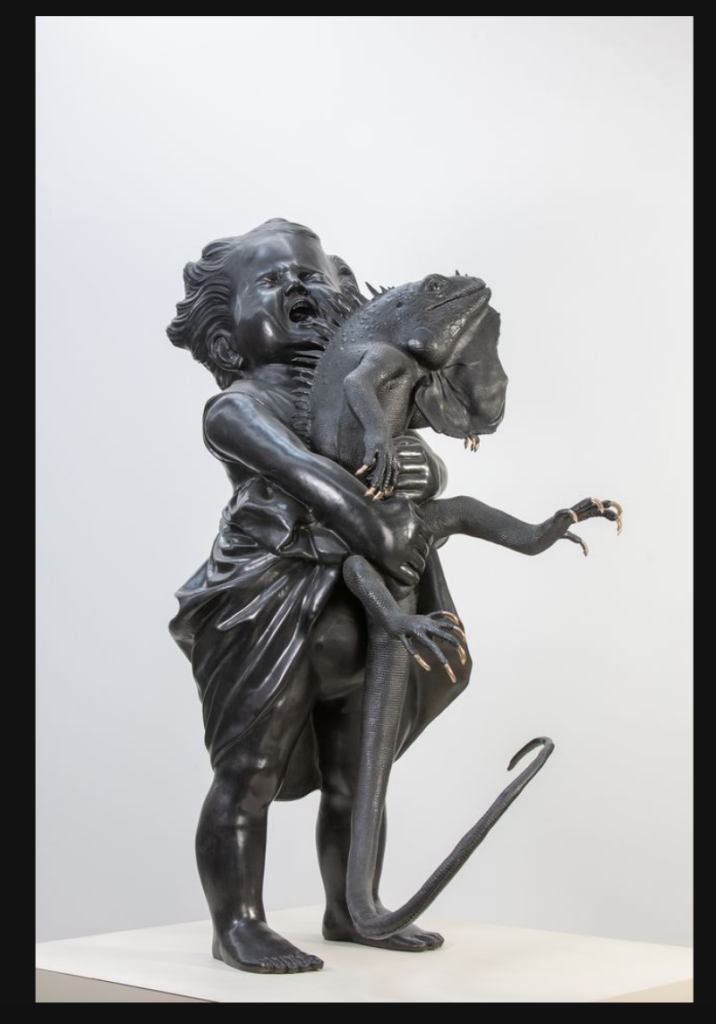
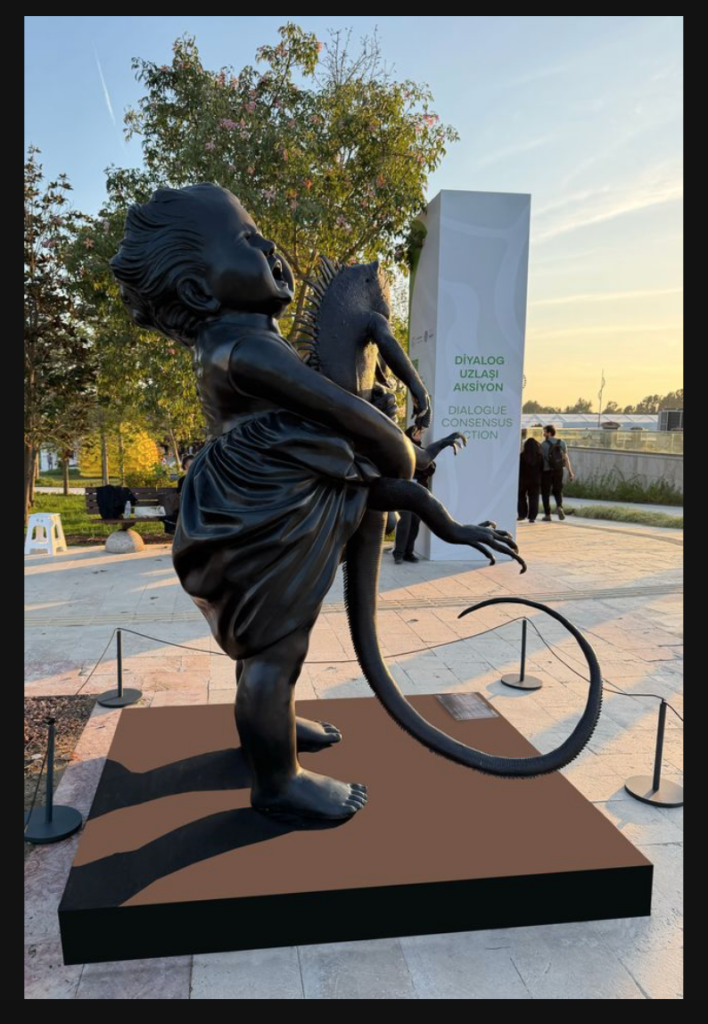
on that single thumb. “The sense of wonder was inspiring.” Outside stands the bronze Cosmopolitan Fossil, in which a child leans back under the weight of an iguana.
During the CNN Arabic interview, Vanmechelen walked through the Green Zone with Nourhan Elkallawy, explaining how he made his sculptures and linking them to the climate talks. “It sometimes seems as though the climate has been pushed into the background, but the wellbeing of nature, and our place within it, remains a matter for all countries together. Anyone who keeps working on a different story deserves a thumbs-up, not the middle finger. All the more so now that their efforts risk being drowned out by other voices.”
The power of a ‘biennale’
This weekend, the conference’s publicly accessible area drew visitors from Antalya and as far afield as Ankara, Izmir and Denizli. Many were school pupils and students. Here, they mingle with experts, ambassadors and ministers. “That gives the site the power of a biennale,” says Vanmechelen. “Culture is the bedrock of change. It speaks a language people understand better than policy, and one that cuts deeper.”
Where science and politics often begin with figures, agreements and targets, art can set something else in motion: a shift in how we see and relate to the world around us. It creates space for imagination and for perspectives that may not yet have a place in existing solutions.
Vanmechelen has already given a lecture at the China Pavilion at COP31. On 18 November, he will speak again in Antalya at the Arthub, during the thematic day devoted to human and social development. He then travels to Shanghai, where his exhibition We Thought We Were Alone opens at the China Art Museum in the week of 7 December. The exhibition takes place as Belgium and the Republic of China mark 55 years of diplomatic relations.
Practical information
COP31, Green Zone, Antalya EXPO · 9–20 november 2026 · free registration via cop31.tr/register-to-visit
Lecture by Koen Vanmechelen · 18 november We Thought We Were Alone,
Palazzo Rota Ivancich, Venice · until 22 november 2026