

Shuang Li Alliance opens at Kunsthalle Basel to coincide with Art Basel, running from 12 June until 13 September, 2026.
The temperature drops rapidly, light shifts from bright to dark, and the air grows heavy, as if it had gained weight. A tornado seems to be building in the exhibition spaces of Kunsthalle Basel. In her first institutional solo exhibition in Europe, Alliance, Shuang Li (b. 1990) turns to the search for storms not only as literal and physical natural phenomena but, more importantly, as metaphors for the highly mediated realities and digital forces that shape and permeate our everyday lives.
The exhibition centers on the premiere of Li’s most ambitious video installation to date. The film follows three main characters, all portrayed by the same “actress”: a sex doll. Accompanied by a film crew, they devote themselves to “storm chasing”—the deliberate pursuit of severe weather events such as tornadoes. Loosely scripted, the film unfolds through a series of unexpected encounters that emerge in real time. This search develops through a sequence of spatial and atmospheric stages. Each of the five exhibition spaces corresponds to a progression on the journey, ranging from everyday observation and the onset of the chase, building in intensity, to the climax in the eye of the storm itself.
People chase storms for many reasons: a fascination with meteorology, a sense of awe at the majestic power of nature, or simply the thrill of an adrenaline rush. Much of a typical storm-chasing day involves long drives across open landscapes, guided by forecasts, yet marked by a constant sense of uncertainty. Li extends this forward-moving trajectory into the exhibition space itself. The rooms become the foundation of a road that winds through heightened, almost overexposed landscapes, passing by film stills and a meteorological map displayed like over-sized roadside billboards.
Here, the search for tornadoes reflects a present characterized by constant circulation. Tornadoes, livestreams, media systems, and digital infrastructures act as forces that are simultaneously distant and menacingly close, physically palpable yet elusive, always in motion and never fully controllable.
Entering Alliance means embarking a journey: a state of motion on unstable ground unfolding across the exhibition spaces. Amidst fragmented landscapes, billboards, flickering lights, and shifting weather maps, movement itself becomes the only form of orientation. Shuang Li stages the exhibition as an ongoing attempt to catch a tornado.
The image of the extreme storm functions for Li both as a concrete meteorological event and as a metaphor for contemporary media environments and their incessant circulation of information. Much like tornadoes forming over flat landscapes, today’s media infrastructures operate via conditions of leveling. Everything appears equally accessible and immediate until one is suddenly drawn into a maelstrom of attention, data, and obsession. The metaphor also speaks to the circulation of information—the past constantly being stirred up; the dust of the past never settles as time passes, as if trapped in a tornado loop for an eternity. Throughout the exhibition, Li translates this oscillation between horizontal plane and vertical suction, drift and compression, into spiraling forms and immersive spatial situations.
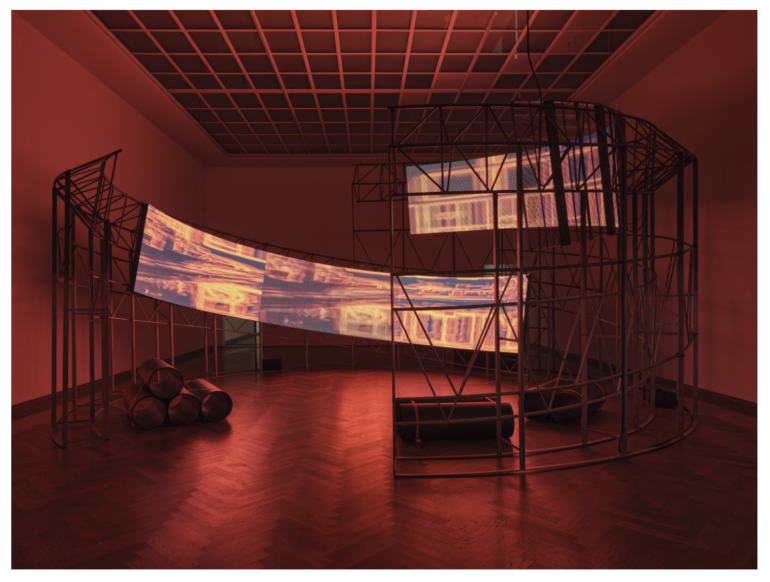
The Middle of the Day That Starts It All (2026) marks the beginning of the expedition. Across thirteen TV screens, images unfold in relentless loops. Landscapes appear as narrow fragments glimpsed from a moving vehicle, digitally amplified to the point where they begin to dissolve before they can fully stabilize. The work functions like a sequence of B-roll footage from a road movie—comprising atmospheric shots of landscapes, the sound of conversation fragments, and passing environments. The installation is embedded in an architecture of metal structures that resemble a section of a rural roadway. Lifted up from the ground itself and gradually losing stability, the material winds through the space as though it can no longer withstand the force and velocity of the movement.
It is in the pursuit of the storm that images become increasingly unstable. The billboard-like works Fire at Will, Stolen from My Eyes,andInterlude (all 2026) layer video stills, private archives, and meteorological maps into shifting lenticular prints. Images no longer possess a fixed beginning or end; they circulate in a state of continual displacement. Landscapes dissolve into gestures, flickering lights into handwritten
notes, weather maps into bruises on a body. Interlude spreads across the floor, its individual parts like detached pixels. Sculptures modeled on meteorological wind barbs have settled upon them—everyday objects preserved in resin, like condensation droplets gathering on smooth surfaces before the storm.
Li approaches digital technologies not as isolated tools or objects but as forces permeating everyday life. Online platforms, infrastructures, and data streams shape communication, mobility, intimacy, and social relationships. They determine how identities form in a state of endless circulation and dictate the rules under which it is still possible to forge connections. With a Trunk of Ammunition Too (2024) translates these conditions into an intimate register, and the dynamics of the exhibition briefly decelerate. Movement yields to a temporary suspension. Morse-code lights illuminate the space, translating a letter the artist wrote to her mother into coded intimacy. Li’s voice remains audible throughout the room, as though slowly drawing the dormant vortex back into circulation.
Entering the final space, the tornado’s force rises as swirling structures soar, as if the wind itself had taken on the materiality of steel. Alliance (Heart Loop) (2026) offers immediate immersion in the storm’s power. Blending the aesthetics of a documentary, a DIY road-trip movie, and a livestream, the video work brings the search for a tornado to life. The film follows multiple figures on their individual storm-chasing journey. Roads, gas stations, industrial buildings, and open fields appear simultaneously familiar and alien. The gradual collapse of the distinction between physical and digital environments blurs the boundary between the two. The sex doll protagonists are driven by a shared desire to enter the tornado itself, hoping to emerge transformed on the other side. Once human, but having lost agency in the storms of digital and algorithmic forces—their desire to reclaim what was taken away by the wind in the first place makes this their final attempt to reclaim agency.
It is in the film that the tornado becomes legible as a symptom of a flattened media landscape in which everything is continuously available all at once. Decisions become unstable as data streams, and swirling information flows continuously organize perception. What appears to be an individual choice is already shaped within these circulating systems. The tornado stands for surrender to the storm, to its pull, and to everything it sweeps away, for the desire to lose oneself within it and perhaps, precisely through this loss, to continue to exist.
Find more information here.