

The Musée d’Art Moderne de Paris presents Kerry James Marshall: The Histories, the first major exhibition in France dedicated to the influential American artist.Originated by the Royal Academy of Arts in London in collaboration with the Kunsthaus in Zurich, the exhibition features seventy works spanning more than four decades, including eight new paintings and highlights Marshall’s powerful reimagining of art history through the representation of Black life. Bringing together paintings, drawings, prints, and sculpture, this landmark show offers a compelling overview of an artist whose work has reshaped contemporary painting.
Considered one of the most influential contemporary painters, Kerry James Marshall is known for his large-scale compositions that centre Black people, frequently elevating the everyday to the epic. By inserting Black figures into art historical archetypes, the artist invites the viewer to witness the undeniable power of presence. Kerry James Marshall addresses themes including the Middle Passage and the legacies of the Civil Rights and Black Power movements, without directly depicting violence or alienation. His work draws inspiration from both the Western art historical canon and other pop cultural forms of visual expression, especially nineteenth-century French painting, contemporary culture, Afro-futurism, comic books, and science fiction.
Organized with the artist’s support, the exhibition covers over four decades of his career. It brings together many bodies of his work, with primarily paintings, as well as examples of the artist’s prints, drawings and sculpture, from museums and private collections across North America and Europe.
In paying tribute to the work of Kerry James Marshall, the Musée d’Art Moderne de Paris is continuing its series of pioneering monographic exhibitions in France devoted to Black American artists, notably Kara Walker (2007) and Jean-Michel Basquiat (2010). Kerry James Marshall works in series and cycles, as reflected in the exhibition’s chronological-thematic arrangement, which showcases eleven groups of works made between 1980 and the present
The exhibition opens with the artist’s early mature works, created in the 1980s, including Invisible Man (1986), inspired by Ralph Ellison’s eponymous novel (1952). This section establishes Kerry James Marshall’s concern with depicting Black figures, while also raising questions about representation in art history and who and what has been excluded. The artist’s radical approach—using a range of black pigments mixed with other colors—affects the viewer’s perception of his figures. The second gallery displays large canvases dealing with the history of the “Middle Passage,” an expression designating the journey of captured Africans across the Atlantic to be sold as slaves.
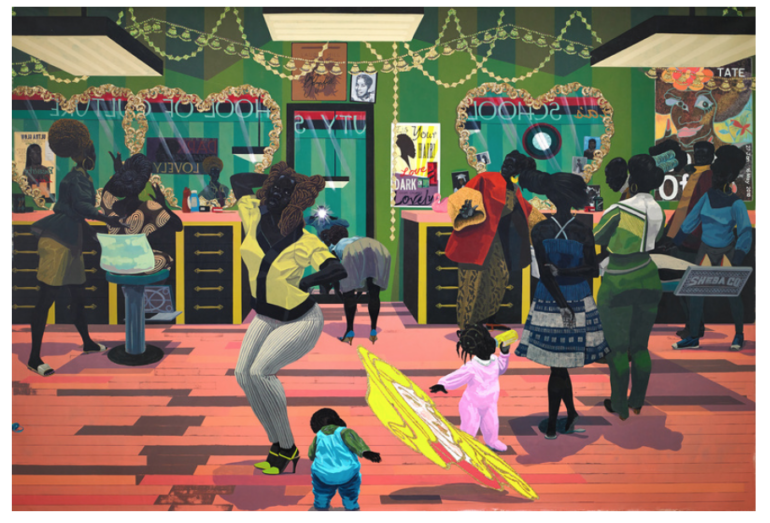
The exhibition continues with a presentation of monumental works illustrating scenes of contemporary life in settings ranging from hair and beauty salons to parks and outdoor spaces. Referencing artists such as Édouard Manet, Gustave Caillebotte, Georges Seurat, and other painters of modern life, Marshall offers a corrective to the absence of large scale images portraying the everyday experience of Black people in the history of Western art.
The series Souvenirs (from 1997 to 1998) takes as its point of departure the American Civil Rights movement; the Vignette paintings (from 2003 to 2014) depict Black couples in a style that draws from rococo paintings as well as American greeting cards. One of the major works in the exhibition is Wake, an accumulative sculpture created in 2003 and enhanced with new medallions each time it is exhibited.
One section groups together imaginary portraits of historical Black figures, such as Scipio Moorhead and Harriet Tubman, examining the way historical portraits can be created in the absence of archives and previous portrayals of individuals. The last galleries follow the development of Kerry James Marshall’s artistic practice, as he reinterprets iconic works of classical Western painting. The 2000s through 2020s underscore the artist’s longstanding interest in the artistic disciplines taught in art schools. One of the major pieces is The Academy (2012), in which a male model posing for a life drawing class holds up his fist in the Black Power salute.
The exhibition concludes with a new series of works. These eight paintings explore lesser acknowledged episodes in African history. Several focus on the transatlantic slave trade, pointing to on the role played by some Africans in the sale of enslaved people to European merchants.
Kerry James Marshall: The Histories is at Musée d’Art Moderne de Paris from 18 September 2026 until 24 January, 2027. Find more information here.