
Words by Maya
When you enter Autograph in Shoreditch, echoey whispers of Thanh Lan’s rendition of Aller Danser draws your attention to the threshold of photographer Nhu Xuan Hua’s exhibition Of Walking on Fire.
Of Walking on Fire (curated by Bindi Vora) exhibits Nhu Xuan Hua’s previous photography series, Tropism, Consequences of Displaced Memory (2017-2022), as well as sculpture and several special examples of new work commissioned by Autograph. Blending the modes of art and fashion photography having previously collaborated with Dior, Maison Margiela, Kenzo and Gucci, Nhu Xuan Hua’s artistic practice reflects on her personal heritage as a woman born in Paris to Vietnamese parents.
Of Walking on Fire begins with bright red walls contrasting stark black walls that punctuate Autograph’s first gallery space. Here, Nhu Xuan Hua’s photography is installed alongside domestic artefacts. The artwork is displayed, for example, above a mantelpiece, next to a vase, or on a book shelf. This placement of artworks next to domestic objects blurs the line between a detached, professional artistic display, and a personal, more private one.
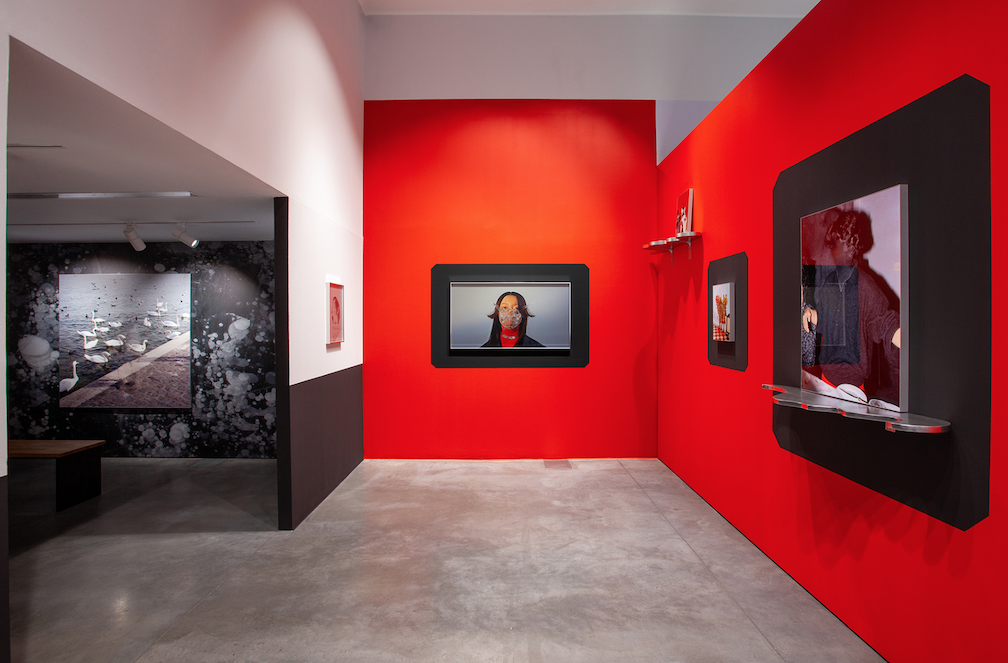
With these touches of domesticity, and a warm, crackly soundscape, Of Walking on Fire is an exhibition that reports on something close to home, in a way that doesn’t feel completely comfortable.
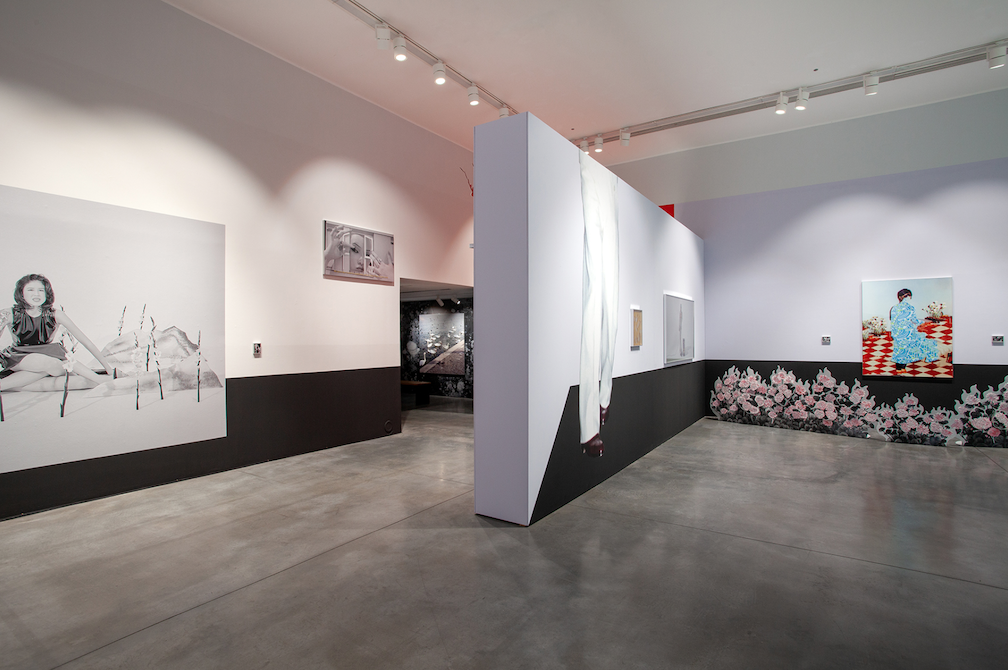
Nhu Xuan Hua’s images from her print series Tropism, Consequences of Displaced Memory dominate the first gallery in the exhibition. Playing on the uncanny, these images first appear as if they could simply be family photos until spectral outlines become visible once you look closer.
For example, Swan – Archive from the year ‘00 (Giclée print under plexiglass), at first glance, is an ordinary, familiar image of a group of swans at a lake. You could easily walk past this piece without observing the shapes of two anonymous people in an embrace. Looking at Nhu Xuan Hua’s work mimics recalling a memory, although the general gist of a setting or atmosphere is in place, the mind has to search for the lost details.
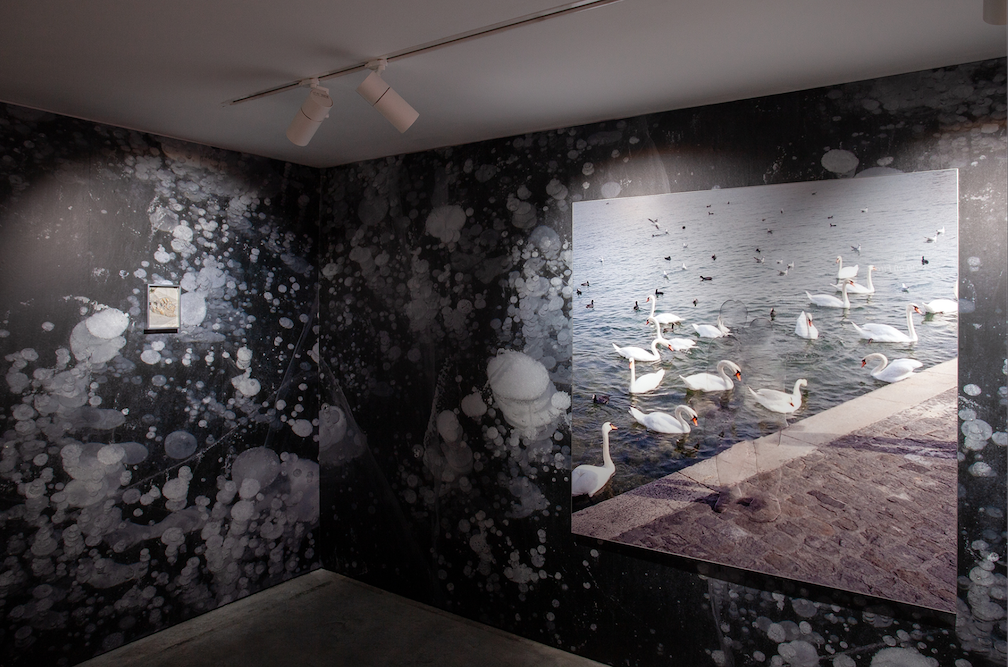
There’s a missing piece, an unknown, forgotten, or redacted piece of information that is absent from each print in Nhu Xuan Hua’s series Tropism, Consequences of Displaced Memory producing something sometimes nostalgic, and other times disturbing.
Nhu Xuan Hua’s artwork Má – Archive from the year ‘88 (Giclée print under plexiglass) is a dark image of a motherly woman whose face has become transfused and displaced with the background behind it. Displacing someone’s face like this almost displaces their humanity, making the image powerful in both a scary and sad way.
Thanh Lan’s Vietnamese language version of Aller Danser that plays as a soundtrack in the first gallery receives the same treatment as Nhu Xuan Hua’s manipulated photo images. The song is chopped up, the vocals are drowned out, and words become indistinguishable. This version of the song is missing the vital intricacies that would make it sound complete. In this way the soundtrack perfectly engages and enhances the theme of displacement and lost memory in Nhu Xuan Hua’s artwork.
Thanh Lan, the Vietnamese-American singer, becomes a thread uniting the first gallery of the exhibition with the second. Her version of Aller Danser plays as a soundtrack upstairs in the second gallery, this time at a faster, more vibrant rhythm that marks the change of mood within the exhibition.
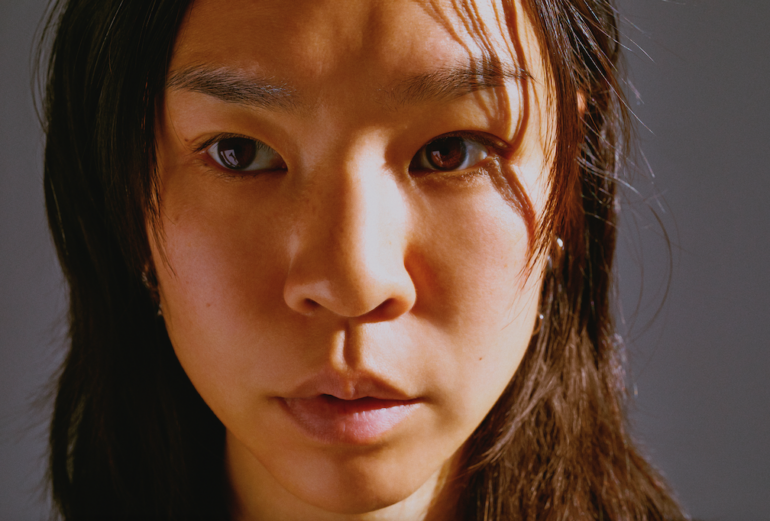
The central piece upstairs is Little Super in Versailles – Archive from the year ‘88 (2026, Giclée print under Plexiglass), an artwork commissioned by Autograph. Set on a pastel purple central wall bordered by sculptural silhouettes of a side profile, the manipulated image depicts a young girl whose face is replaced by the garden behind. Her eyes, however, are suggested by two lilac flashes, which gives the figure a laser-like vision.
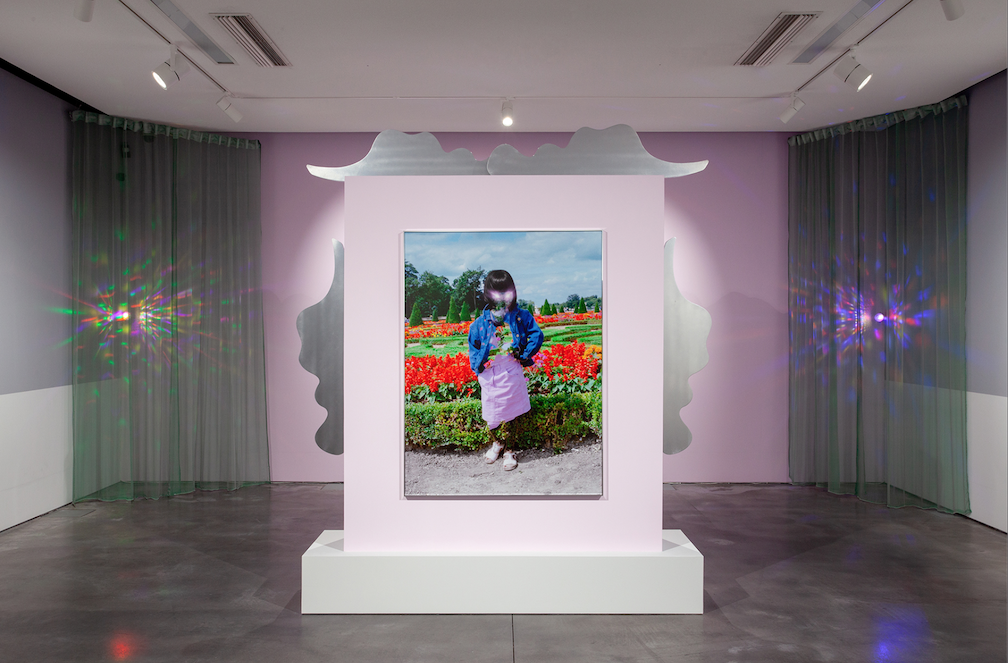
Whereas in her series Tropism, Consequences of Displacement we assume the role of observer alongside Nhu Xuan Hua’s retrospective gaze on her family archives, in Little Super in Versailles – Archive from the year ‘88 we are met with Nhu Xuan Hua’s gaze ourselves if we assume that the image is a self-portrait.
The girl looks back at us with laser beaming eyes, enhanced by disco lights installed by either side of the artwork, which have a playful and yet commanding effect. The tension and darkness that began the exhibition is resolved by the colourful image presented in Little Super in Versailles.
Across its two galleries, Of Walking on Fire successfully presents the journey of an observer who has become comfortable with (and conscious of) being the one observed, as well as the one who returns her vibrant gaze to us.
Nhu Xuan Hua: Of Walking on Fire is exhibiting at Autograph until the 19th of September 2026 at Autograph, EC2A 3BA.
The exhibition is free to visit.
See more information about Of Walking on Fire here: