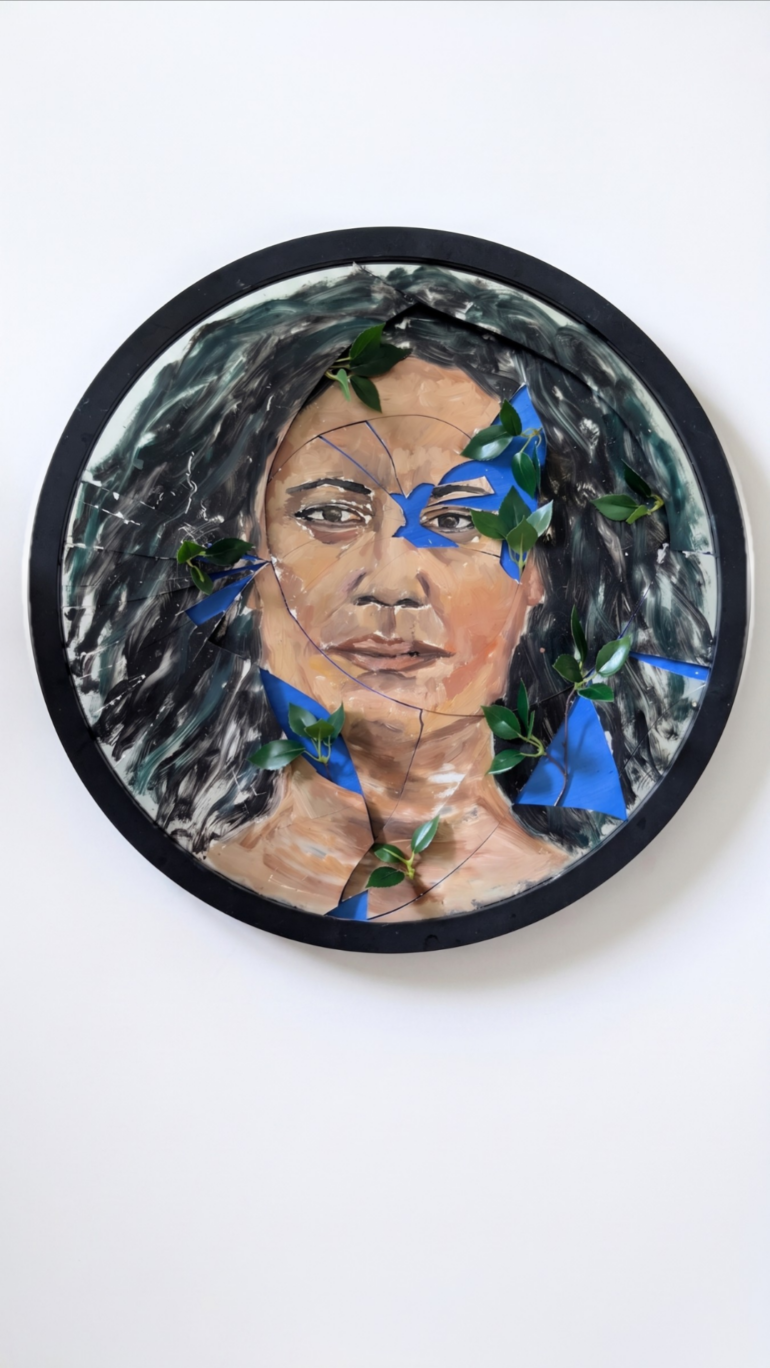
The CAMP Gallery in Miami presents Dissolving Into Becoming, an exhibition of paintings by Samara Couri that transform the environment beyond mere setting and into a living participant in the lives of human beings. The exhibition features new paintings created during the artist’s online residency with the gallery.
Samara Couri’s paintings in the exhibition merge figures with their environmental backgrounds to dissolve the boundaries between the human figure and the natural world. These figures and environments possess a shared ancestral memory that asks viewers to reconsider their relationship with the landscapes they navigate. In describing the work, the gallery writes: “What becomes of our relationship with land when we attempt to separate ourselves? Through recollection and acknowledgement of those who came before us, we recognize the environment as not as a sundered entity, but as our kin.”
In addition to the works on canvas, Couri has also experimented with painting on cotton curtains, creating yet another material exploration of breaking down boundaries between subject and viewer. This approach has led to further explorations of paintings on mirrors beyond the exhibition, which turn the viewer and environment into reflected participants.
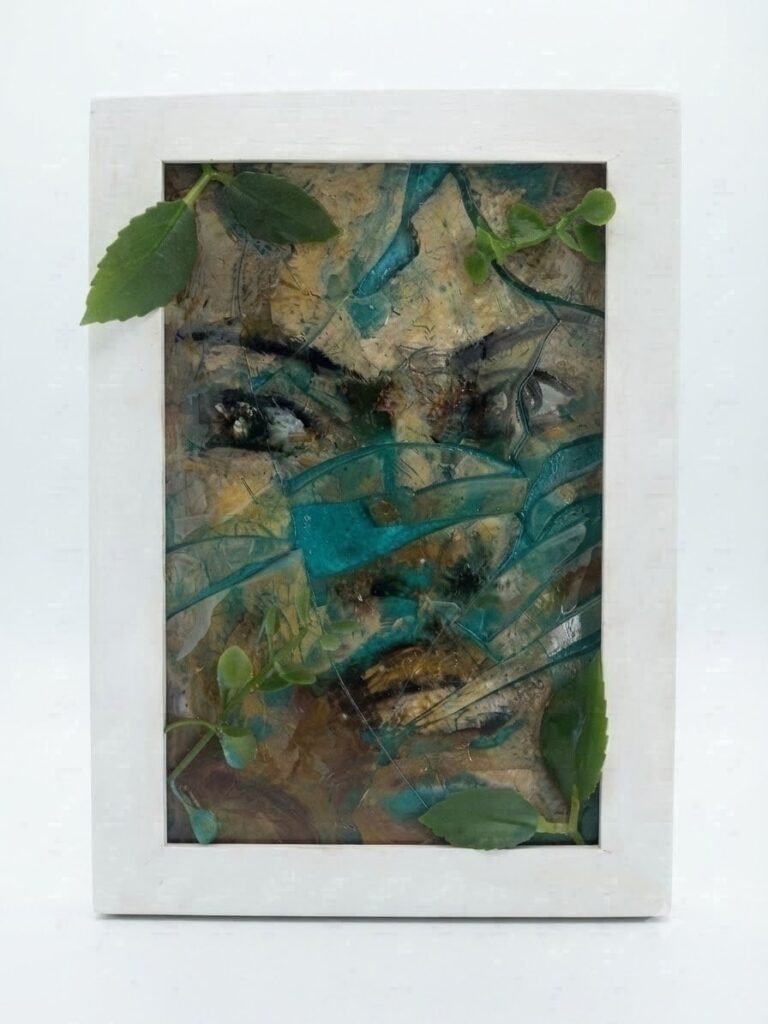
In your exhibition with CAMP, your work describes the environment as “not a sundered entity, but as our kin.” How do you view the relationship between the figure and the natural world?
I see the relationship between the human figure and the natural world as one of profound interconnectedness. We are not separate from nature, nor are we simply inhabitants of it. We are an extension of it. The land, the ocean, the mountains, and the forests are not merely environments that surround us; they are a living presence that shape our identities, carry our memories, and sustain our existence.
This understanding is at the heart of my work, particularly in my exploration of the relationship of Indigenous peoples to their land, such as between the native Hawaiians and their islands. The connection between Indigenous peoples and their ancestral lands is not simply physical, but deeply spiritual, cultural, and generational. The people are the land, and the land is the people. One cannot exist in its fullness without the other.
In my paintings, I explore this inseparability by allowing the human figure to dissolve into its surroundings. The boundaries between body and landscape become fluid, sometimes almost indistinguishable. Brushstrokes move between the figure and the environment, creating a sense that both are emerging from the same energy, breathing the same breath. The figure is not placed within nature as an observer, but exists as an integral part of it.
There is also a spiritual dimension to this relationship. The light that moves through my paintings represents healing, resilience, and the life force that connects all living things. I am interested in the idea that the natural world holds memory, and that we, as human beings, carry fragments of that memory within ourselves.
Ultimately, my work seeks to dissolve the illusion of separation. To view the environment as our kin is to recognize that our relationship with it is rooted in reciprocity, responsibility, and belonging. When we care for the land, we care for ourselves. When the land suffers, we suffer alongside it. And when it heals, we heal together.
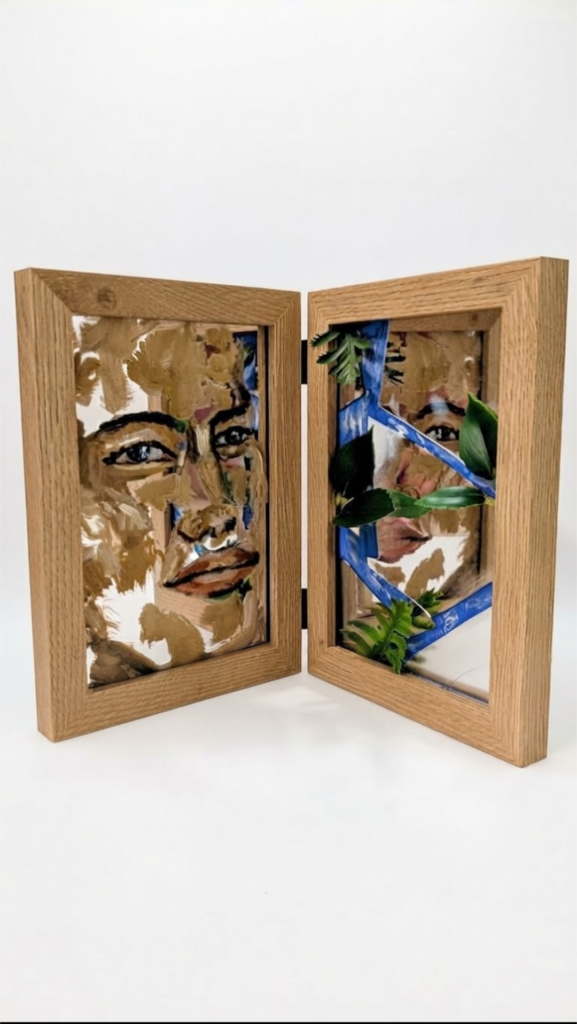
In this body of work you paint on canvas as well as some experimentations on curtains. How did this experimentation come about and how has it informed your process?
My experimentation with curtains came from a desire to explore how painting could exist beyond the traditional boundaries of a canvas mounted on a wall. I was interested in allowing the artwork to occupy space differently, introducing a sense of movement, softness, and freedom into the way it is experienced.
Unlike canvas, curtains have an inherent fluidity. They hang naturally, responding to gravity, movement, and the surrounding space. I wanted to embrace these qualities by creating paintings that could be suspended as curtains would be, rather than confined to the rigidity of a conventional canvas. This allowed the material itself to become an extension of the ideas I explore in my work.
Throughout this body of work, I have been interested in dissolving the boundaries between the human figure and the natural world. Painting on curtains became another way of exploring that philosophy, this time by challenging the boundaries between the artwork and its environment. Just as the figures in my paintings merge with the landscapes around them, I wanted the paintings themselves to feel more integrated into the space they inhabit.
Working with fabric also introduced a different relationship with the painting process. Its softness and flexibility encouraged a more intuitive approach, allowing me to embrace the organic qualities of the material rather than impose the structure of a traditional canvas.
Ultimately, this experimentation has expanded my understanding of what a painting can be. It is not simply an image to be observed on a wall, but something that can exist within a space, responding to its surroundings. For me, this reflects the central philosophy of my practice: that nothing exists entirely in isolation, and that the boundaries we perceive between ourselves, nature, and our environment are far more fluid than we imagine.
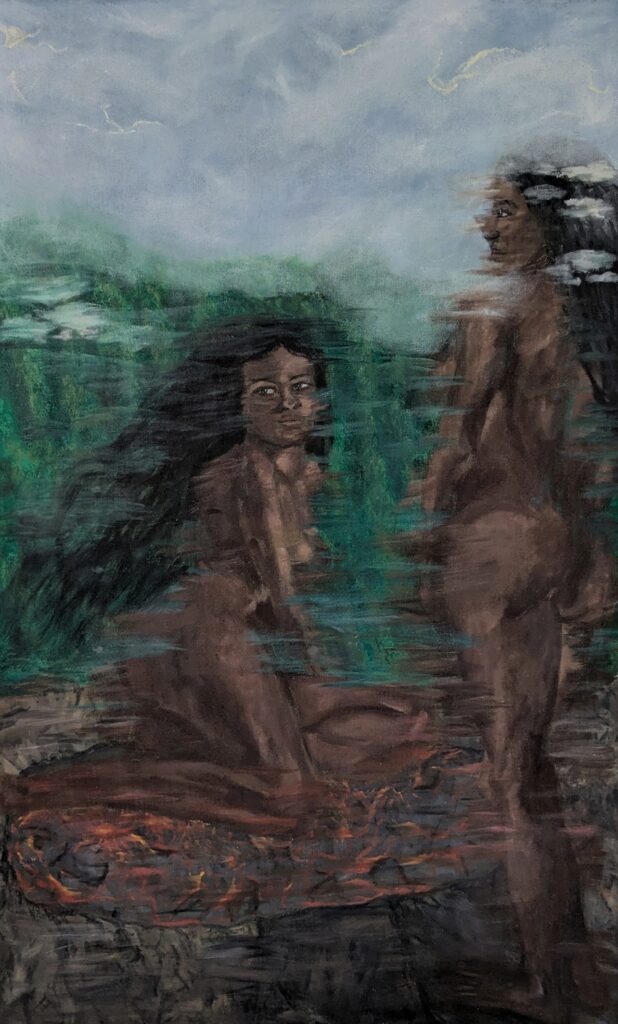
Beyond the exhibition you have returned to more paintings on mirrors. Have the paintings in your exhibition informed these new mirror paintings in terms of how you approach a reflected environment?
It has definitely helped. The paintings I created for the CAMP exhibition have deeply influenced the way I approach my new mirror works, particularly in how I understand the relationship between the human figure, its surroundings, and the idea of reflection.
Throughout the exhibition, I explored the inseparable connection between humanity and the natural world, allowing figures to dissolve into landscapes, where the boundaries between body and environment become fluid. Returning to mirrors, I wanted to take this exploration further, not only through the painted image, but through the physical fragmentation of the surface itself.
In these new works, I paint directly onto framed mirrors before deliberately breaking them and reconstructing the compositions, sometimes leaving fragments missing. These openings allow the space behind the mirror to become visible, while the remaining reflective surfaces capture fragments of the surrounding environment and the viewer. By incorporating plants into the fractures and exposed spaces, I introduce nature as a physical presence rather than simply a painted representation.
I feel there is something deeply symbolic about this process. A mirror traditionally offers us a reflection of ourselves, but once fractured, that reflection becomes fragmented, interrupted, and intertwined with everything around it. The viewer is no longer presented with a complete image, just as the human figure in my paintings is never entirely separate from its environment. The missing pieces are as important as those that remain, creating openings through which something new can emerge.
I am particularly interested in the relationship between destruction and regeneration. Breaking the mirror is an act of transformation. The fractures become spaces of possibility, where nature can reclaim its presence and where the boundaries between the painted figure, the reflected world, and the physical environment begin to disappear.
In many ways, these mirror paintings are a continuation of the same philosophy that guided my CAMP exhibition: that we are not separate from our surroundings, but exist in constant relationship with them. The difference is that the environment is no longer only represented within the painting. It becomes an active participant in the work itself.
Ultimately, I see these pieces as an exploration of how even through fragmentation, we remain connected to something greater than ourselves. There is beauty in what is broken, life in what is absent, and the possibility of renewal in the spaces we leave open.
Follow Samara Couri here.