

Artist Victoria Yuan moves fluidly between painting and digital art in her accomplished practice, creating visionary worlds where bodies, landscapes and spirituality collide with technology.
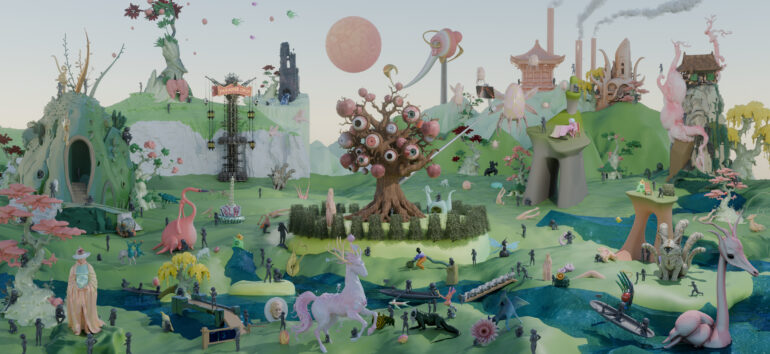
Victoria Yuan’s multi-disciplinary oeuvre spans a wide range, from the candy-coloured Surrealism of digital image The Divine Entertainment Ltd. to the earthy palette and materiality of The Host Body series and cubist landscapes of And Then There Was Light, Yuan’s multidisciplinary practice explores the porous boundaries between the corporeal and imaginary worlds.
Yuan’s art occupies an intriguing space at the intersection of digital fantasy and traditional painterly techniques. She works across traditional and digital media, adapting both to construct environments where distinctions between body and landscape, nature and technology, interior and exterior are increasingly blurred. Central to her practice is an artist’s exploration of a philosophical question: Where does the body end and the world begin? This is a question posed by French philosopher Merleau-Ponty, who disputed the notion of dualism and described perception as a merging of body and environment. There is a kind of dualism found in Yuan’s work, where imaginary worlds such as the one she creates digitally in The Divine Entertainment Ltd are contrasted with paintings such as the The Host Body series, where the hand of the artist is evident through the physicality of the canvases. Her paintings and digital works consequently feel more like visions of parallel universes than representations of a stable reality.
Yuan creates a tension in her work by using different medium, and her digital works are generally transformed into physical prints for exhibition, which creates a contradiction between digital imagery and tangible work of art. Her forthcoming exhibition of The Divine Entertainment Ltd. at the RBSA Annual exhibition brings a digitally conceived imaginary world into the physical realm.
Yuan’s most strikingly exuberant work is The Divine Entertainment Ltd, a madcap universe of pink Unicorns, flamingos, Oriental houses, disembodied legs, animal-human hybrids and a tree covered in red-veined eyeballs recalls the feverish visual world of Hieronymous Bosch, filtered through the sensibility of contemporary digital culture. Architectural fragments and trees covered in apples and eyes replacing fruit, collide in a candy-coloured landscape that is simultaneously grotesque, playful and yet strangely seductive.
The comparison with Bosch is revealing. Where Bosch used fantastical creatures and densely populated hellscapes to construct moral and theological allegories, Yuan transforms the visual density of that tradition into something distinctly contemporary. Her imagery belongs to a world saturated by pop culture, digital imagery and hybrid identities. There are also echoes of contemporary artists who have revisited Bosch, including the Dutch collective SMACK, as well as the hybrid creatures of French artist Amandine Urruty and the densely populated compositions of Korean painter Ryu Noah.
But Yuan’s digital universe is not simply an exercise in Surrealist excess. Beneath its candy-coloured surface lies an interest in transformation: the human becomes animal, the natural becomes artificial, and the familiar becomes strange. In Yuan’s world, the body is no longer a fixed category but one element within a constantly mutating ecosystem.
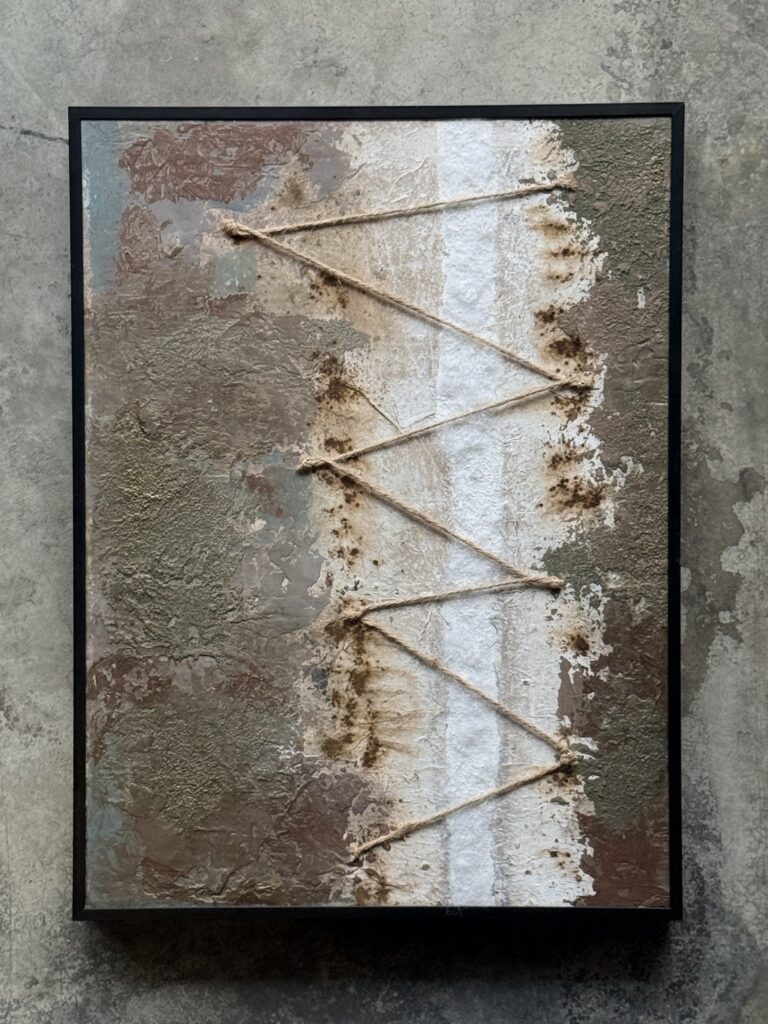
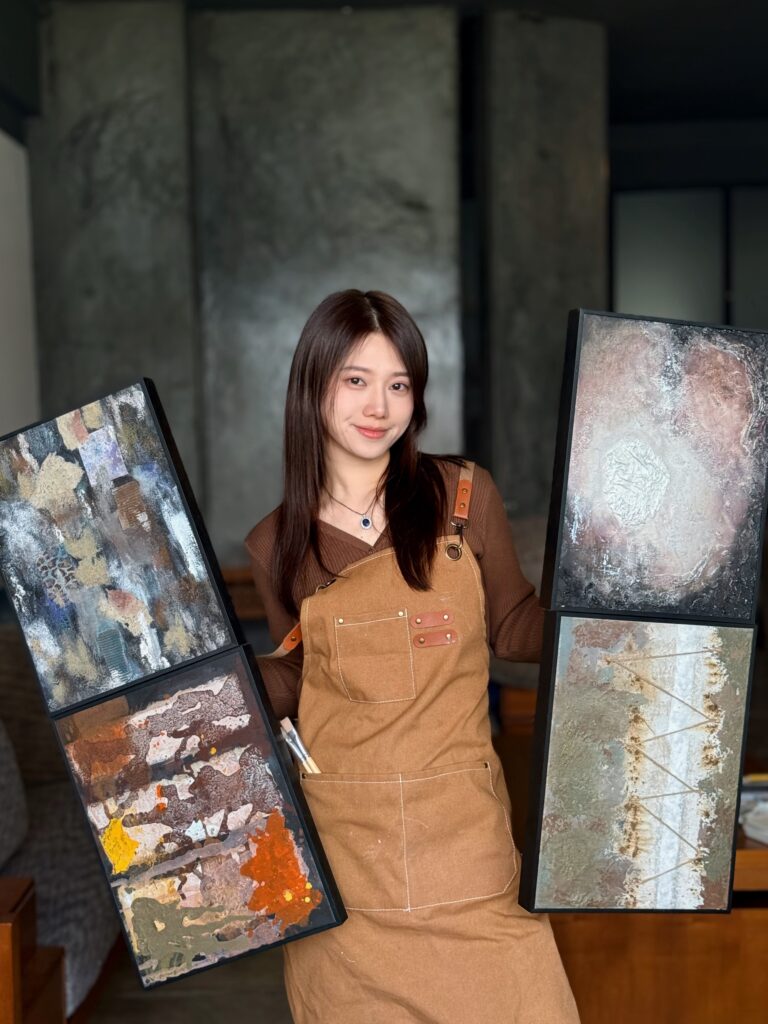
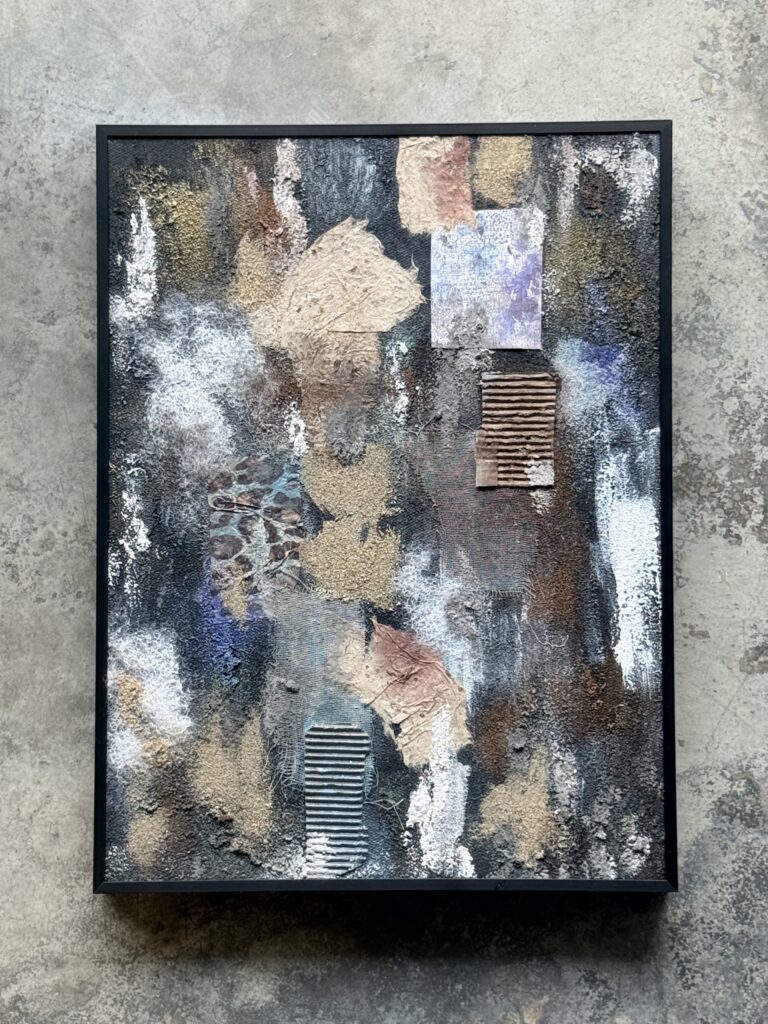
This concern becomes more materially grounded in The Host Body series, where Yuan moves away from the bright palette of The Divine Entertainment Ltd. towards muted, earthy tones. Rope, cardboard and textured surfaces introduce a distinctly corporeal quality, suggesting skin, scars, organic matter and the remnants of an archaeological or ritual object.
The titles of the works: The Host Body I – Suppression (Healing), The Host Body II – Anomaly (Newborn), The Host Body III – Assimilation (Advancement) and The Host Body IV – Aftermath (After light): imply a sequence of transformation. Suppression gives way to healing, anomaly becomes newborn and assimilation becomes advancement. Rather than presenting the body as a finished state, Yuan treats it as something continually altered by experience and environment.
Religious imagery is an important reference point in Yuan’s practice, but The Host Body series extends beyond straightforward religious symbolism into a broader investigation of materiality, transformation and embodiment. Its dusty palette and richly worked surfaces recall the Spanish tradition of materia painting, particularly the material experimentation of Antoni Tàpies, whose surfaces incorporated substances including sand, marble dust and resin. The torn and repaired sackcloth of Manolo Millares offers another relevant point of comparison. In both artists, material is not merely a vehicle for an image, it becomes part of the meaning.
Yuan similarly allows matter to carry psychological and bodily associations. Rope and cardboard are humble, tactile materials, but in her hands they suggest something more elemental, such as a body constructed, constrained, damaged or transformed. The resulting works hover between painting and object, image and physical residue.
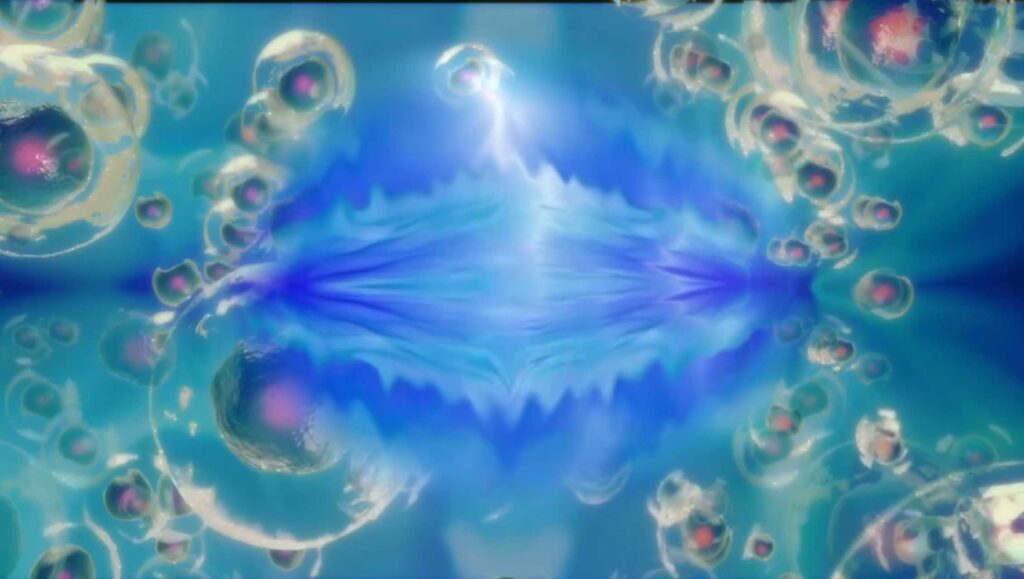
This interest in transformation also informs Light in Womb, where Yuan creates a psychedelic yet soothing environment of Azure blue, bright pink spheres and bubble-like forms. The work suggests an underwater Atlantis, but also something embryonic: a protected interior space in which life is suspended before emergence. The title itself connects light, birth and enclosure, reinforcing Yuan’s fascination with states of transition.
If Light in Womb imagines transformation from within, And Then There Was Light relocates that instability into the landscape. The brightly coloured work centres on a lighthouse constructed from displaced geometric forms, combining hints of symbolism with the optical illusion of an M.C. Escher drawing. Rather than functioning as an unequivocal symbol of stability and orientation, however, the lighthouse appears precarious, almost as though it might tilt, fracture or reorganise itself. There are also spiritual connotations of depicting a lighthouse, which fit with Yuan’s visual exploration of spirituality, and she uses it as a metaphor for hope, guidance and a safe retreat during contemporary times of global unrest and war.
The surrounding sea, mountains and swirling sky intensify this sense of instability. Yuan draws on Chinese landscape painting while also engaging with the abstract spatial language associated with Zao Wou-Ki. Landscape becomes less a depiction of a specific place than an atmospheric field assembled through movement, pressure and colour.
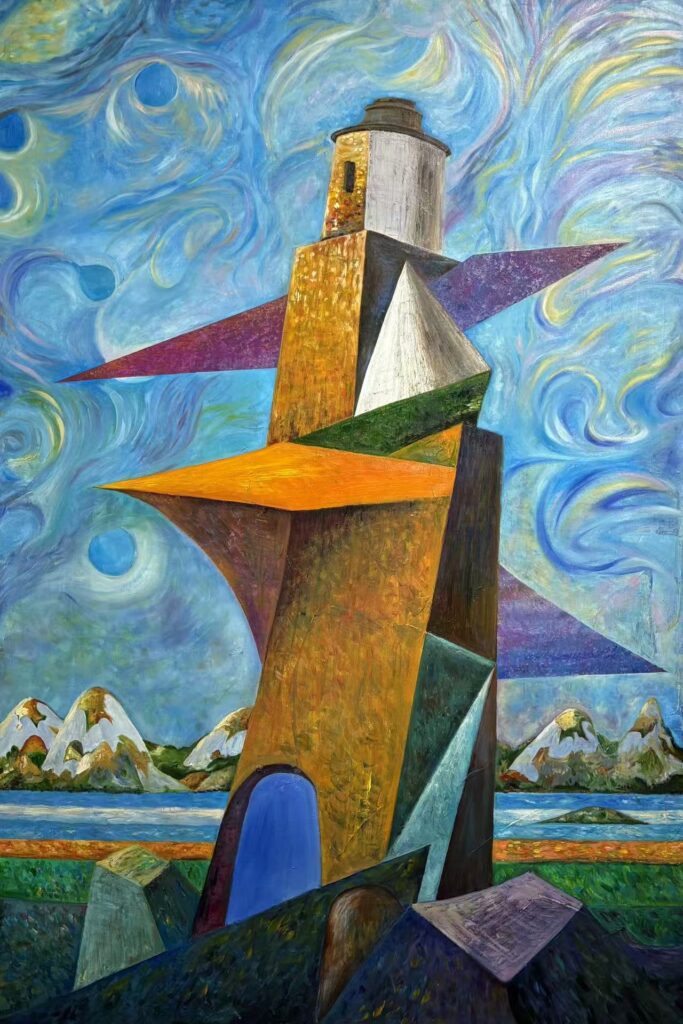
Yuan veers between representation and abstraction, depicting mountains, rock, water and mist as atmospheric visions within a shifting pictorial space. The Chinese expression “as light as a feather, as heavy as Mount Tai” provides a conceptual hook for the work, bringing opposing sensations of weight and lightness into the same pictorial field.
Throughout her practice, Yuan repeatedly returns to the same fundamental investigation of transformation. Whether through the fantastical hybrids of The Divine Entertainment Ltd., the ritualistic materiality of The Host Body, the embryonic atmosphere of Light in Womb or the unstable lighthouse of And Then There Was A Light, nothing in her visual universe remains entirely fixed.
This is what makes Yuan’s multidisciplinary approach significant. Digital art allows her to imagine bodies and environments without the physical limitations of the material world. Painting, by contrast, forces her to confront the resistance, weight and texture of matter. By moving between the two, she makes the distinction between virtual and physical experience itself part of the work.
Born in Shenzhen in 1992 and now living and working between London and Shenzhen, Yuan studied Visual Art at Fordham University between 2012 and 2016. She has exhibited in the UK, Europe, United States, China, Japan and Turkey. Notable exhibitions include; Mosaic and the Estuary Artist Residency Show at Trinity Art Gallery, the RBSA Annual Exhibition at the Royal Birmingham Society of Artists, ¡AGUANTA! at DAMA Gallery in Los Angeles and the Tokyo Calligraphy and Painting Art Exhibition 2026 at Tokyo Metropolitan Art Museum. Her work has also appeared at KunstRAI Amsterdam, PrimoPiano Livin Gallery in Lecce and The White Conduit Projects in London.
Yuan’s practice ultimately proposes a world in which identity is not something possessed but something continually negotiated. Bodies absorb environments, landscapes become psychological, matter carries memory, digital imagery becomes physical. Her art does not resolve the boundary between self and world so much as make that boundary visible before steadily dissolving it.
Review by Culturalee Editor Lee Sharrock