

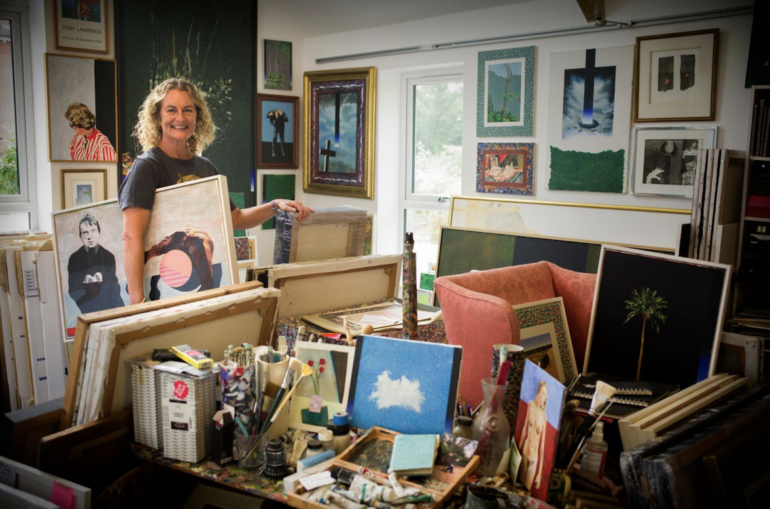
As the daughter of post-modern British artist Anthony Lawrence, Sara Lawrence has spent the years since his death in 2022 uncovering, cataloguing and bringing new audiences to an extraordinary artistic archive spanning decades. Now, Anthony Lawrence: A Practical Guide to Aesthetics, at St John’s Waterloo from 15–23 October 2026, brings together major bodies of work including Dante, Tannhäuser, The Damned Demoiselles, the Desert paintings, portraits, religious works and the newly restored A Practical Guide to Aesthetics series.
In this edition of Culturalee in Conversation, Sara Lawrence discusses with Culturalee Editor Lee Sharrock the deeply personal journey of taking on her father’s artistic estate, the remarkable breadth of his influences — from Dante, Wagner and Francis Bacon to cinema, music and popular culture — and the distinctive post-modern language that emerged from their collision. She also reflects on why St John’s, Waterloo provides such an evocative setting for his paintings, coinciding with the 75th anniversary of the Festival of Britain, and how the exhibition reveals the connections between art, faith, family, humour and life that ran throughout Anthony Lawrence’s practice.
The title A Practical Guide to Aesthetics is intriguing, particularly given Anthony Lawrence’s fascination with the tension between the sacred and the secular, tradition and invention. How did you arrive at this title, and what does it reveal about the way you want audiences to approach his work?
A Practical Guide to Aesthetics is actually the title Dad gave to a huge work from 1992: twelve 40 x 60-inch canvases, arranged as four triptychs, which can be shown together as one enormous piece, as individual triptychs, or as standalone paintings. He always said that his intention was to put down absolutely everything he knew about painting up to that point in the early 1990s, so that he could clear the decks and leap forward. He was also never one to shy away from a little self-praise and was very pleased with the result! That confidence was characteristic of Dad. He had a remarkably singular vision and wasn’t interested in seeking validation from anyone other than himself. What mattered to him was whether he liked what he had made. If he did, that was enough. And he definitely liked these paintings.
He loved titling his work. In the case of A Practical Guide to Aesthetics there’s a lovely tension in the words: the almost instructional, didactic quality of ‘a guide’ alongside the rather more elusive concept. To me, it captures something fundamental about his work. Dad was an exceptionally skilled and technically precise draughtsman, but his paintings were never simply exercises in technique. They are full of ideas, references and art-historical knowledge, but also atmosphere, humour and feeling. We can look at his paintings intellectually but still feel something much more mysterious and emotional in their meaning.
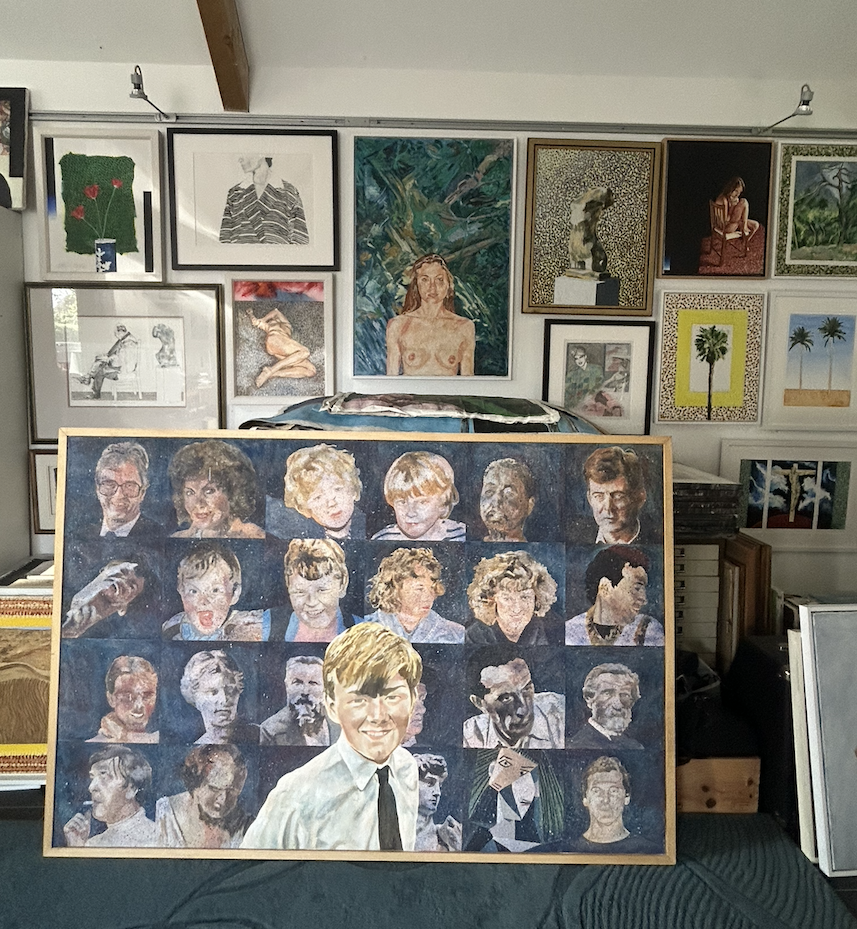
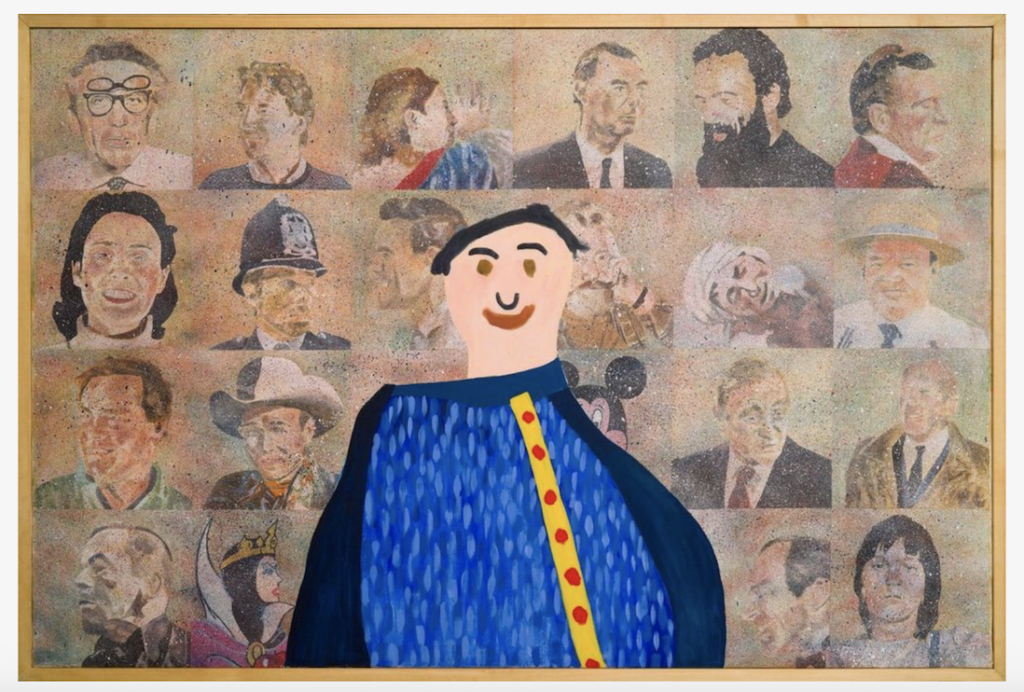
That tension between tradition and innovation, the sacred and the secular, runs throughout his work. I think Dad made those things collaborators rather than opposites. He could take something from the classical tradition and put it alongside pop culture, personal memories or completely unexpected characters, and somehow make the combination feel entirely natural. You can see that particularly clearly in these paintings. In the triptych we’re showing, Dad turned the idea of the self-portrait into something much bigger. There is a portrait of him as a boy, one of him in his forties, when he painted the work, and a charming childish replica of a painting of Dad made by my then seven-year-old brother George. Around and behind those self-portraits are small portraits of dozens of other people — some he knew personally, some he admired, some who had influenced him, and some who simply amused him. There are musicians, artists, historical and cultural figures and fictional characters. Roy Rogers and Desperate Dan appear alongside Picasso, Andy Warhol, Peter Blake, Dad’s father and sister, Philip Morsberger, who was the Ruskin Master when Dad was at Oxford, and one of his favourite classical busts. Our immediate family are adjacent to our local butcher, policeman and a depiction of David’s Marat. There’s jazz singer Cleo Laine – Dad’s godmother, as well as Britannia, Mickey Mouse and the Mona Lisa. It’s a very idiosyncratic melange and very Dad. He used to say that he could have filled at least another three canvases with people he admired, loved or who had helped shape him. In that sense, these paintings become a map of the person he was at that moment: the people, images, ideas and cultural references that had accumulated in his mind and informed the artist and man he had become.
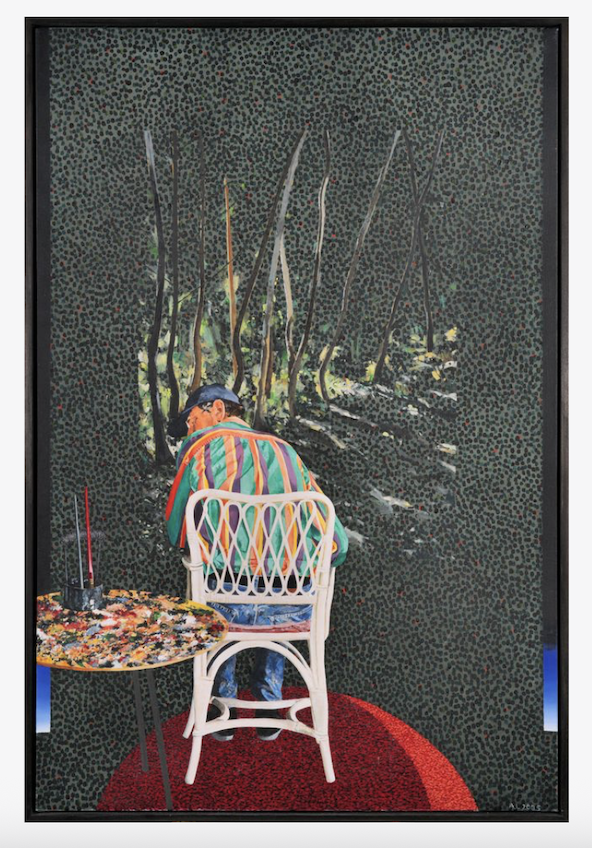
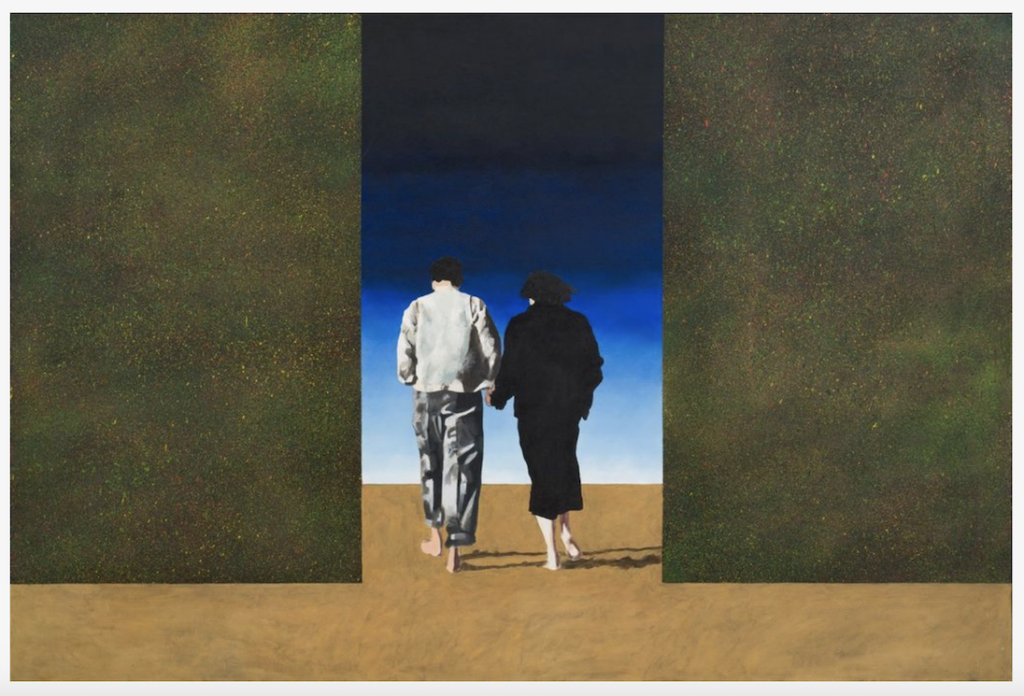
The other A Practical Guide to Aesthetics painting in the exhibition is very different in subject but has the same sense of mystery and possibility. It shows a couple walking away into an unmistakably Lawrencian landscape. The image of the couple came from a photograph sent to Dad by his great friend, the British-American actress Annie Ross. People were constantly asking him what the painting was ‘about’, and his response was usually to ask them what they thought it was about. He was endlessly entertained by discovering there were as many interpretations as there were people looking at it. The marvellous thing, he always said, was that they were all correct. Perhaps that is one of the most useful things to know about him before looking at the work: you don’t need to find the ‘right’ answer. Dad would much rather you found your own. He cared enormously about painting, but never believed it was his role to tell the viewer what to see – the idea that the person looking at the painting had an equal role in bringing it to life was very important to him. His Ruskin tutor Philip Morsberger described him as an artist for whom the questions raised by a painting could be more important than the answers, and that feels very true to me. And, of course, I would love audiences to see the genius in Dad that he was in absolutely no doubt he possessed! But he genuinely didn’t care if someone disliked his work. If you liked it — fantastic. If you didn’t — never mind. He was going to carry on painting exactly as he wanted to anyway.
St John’s, Waterloo is an unusual and evocative setting for an exhibition of Anthony’s paintings, particularly given the religious and spiritual dimensions of his practice. Why did you choose a church as the venue, and how do you think the architecture and history of St John’s will change the way these works are experienced? The exhibition also coincides with the 75th anniversary of the Festival of Britain and the church’s role in that cultural history. Was that significant to your thinking?
I think, in the end, we didn’t so much choose St John’s as discover it. Art critic Jonathan Evens came to see our 2025 retrospective at Palais des Vaches in the New Forest and wrote a wonderful review of it for The Church Times, subsequently selecting the retrospective as one of his exhibitions of the year in Artlyst. His Church Times review found its way, via conversations with Laura Moffat at Art and Christianity, to St John’s Waterloo, and Euchar Gravina, the Artistic Director, came to visit us at the studio in the New Forest. Euchar loved the work and the idea for the St John’s exhibition really grew from that visit.
We had deliberately chosen a very unconventional setting for the 2025 retrospective too. Palais des Vaches is a former cow barn built during the Second World War, beautifully hidden away down a long track in Exbury near Beaulieu in the New Forest, and the work looked extraordinary there. The architecture becomes part of the experience, and gives people permission to look at the work slightly differently.
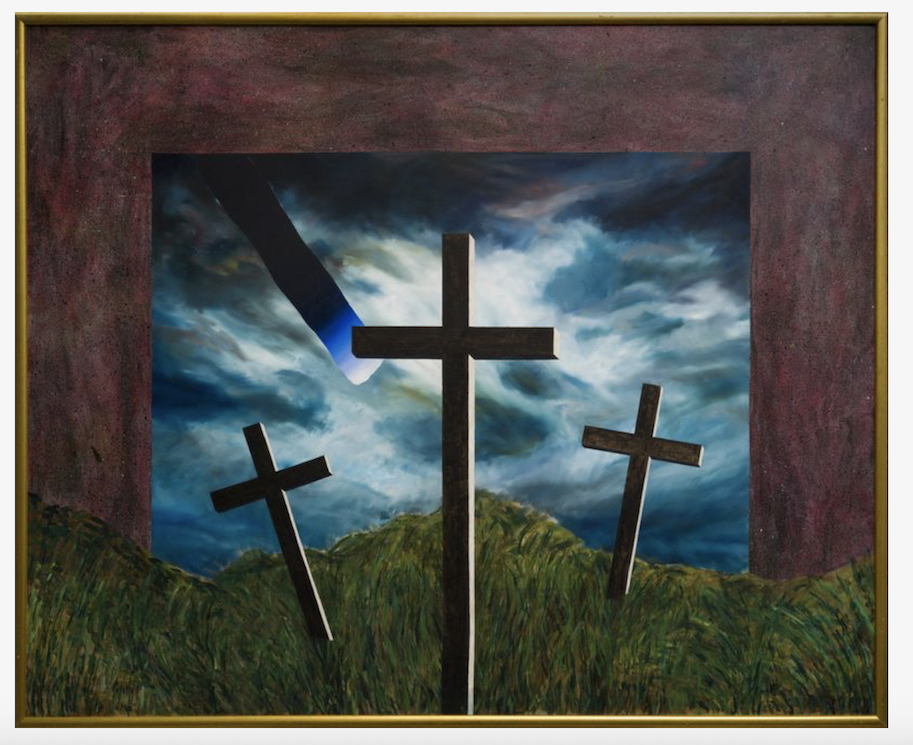
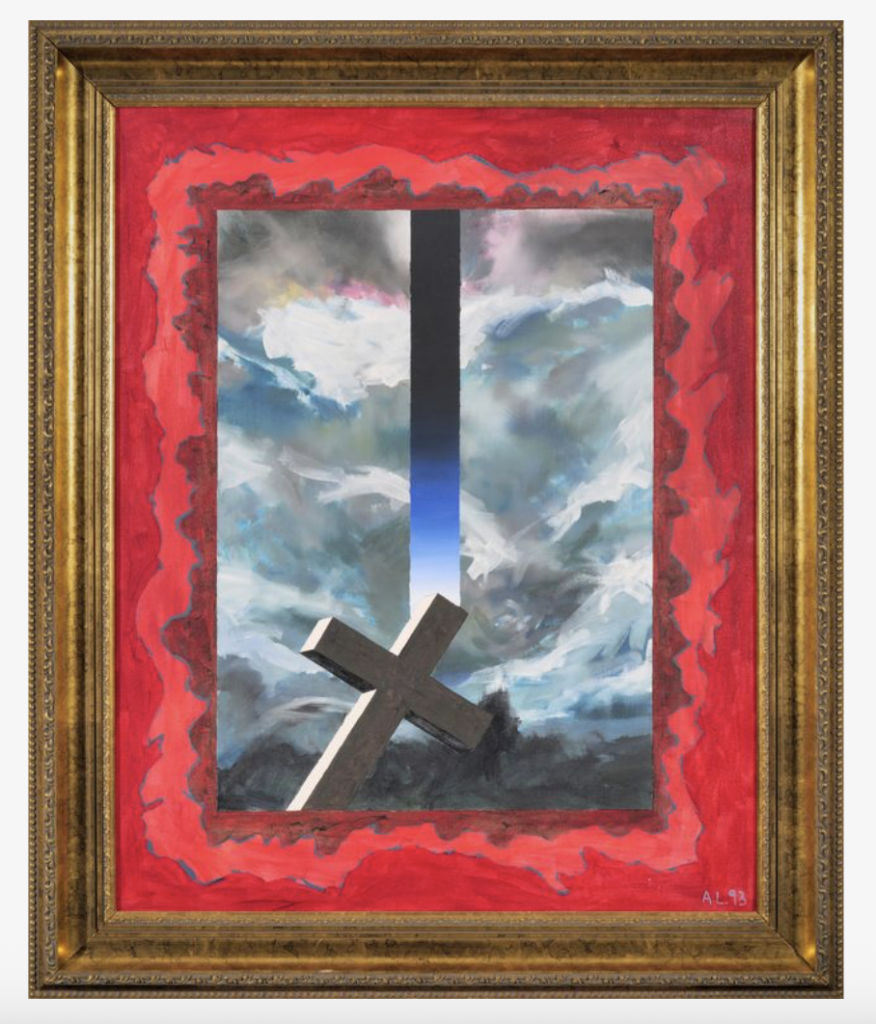
St John’s feels like a new version of that idea. The Old Crypt is atmospheric and intimate, with its brick walls and sense of history. It has a presence of its own without competing with the paintings. And I love the fact that you can go from something as monumental and intellectually dense as the Dante works to something deeply personal like a portrait, or the religious paintings, and the space allows each of them to breathe in its own way. There is also something particularly appropriate about showing Dad’s work in a church. He was fascinated throughout his life by religion and spirituality and by what he called the constant fight between the sacred and the secular. But he was never a conventionally religious painter. He was interested in questions, contradictions and the human experience of faith. So putting these paintings into a space that is used for worship, serenity, community and prayer gives that aspect of the work another dimension, without dictating how anyone should interpret it.
And then there is the Festival of Britain connection, which I think is rather wonderful. St John’s was rebuilt in 1951 as the Festival of Britain church and became one of the Festival’s designated arts and music centres, alongside the Royal Festival Hall. Its newly restored nave was decorated with murals by the German Jewish refugee artist Hans Feibusch, and hosted choirs from around the country during the Festival. Seventy-five years later, it is still functioning as a place where art, music, ideas and community come together. That feels particularly significant for Dad because he was so interested in the relationship between tradition and invention, and between history and the contemporary world. The Festival of Britain was an enormously forward-looking moment — a celebration of what Britain might become — whilst taking place in a building with a much older history. That combination of old and new feels very Lawrencian to me. Dad would also have been fascinated by the Festival of Britain anniversary itself. He was intensely curious about culture and history and about the way different generations reinterpret what has come before them. I think he would have enjoyed the fact that his paintings are now being shown in a building that was itself reinvented for a great cultural moment 75 years ago.
So, following on from our Palais des Vaches retrospective, St John’s feels like the perfect next chapter. They couldn’t be more different as spaces, but both are unusual places in which to encounter Dad’s work. His paintings are full of unexpected juxtapositions, so perhaps it’s appropriate that the environments in which we show them should have a bit of unexpectedness too. I want people to walk down into the crypt and feel like they have discovered something — not just an exhibition of paintings, but a slightly unexpected world belonging to Anthony Lawrence.
Taking on the estate of a late parent’s work must be both an intensely personal and an art-historical undertaking. How have you approached the responsibility of looking after Anthony’s vast body of work, deciding what to bring back into public view and shaping the story of his career for a new generation of audiences?
I adored my dad. And the most wonderful thing about all of this is that working on his archive has given me a way of continuing to get to know him. Taking on Dad’s work after he died has been an enormous undertaking, both practically and emotionally, but it has also been one of the greatest privileges of my life. He was a brilliant artist but also the most brilliant father who spent a great deal of time bringing up his five children, and I think that makes it impossible for me to separate the two things. I’m not looking after an artist’s estate in some detached, purely art-historical way – I’m looking after my dad’s life’s work.
During lockdown, Dad and I started an Instagram account together, @anthonylawrenceart. Every day I would photograph one piece of his work and ask him to tell me about it. It could be a huge painting, a tiny sketchbook page, a watercolour, drawing, oil painting or etching. We jumped backwards and forwards through decades and series, and I would ask him about the things I didn’t understand. Looking back, this gave me context and knowledge of the artist that I didn’t have before. It taught me an enormous amount about his work, but, more importantly, it gave me a way of understanding how he saw it. I learned the stories behind paintings, the connections between different series, the people and ideas that kept recurring, and the things he thought were important. It also meant that I was asking him questions whilst he was still here to answer them, which now feels like the most extraordinary gift.
When Dad died, we were left with thousands of works. It was completely overwhelming. I knew which were the major pieces and I understood the broad outlines of the different series, but there was a vast amount of work that needed to be identified, catalogued, restored and, in many cases, simply understood. We’ve taken it bit by bit. We’ve now catalogued around a thousand works, and there is still a huge amount to do. Some paintings needed significant restoration, and the process of putting everything in its right place has been a massive undertaking. But I find that process incredibly rewarding because every time I open a drawer, turn over a canvas or find something I haven’t seen for years, there is another little piece of Dad to discover.
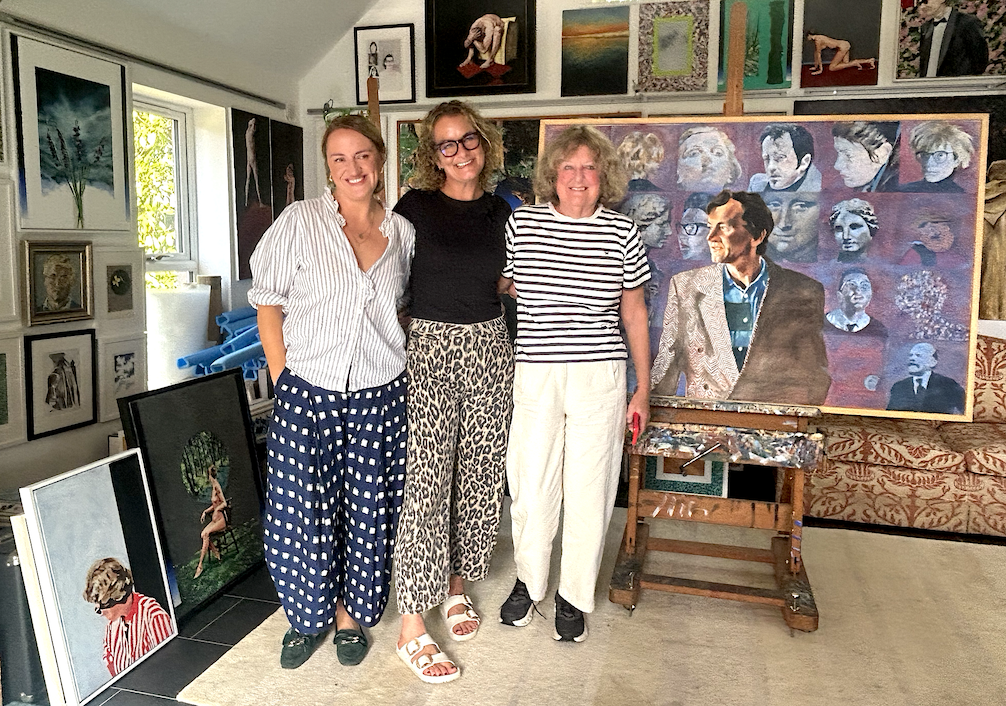
I also haven’t done this alone. My mum, Lesley Lawrence, and my great friend Liz Barrett have both been absolutely key to everything that has happened. Mum, Lesley, has been beside me throughout. She has helped me work through endless decisions and, perhaps most importantly, been the sounding board for all of it. She knew Dad better than anyone and understands the man behind the paintings in a way that nobody else possibly could. And then there is my friend Liz Barrett, who dad adored. Liz has an extraordinary understanding of the cultural world through her communications work with major institutions including Tate and the V&A, and she has been invaluable in helping us turn this enormous undertaking into something coherent and public, helping us navigate the cultural world and how to present Dad’s work to new audiences. So the three of us have rather unexpectedly become colleagues and are slowly bringing it all together.
What is slightly extraordinary is that it has also developed a life of its own. One thing seems to lead naturally to the next. The Instagram account led to a much deeper understanding of the archive. That led to the website and the cataloguing. Then came the Palais des Vaches retrospective, which led to journalists discovering the work, which led to Jonathan Evens coming to see it, which ultimately led us to St John’s and this London exhibition.
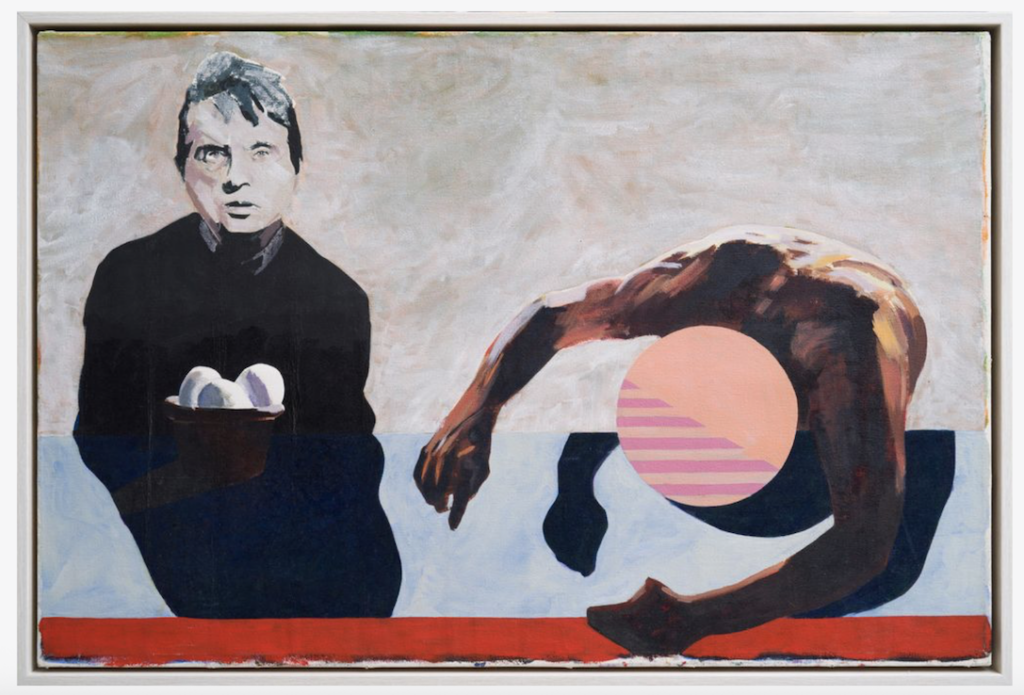
Anthony’s influences were remarkably wide-ranging, from Francis Bacon and the Old Masters to Dante and Wagner, as well as popular culture and figures from stage and screen such as John Wayne. How did this collision of high and popular culture shape his distinctly post-modern approach to painting, and are there particular influences you think have been overlooked in discussions of his work?
Dad didn’t really see a hierarchy between influences. He absorbed things because they interested, moved, amused or challenged him and then put them all through the particular filter of his own art. I think he would have found the idea of separating his influences into ‘high’ and ‘popular’ culture quite funny. He was certainly hugely influenced by the Old Masters, by Dante, Wagner, Francis Bacon and the great traditions of European painting, but he was equally interested in fashion, books, cartoon characters, country music, rock and roll, cinema and the people he encountered in everyday life. To him, they were all part of the same world – his world.
He once said that ‘life’ was his main influence, and I think that is the key to understanding him. He didn’t really believe in putting up barriers between art and life, or between one cultural reference and another. His training at the Ruskin gave him an exceptionally strong classical foundation, while his time at St Martin’s exposed him to Pop Art and modernist experimentation. He then spent his life bringing all those things together. That is perhaps what makes the term ‘post-modern’ so appropriate for him. He wasn’t interested in choosing between tradition and modernity. He used both. He could take a Renaissance composition, a Biblical subject or an idea from Dante and put it alongside a film still, a popular character or a visual joke. He could paint Francis Bacon and call the portrait Bacon and Eggs. He could take inspiration from Picasso, Cézanne or Man Ray and then put those references into a painting that was also full of his own family, friends and obsessions. There is an enormous amount of knowledge in his work, but it is never presented solemnly. There is always wit, mischief and a sense that he is enjoying the possibilities of painting.
And I think the cinematic influence is particularly interesting. Dad grew up surrounded by film and theatre through his father, Quentin Lawrence, who was a television and film director. People such as Michael Caine and Stanley Baker were part of the world around our family, and Dad later painted people including John Wayne, Ian McKellen and Yehudi Menuhin. So the stage and screen weren’t some separate cultural world that he discovered later — they were woven into his experience of life from childhood. You can sometimes feel that in the theatrical quality of his compositions: the way a scene is staged, the way figures enter or leave a landscape, the sense that something has happened just before or is about to happen just after.
Then there is music. He was an expert bass player and obsessed with music – particularly Crosby, Stills & Nash, the Byrds, Rolling Stones, Eric Clapton, all kinds of country musicians and countless others. Wagner’sTannhäuser became the subject of an important series of etchings in the 1990s, just as Dante had already become the basis for a huge body of paintings. But I don’t think literature, music, painting and life existed in separate compartments in his head. They fed one another. His Dante paintings, for example, aren’t illustrations of The Divine Comedy. He took Dante’s ideas and used them as a framework through which to explore his own experiences, anxieties, relationships and preoccupations.
If there is an influence I think has been slightly overlooked, though, it is people. Dad was fascinated by character. He watched people very closely and was endlessly interested in what made someone recognisable — sometimes with the tiniest amount of information. His portraits could be of Francis Bacon, Seamus Heaney or John Wayne, but they could just as easily be a member of our family or someone he met in everyday life. That human curiosity runs through the whole body of work.
Alongside that, I would say that humour is an influence in its own right. It can be tempting, when looking at an artist with such an impressive knowledge of art history, literature and music, to concentrate on the serious intellectual references. But Dad was extremely funny. He saw the absurdity in all things, including himself, and that humour gave him enormous freedom, and no need to apologise for contrasting juxtapositions – rather he delighted in them.
I think his post-modernism was deeply instinctive; not solely about clashing high and low culture. Dad simply had a huge appetite for the world. He took things in, remembered them, questioned them, loved some of them, laughed at others, and eventually they found their way into his paintings.
Perhaps the most important thing is that, although you can identify all these influences, the finished paintings never feel like exercises in imitation. He absorbed an extraordinary amount from other artists, writers, musicians and popular culture, but digested it all so completely that it became part of his own visual language. That’s why I think the most overlooked influence of all may actually be Anthony Lawrence himself. All these references mattered, but ultimately they were passing through one very distinctive mind. His paintings are a record not simply of what he looked at, but of how he saw.
This exhibition brings together major bodies of work including Dante, Tannhäuser, The Damned Demoiselles, the Desert paintings, portraits and his religious works, alongside newly restored paintings from the early 1990s A Practical Guide to Aesthetics series. What do you hope audiences will discover about Anthony Lawrence when they encounter the breadth of his practice in this exhibition that they might not have understood from seeing individual works or reading about his career?
Dad saw life and art as inseparable and that becomes apparent when you see the different series hung together. His old Ruskin tutor Philip Morsberger described the body of work as a journey through self, introspection, art, religion, sex and poetry – with painting itself as the connecting thread. Recent reviews of our 2025 retrospective similarly picked out the combination of technical discipline, humour, warmth and accessibility. I hope people discover how completely connected all of Dad’s work is. If you see one painting on its own, it’s very easy to focus on what is immediately in front of you — the subject, the technique, the colours, perhaps the references. But when you see the Dante paintings alongside the Desert paintings, the portraits, the religious work, Tannhäuser, The Damned Demoiselles and A Practical Guide to Aesthetics, you begin to realise that they are all coming from the same particular way of looking at the world.
He didn’t compartmentalise his greatest influence, life itself, into different sections of art, family, faith, music, literature, friendship and the everyday world. They all fed into one another. His own work was about asking questions — emotionally, intellectually and technically — and creating a dialogue with the person looking at it. That’s why the breadth of this exhibition matters so much to me. You can see him wrestling with Dante and the human condition, then move into the Desert paintings and encounter something much more atmospheric and almost dreamlike. You can look at the religious paintings and see his fascination with the tension between the sacred and the secular, and then turn a corner and find a portrait of someone he loved or admired. Then there are the Tannhäuser etchings, the Damned Demoiselles, and these extraordinary A Practical Guide to Aesthetics paintings, which seem to pull together so many of the ideas, people and images that had occupied him. The exhibition allows you to see the connections as well as the individual works.
And I think one of the things that might surprise people who didn’t know him is how playful he was. Dad could be dealing with Dante’s Inferno or profound questions about faith and mortality, but he was never a solemn person. He loved jokes, absurdity, popular culture and the sheer pleasure of painting. That humour sits alongside an extraordinary seriousness about his craft. Recent reviews have picked up on exactly that combination — the precision and technical discipline alongside warmth and humour.
I also hope people discover not just his ideas, but his relationships, his friendships, his family, his faith, his loves, his obsessions. Even when he was painting something as grand and apparently universal as Dante, there was always an element of himself in it. Seamus Heaney, for example, became part of the Dante story in a very personal way after Dad met him at a time when he was struggling with the project. Heaney encouraged him to continue, and that relationship became part of the work itself.
He was interested in who we are, what we believe, what frightens us, what delights us, how we relate to one another, how we make sense of the world and how we leave our mark on it. Sometimes he explored those things through Dante, sometimes through religion, sometimes through a portrait, sometimes through a desert landscape and sometimes through something as apparently playful as Mickey Mouse appearing amongst Renaissance and modern art references. And I think when you see all of that together, you realise that the apparent contradictions aren’t contradictions at all. The classical and the contemporary, the sacred and the secular, the intellectual and the funny, the deeply personal and the universal — they were all part of Dad’s world.
I hope people discover that he was much more than any one description of him. He was an extraordinarily curious, technically gifted painter who never stopped looking, questioning and experimenting. He had an enormous appetite for life which can be felt in the work. And perhaps that is what I would most like people to come away with: the sense that Dad wasn’t an artist who painted lots of different subjects. He was an artist who spent his whole life looking at the same enormous set of questions from different directions.
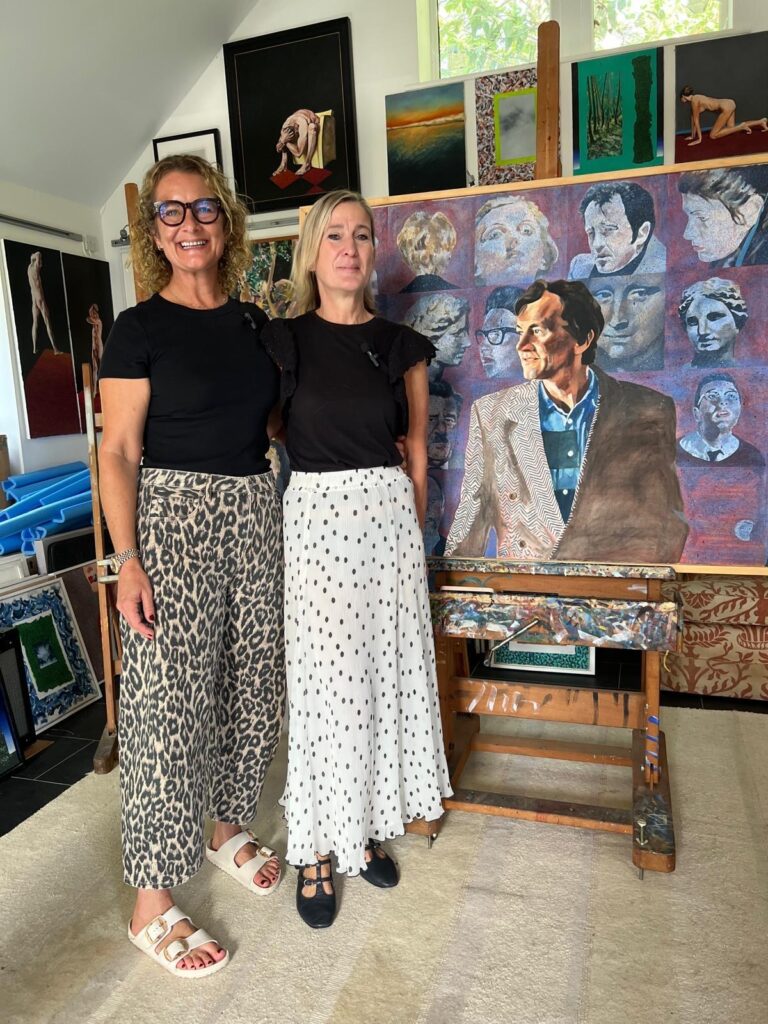
We never sat down and devised some grand five-year plan. People enter the story, friendships are made, connections form and suddenly we find ourselves somewhere we could never have imagined when we started. Sometimes it feels as though Dad is still guiding us. As fanciful as it sounds, working with the archive and feeling its power reminds me daily of his involvement, still. And perhaps that is why, despite the scale of it, I don’t think of this as a burden at all. It’s a huge amount of work, and there is still so much more to do, but it is also a continuation of something we were already doing together. I work in the studio every day, discovering and asking questions – sometimes I’ll come across a painting and remember something he told me about it, and so it feels as if I am still learning. Even though he is no longer here, our conversation is ongoing. It feels as though Mum, Liz and I are continuing the project with him — and perhaps, in some strange way, he is still the fourth colleague.” Sara Lawrence
Anthony Lawrence: A Practical Guide To Aesthetics is at St. John’s Waterloo, 73 Waterloo Road, London SE1 8TY from 15 to 23 OCTOBER 2026.