

Artist Ida Ivanka Kubler is redefining the relationship between art, audience and environment through a series of private, immersive art experiences that bring together natural materials, performance and conceptual practice. Moving beyond the conventions of the gallery, Kubler invites collectors into an intimate world where the body becomes a medium, the landscape a canvas, and the act of making an artwork an experience in itself.
Known for her abstract masterworks inspired by vacated silk cocoons and her multilayered figurative oil paintings, Kubler has developed an artistic language that explores transformation, impermanence and the interconnectedness of human experience and the natural world. Her latest initiative extends these concerns into a more participatory practice, offering individually curated encounters in which art is experienced through physical engagement, sensory perception and direct interaction with organic matter.
Rather than positioning the artwork as a finished object to be viewed from a distance, Kubler creates situations in which participants become active contributors to the artistic process. These bespoke experiences invite a reconsideration of what art can be, shifting the emphasis from possession and observation towards embodiment, experimentation and shared discovery.
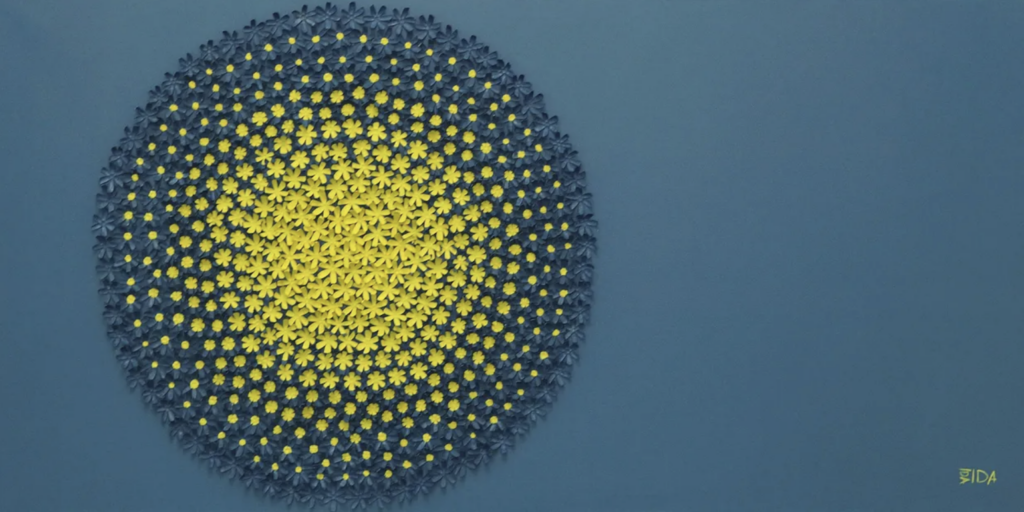
Silk Cocoons left by the butterflies and Old Holland New Masters Acrylics on Canvas
From Human to Painting to Private Immersive Experiences
The origins of Kubler’s immersive practice can be traced to Human to Painting, a performance staged at Far Rockaway Beach. In this work, the removal of her hair becomes an act of personal renewal, transforming the artist’s body into a beige canvas. The gesture explores the body as both a site of identity and a surface upon which transformation can be made visible.
The performance also exposed the tension between the freedom of artistic expression and the constraints of conventional social behaviour. One observer, inspired by the encounter but ultimately remaining tethered to corporate conventions, became an unexpected point of reflection within the work’s wider conceptual framework.
This moment prompted Kubler to develop an ongoing series of events that challenge the boundaries between art and life. Her private immersive experiences build on this premise, creating environments in which participants can engage with materials, landscapes and gestures that resist the detachment often associated with traditional art-viewing.
Nature is not simply a backdrop for these encounters. It becomes an essential collaborator, providing both the physical materials and the conceptual framework through which questions of identity, belonging and transformation are explored.
HONEY! COLOURED! — The Sensory Language of Nature
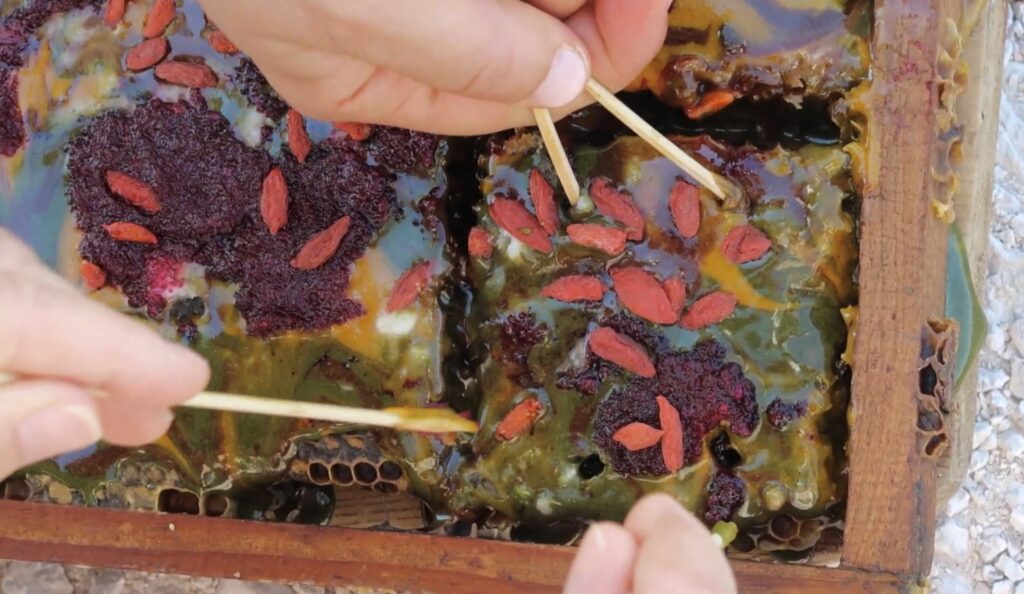
In HONEY! COLOURED!, Kubler explores the relationship between natural pigments, organic forms and sensory immersion. Using colours derived from roots and plants, she creates a honeycomb-inspired painting that evokes the intricate structures of the natural world while inviting viewers to reconsider their relationship with the artwork.
The honeycomb motif introduces associations with collective organisation, interconnectedness and the rhythms of nature. Its geometric structure provides a counterpoint to the irregularity of the organic materials, establishing a visual dialogue between natural processes and the artist’s conceptual interventions.
The work also opens up the possibility of art as an embodied experience. By encouraging viewers to become active participants rather than passive observers, Kubler challenges the conventional separation between artwork and audience. The inclusion of edible sculpture further complicates this relationship, bringing questions of consumption, materiality and sensory perception into the artistic encounter.
Set against extraordinary rock formations, HONEY! COLOURED! establishes a compelling dialogue between the geological permanence of the landscape and the transience of the materials used to create the work. It is an invitation to experience art through multiple senses, where the act of looking becomes inseparable from the possibility of touching, tasting and inhabiting.
RED BRICKS & SAND — Reimagining the Landscape Through Land Art
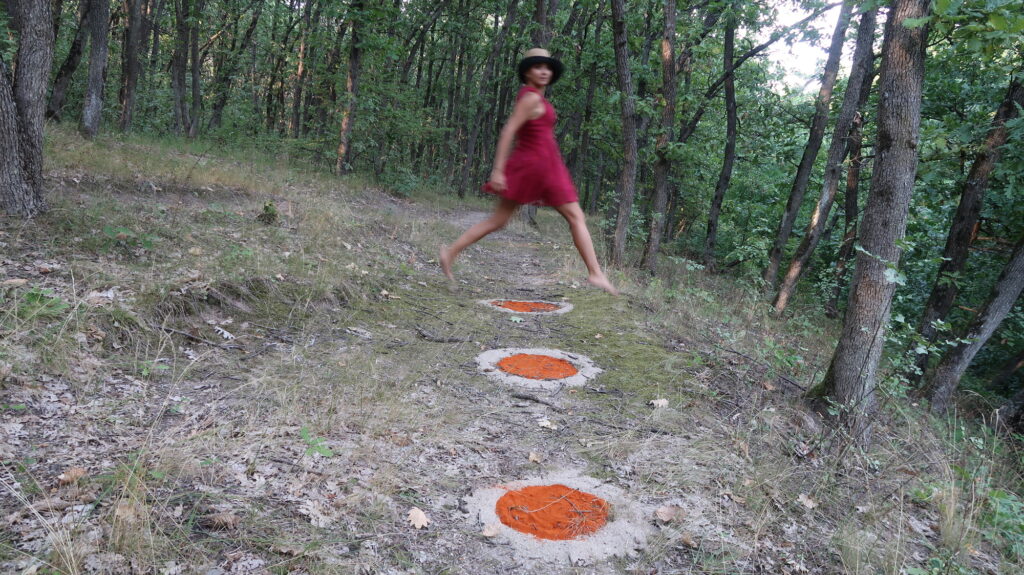
In RED BRICKS & SAND, Kubler transforms a forest path into a temporary stage for land art and performance. Circles of pulverised red bricks and pale cream sand punctuate the woodland floor, creating a sequence of vivid, site-specific interventions across the natural terrain. The artist leaps between these circular forms, introducing movement and bodily presence into the composition.
The circles function as ritualistic stepping stones, suggesting a passage through space while establishing a visual rhythm that contrasts with the organic complexity of the surrounding forest. Through this simple yet striking intervention, Kubler turns the landscape into an environment to be navigated and experienced rather than merely observed.
The materials themselves carry a conceptual tension. Pulverised bricks, remnants of human construction, introduce the traces of architecture and urban life into the woodland. Their presence suggests the possibility of reintegration, as the products of human intervention are returned to the earth in altered form. Against the pale sand, the red pigment becomes a marker of movement, memory and transformation.
The ephemeral nature of the installation is central to its meaning. Unlike a permanent sculpture, RED BRICKS & SANDexists through its relationship with the site and the artist’s actions within it. The work is ultimately less concerned with establishing an enduring physical object than with creating a moment of heightened awareness.
By incorporating the body into this temporary environment, Kubler explores how human presence can be understood as part of a wider ecological continuum. Art becomes something enacted and lived, its significance emerging through movement, material and the fleeting encounter between the individual and the landscape.
WILD HUCKLEBERRY & CLAY — The Circle as a Symbol of Connection
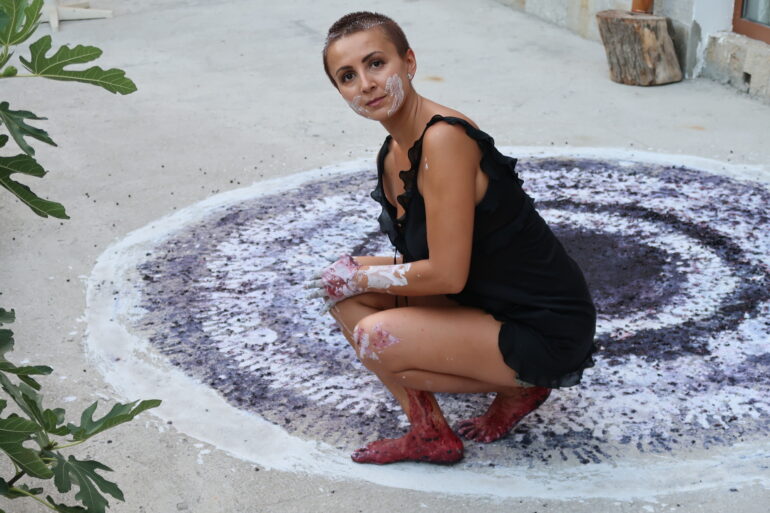
In WILD HUCKLEBERRY & CLAY, the circle becomes a metaphor for the universe, establishing a shared space in which the body, the earth and the natural world converge. Deep violet wild huckleberries and white clay transform a concrete surface into a living composition, bringing together contrasting materials in an exploration of impermanence, vulnerability and belonging.
The chromatic relationship between the berries and clay creates a dialogue between intensity and restraint, wildness and purity. Yet the work’s significance extends beyond its visual contrasts. Through touch, movement and bodily presence, the materials become vehicles for exploring the relationship between individual experience and collective existence.
The circle offers a conceptual structure within which boundaries can be questioned. Its form suggests wholeness and continuity, while the organic substances it contains remain subject to change. The resulting tension between containment and transformation reflects Kubler’s broader interest in the fragility of material forms and the interconnectedness of living systems.
By inviting participants to engage directly with these materials, the artist shifts the emphasis from representation towards experience. The work does not simply depict nature; it creates an opportunity to encounter natural matter through physical interaction. In this context, the circle becomes both a compositional device and a space for reflection, encouraging participants to consider their relationship with the environment and with one another.
Beyond the Gallery: A Bespoke Approach to Immersive Art
Kubler’s private art experiences extend across a diverse range of materials, forms and environments. Eggshell structures, fig-leaf assemblages, corn-fibre forms, bush phantasy, pine-cone objects, berry pigments and lava mountain provide the foundations for a series of individually curated encounters that explore the possibilities of making through direct engagement with nature.
Each experience is conceived as a bespoke process, shaped by the materials, spatial conditions and conceptual questions that inform the encounter. Participants are invited to experiment with natural matter through acts of making, embodiment and spatial intervention, discovering how materials can be transformed through touch, movement and imagination.
The emphasis on organic substances introduces an element of unpredictability into the process. Unlike conventional materials that are often selected for their durability and consistency, natural matter carries the marks of its origins and remains subject to change. Eggshells, leaves, fibres, berries and pine cones each possess distinct physical qualities, inviting different forms of interaction while raising questions about fragility, decay and renewal.
These encounters also challenge established expectations surrounding the ownership and consumption of art. While private collecting traditionally centres on acquiring and displaying finished works, Kubler proposes an alternative model in which the value of art resides partly in the experience itself. The collector becomes a participant in a creative process, engaging with the artist’s ideas through direct involvement rather than simply through the acquisition of an object.
This approach positions the experience as both an artistic event and an opportunity for personal reflection. The intimacy of the setting allows for a more individual engagement with the work, while the use of natural materials establishes a connection between creative practice and the environments from which those materials emerge.
An Artistic Practice Without Fixed Boundaries
Kubler’s international career has unfolded across a succession of geographical and cultural contexts, each contributing to the development of her artistic practice.
Her early years in Bulgaria preceded her studies at the National Academy of Arts in Sofia, undertaken after she was inspired by the work of Christo. From 1997 to 2008, she studied at the University of Applied Arts and Sciences in Bielefeld, Germany, while maintaining studios in Berlin, Bielefeld, Sauerland, Cologne and Munich.
Between 2008 and 2021, Kubler’s English period included studies at Chelsea College in London, where the work of Peter Doig provided an important source of inspiration. She also maintained studios in London. From 2012 to 2014, she worked in Asker, Norway, undertaking commissioned projects, before developing an extensive American period that took her across New York, California, Texas, Iowa and Florida between 2012 and 2024.
These overlapping periods reveal a practice shaped by movement, experimentation and encounters with different environments. Rather than following a single geographical or stylistic trajectory, Kubler has developed an approach that encompasses painting, performance, abstraction and site-responsive work.
Her interest in vacated silk cocoons and multilayered figurative oil painting finds a conceptual counterpart in her immersive experiences, where the transformation of materials becomes a way of thinking about identity, presence and change. Across these different forms, the artist returns to the question of how something can be transformed while retaining traces of what it once was.
Kubler’s private immersive art experiences represent a further evolution of this enquiry. By bringing together natural materials, the body and the landscape, she creates situations in which art is no longer confined to the finished object or the institutional setting. Instead, it emerges through participation, interaction and the temporary relationships formed between people, materials and place.
For collectors seeking an alternative to conventional encounters with contemporary art, Kubler offers a distinctive proposition: an opportunity to enter the creative process itself. Her work suggests that art’s most meaningful transformations may occur not only in the objects an artist produces, but also in the experiences that those objects and gestures make possible.
For more information on Ida Ivanka Kubler visit: