

In this edition of Culturalee in Conversation, Women in Art Prize 2026 finalist Christine Roychowdhury discusses the inspiration behind her powerful shortlisted painting Protest, exploring the history of women’s rights, political activism and the importance of defending freedom of expression. Drawing on personal and historical narratives, Roychowdhury reflects on the artist’s responsibility to bear witness to social injustice, her distinctive approach to figurative painting and her forthcoming work exploring protest, remembrance and collective resistance.
Congratulations on being a finalist in the 9th Women in Art Prize. How does it feel to have your work recognised by the Prize?
The women in Art Prize has gained in importance and influence each year. Each year its reach has gained ground and the quality of the entrant is very high as the prestige is being recognised. It is an honour and a privilege to be counted amongst the finalists for the 9th WIAP painting category and to have the opportunity to exhibit with all the finalists at the TAP gallery in Chelmsford is an important milestone for my art.
Your shortlisted painting, Protest, is a powerful and thought-provoking work. What inspired you to create the painting, and could you talk us through your technique and the process of translating the idea of protest into the finished work?
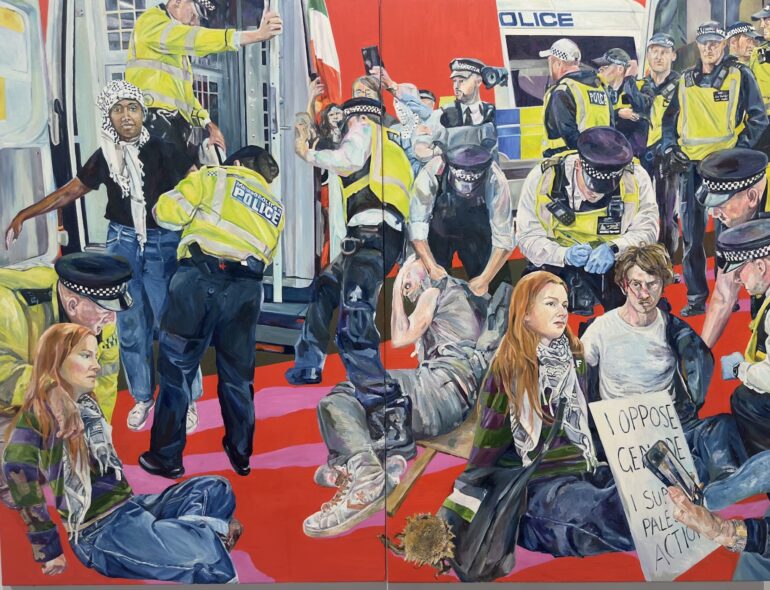
My work is always both political and personal. I was inspired to produce the work ‘Protest’ by the protests going on around Britain, particularly by those in London, which I attended while absorbing the atmosphere and taking photographs. I was appalled by the idea that the right to protest which was enshrined in UK law and articles 10 and 11 of the European Convention of Human Rights was being challenged and put at risk by the changes to these laws, changing as recently at June 2026.
I was pushed to produce this painting as I felt that the right to protest was an important right to protect in order that a government doesn’t become authoritarian, and that the right to protest was needed to maintain the principle of government by the people for the people, as a means of holding the government to account and changing wrongs.
The right to protest dates back to the Magna Carta in 1215. These rights were hard won and have been built upon for 800 years. My ancestors were at Peterloo in 1819 and took part in the Women’s march for equality of pay in the 1970’s. The rights of women have always interested me. My mother “wore the trousers” in our house growing up in a working class household. She handled the money and made the decisions. She was born in 1932, which was a year after the first UK general election where women were allowed the vote. Women only gained the right to vote after the Suffragettes marched, chained themselves to railings in protest and indeed died to challenge and change the status quo. It struck me that the Laws so recently changed would have stopped many of the actions taken by the Suffragettes. Churchill was very much against giving women the vote, stating that women should be satisfied to be represented by men. The fact that it was less than 100 years since women gained the vote in Britain made me realise how easily it could be lost.
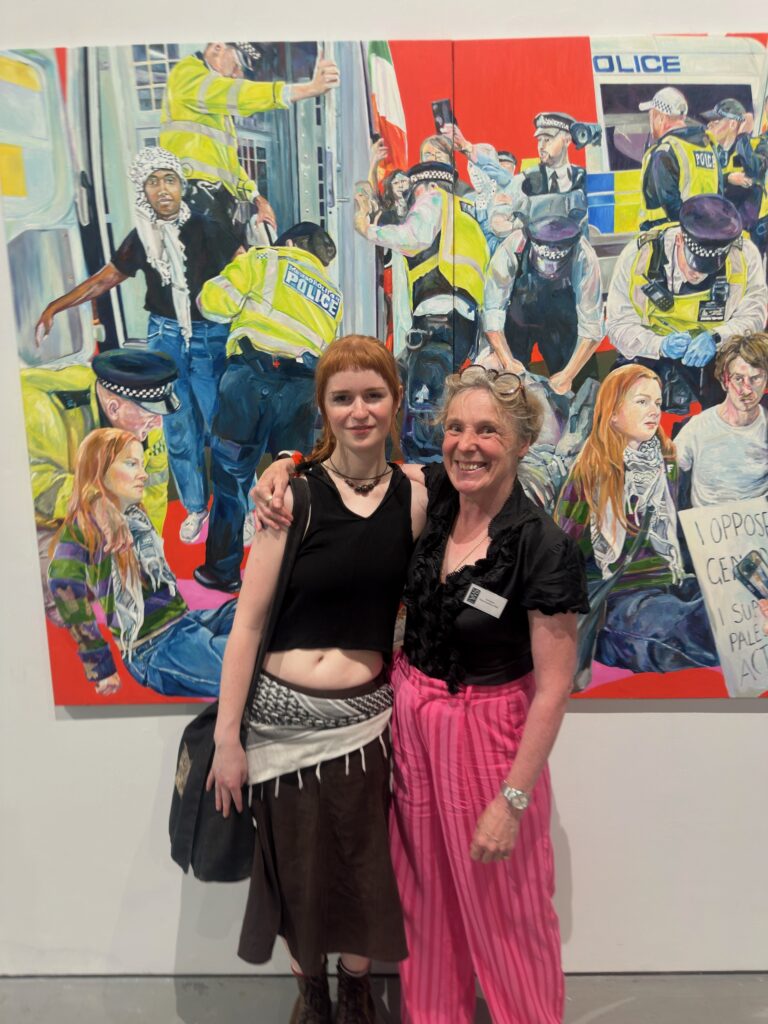
Hence, I included Bridie my model in suffragette colours of green, purple and white, and I added the sunflower representing suffragette heritage. The painting includes references to Calvary and Mary and Joseph, who were some of the first people to stand against oppression and injustice. It also references the intimidation faced by the young vulnerable females, many of whom are targeted by male officers during arrests. Women who put themselves into vulnerable positions when they protest dates back to Suffragette protests, where they were dragged along streets and often ended up with cuts a bruises.
The cameras and camera phones within the painting refer to the idea of bearing witness, specifically at the front right where the hand holding a camera is my hand representing everyone standing in this position as witness to events. We as artists have a duty to bear witness. The idea that you could be arrested for holding a cardboard sign protesting against a genocide was appalling. That 21,000 children could be killed and that people would be silenced prompted me to produce this painting.
I was halfway through the painting when Bridie Leggat, the main protagonist with the flaming red hair and beautiful face contacted me. Talking to Bridie allowed me to gain clarity into what I was presenting. I wanted to have the feeling of movement and most of all authenticity. I took my own photographs at protest marches and collected images from the internet. I also found myself acquiring multiple police hats and uniforms. Meeting and talking to Bridie allowed me to hone her image and likeness, driving depth and character.
I was pleased when Bridie saw the completed piece and said that it felt like she was back at the time of her arrest and that I had captured the feeling of the moment. She talked of “finding her solace in art particularly at difficult moments”, and said that my painting allowed her “to find a connection to the lineage of protest which long proceeded her”.
Looking ahead, what exhibitions and projects do you have coming up? Are there any new bodies of work or themes you are currently exploring that we can expect to see in your forthcoming exhibitions?
I always work on multiple paintings and projects at the same time. I am just completing my second in the series of paintings on protests called “Never Again”, which references the role of my ancestors at Peterloo, and explores how the choices we make don’t always come out on the right side of history. It talks about the coming together of different cultures religions and generations for a cause. The painting has the names of children killed in Gaza on the reverse and is in part a memorial to them.
As for exhibitions, this year I have exhibited at the Royal Scottish Academy and won the Changing Ideas inaugural prize, and I also exhibited at the Mall Galleries in London with the SWA, and in the WIAP exhibition in October at the TAP gallery in Chelmsford. My hope and plan for my art is that I am able to break the glass ceiling which is forever present for Women in Art.