

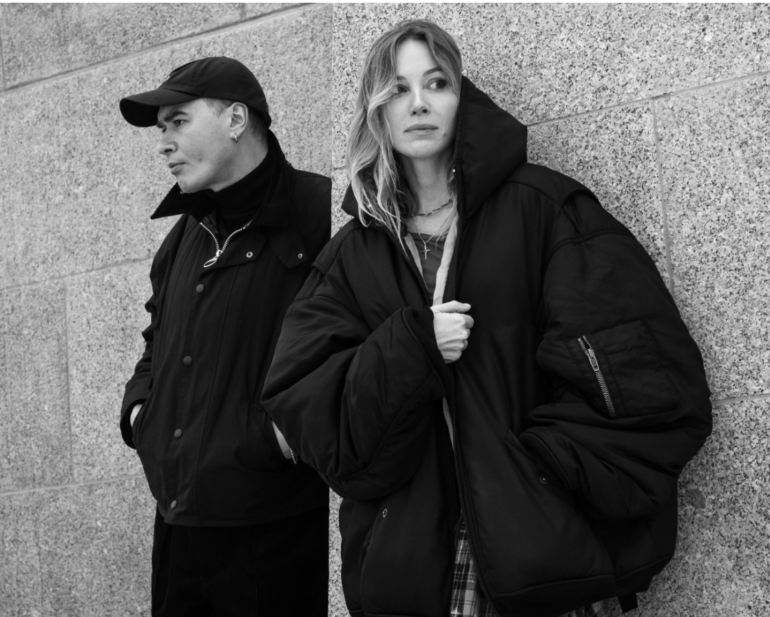
Ukrainian artist Nikita Kadan and curator and art historian Natalia Sielewicz have been selected to curate the 16th edition of the Baltic Triennial, one of the Baltic region’s most significant contemporary art events.
The exhibition will take place in 2027 at the Contemporary Art Centre Vilnius in Lithuania. Chosen by an international selection committee, the curatorial duo will develop a concept exploring themes of grief, mourning and resurrection, reflecting on how art responds to moments that profoundly disrupt meaning, language and lived experience.
The Baltic Triennial is one of the most ambitious contemporary art events in the Baltic region, and has been organised every three years since 1979. Since 1992, when CAC took over the Baltic Triennial, each edition has been curated by different curators. As the project has grown, it has expanded to present artists from across the world. This year, invited curators submitted their proposals to an international committee of seven members who, after long and careful consideration, selected Ukrainian artist Nikita Kadan, based in Kyiv and Natalia Sielewicz, an art historian and writer serving as Chief Curator at the Museum of Modern Art in Warsaw, to curate the upcoming edition. For the 16th Baltic Triennial, they have proposed a concept centred on grief and resurrection.
The curators of the upcoming Triennial were selected by an international committee bringing together leading voices from the cultural field. The committee comprised Valentinas Klimašauskas (Chair of the Selection Committee, Director, CAC, Lithuania), Virginija Januškevičiūtė (currently Senior Curator, CAC, Lithuania), Edgaras Gerasimovičius (Head of Art Programme at Sapieha Palace, a branch of CAC, Lithuania), Inga Lāce (Chief Curator, Almaty Museum of Arts, Kazakhstan), Maria Arusoo (Director, CCA, Estonia), Sebastian Cichocki (Senior Curator, Museum of Modern Art, Poland) and Cosmin Costinas (Senior Curator of Exhibition Practices, Haus der Kulturen der Welt, HKW, Germany).
Traditionally, each Triennial includes a prologue event one year prior to the main exhibition. The prologue to the 16th Baltic Triennial will therefore take place in mid-2026. The 16th Baltic Triennial is financed by Lithuanian Council for Culture
Arising from an ongoing dialogue on grief and resurrection that has come to mark our friendship, we reflect on what it means to live after an event that breaks the continuity of meaning – when experience, language, and the world itself are altered at their foundations.
We speak from within a position that is itself unstable. As artists who sometimes curate, and as curators unsure where our creative practice ends, we wish to occupy a double position that unsettles fixed definitions and singular authority. Our roles are relational and continually negotiated, shaped as much by doubt and listening as by intention.
From this position, we propose an exhibition that approaches despair and mourning not as pathologies, but as spaces of careful listening. Inhabiting despair thus becomes a form of fidelity: an attunement to the faint echoes of what might yet return, to the resonance of hope that lingers beneath lament, and to the quiet call of what has withdrawn – awaiting those who can still hear it.”
Curators Nikita Kadan and Natalia Sielewicz
The curators were selected to provide space for experimentation, dialogue, and sensitivity towards the larger region. Nikita and Natalia were chosen for their ability to create an sensitive, open, and critical conversation with art, history, and the public.”
Chair of the committee and CAC Director Valentinas Klimašauskas