

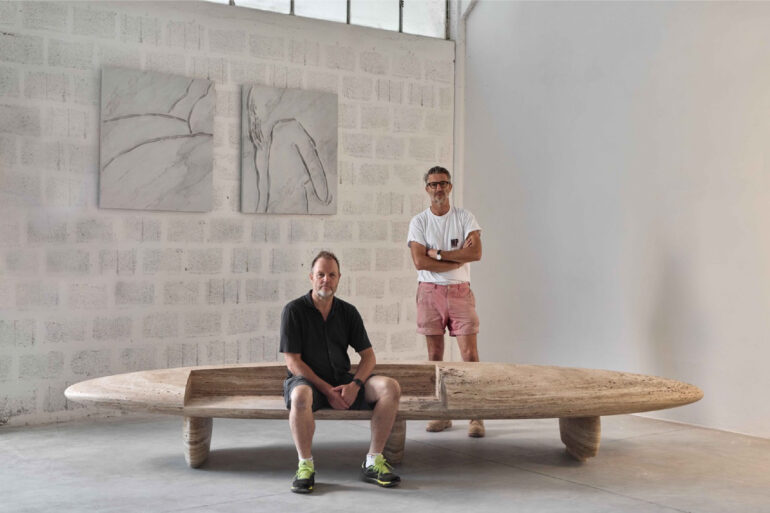
In this exclusive Culturalee interview, British sculptor David Worthington and Kevin Francis Gray, founder of Marble Projects, discuss their groundbreaking collaboration on a major public commission at 20 Gresham Street with John Robertson Architects. The commission to create four monolithic sculptural benches carved from Tuscan travertine, brings together art, architecture, and advanced fabrication techniques.
From sourcing a rare five-metre slab of stone in Tuscany to blending robotic carving with traditional hand-finishing, the conversation reveals how innovation, craftsmanship, and material history converge to transform a City of London lobby into a tactile, riverbed-inspired sculptural landscape.
Kevin Francis Gray: David had been a bit of a Pioneer in Pietrasanta before a lot of British artists had gone over there. And then he left Pietrasanta to return to the UK, and then I came in a few years behind him. I set up my studio there, and then set up Marble Projects, which is a business designed specifically to help artists make their art in an affordable and accessible way, with high end machinery and knowledge of all the artists who have worked there before. So that’s really how it all started.
David Worthington: Basically I had the (20 Gresham Street) commission, and there were a few issues around finding someone to fabricate it. I’d met up with Kevin at Frieze art fair the previous year, and he said that he was buying a robot and setting up Marble Projects. So I reached out to him and said ‘I’ve got this commission, would you be interested in collaborating and getting involved’? Which Kevin agreed to.
Culturalee: How many artists have you worked with, and do you work with the same artists on a regular basis?
Kevin Francis Gray: I only set up Marble Projects a year and a half ago, before that it was my studio where I was working on my own work. When I was younger I was helped by a couple of artists, who really helped me establish myself and gave me a foothold in my career. And I remember thinking ‘If I’m ever in a position to be able to help an artist in the future then I will’. So for years I’d been thinking about setting up a small school to teach people how to work in stone. And then I thought, ‘what about actually physically being able to help artists realise their work?’ Because it’s an extremely expensive thing to do to make work like David’s in stone, and to make my work. So I thought about setting up a company that helps artists make their work for the artist’s price. And then if they have a commission, there’s a commission price. I would consider it a real hotbed of creativity where artists can come in and make work inexpensively, and experiment with high end machinery and knowledgable artisans.
And then if the artist is lucky enough to get a commission – such as public sculpture or private commission – we are able to charge a little bit more. It’s not fully philanthropic but it’s definitely leaning towards that idea.
Culturalee: What you’re doing at Marble Projects is really pushing the boundaries of what you can do with marble. How did that work with David – did you discover new technique through the commission for 20 Gresham Street?
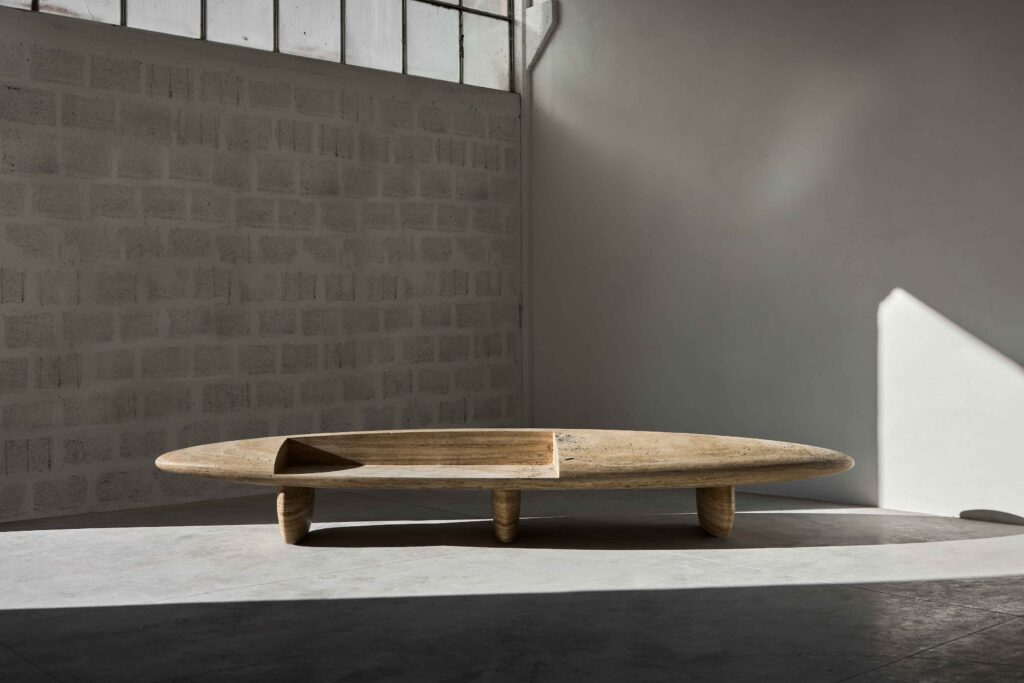
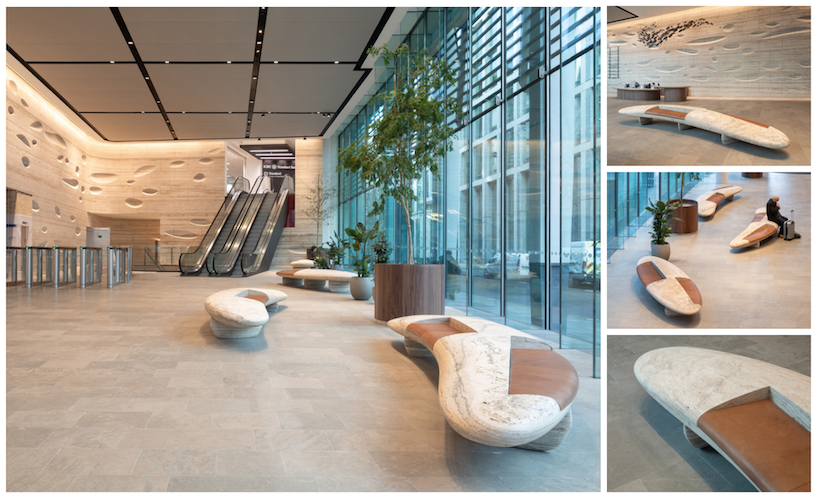
Kevin Francis Gray: David’s work is not only ambitious in scale, but also conceptually ambitious. So to make those pieces was a huge challenge. Although the photos don’t really do them justice, they are really monolithic sculptures. The thing about David’s work is that the simplicity of the aesthetic underlies an incredible artisanal knowledge of stone and space, and sculpture and architecture as well. So really when we started with David, we thought it was going to be an easy ride, but in fact it was extremely challenging and very difficult.
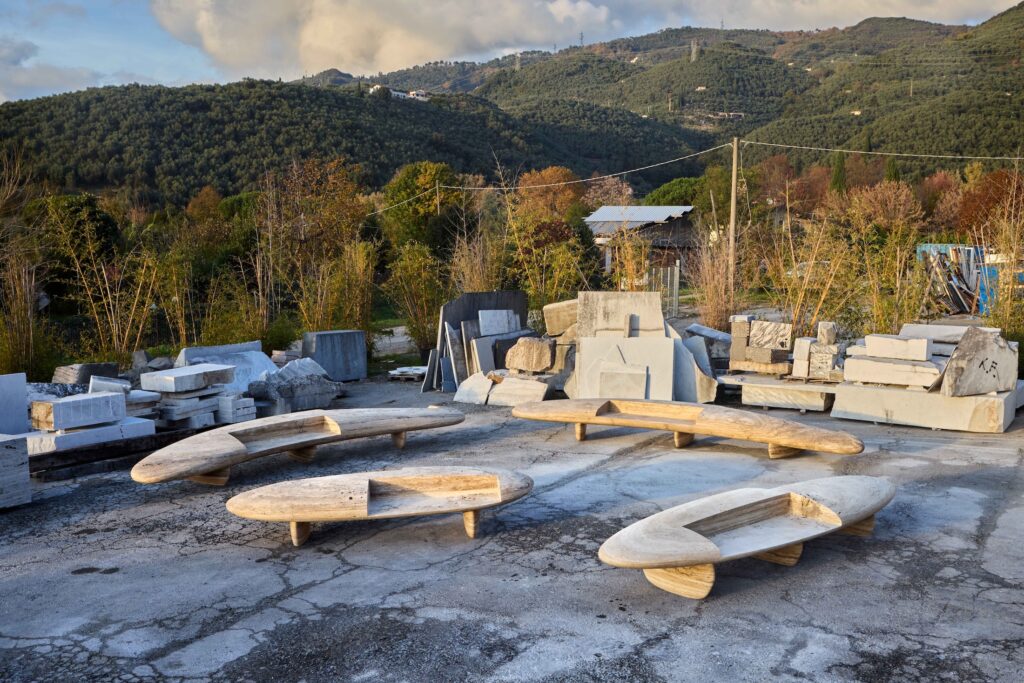
David Worthington: Also we had a lot of discoveries during the journey. The first discovery was,I thought the stone of the lobby wall came from near Rome and was typical Roman Travertine. But we discovered through Kevin’s associates that it comes from Tuscany. So we went to visit the quarry in Tuscany, which was an extraordinary trip, as it was in a corner of Tuscany that doesn’t seem to have any tourists. Kevin persuaded the quarry owner to take out of the quarry wall one piece of stone 5 metres long, in order to make the benches in one piece. I thought we would have to make it in sections, but that’s really where Marble Projects really came into their own and were able to help me, by sourcing the material and dealing with the quarry to get a massive piece of material for the benches.
Culturalee: Can you explain a bit more about Travertine as a material. Is it a kind of marble?
Kevin Francis Gray: David knows almost as much about marble as much as our geologists. Travertine is a sedimentary stone. As opposed to Carrara – which is a white marble that comes from the mountains – Travertine would be traditionally found at the bottom of lakes that have been dried over millions of years, and condensed through pressure. So it’s a sedimentary stone, and that’s why you get that beautiful ochre, and also those different textures and lines. Someone said it’s like a lasagne. It’s like millions of years of Bolognese and homemade lasagne!
David Worthington: I hadn’t understood this, and that’s why it’s so exciting doing this kind of project. Kevin’s geologist basically said there was a lake stretching from Southern Tuscany all the way down to Rome in ancient times. And the mud that built up became this travertine bed that stretches all that way. This was an incredible bit of discovery, which the client really liked, and it fitted in with the building, which has this travertine stone wall made of Tuscan travertine. So that was part of the exploratory discovery of this project.
Culturalee: So the starting point was the fact that the wall in the building was made of Travertine?
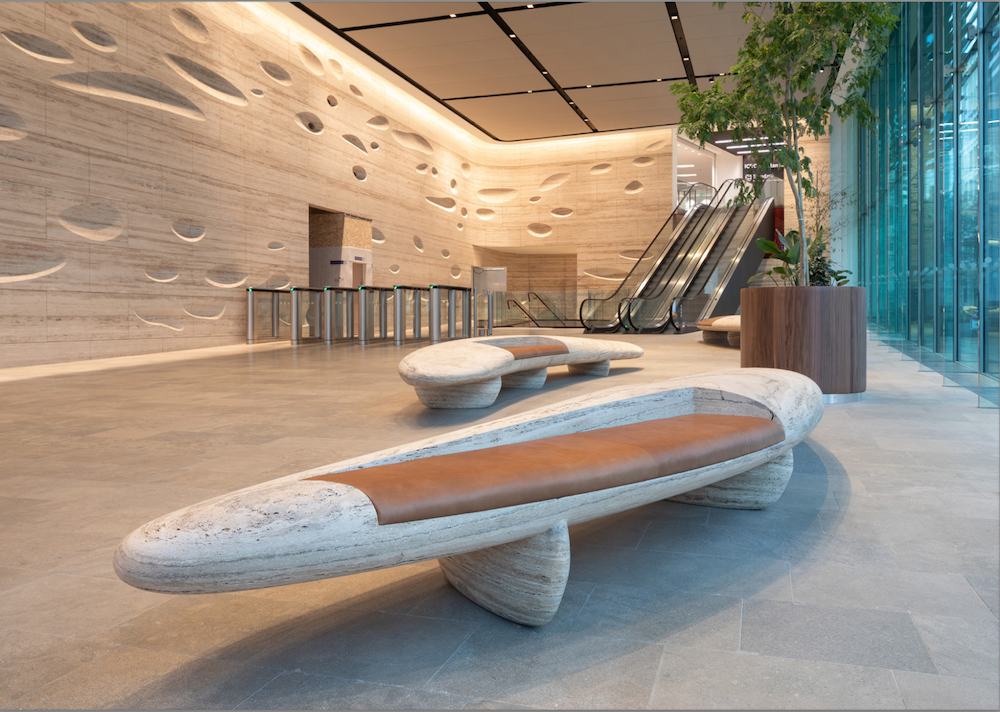
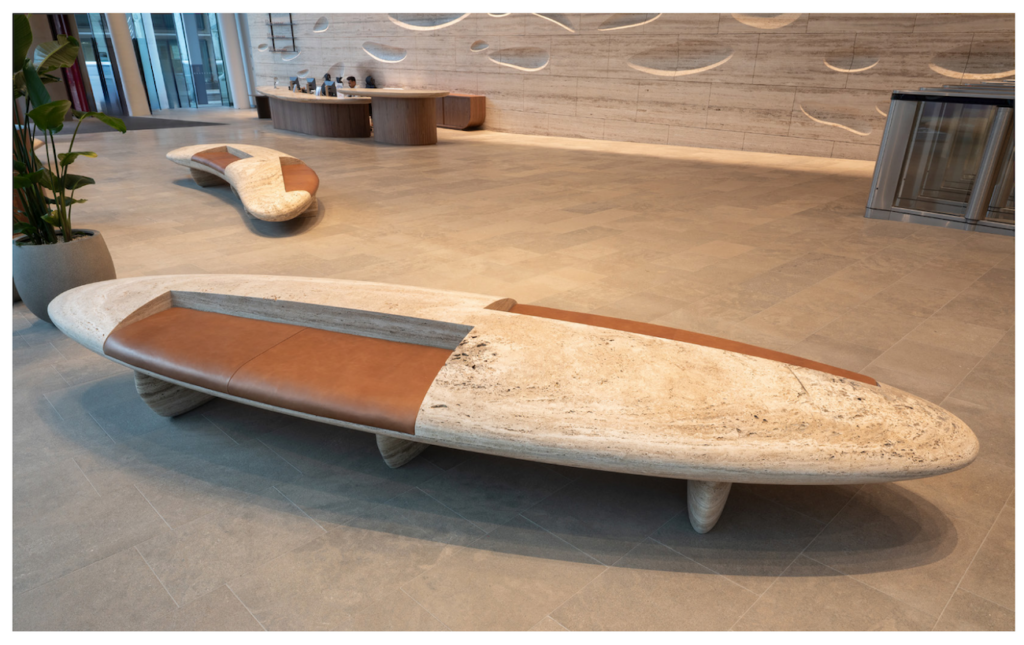
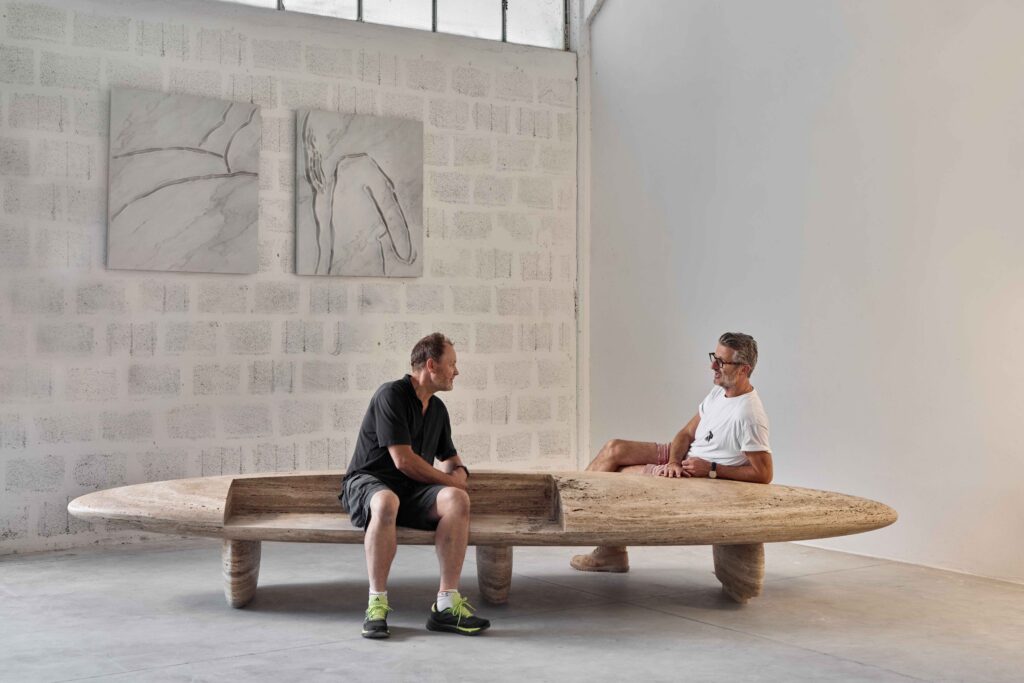
David Worthington: Yes. That was the reason they commissioned the benches (for 20 Gresham Street). They wanted to use that material for the benches, to reflect these oval scallops that had been carved into the wall, and give the whole space the feeling of a river bed, with boulders that had been rolled and tumbled into these shapes.
Culturalee: Can you talk a bit about the more technical side of it? David, you said you did a digital design and sent it virtually or digitally to Kevin to 3D print. And then you went to Pietrasanta to work with Kevin on the benches by hand?
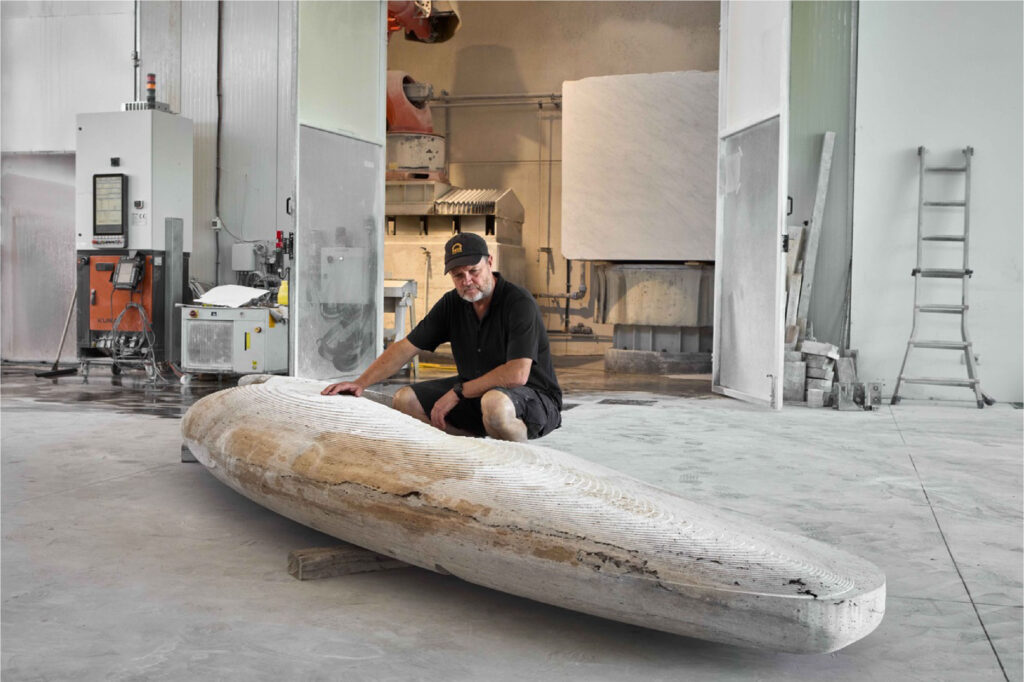
David Worthington: I worked with a CAD designer, I do the design on paper, as a pencil drawing. So I drew the important profiles in a pretty old school way. Then I handed these over to my CAD designer, Jack Draper, who took my profiles and built them up using splines to make a 3D model. Once the 3D model was finished our end, we then sent it to Kevin, to his workshop, who analysed it and worked out how the robot would carve the shape into a block of stone. Also they had to deal with the engineering, structure, safety and how it could be supported. That’s where Kevin and his team came in.
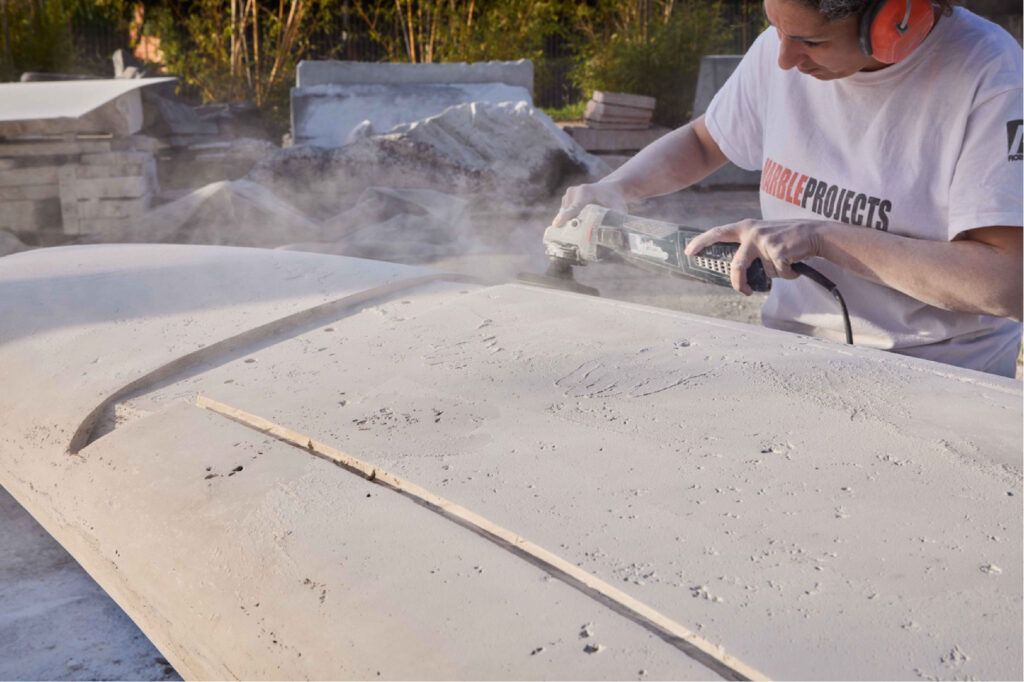
Once it was finished and we got to the studio, I realised that there are lots of things you have to work on by hand. Because you’re working on a computer (in the early stages), there are lots of things you can’t actually see until you are with the physical sculptures. We had to iron lots of lumps and bumps out by hand, and fine tune it with one of Kevin’s technicians. So, although I say the sculpture has been made by a robot, that’s not really true. It’s always finished by hand, because you have to have the eye and feel of the artist involved.
Kevin Francis Gray: I do think it’s very easy with this type of technology to think that it creates the sculpture. But actually it is simply a tool. It’s like a hammer and chisel. The important thing was that David was there to finesse. Like Michelangelo who very rarely touched the sculptures but did a lot of the final detail and intricate work. That’s a metaphor for how David worked with these sculptures.
When the artist then starts to work on it physically, the whole thing becomes a different piece, it becomes a different sculpture. And that’s necessary, because had we just made it with a robot, it have lacked any authenticity and integrity. So it’s really important that the artist is there. So the process for me is, in the end, as important if not more important than what happens in the design phase.
David Worthington: All the robot does is what in history an assistant would have done. So you take a square block, and in the past you would have had an assistant knocking away, and getting closer and closer to the finished form. Then the artist would come in and finish the piece. So essentially we’re doing is using a robot to take out some of the manual labour.
Kevin Francis Gray: With all the work that Marble Projects does, the artist is intrinsically involved from start to finish. The machinery and technology is simply used as a tool. In the same way a hammer and chisel would be considered a tool.
Culturalee: How would you describe that the different disciplines of art, architecture, design and technology meet in these benches?
Kevin Francis Gray: I think they’re a perfect a simile of all of those practices – architecture, furniture, sculpture and design. They’ve like living hybrid sculptural beasts that have taken all of these elements in. They really function to me. They’re monolithic, statuesque, architectural. They really do tick a numer of boxes, and that’s why I think people have really connected to them. They have a multidisciplinary feel combined with a cute functionality that you can sit with them.
Culturalee: Whose ideas was it to get Bill Amberg to design the leather for the seats?
David Worthington: I approached Bill because he did a fantastic bench for an architect I know. He created a kind of leather banquette but it had a great sculptural quality to it. It was on a whole other level to ordinary furniture. So I wanted Bill’s knowledge of leather and his expertise. Bill is also kind of an artist-craftsman, and everything he does has got this real sculptural, physical quality to it.
In history, this whole separation between sculpture, art, architecture and design is an incredibly new thing. It really only came about in the 18th/ 19th Century. So, I don’t see the difference between designing a bench and designing a sculpture. The bench has a utitlity to it, but what’s really important is the concept the artist has and brings to the work, and also the tradition and the art historical references and feelings of material and form. That’s what defines it. So whether its Philippe Starck doing an orange squeezer – which to me is a fantastic piece of sculpture – or me designing a bench. I see myself in the tradition of Brancusi or Noguchi, who were very happy to make sculptures, benches or pedestals. For example Noguchi’s sofa is a fantasticly surreal form. The aesthetic and the concept is no different.
Find more information about David Worthington’s commission for 20 Gresham Street here.