


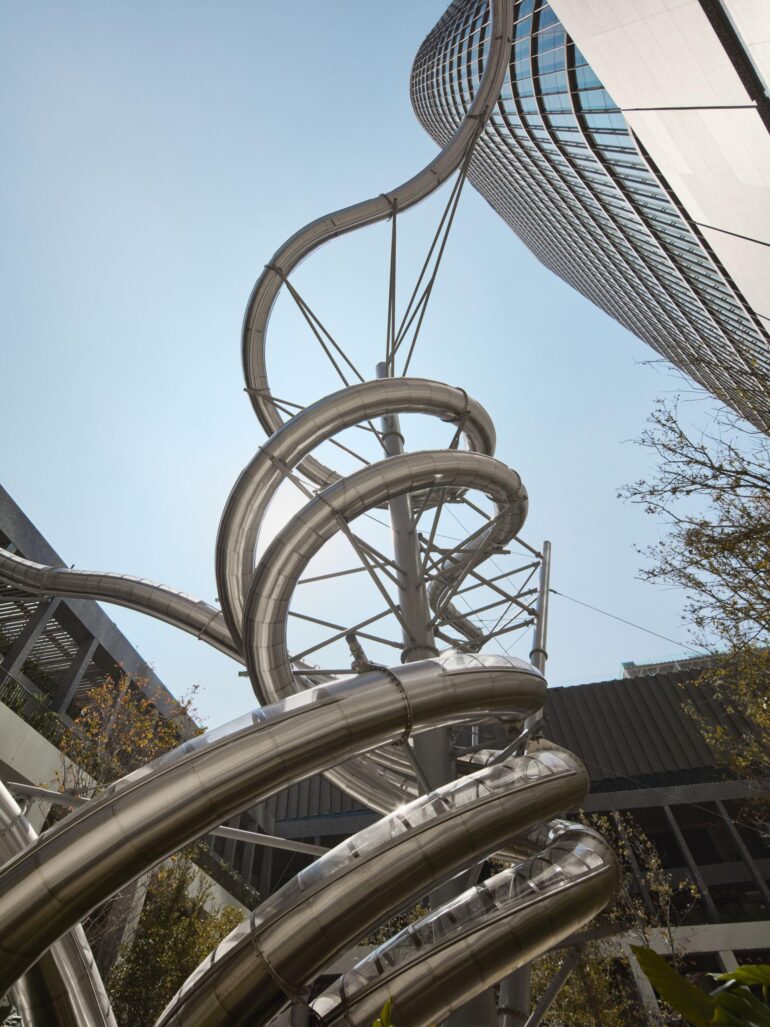
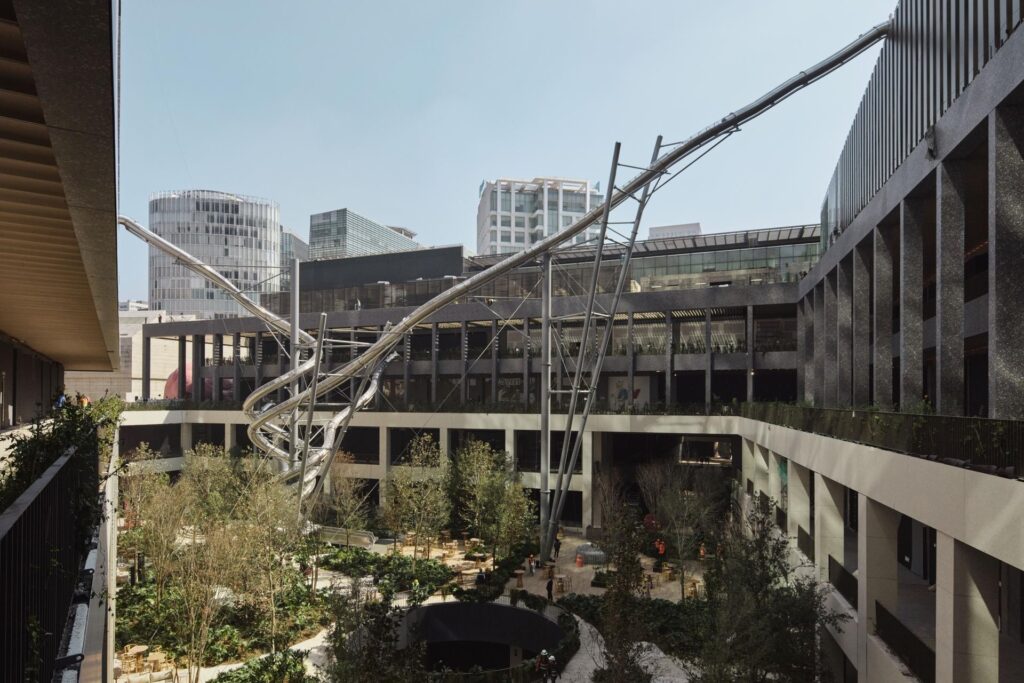
Internationally acclaimed artist Carsten Höller presents Mexico City Slides (2026), a new large-scale and permanent installation at Arte Abierto Polanco in Mexico City, commissioned by Arte Abierto and Sordo Madaleno Arquitectos. The work consists of four spiral slides integrated into the architectural fabric of Antara, forming a sculpture that unfolds across the site.
Antara, a mixed-use development in Polanco, Mexico City, brings together retail, dining, entertainment, offices and public space, with gardens, plazas and a central pedestrian promenade. Its latest expansion includes a new park, additional shops and restaurants, offices including Google and the city’s first Rosewood hotel, alongside Arte Abierto’s new cultural space, where Höller’s slides form part of the wider development.
Mexico City Slides is part of a series of works that Höller has been working on since 1998, where the slide, otherwise associated with play and fun, is transformed into “a sculpture with people inside” and architecture. Examples include Test Site (2006) at Tate Modern in London; Victoria Slide (2011) at the New Museum in New York; Vitra Slide Tower (2014) at the Vitra Campus in Weil am Rhein; Isometric Slides (2015) at the Hayward Gallery in London; Florence Experiment Slides (2018) at Palazzo Strozzi in Florence; DAC Slide (2020) at the Danish Architecture Centre in Copenhagen; Isometric Slides (2021) at the Luma Foundation in Arles; and Stockholm Slides(2025), a permanent installation on the façade of Moderna Museet in Stockholm.
For Mexico City Slides, four spiral slides vary considerably in scale, ranging from 12 to 38 metres in height and 31 to 90 metres in length, with all four accessible to the public. The slides wind through the complex, allowing four people to ride simultaneously from different entrance points—family-style restaurants, the Google Office, the Rosewood Hotel, and the Arte Abierto Art Space. By drawing riders from these varied locations, the installation acts as an “equalizer,” bringing people together through a shared, transformative experience: they will all land next to each other. One doesn’t have to go down the slide to experience it; passersby can watch people zoom through the structure or simply admire the slides’ physical form within the architecture.
The downward movement activates not only the body, but also an emotional and cognitive dynamic: yielding to gravity creates a controlled state of loss where powerful feelings such as fear and delight coexist. Höller describes the experience of sliding as a controlled fall, a state of “voluptuous panic upon an otherwise lucid mind” – borrowing from the sociologist Roger Caillois.