

The Musée Jacquemart-André in Paris presents a major exhibition dedicated to Félix Vallotton (1865–1925), the celebrated Franco-Swiss artist whose incisive observations of modern life captured the complexities, contradictions and social tensions of his era. Running from 26 February to 1 August 2027, the exhibition explores Vallotton’s distinctive artistic vision, in which sharp psychological insight, subtle irony and social criticism combine to expose the intricacies of human relationships and bourgeois society. Through his compelling portrayals of everyday life, Vallotton emerges as a fascinating chronicler of modernity, offering a perceptive and often unsettling reflection on the world around him.
A prolific and multidisciplinary artist, Félix Vallotton was a Swiss painter, printmaker, illustrator and writer who became a naturalised French citizen in 1900. Throughout a career spanning from the Belle Époque to the interwar period, he established himself as a key figure in the avant-garde of his time. Having arrived in Paris in 1882 to study painting at the Académie Julian, he distinguished himself through his use of a smooth brushstroke and rigorously constructed compositions. At the same time, the young Vallotton learnt woodcut printing – a technique then experiencing a genuine revival – under the guidance of the anarchist painter and engraver Charles Maurin.
His black-and-white compositions, based on simplified forms and bold framing, met with early success, which contributed to his recognition within Parisian artistic circles. In both printmaking and painting, his approach, characterised by an economy of means – reinforces the narrative and satirical nature of the subjects he depicts.
His detached style is also not unrelated to the staging techniques of the pioneers of cinema, with whom he was a contemporary. Sensitive to the personal and social violence pervading society, Vallotton put his art at the service of his political convictions. Thus, he defended the anarchists and became an early advocate for Captain Dreyfus, whilst also bearing witness, as an artist attached to the armed forces, to the horrors of the First World War.
Vallotton’s prolific body of work spans all genres, from the female nude to still life, including portraiture and landscape. The exhibition chooses to highlight a key theme: the artist’s critical and ironic view of human nature. His works lay bare pretence, vanity, social ambition, violence and the games of seduction. A single gesture, a posture, or the distance between two figures is enough to suggest an intention lying beneath the surface. Vallotton thus remains an indispensable witness to his era, and his perceptive insight as an observer continues to resonate powerfully today.
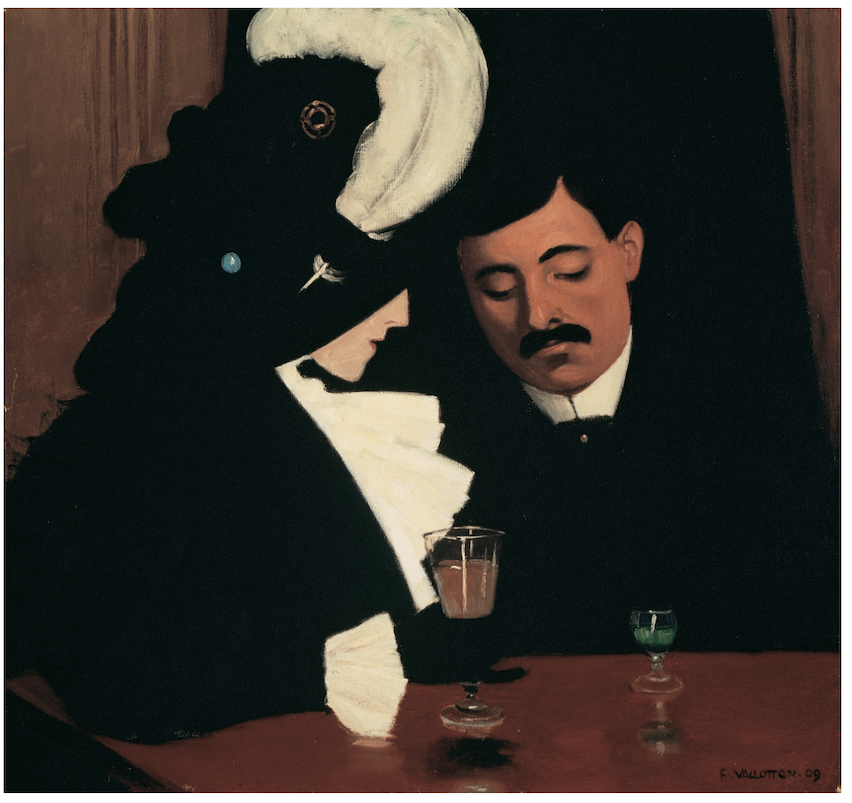
Courtesy of the Pauline Art Foundation
Bringing together some sixty paintings, engravings and illustrations from major French and international public and private collections, the exhibition at the Musée Jacquemart-André offers a thematic journey that allows visitors to grasp the full complexity of Vallotton’s perspective on the society of his time.
The exhibition opens with humorous compositions in which public spaces become the backdrop to a world hungry for pleasure and glory. The artist displays a clear interest in the spectacle of Parisian life, which he depicts drawing on the aesthetic principles of the Nabis (a group he joined in 1893): simplified line work, bold blocks of colour, shadowless lighting and a deliberately flattened perspective.
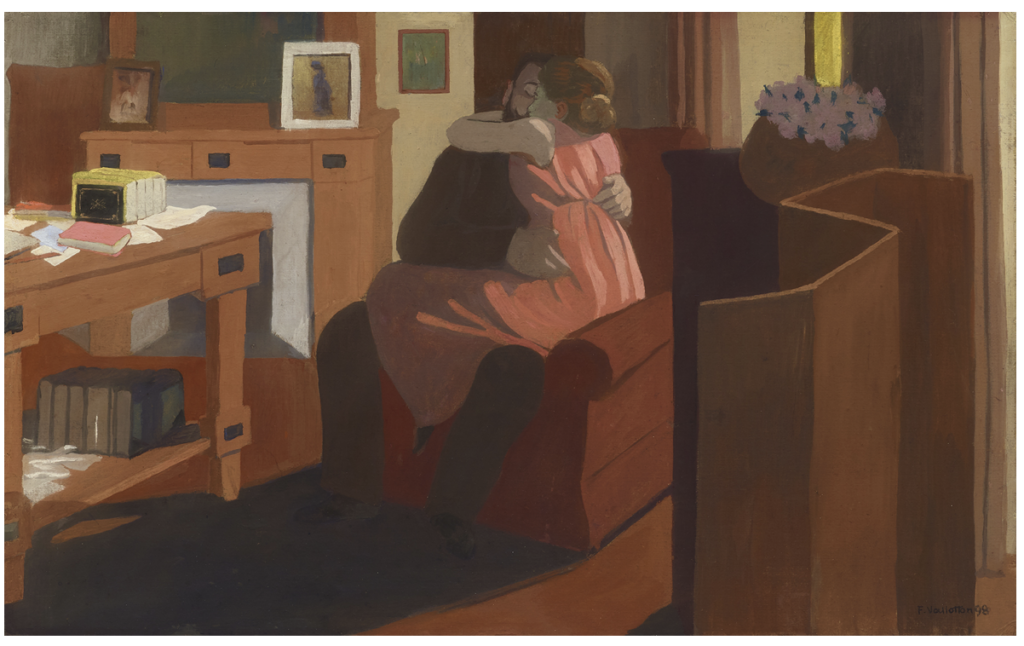
He also excels at interior scenes, particularly in the engraved series Intimacies (Intimités), which stands out as one of his greatest masterpieces. Both biting and technically masterful, this series of ten woodcuts lays bare, with relentless lucidity, the underlying tensions of married life – a subject the artist also explores in his paintings.
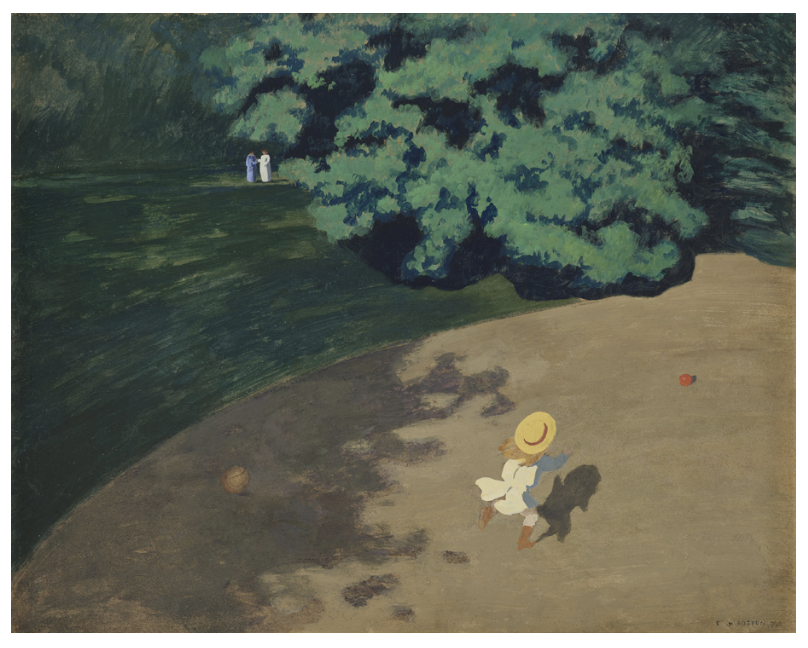
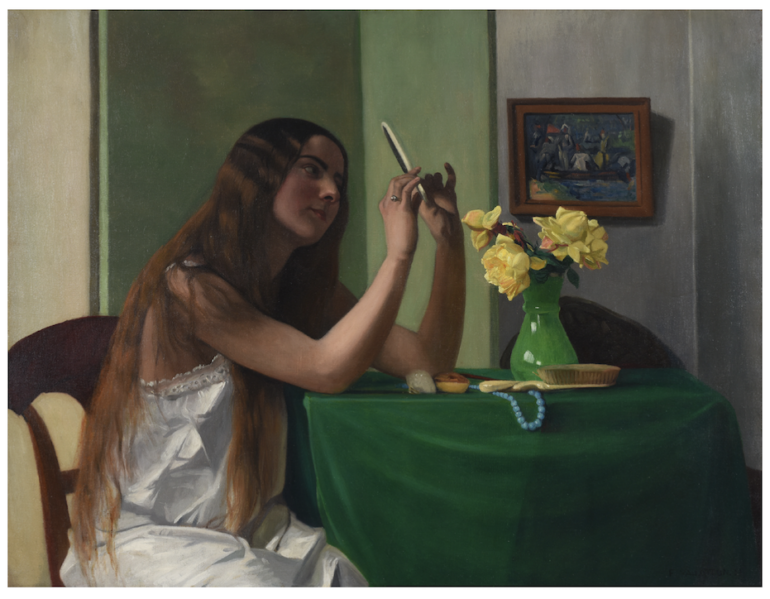
A central theme in his work, Vallotton’s nudes featured in the exhibition convey the full ambiguity of the artist’s perspective on female beauty, oscillating between attraction and disillusionment. Following his marriage to Gabrielle Rodrigues-Henriques, Vallotton explored family life by painting his wife and stepchildren. Far from idyllic depictions of harmonious homes, his meticulously detailed compositions reveal complex and mysterious spaces, theatres of unspoken truths. Childhood is portrayed as a fragile time weighed down by threats, as illustrated by the unsettling shadows behind the child in the painting The Ball (Le Ballon).
The exhibition’s subtitle is a reference to Honoré de Balzac’s monumental work, conceived as early as October 1841: The Human Comedy. This collection, comprising more than 90 novels, short stories and various other texts, forms a critical social panorama in which the aspirations, successes and disillusionments of Balzac’s contemporaries are laid bare. Sixty years later, Félix Vallotton, in turn, explored human passions, revealing social and psychological mechanisms that seem to transcend the centuries. By lending his work a timeless quality, he may well have embraced the principles set out by the writer in his 1842 foreword: ‘Man is neither good nor evil; he is born with instincts and aptitudes. Society, far from corrupting him, as Rousseau claimed, perfects him and makes him better; yet self-interest also develops his evil inclinations.’
The exhibition ‘Vallotton. The Human Comedy’ will aptly reveal the artist’s ironic view of the society of his time and of human relationships – a perspective that remains entirely relevant today. This exhibition is organised and produced by Culturespaces, in collaboration with the Fondation Félix Vallotton.