


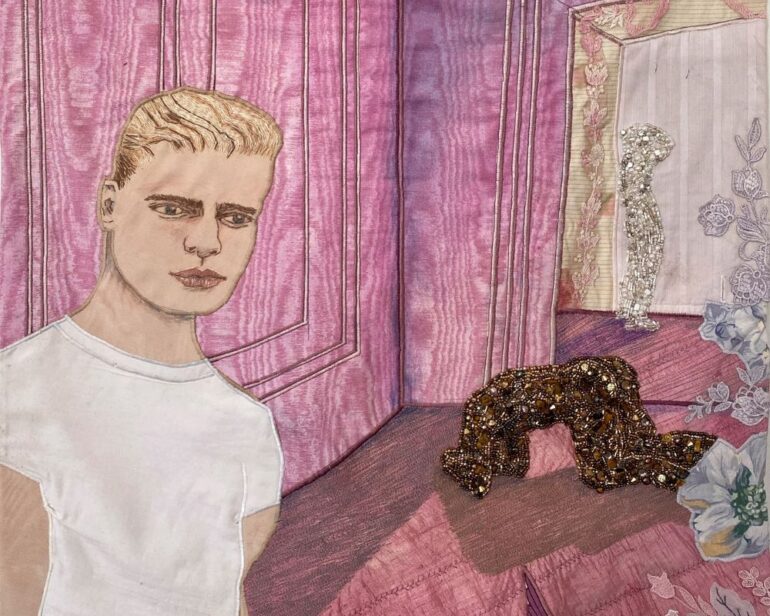
Opening this May in Hove, The Male Gaze by Tony Mentel, presented by The Adelaide Salon as part of the Brighton Festival Open Houses, is a compelling solo exhibition that explores queer identity, memory, and coded histories through intricate craft-based works.
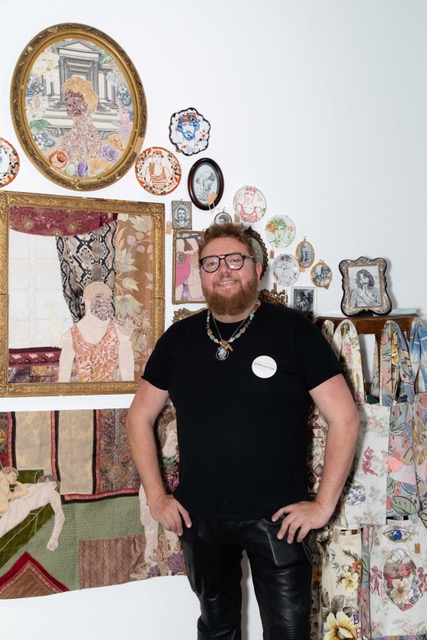
Blending tapestry, ceramics, and mixed media, Mentel transforms decorative traditions into powerful storytelling tools, revealing the hidden narratives of queer lives shaped by visibility, erasure, and resilience. The Male Gaze, presented by The Adelaide Salon, brings together new works by Brighton-based artist Tony Mentel in an exhibition that moves between surface and secrecy, beauty and unease.
Working across needlework, tapestry, ceramics and mixed media, Mentel draws on visual languages long dismissed as decorative to tell stories that were never meant to be easily seen. At first glance, the works seduce: intricate stitching, luminous colour, richly layered textures. But look longer, and something else begins to emerge—fragments of bodies, mythological figures, gestures caught mid-transformation. These are images that do not announce themselves. They reveal slowly, often uncomfortably, as if the viewer has arrived too early—or too late.
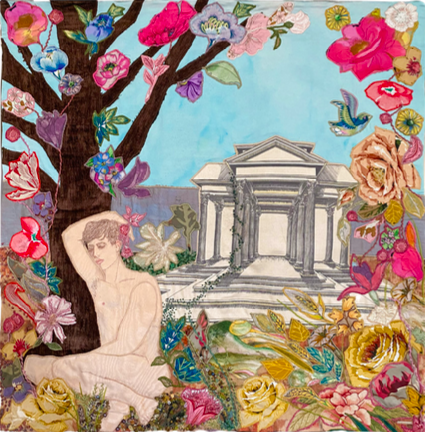
Mentel’s practice is rooted in the question of how queer histories survive. While ancient mythologies once held space for fluid identities without apology, later centuries forced those narratives into hiding. Stories became encoded — embedded in ornament, passed through craft traditions, disguised within religious iconography. In The Male Gaze, these coded languages return, not as relics, but as active tools of storytelling. Religious imagery runs throughout the exhibition, though not as devotion. Instead, Mentel reworks the visual authority of the Church—an institution historically tied to the regulation and erasure of queer experience—transforming saints, symbols and sacred forms into carriers of alternative narratives.
What was once used to exclude is here reclaimed as a site of expression. Material is central. Using reclaimed fabrics, beads, and objects worn close to the body, Mentel builds works that carry traces of lived experience—touch, time, and proximity embedded within their surfaces. These materials do not simply illustrate memory; they hold it.
At the heart of the exhibition lies a deeply personal act of remembrance. The Male Gaze is dedicated in part to George and Harry, two men from Mentel’s youth in Waltham Abbey who were ostracised during the AIDS crisis of the early 1990s. Their story—of visibility, loss, and quiet erasure—lingers throughout the work, shaping its emotional and political weight.
By working within mediums historically marginalised and often associated with women’s labour, Mentel also challenges the structures that have defined artistic value. His practice occupies a space where authorship, gender, and legitimacy remain unsettled—where what was once overlooked becomes central.
Central to The Male Gaze is a personal and collective act of remembrance. The exhibition is dedicated, in part, to George and Harry—two men from Mentel’s youth in Waltham Abbey whose lives, once quietly integrated within their community, became marked by exclusion and hostility during the AIDS crisis of the early 1990s. Their story, and the impact of their erasure, remains a formative presence within Mentel’s practice. The exhibition emerges as both tribute and reckoning: an acknowledgment of visibility, vulnerability, and the cost of being seen.
By situating his work within mediums historically dismissed as decorative or marginal—practices long associated with women’s labour and excluded from dominant art histories—Mentel further complicates questions of authorship and legitimacy. His engagement with these forms simultaneously inherits their historical invisibility and resists the boundaries that once defined them. In doing so, he repositions craft not as peripheral, but as a critical site through which suppressed narratives endure.
The Male Gaze ultimately reflects on what is buried and what persists. It considers the quiet mechanisms through which histories are carried forward—through material, through gesture, through lives lived in partial visibility. It is an exhibition about endurance: of stories, of forms, and of those who sustained them, often without recognition.
Presented as part of the Brighton Festival Open Houses, The Male Gaze transforms a domestic interior into a site of encounter—intimate, layered, and quietly confrontational. This is not an exhibition that declares itself. It asks to be approached slowly. To look again. To recognise what has always been there, just beneath the surface.
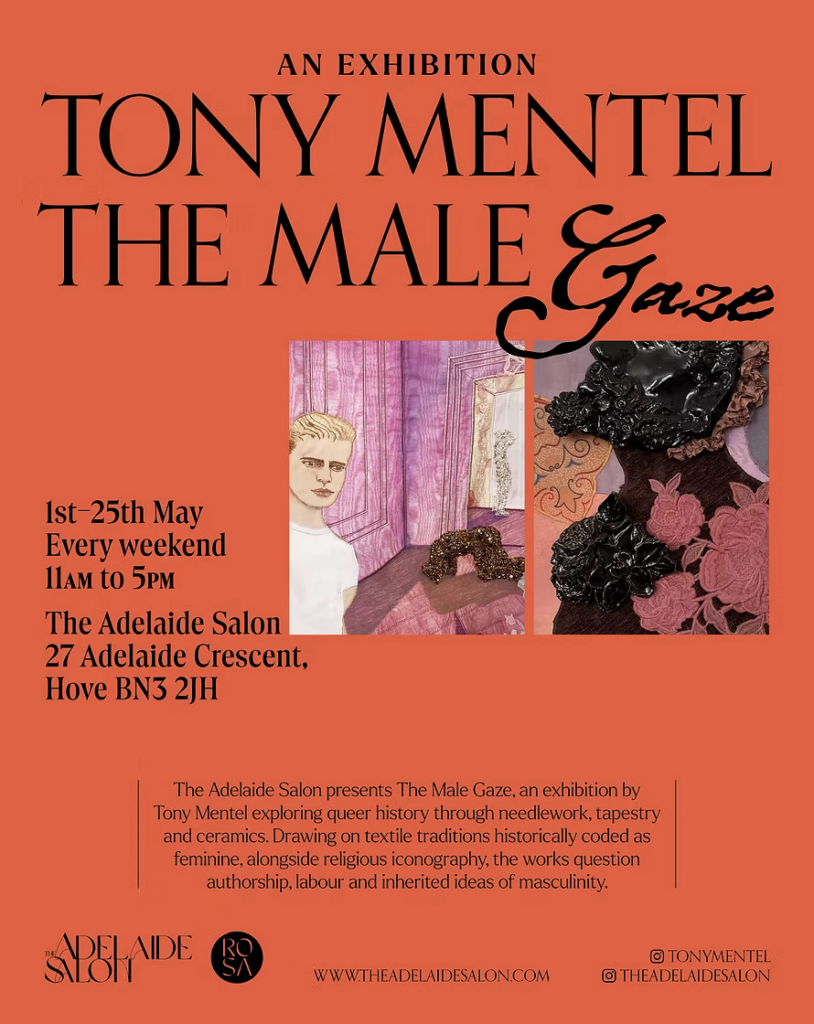
The Adelaide Salon Presents The Male Gaze by Tony Mentel from 1–25 May, 2026. Weekends, 11am–5pm at
27 Adelaide Crescent, Hove BN3 2JH. Find more information here.