

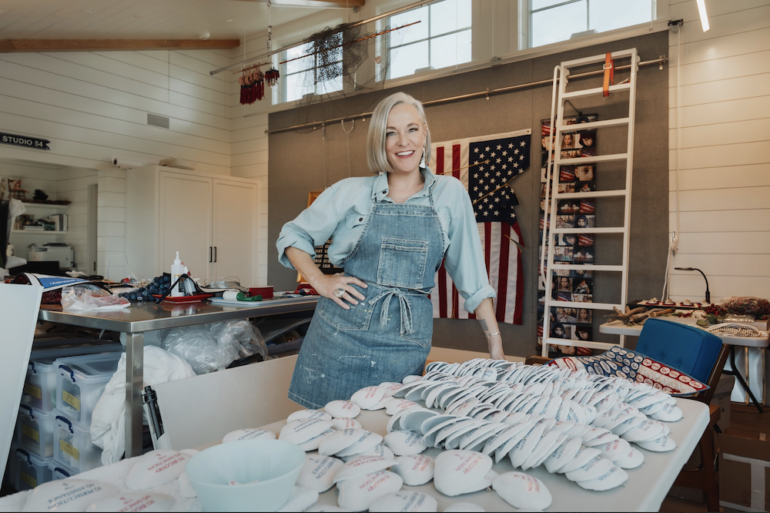
In this edition of Culturalee in Conversation, we speak with Rhode Island-based artist Tracy Weisman, whose multidisciplinary practice transforms found objects, textiles, photographs and discarded materials into powerful visual narratives. Before dedicating herself fully to art, Weisman spent years as a communications professional and speechwriter, developing a deep understanding of storytelling that continues to shape her work today. Drawing on the histories embedded within everyday objects, she creates evocative assemblages that explore memory, identity, social justice and the complexities of contemporary American life.
Our conversation coincides with the presentation of Some Birthday, America, an exhibition created during the 250th anniversary year of the United States. Rather than offering a straightforward celebration, the exhibition reflects on themes of patriotism, grief, democracy, inheritance and belonging through a distinctive visual language of red, white, blue and black. Weisman discusses the childhood experiences that shaped her creative voice, her fascination with the “past lives” of found objects, and how materials often lead the direction of her work. She also reflects on the contrast between the optimism of America’s 1976 Bicentennial and the divisions of the present day, revealing how art can create space for empathy, questioning and dialogue. The result is a compelling discussion about the role of artists in turbulent times and the power of material storytelling to illuminate both personal and national histories.
Before becoming a visual artist, you spent years working as a communications professional and speechwriter. What first drew you toward visual art as a new form of storytelling?
The combination of storytelling and visual arts has been with me since childhood. I used to write dialogue for the stuffed animals and dolls on my bed and was fortunate to experiment with many visual arts tools as a child. Yankee ingenuity runs deep in my family: my grandfather painted and built ship models, my mom taught me how to sew, my dad had a basement workshop, and I was fortunate to grow up when you could still take Home Economics and Woodshop, so my brothers and I have always worked with our hands. They build furniture and I was a quiltmaker for decades.
I made the commitment to become a full-time visual artist about 8 years ago when my husband and I moved from Chicago back to my hometown in Rhode Island. I was finally able to have a dedicated studio with storage and began collecting found and collected objects. They whisper to me of their past lives. Adding that energy to my vocabulary gave my work a new depth that thrilled me and I saw a vast horizon of possibility ahead of me. That’s when I committed to a full-time visual art practice.
Were there artists, movements, or experiences that helped you find your creative voice?
Childhood play using physical objects as narrative tools first gave me agency to get my feelings out into the world. In my studio today you’ll find a lot of toys: army men, Tinkertoys, Barbie dolls as well as a huge assortment of vintage objects. I also read and wrote a lot as a kid which gave me the confidence to translate my ideas into a shareable product. Certainly, encouragement from teachers and my parents played a huge role. I’m a huge believer in keeping kids off screens and working with their hands. It breaks my heart that arts education is so undervalued and underfunded in the US.
I’m inspired by artists who have strong materials-based practices. Nick Cave is utterly brilliant and I’m manifesting a visit to his Chicago studio someday. And because much of my work is political, I’m also drawn to legendary artists like Judy Chicago who’ve made that a centerpiece of their careers.
You’ve described being interested in the “past lives” of found objects. Is there a particular object or material you’ve discovered that completely changed the direction of a piece?
So many! A very special one that comes to mind is a family of small, handcrafted dolls I found in a Newport antique store. The owner told me they were Russian and about a century old. They created a vision in my mind of a young girl immigrating to America who carried the dolls with her on the long ocean journey. I repurposed them by mounting them on a small piece of scavenged local driftwood and installed the objects on one of my photographs taken on a beach. Called “Tempest Tossed,” it made a powerful statement about welcoming the stranger at a time when immigrants (as well as citizens) of color are being detained and imprisoned in the US.
Your practice often involves altering familiar objects through stitching, accumulation, and disruption. What interests you about physically transforming materials by hand?
I mentioned my long-held commitment to craft, which is where I feel most comfortable as an artist. I don’t eschew digital materials, but as long as I’m able, my work will always have a significant hands-on component. For me, physically creating and/or transforming materials inserts my soul into objects and personalizes the way they communicate.
In my speechwriting, I always strove for the perfect visual metaphor to epitomize an idea because people remember best through storytelling. After all, through most of human history we have communicated orally; written language is a relatively new invention. That instinct carries over into my visual arts practice where I take an object and alter it to create a memorable visual impression. I use my hands in service of creating wordless communication.
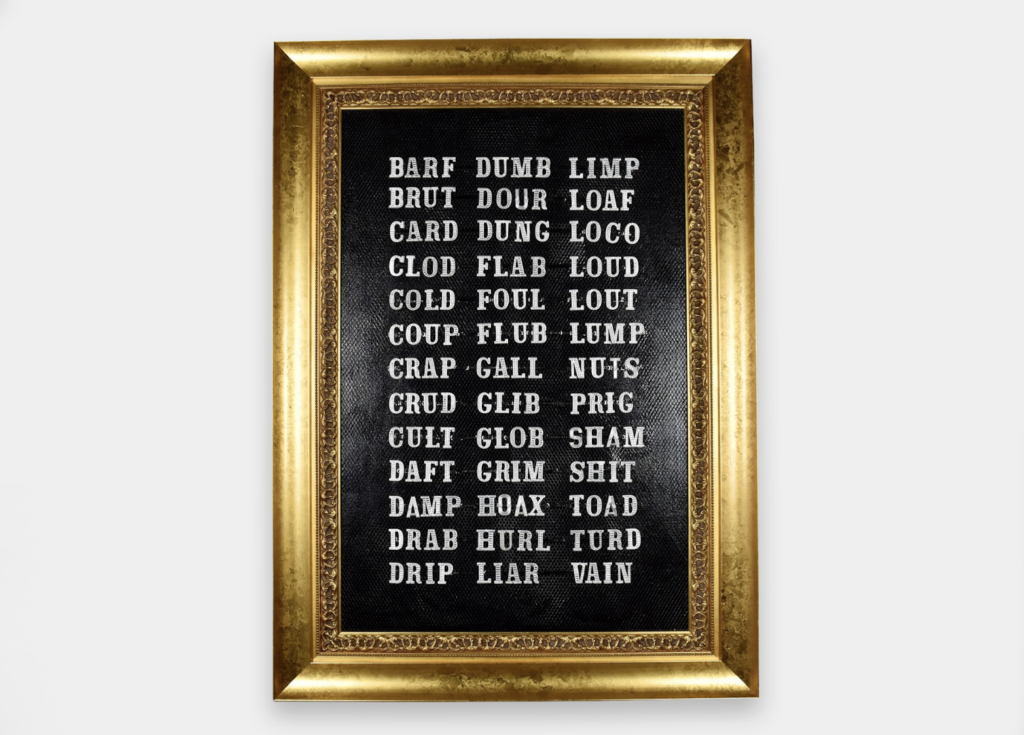
Many artists talk about their work as a conversation between themselves and the materials. Is that true for you? How much control do you keep, and how much do you allow the materials to lead?
Materials are 100% in the lead! My acquisition of an object is driven by instinct, but materials may sit in the studio for years before I can hear what they’re trying to tell me. I liken the relationship to that of parent and child: children enter the world with intact personalities. Successful parenting isn’t about “making” your kids into something; rather, it’s about observing and absorbing their inherent nature and doing all you can to honor and support them. Materials are the same way. I can’t force them to be something they’re not.
Some Birthday, America arrives during the United States’ 250th anniversary, but the exhibition feels less like a traditional celebration and more like an invitation for reflection. How did the idea for this show first come about?
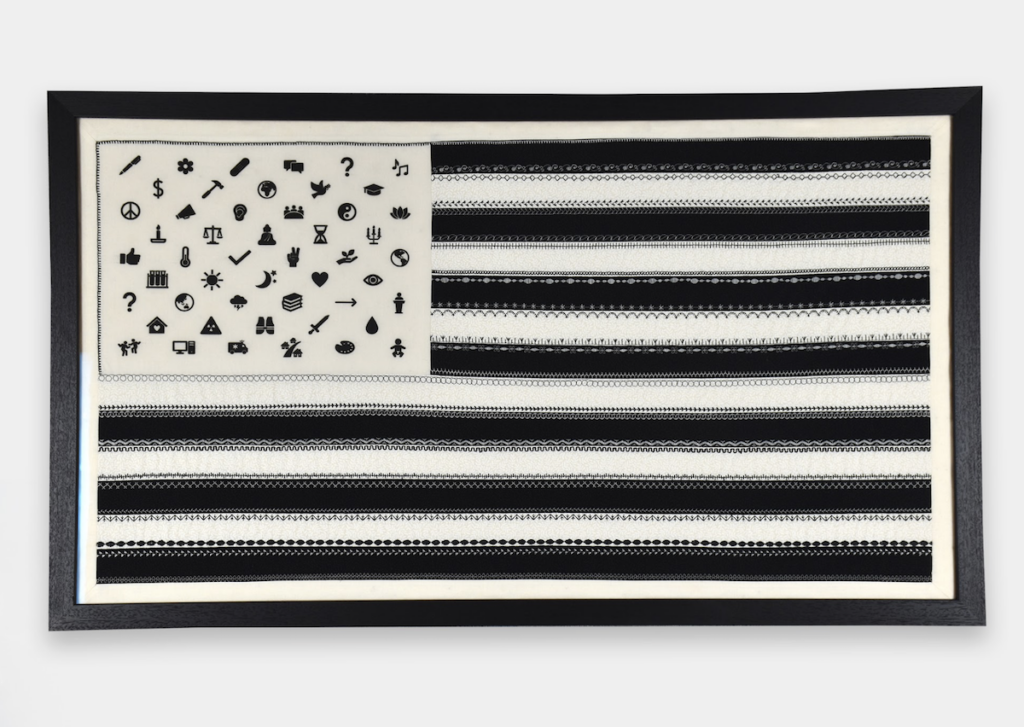
That’s exactly it. The impetus for Some Birthday, America is my prediction that our country’s 250th birthday will be more solemn than celebratory. Looking back at the work I had been making over the past year, I realized the visual language was steady and consistent—the familiar American palette of red, white and blue, but counterbalanced with a lot of black that tempers that patriotism with unease and grief. You’ll see vintage materials from the French and Victorian mourning traditions in this show.
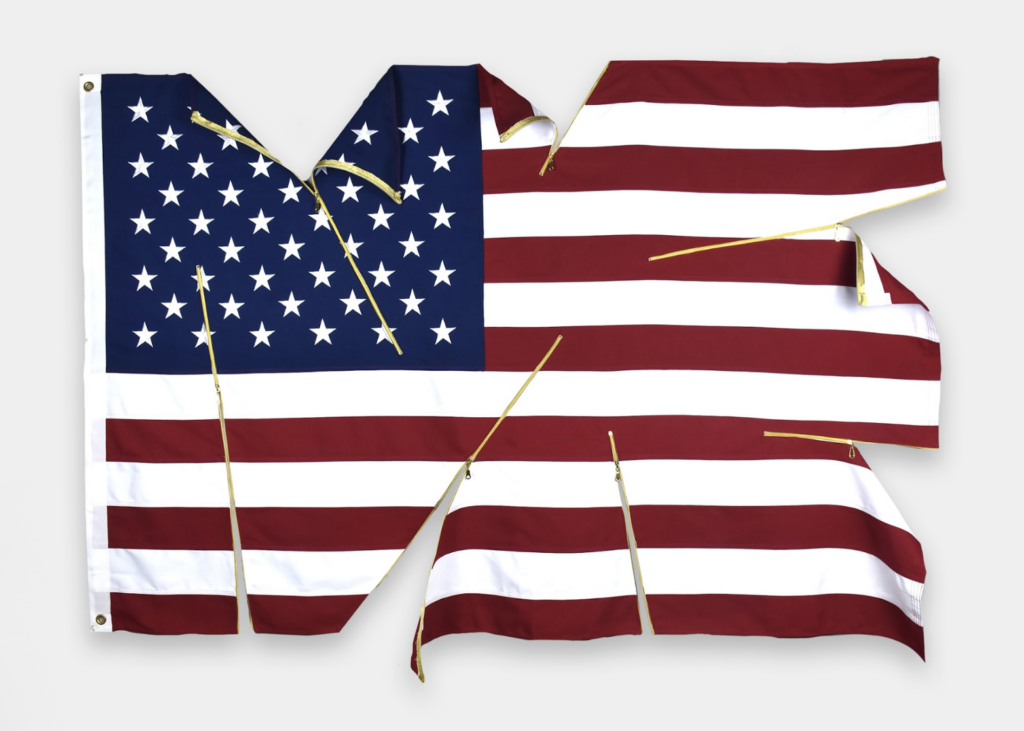
The show mirrors my conflicted feelings about my country. Like many others, I’ve been grappling with feelings of mistrust, shock, and fear about the erosion of democratic norms, the integrity of our executive and judicial branches, voting rights, and women’s rights. I found myself thinking about the anniversary not as a celebration, but as a moment of deep internal and national conflict. And I remember thinking, damn, it’s going to be Some Birthday, America. That became the seed of the exhibition, which is neither a patriotic tribute or a simple critique. Rather, it explores the tension between attachment and disillusionment, pride and discomfort. The familiar symbols in the exhibition—flags, military references, textiles, domestic materials—became a way of examining how our national identity is carried, questioned, and experienced in personal, everyday life.
You’ve spoken about experiencing the Bicentennial celebrations in Newport in 1976 and feeling a powerful sense of national pride. How did those memories shape this exhibition?
The Bicentennial took place before the internet when most Americans received their news from the same sources. Our country wasn’t perfect by any means, but it seemed then that despite our differences we were able to put them aside for a while to celebrate what we held in common. That shared baseline was a common thread that ran through the celebrations in 1976.
Those memories are in stark contrast to what I’m feeling in 2026. Our media landscape is fractured and siloed, and truth is now a relative concept. We still have not reckoned with our foundations of colonization and enslavement. And we have twice elected a molester of women and children to the highest office in the land, a man who has flippantly turned allies into enemies and brazenly enriches himself and the privileged at the expense of our citizens. That chasm between 1976 and 2026 is the basis for the exhibition.
The exhibition incorporates local quahog shells stamped with George Washington’s words from his 1790 letter to Newport’s Touro Synagogue: “to bigotry no sanction, to persecution no assistance.” What made this historic statement feel important to revisit now?
Washington was of course referring to America’s founding principle of religious liberty which guaranteed all persons the right to worship as they chose. On our 250th anniversary, fundamentalism and bigotry is fueling discrimination against non-Christian, non-white and foreign-born Americans.
In the context of my exhibition, I am interpreting Washington’s statement to broadly include all manners of discrimination and persecution and am harnessing his words as a call to action for visitors. The shells and other small artifacts will be sold with all proceeds donated to Dr. Martin Luther King, Jr. Center, a long-standing social service agency serving vulnerable Newport populations.
Your work also touches on the idea of inheritance, not only what we receive from history, but what we choose to carry forward. What do you believe this generation is responsible for preserving or changing?
We have a responsibility to do both. The ideals upon which our country was founded are a noble blueprint worth preserving…but we must continue the difficult work of interpreting them to fit current times and ensuring that they belong to the many, not the few.
Rather than presenting clear political conclusions, your work invites contradiction, discomfort, and empathy. How important is ambiguity and open interpretation within your work?
It’s essential. The success or failure of the American experiment relies on people’s willingness to educate themselves and engage with complex, ambiguous issues. As such, I’m not interested in simplistic emotional positions—either raw patriotism on one hand, or pure cynicism on the other. The emotional truth for many of us lives somewhere in the tension…and that complexity feels in sync with the moment we’re living in. Some Birthday, America encourages viewers to bring their own experiences and questions into the encounter.
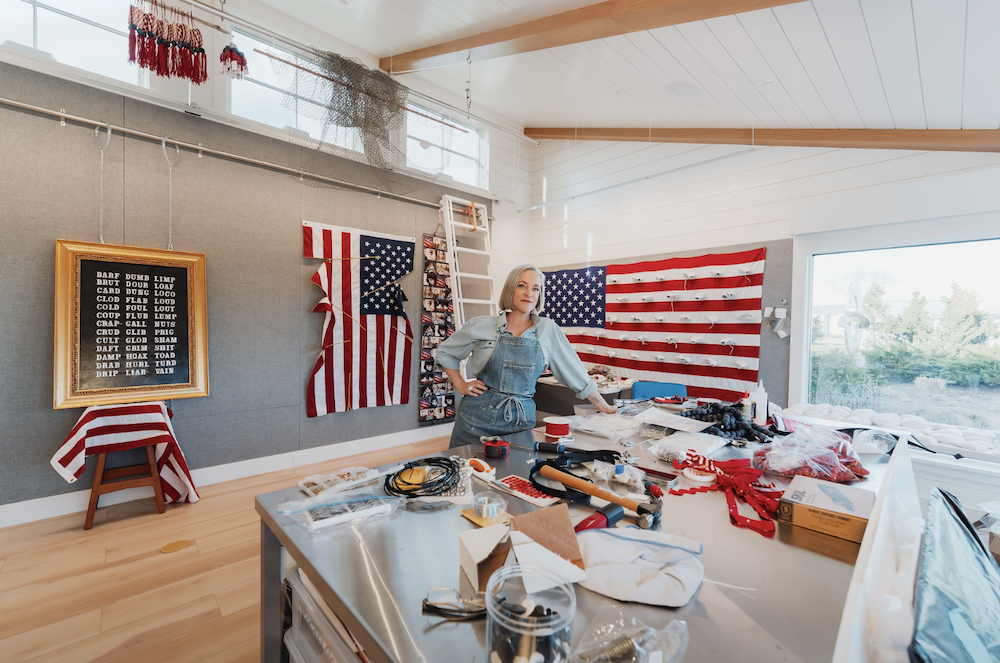
I hope the work encourages people to look more closely—at symbols, at inherited narratives, at their own emotional relationship to the country and its ideals. History isn’t something that happened to other people a long time ago…we shape it daily through action and inaction. As we turn 250, our messy American democracy is struggling. If my exhibition creates moments of recognition, questioning, discomfort, curiosity, or renewed engagement, I’d consider that very meaningful.” Tracy Weisman