
Following her recent Saatchi Gallery exhibition and ahead of her presentation with Rademakers Gallery at CAN Art Ibiza 2026, London-based Dutch artist Anne von Freyburg speaks to Culturalee about transforming the opulent floral paintings of 18th-century Dutch master Jan van Huysum into immersive textile installations that challenge historical narratives around gender, beauty and desire.
Known for her richly layered, large-scale works that fuse painting, sculpture and textiles, von Freyburg revisits iconic images from art history through a contemporary feminist lens, reclaiming agency for female subjects and disrupting the conventions of the male gaze. In this conversation, she discusses her fascination with Dutch still-life painting, her reinterpretation of Fragonard’s The Swing, the symbolism embedded within her choice of fabrics, and the artists who have shaped her distinctive practice. The result is a compelling exploration of art history, materiality and female pleasure, woven together through colour, texture and radical acts of transformation.
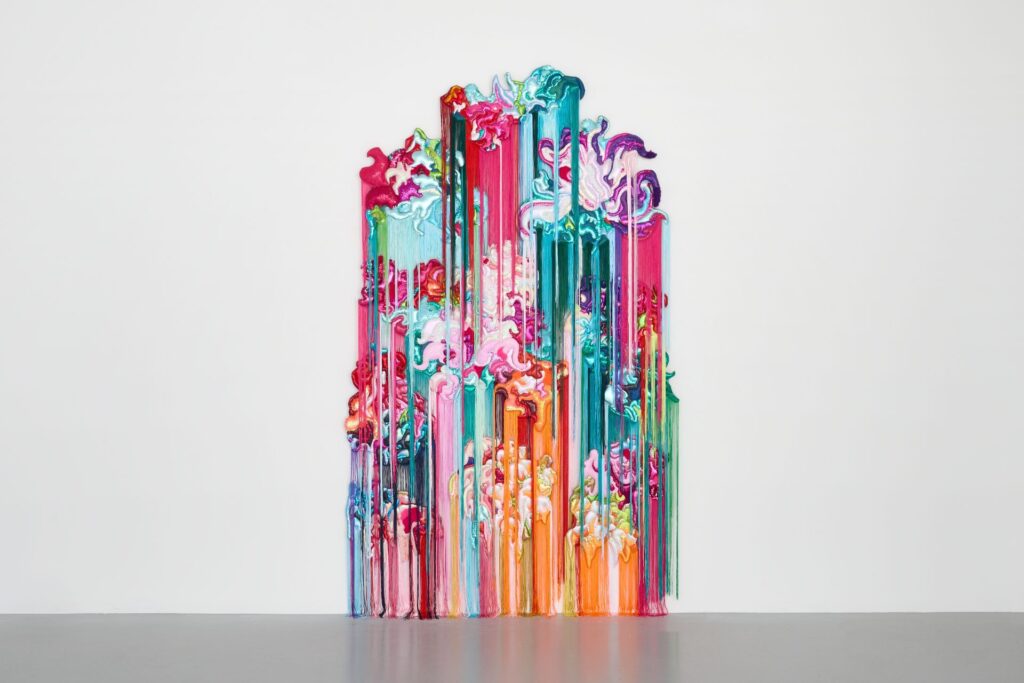
At CAN Art Ibiza with Rademakers Gallery, you will present a large-scale deconstructed floral textile wall installation inspired by the Dutch Old Master Jan van Huysum. What first drew you to van Huysum’s exuberant floral compositions, and how have you translated the precision, abundance and symbolism of his paintings into a contemporary textile language?
My interest in still life painting was sparked some years ago when I was visiting the Wallace Collection in London and saw the two flower still-life’s they have displayed from Jan van Huysum.
As a Dutch person I’m familiar with the colonial history of The Netherlands and their specialism in botany. I was interested in what they represented at that time and by whom and why they were painted. Flowers were one of the few subjects female painters could take on in the 18th century. This started my interest in how flowers over time were used as a painting subject for female painters to subvert.
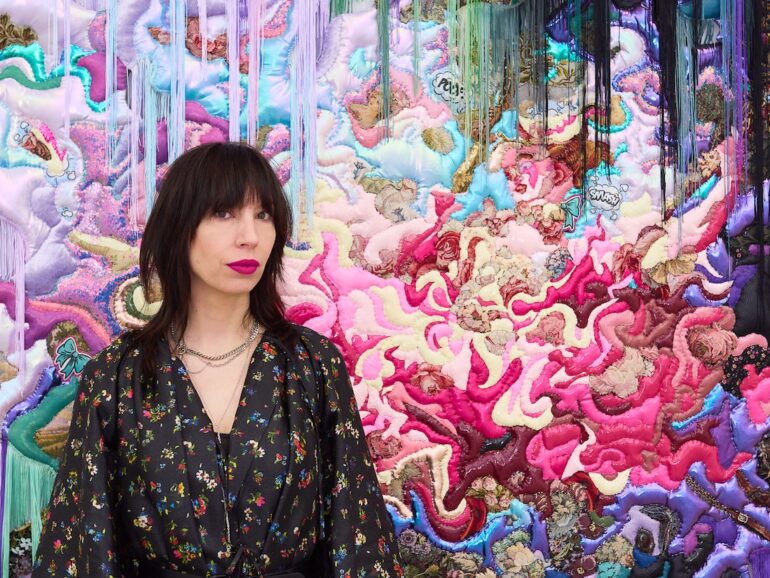
Male artists have been using flowers as erotic symbols: Representations of sensual pleasures, fertility and stand-ins of female genitals. I want to reclaim and play with these stereotype ideas around the flower as being feminine and a sexual metaphor. By making them abstract and fluid looking I’m going against the idea of the pretty flower as a static artificial object and making it part of the stream of nature again. In this work I used a vibrant colour palette, lots of lace and shiny glossy fabrics to hint towards seductiveness, and fake fur to subvert it. Some parts of van Huysum’s work are still oozing through. My intention was to destabilise the original still-life and disrupt the masculine central viewpoint. Instead of flowers and fruit being displayed as delicate objects in perfectly painted compositions, I wanted to create a feeling and a sensation of ecstasy.
What conversations are you hoping this new work will open up between art history, materiality and the natural world?
I hope they can open up a conversation about gender and the importance of female sensuality, pleasure and joy in life.
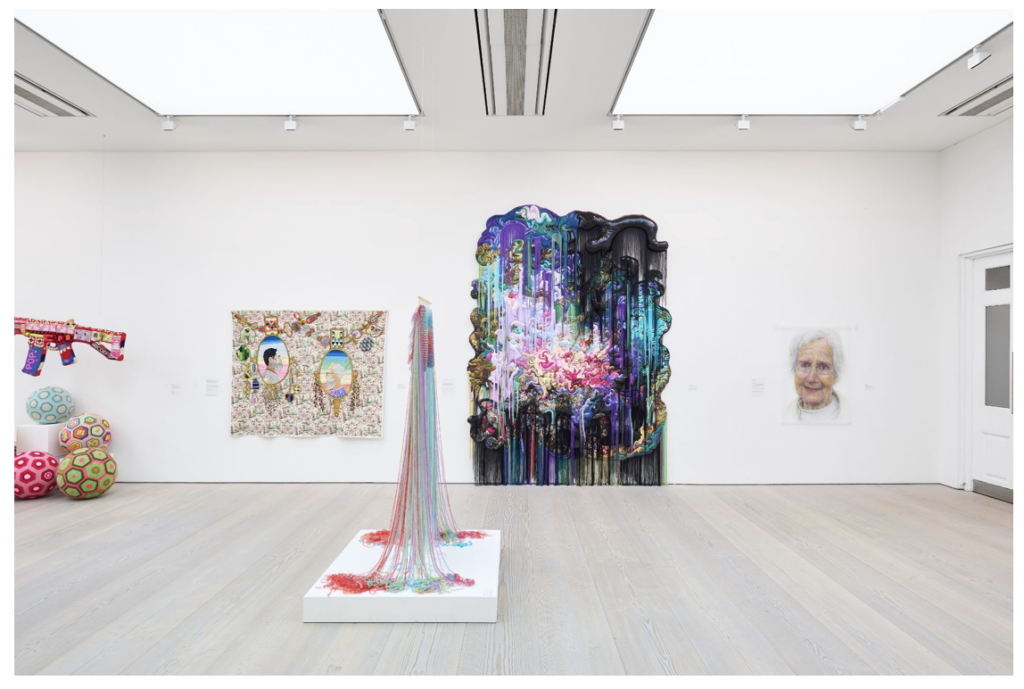
Your work often revisits iconic images from art history through a distinctly contemporary and feminist lens. For example, In Flight Mode (After Fragonard, The Swing) – which was exhibited in Textile Art Redefined at the Saatchi Gallery in 2026 and curated by Helen Adams – you reinterpret one of the most recognisable paintings of the Rococo period. What is it about Jean-Honoré Fragonard’s The Swing that continues to inspire your work, and why do you think it has become one of the most appropriated images in mainstream commercial culture?
This was actually the second time I repurposed The Swing. In 2023 I made Oops I Made You Lose Your Head (After Fragonard, The Swing) with the focus of making her the main subject and leaving the male spectators out of the work.
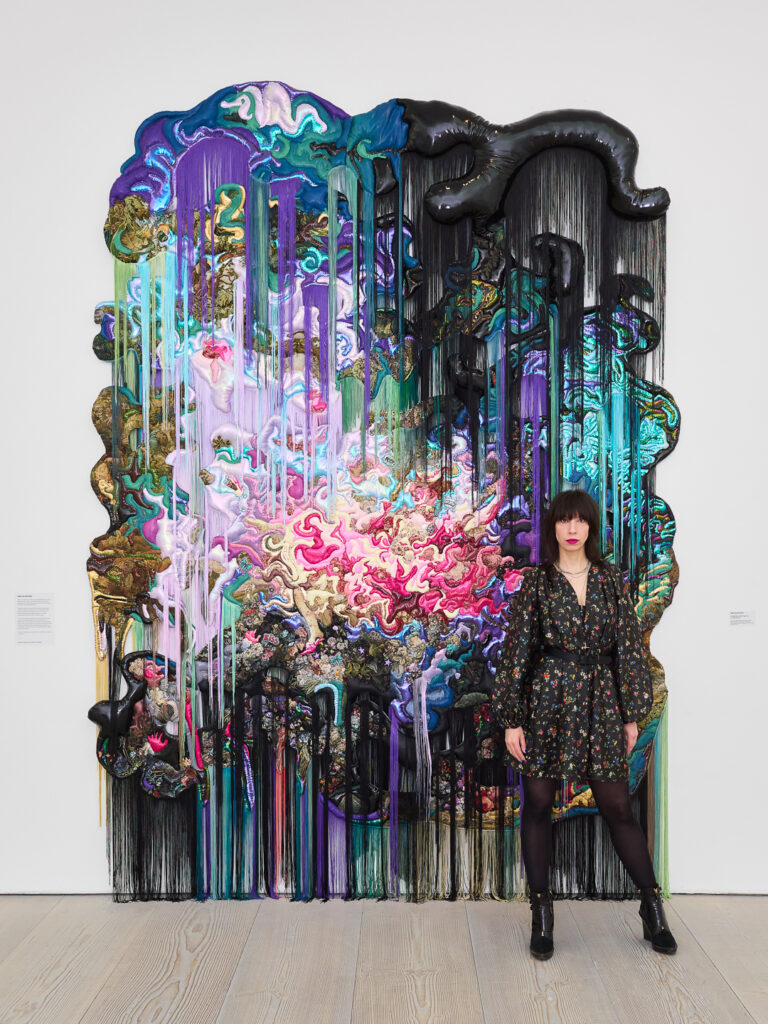
For the recent one I wanted to see what I could do when the subject would be about looking and being looked at: the two men who are looking at the woman and the viewer who is looking at the painting. Originally The Swing was meant for the male gaze and male sexual fantasy. The woman has no agency; it’s the man who’s swinging her that is in control. I wanted to take back female control by making a work that is loose and dynamic in gesture. Through its extra-large scale, in contrast to the original small size, I was able to emphasize movement and disorientation by obscuring the subjects – for example, the woman’s dress that appears as if it’s going in and out of shape.
Surrounding the central figure with fringes might give the idea that one is looking at a theatre stage where the woman is acting out her fantasy. My reinterpretation can be read as taking pleasure in being looked at, but only on one’s own terms and with total freedom of expression.
Your wall-based textile works are remarkable for their intricacy, colour and sculptural complexity. How do you select and source your materials, and what does your creative process look like from the initial spark of an idea to the finished installation?
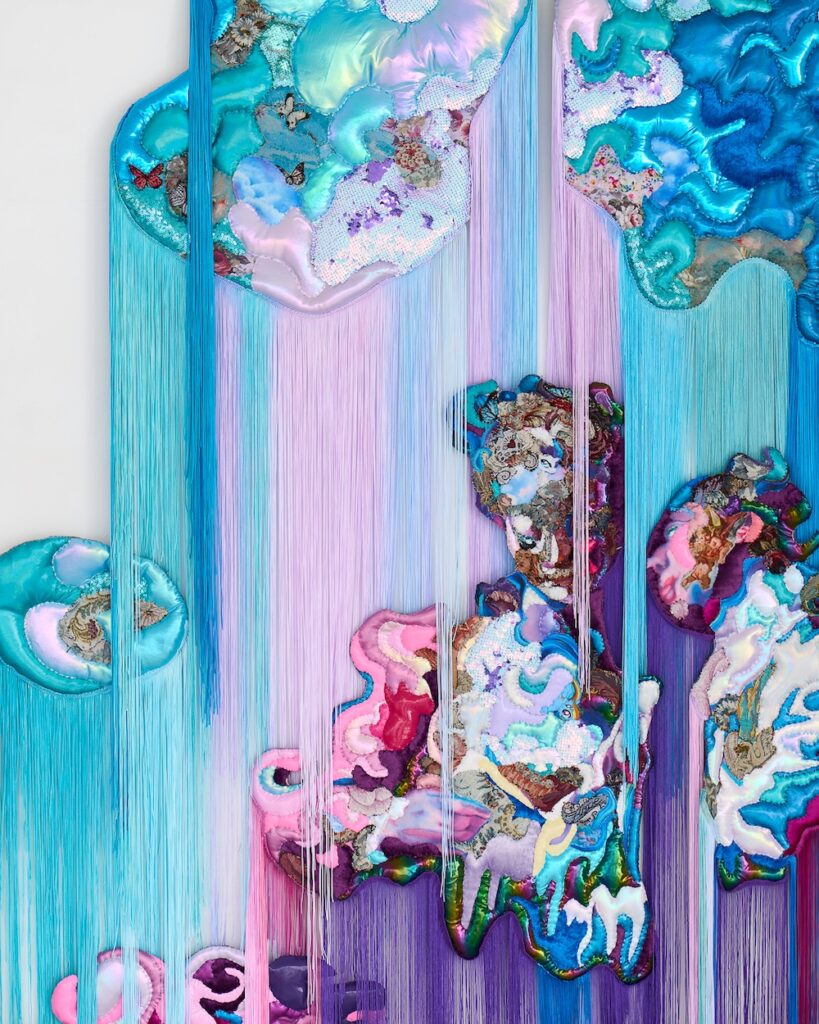
Every fabric has its own story in history and social connotations and can be even used politically. An ornament, fabric or colour can be considered kitsch in one time period, and in another seen as edgy and hip. I select them on these qualities.
For instance, in this work I repurposed lingerie lace, sequin fabrics, glossy pvc and metallic shiny fabric for the stereotype of their relationship to femininity and seductiveness. By adding some hairy fake fur, I wanted to give an edge to the slick seductiveness of these shiny materials. When using contemporary fabrics that are used in the fashion industry, I can make a link to contemporary culture.
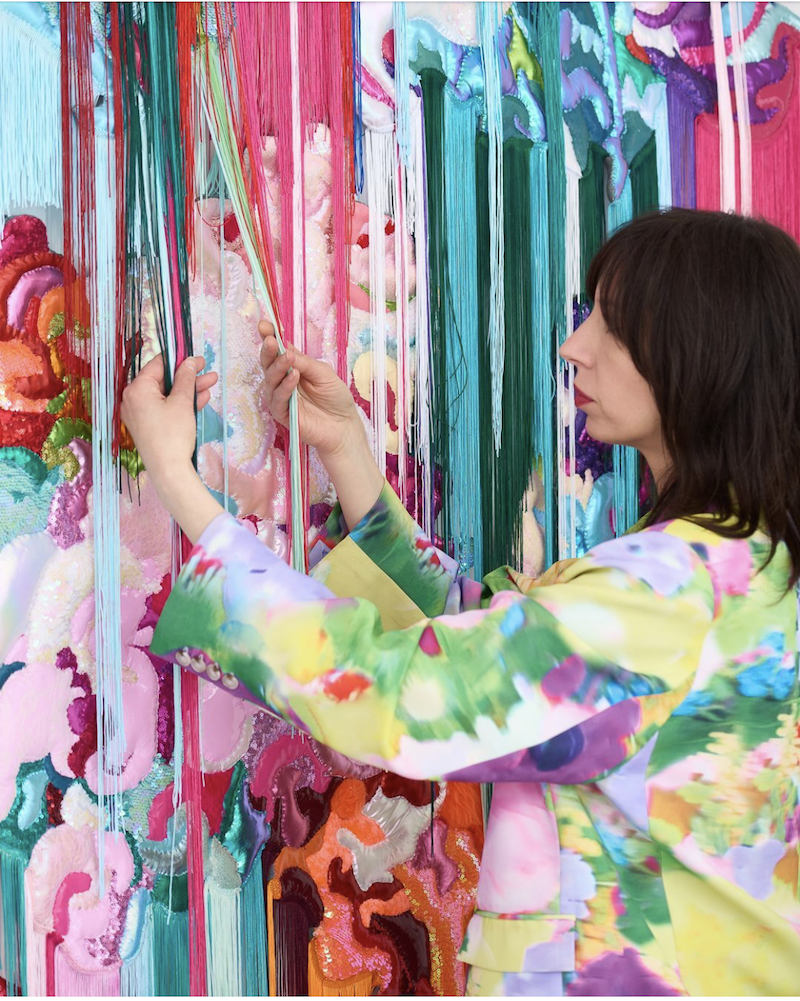
I find my painting subjects online or while visiting museums. I use Photoshop filters to change the colours and shape of the ‘old masters’ paintings. This functions as the reference for the painting. Photoshop is a great tool to try out ideas of colour, shape, and to think about the more formal aspect of the painting. It is like painting with digital instruments on Old Master reproductions. I translate that onto raw canvas fairly quickly with acrylic inks as an under-painting and conceal it with fabrics, which are then hand stitched and quilted onto the stretched canvas. I’ve been collecting various textiles for over 20 years, sourcing them from flew markets, online auction, old clothes and fabric stores. It’s a huge collection sorted on colour and theme. Like a painter has a colour pallet I have mine in fabrics. The last element to add are the hand painted fringes that refer to modernist abstract drip paintings.
Who have been the biggest artistic influences on your practice, whether from art history, contemporary art, fashion or beyond, and how do those inspirations shape the works you create today?
Some artists and work that influenced my practice are for example Miriam Shapiro’s feminage’s (a combined word of feminine and collages) and the ‘pattern and decoration’ movement she was part of, Mike Kelley’s memory work, Joanna Vasconcelos large textile sculptures, Rachel Kneebone’s sensual porcelain sculptures and Cecily Brown’s earlier abstract expressionist paintings of pornographic imagery. I admire Glenn Brown for his appropriation of art history paintings.
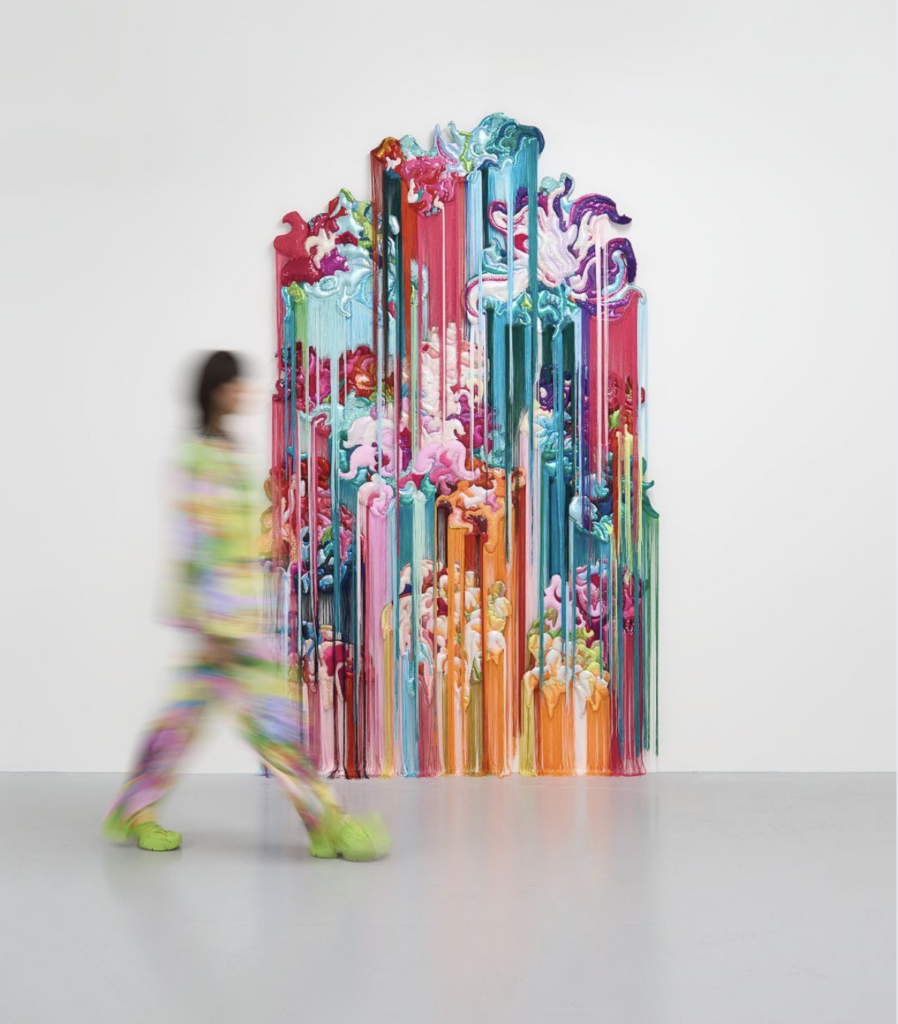
Male artists have been using flowers as erotic symbols: Representations of sensual pleasures, fertility and stand-ins of female genitals. I want to reclaim and play with these stereotype ideas around the flower as being feminine and a sexual metaphor. By making them abstract and fluid looking I’m going against the idea of the pretty flower as a static artificial object and making it part of the stream of nature again.” Anne von Freyburg