

The Museum of the African Diaspora (MoAD) in San Francisco will present Dewey Crumpler: Sonic Lineages, the first institutional solo exhibition in the city dedicated to the acclaimed Oakland-based artist, muralist and educator. Opening on 30 September 2026 and running through 30 May 2027, the landmark exhibition explores more than five decades of Crumpler’s groundbreaking practice through new kinetic sculptures, monumental paintings and multisensory installations inspired by the rhythms of jazz.
Curated by Key Jo Lee, Sonic Lineages positions Crumpler as a pivotal figure in the history of Black abstraction and Bay Area cultural life. Bringing together his celebrated hoodie and container ship series alongside newly commissioned works, the exhibition traces connections between African diasporic histories, migration, memory and improvisation. Through dynamic exchanges between visual art and music, Crumpler transforms abstraction into a language of possibility, revealing how Black histories and futures continue to resonate across generations, geographies and artistic disciplines.
Dewey Crumpler is one of the most meaningful artists of our time, and his work has been woven into the cultural identity of San Francisco for more than five decades. MoAD first exhibited Dewey’s work in 2012, and we’re proud to be the first San Francisco museum to dedicate critical attention to his practice through a solo exhibition at this scale. Our hope is for viewers to feel a renewed sense of appreciation for the Black artistic life that’s long existed in our region, and join MoAD to honor Dewey’s sustained commitment to experimentation and community.” Monetta White, Executive Director and CEO
Courtesy of the artist, MoAD, and Jenkins Johnson Gallery, New York and San Francisco
Across his long career, Dewey generously offers Black abstraction as a language that does not withdraw from political life but offers a new way of thinking through it. Through painting, sculpture, printmaking, scholarship, and pedagogy, he has built one of the most expansive artistic practices to emerge from the Bay Area, creating continuity across genres, disciplines, and histories. His work forms a pulse and rhythm that moves from the African continent across geographies and forward through time. This exhibition offers MoAD an opportunity to recognize Dewey’s enduring contributions to contemporary art, Black aesthetics, and artistic education and to position him within the pantheon of Bay Area artists whose influence has resonated nationally and internationally, including Raymond Saunders, Oliver Lee Jackson, Mildred Howard, and JoeSam.” Key Jo Lee, Chief of Curatorial Affairs and Public Programs
Born in Arkansas in 1949 and raised in the Hunters Point neighborhood of San Francisco, Crumpler received an MFA from Mills College in 1989. His artistic practice began as a city muralist, and throughout the 1970s and 1980s he created public murals across San Francisco–many of which are still on view today–that use speculative Black aesthetics while affirming the local community at the street-level. He taught at his undergraduate alma mater SFAI from 1989 until its closure in 2022, where he instructed painters who would ascend to international recognition such as Deborah Roberts, Rozeal., and Kehinde Wiley. In the 1990s the artist began his popular paintings using hoodies and container ships, which furthered his investigations of Blackness within modern-day economic and philosophical conceptions alongside new configurations of Black existence in the West.
Dewey Crumpler: Sonic Lineages will be the first time that the artist’s work is placed in cross-disciplinary exchange with jazz composition. Through Crumpler’s brush, jazz functions as a living, structural force, one in which improvisation, repetition, and syncopation shape the artist’s visual worlds the way they shape music itself. In MoAD’s Bates Gallery, Crumpler will debut new kinetic sculptures that move at different timings and rates. Like meters found in jazz, these works dance, swing, and evade rigidly imposed tempos in favor of free interplay with one another. In this series, viewers encounter time and movement as artistic materials in their own right, sensing that they inhabit several timescales at once.
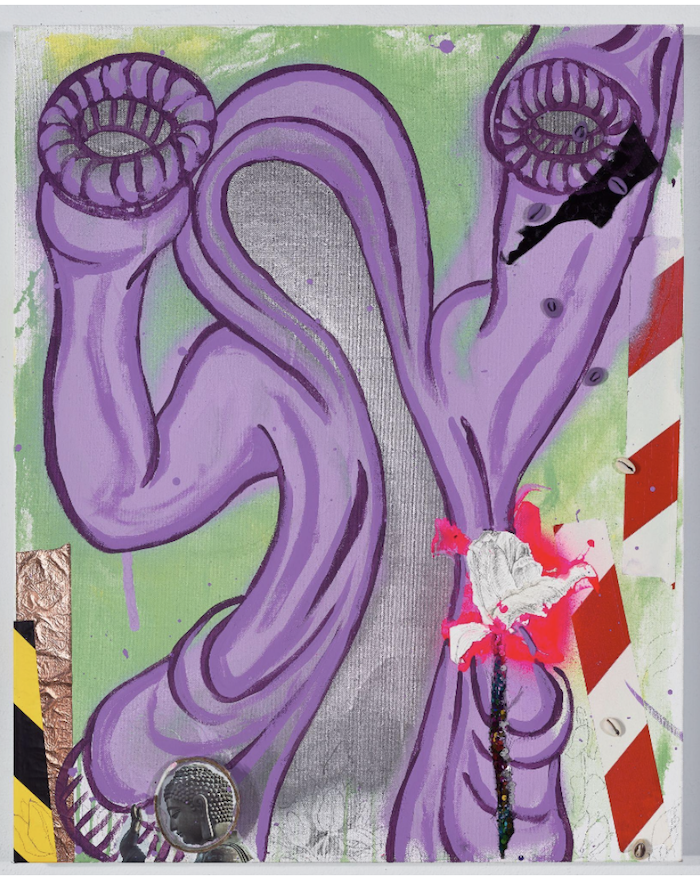
Figures, forms, and small moments of suspension in Crumpler’s paintings contain absences or vacancies, replicating moments in jazz where negative space invites call-and-response or emotional tension. These originate from an oval iron collar that the artist encountered in a book on the Atlantic slave trade, once used in African spiritual ritual and dance, but repurposed as an instrument of bondage. The artist inherits these void-forms as ancestral memory and tunes them to a new conceptual frequency or musicality. Each of the three painting series in the show features this central motif in inventive and unprecedented ways.
Crumpler’s series of hoodie paintings began in the 1990s after he observed the ovoid form of a hooded sweatshirt draped over a chair. Throughout the second-floor galleries, works such as In the Moment (2023) depict hooded forms moving through expansive fields of color, gesture, and cosmic possibility. Emerging from Crumpler’s long engagement with Black cosmology, abstraction, and the symbolic power of the void, these paintings transform the familiar silhouette of the hoodie into a site of speculation and becoming. The hood is at once body, portal, vessel, and universe: a recurring form through which Crumpler explores the relationship between visibility, memory, and the boundless potential contained within Black life. A neon sculpture extends this signature form into luminous territory, now charged with the electric pulse of plasma and deep space.
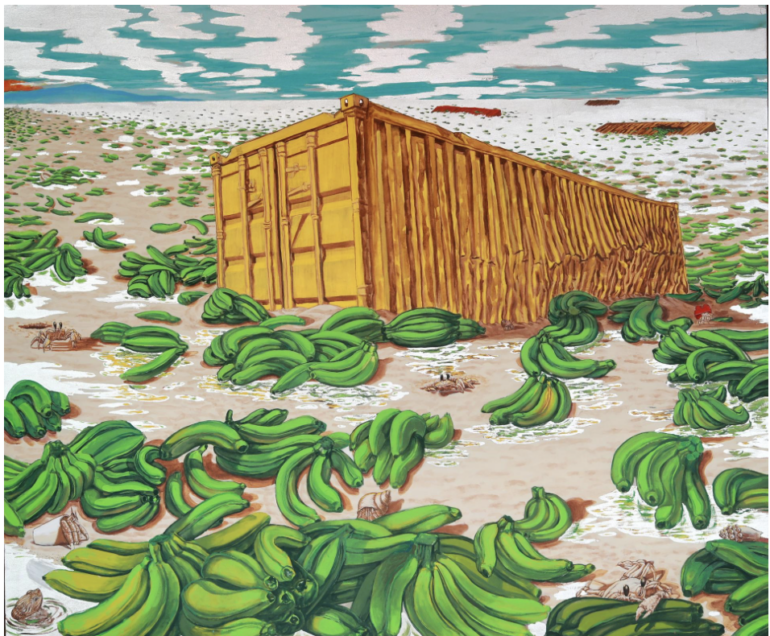
Similar to musical improvisation, these forms embrace multiplicity and resist fixed meaning. Elsewhere, the void emerges within Crumpler’s container ship paintings, a motif he began developing in the 1990s after observing the steady movement of cargo vessels through the Port of Oakland. These works position the container ship as a structure of passage, connecting histories of forced migration, global commerce, cultural transmission, and contemporary mobility. Moving between the specific and the symbolic, the ships become vessels of memory and transformation, carrying traces of the Middle Passage while illuminating the ways Black histories continue to shape and move through the modern world.
Works such as Breach (2023) explore moments when systems of movement and exchange become visible through disruption. Here, the ordered geometry of stacked containers gives way to a scene of rupture, as vessels and cargo drift across a turbulent sea. Collapsing distinctions between past and present, the painting connects contemporary networks of global commerce to longer histories of maritime passage, migration, and displacement. In Crumpler’s hands, the container ship becomes both a material reality and a metaphor for the ways histories, memories, and cultures continue to move across time and space. These themes are also taken up through three-dimensional forms, including a series of black and white spheres evoking navigational instruments and the intertwined forces of boundlessness and containment.
Across both his paintings and sculptures, Crumpler stretches and transforms a historical form to demonstrate how abstraction activates Blackness as an expansive field of possibility. The artist reveals that both the jazz composition and the painting contain layered temporalities and moments of silence, where past and future call to one another across generations and converge within new visual and sonic planes. Underlying this approach is Crumpler’s principle of “absolute autonomy,” the belief that everything in the universe is available as material for artistic transformation. Forms migrate across bodies, ships, landscapes, and abstractions, generating unexpected relationships and new ways of seeing. The result is a vision of Blackness as dynamic, relational, and continually unfolding.
A fully illustrated exhibition catalogue, forthcoming from Stable Books in Spring/Summer 2027, will accompany the exhibition with essays by Key Jo Lee, Dr. Tiffany Barber, Dr. Luke Williams,and Cornelia Stokes
The exhibition opens timed to the third annual Nexus: SF/Bay Area Black Art Week, with tickets available at moadsf.org
Dewey Crumpler: Sonic Lineages is at The Museum of the African Diaspora (MoAD) in San Francisco from 30 September 2026 until 30 May 2027. Find more information here.