

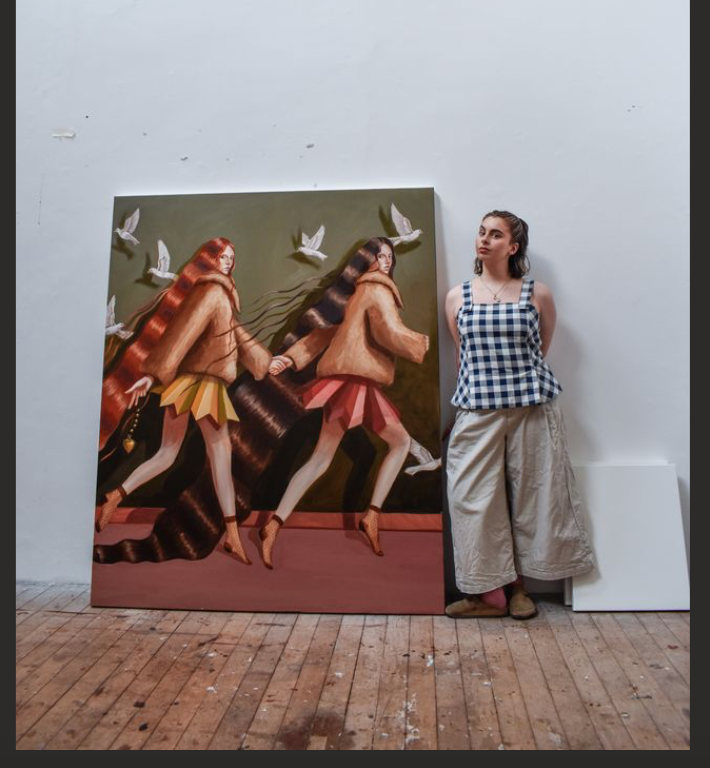
Welsh artist Darcy Whent creates paintings that inhabit the space between the familiar and the fantastical, where personal memory, folklore and women’s histories intertwine. Drawing on the landscapes and stories of her rural Welsh upbringing, Whent constructs enigmatic worlds populated by hybrid characters and charged, dreamlike spaces. Her compositions are seductive yet unsettling, balancing beauty with menace and pleasure with pain.
Her first solo exhibition in the US, Soft Bodies, Hard Frames at Kristin Hjellegjerde Gallery in West Palm Beach, Florida, explores the ways inherited stories and cultural narratives shape our understanding of identity, desire and belief. Moving between the personal and the archetypal, Whent’s paintings question what we absorb from the histories, myths and expectations that surround us—and how these narratives continue to influence the ways we see ourselves and one another.
In this Culturalee in Conversation, Whent discusses the memories, folklore and women’s histories that inform her work, her distinctive technical process, and the relationship between imagination, observation and lived experience in her paintings. She also reflects on Soft Bodies, Hard Frames and the complex, often contradictory worlds she creates within the canvas.
Your paintings occupy an intriguing space between fairy tale, folklore, religious imagery and personal memory, where myth, truth and belief become difficult to separate. What initially drew you to these inherited narratives, and what do you hope happens when you begin to question the authority or assumptions embedded within them?
I’m drawn to stories because they are unreliable. Through repetition, memory, family, religion and folklore, the line between something that happened, something you were told, and something you have believed for long enough that it feels true becomes blurred.
I’m particularly interested in the stories historically used to explain women to themselves: fairy tales, religious parables, cautionary tales, old wives’ tales and warnings. So many contain instructions. Be beautiful but unaware of it. Be desirable but not desiring. Be patient, polite and grateful. Don’t be too curious. There is often a reward for performing femininity correctly and a punishment for getting it wrong.
That led me to think about the “good girl” as an inherited performance. You learn very early which versions of yourself receive approval and which are corrected, and praise can be just as powerful as punishment.
I recognise that in myself. I loved painting from a young age, but I was also very aware that it was something I received praise for. It became somewhere I knew how to be “good.” That doesn’t make my love of painting less genuine, but it does make me question where love, ambition and approval begin to blur into one another.
I can still catch that desire for praise consuming me. What interests me is how completely it can become internalised. Eventually nobody needs to tell you to work harder, prove yourself or perform correctly; you begin doing it to yourself. The authority becomes your own voice.
That is why I don’t want to illustrate folklore faithfully. I want to interfere with it: remove the moral, interrupt the punishment, change who holds the power or stop the story before its expected conclusion. Once you recognise that a belief has been constructed and inherited, it becomes possible to question who it serves
Your upcoming exhibition Soft Bodies, Hard Frames, your first solo exhibition in the US, opens at Kristin Hjellegjerde Gallery in West Palm Beach, Florida, in September. What was the starting point for this new body of work, and how did the exhibition’s ideas around women’s histories, belief systems and the stories we inherit develop through the paintings?
Soft Bodies, Hard Frames began with the tension between vulnerability and structure. I was thinking about the frameworks women live within — the home, family, religion, the body and ideas of femininity — and how the same structure can offer protection and belonging while also becoming restrictive. As the paintings developed, I became interested in the frameworks we no longer recognise as frameworks at all: behaviours and expectations repeated for so long that they begin to feel natural. The women in the paintings often appear to be following a rule or ritual, but it isn’t clear who taught it to them or why they are continuing it.
Alongside that came the idea of the things women learn without being told. So much knowledge has historically travelled between women outside official forms of record: through oral histories, gossip, warnings, superstition, domestic rituals and repeated behaviours.
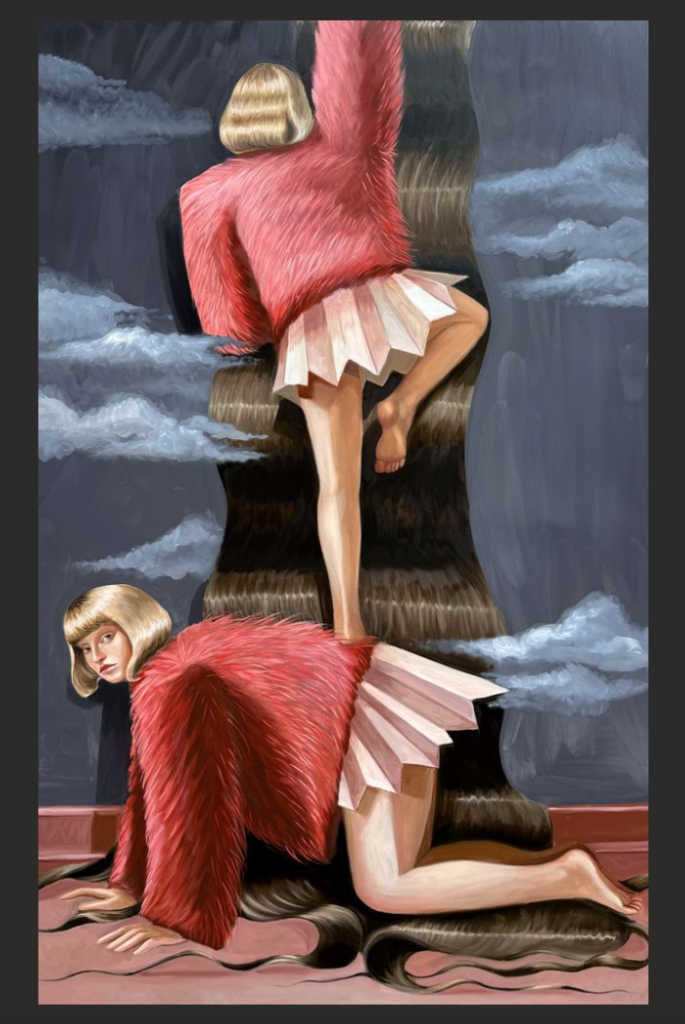
Gossip became particularly interesting because it is so contradictory. It can wound, but it can also warn. It has allowed women to exchange information and speak about experiences that might otherwise remain unrecorded. That appears throughout the paintings in birds acting as messengers, letters passing between women, whispering and silencing, hair connecting bodies, and walls that divide people while still allowing information through.
The exhibition asks what we inherit, what we continue without questioning, what we pass on to protect one another, and what might be worth interrupting.
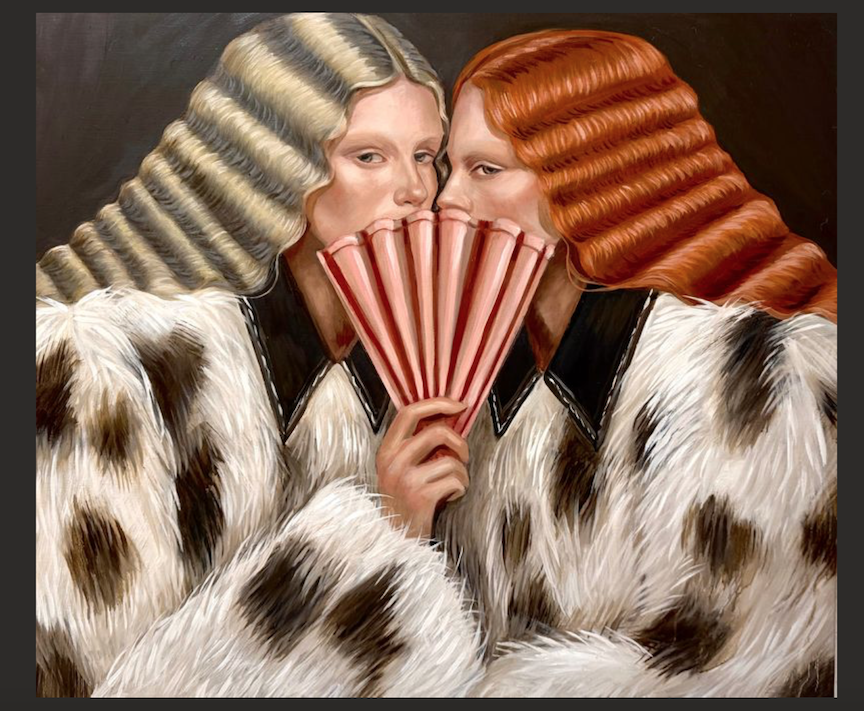
Your figures often appear caught between innocence and authority, vulnerability and power, girlhood and womanhood. Hair, vines, eggs, birds and the natural world become recurring motifs that can suggest both protection and entrapment. How do you use these symbols to explore the complexities and contradictions of female experience?
I rarely want a symbol to mean one thing. I’m much more interested in something being protective and threatening at the same time.
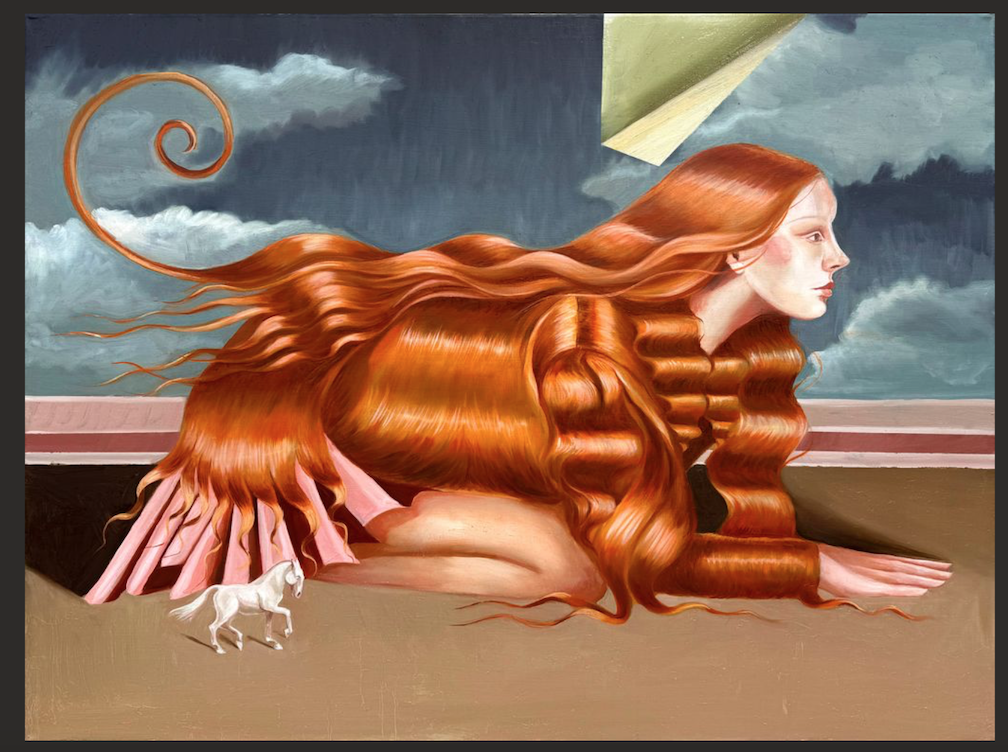
Hair is probably the clearest example. I think about it almost as an architectural material. It can become a curtain, rope, shelter or boundary. It connects women while also tying them down or obscuring them.
It also carries so many inherited rituals around femininity. We grow it, cut it, brush it, hide it and display it. It belongs to the body but can survive beyond it, so I think about it almost as an archive. In the paintings I exaggerate it until it begins to occupy the room independently of the woman.
Eggs interest me because the shell is both protection and confinement. It holds something fragile, but its purpose is ultimately to be broken.
Birds often act as messengers or witnesses. They can move between spaces the women themselves cannot cross, while carrying associations with religion, folklore, warning and freedom. I deliberately leave their intentions uncertain: are they protecting someone, exposing something, or carrying information?
The natural world enters the house in a similar way. Weeds, vines and flowers grow where they aren’t supposed to. I keep returning to the thought that a weed is only a weed because somebody has decided it is growing in the wrong place. For me, that raises a larger question around girlhood and womanhood: who gets to decide what correct growth looks like?
That contradiction runs through the figures too. Someone can be vulnerable and still hold the power. One woman can protect another while silencing her. Something nurturing can also become restrictive. I’m interested in keeping those meanings unstable.
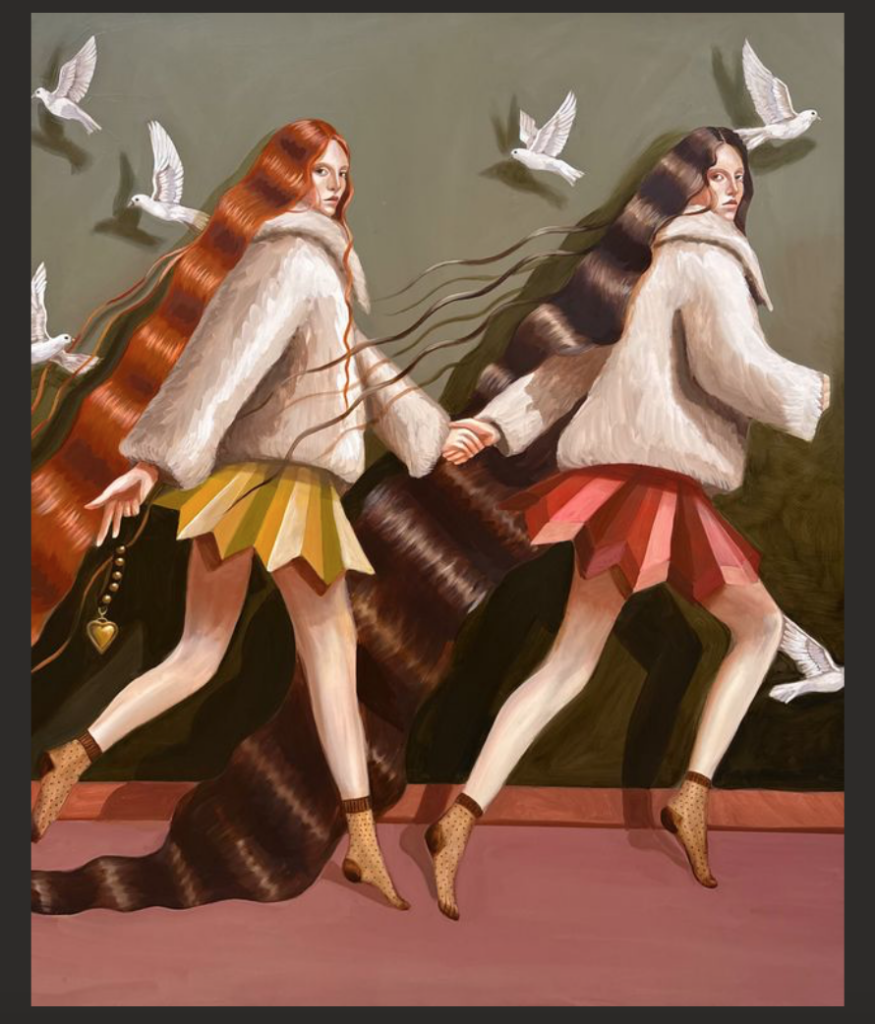
Your paintings have an incredibly precise, dreamlike quality, while retaining a sense of psychological unease. Could you talk us through your technical process, from developing an initial idea to building the final composition? Are the works primarily studio-based, and do you work from photographs, life models, sketches or found imagery, or do you allow the figures and environments to emerge largely through imagination?
The paintings are very studio-based and usually begin with a fragment rather than a complete image: a sentence, a gesture, an object, a piece of folklore or an interaction between figures. I collect photographs, clothing, architectural details and poses until separate things begin to speak to one another.
I construct the scene rather than record something that already exists. Photographs and drawings are scaffolding, but I’ll alter scale, perspective or anatomy.
The domestic interiors are especially important. They aren’t usually real rooms. Architecture becomes another way of controlling the composition and containing the figures: a wall divides two women, an opening allows communication, or a room feels fractionally too small for what is happening inside it.
I build the paintings slowly in layers of oil and want the surfaces to feel convincing enough that the strange parts aren’t immediately rejected as fantasy. I’m less interested in depicting dreams than in using dream logic: everything is recognisable individually, but the relationships between things are slightly wrong, and nobody inside the image seems particularly alarmed by it.
I also don’t need to completely understand an image before I begin. Painting is part of the thinking. Often the work becomes most interesting when it starts resisting the idea that produced it.
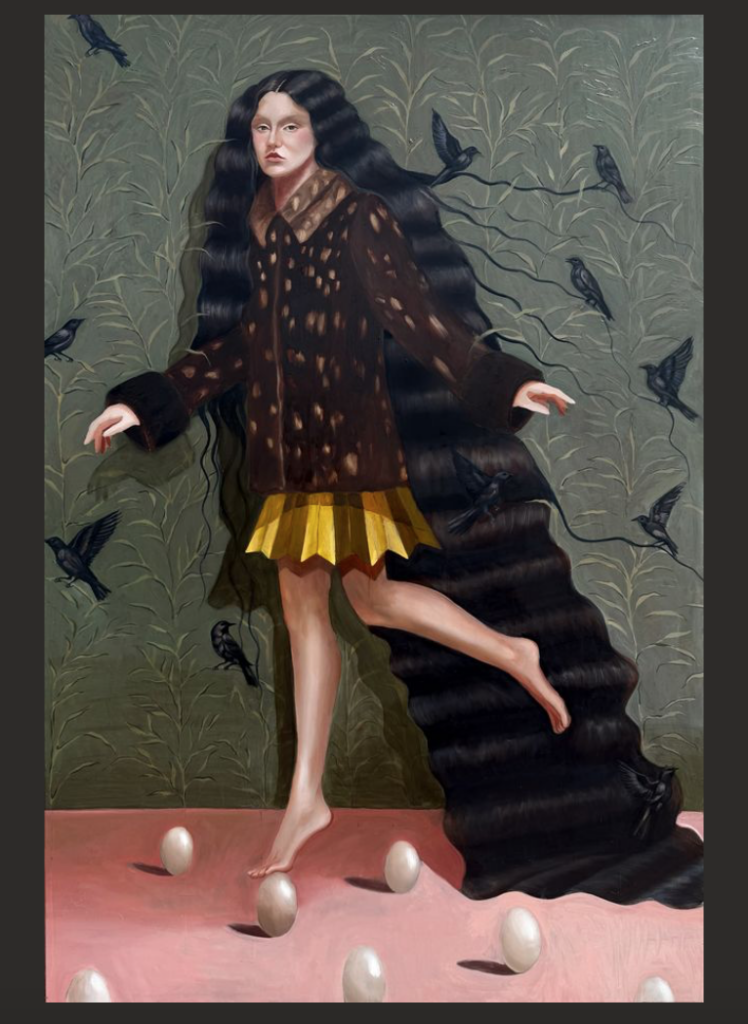
You grew up in rural Wales and have spoken about painting as both an escape and a way of processing complex experiences without necessarily resolving them. How has your Welsh upbringing shaped your visual language, and what other artists, writers, folklore, films or cultural references continue to inspire the fantastical worlds you create?
Growing up in Wales shaped the work enormously, although not through literal depictions of landscape. My women almost always remain inside; the domestic interior is really the world of the paintings. What I carried with me was a relationship to folklore, superstition and oral storytelling, the way stories move through families and communities and change slightly each time they are repeated. Eventually fact, memory and myth become difficult to separate.
The world outside tends to enter the house rather than the women entering the landscape. Birds appear inside rooms, weeds and flowers grow where they shouldn’t, and hair begins behaving like something organic and uncontrollable. I like the sense that the domestic space is trying to contain everything, but something keeps finding its way through.
I’m interested in ordinary interiors because they can hold enormous amounts of emotional memory. Wallpaper, curtains, clothing or a hairstyle can become almost talismanic. The house is never simply a backdrop; it becomes psychological architecture. It can shelter the women, divide them, contain them or force them together.
Painting began as an escape for me, but now I think of it less as escaping reality and more as rearranging it. I take an emotional truth without feeling obliged to reproduce an event exactly as it happened. A memory can become entangled with folklore, religion or something invented until its origins become impossible to separate.
I don’t think making an artwork about something necessarily resolves it. Sometimes painting simply gives a contradiction somewhere to exist.
Paula Rego has been hugely important to me because of the way she used storytelling without simplifying women into victims or heroines. Her figures are allowed to be vulnerable, cruel, funny simultaneously. Labyrinth has also remained an important reference, particularly Sarah navigating a world whose rules continually change around her.
But I’m equally interested in stories without a single author: folk tales, superstitions, warnings passed between women, children’s games, sayings and gossip, things that survive because somebody keeps repeating them.
I think the question underneath much of the work is: how much of what we believe about ourselves actually belongs to us, and how much has been handed to us?
Darcy Whent “Soft Bodies, Hard Frames” at Kristin Hjellegjerde Gallery, West Palm Beach, Florida
Exhibition dates: 18 September -24 October 2026
Find more information about Darcy Whent HERE
Find more information about Kristin Hjellegjerde Gallery,HERE