

In contemporary digital culture, where animation is often flattened into advertising, entertainment, or endlessly disposable content, artist Egor Koltsov approaches motion differently. His work treats animation not as spectacle, but as an emotional and cultural language capable of carrying humour, nostalgia, satire, and collective identity simultaneously. This position was particularly visible in Trajectories of Life: Art in Motion at AMOVE Gallery, curated by Irina Bogatikova, where Koltsov’s practice emerged as part of a wider reflection on permanence within an increasingly unstable visual culture.
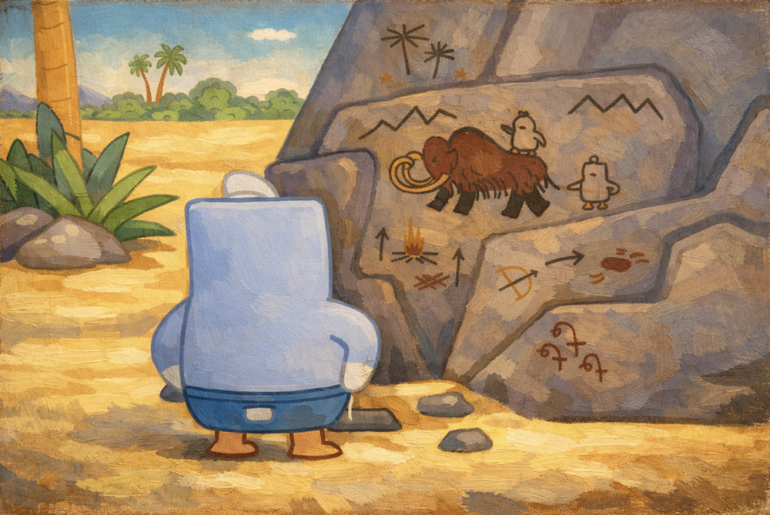
He exhibited a painting titled The First Imprint in Art in Motion, an analogue version of his digital artwork inspired by cave paintings, which establishes a compelling dialogue between prehistoric image-making and contemporary digital aesthetics. Pixelated cartoon figures appeared across surfaces reminiscent of ancient cave paintings, compressing millennia of visual communication into a single frame. The work proposed that humanity’s instinct to leave symbolic traces – whether through handprints on stone walls or looping GIFs shared online – remains fundamentally unchanged. Rather than framing digital culture as detached from history, Koltsov positions internet imagery within a much longer lineage of collective storytelling.
This intersection of art historical memory and mass digital culture defines much of his wider practice. Koltsov also seems to draw inspiration from the rich visual vocabulary of Soviet-era animation, particularly the theatrical softness and exaggerated character design associated with Soyuzmultfilm. Elements of Disney’s Golden-age animation also surface throughout his work, though his aesthetic deliberately resists corporate polish. Instead, his animations feel consciously internet-native: slightly chaotic, self-aware, and deeply informed by the mechanics of circulation and meme culture.
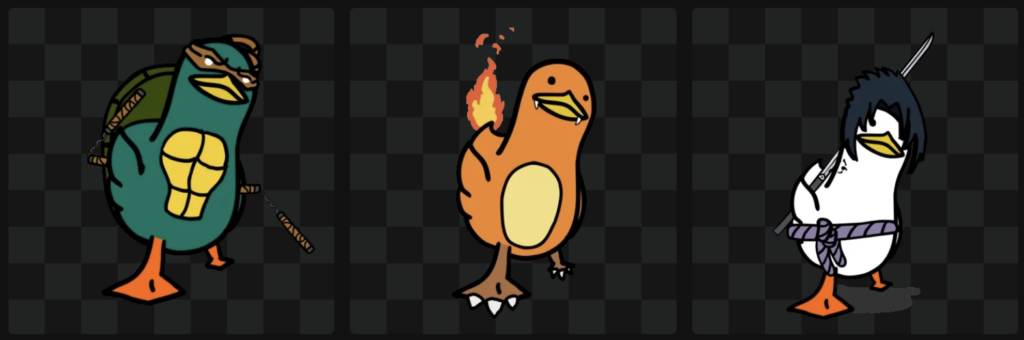
That sensibility reaches its clearest expression in Animated Ducklings, his ongoing series of walking duck characters styled as pop-cultural archetypes. Distributed through GIPHY, the digital project demonstrates how contemporary digital art increasingly exists beyond gallery systems. The ducklings function simultaneously as artworks, memes, and communicative tools embedded within the rituals of social media interaction. The ducklings went viral and have had close to one billion uses across platforms including Instagram, WhatsApp, Facebook, and iMessage. The popularity of Koltsov’s ducklings reflects more than algorithmic virality, it reveals the emotional immediacy and recognisable universality of his imagery.
What makes Animated Ducklings particularly significant is the extent to which audiences complete the work through use. Unlike static digital artworks confined to exhibitions or NFT marketplaces, these animations remain active through circulation, constantly repurposed in conversations, reactions, and online performance. In this sense, Koltsov’s practice dissolves traditional boundaries between artist, audience, and platform.
As digital culture increasingly shapes contemporary visual language, Koltsov represents a generation of artists redefining animation as a participatory form of twenty-first-century folk art.