
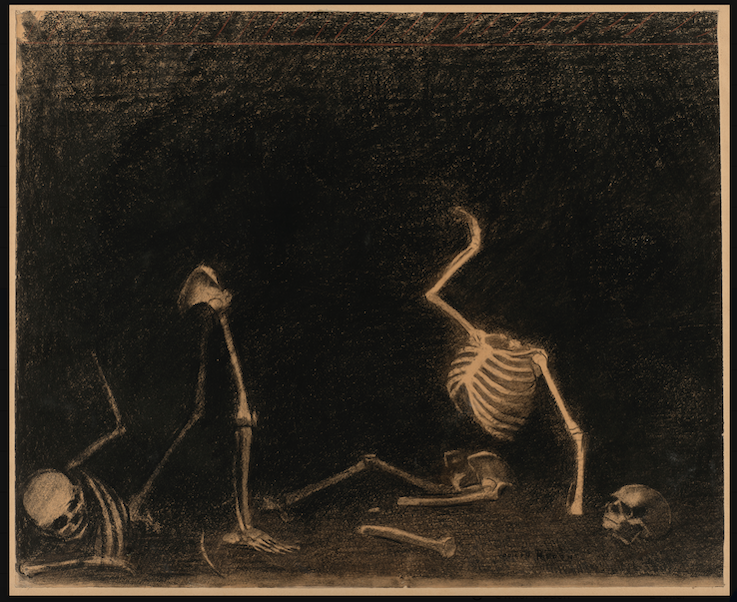
The J. Paul Getty Museum presents “Odilon Redon: Otherworldly Visions,” an exhibition featuring the French artist’s fantastical works from mysterious darkness to luminous color. The exhibition features an exceptional group of charcoal drawings, lithographs and pastels from the Getty’s collection, including the macabre “Battle of the Bones,” a recent acquisition, as well as loans from a handful of other institutions.
Visitors will explore Redon’s singular artistic vision through his diverse sources of inspiration, from religion and mythology to literature and modern science. “As an artist who dissolved the boundaries between the visible and the imagined, this display brings renewed attention to Redon’s visionary work which has always been highly popular with our visitors,” said Timothy Potts, Maria Hummer-Tuttle and Robert Tuttle Director of the Getty Museum. “Building on that popularity, in this exhibition we are delighted to share the Museum’s remarkable collection of Redon’s noir drawings, pastels and prints in one cohesive experience”.
Born in Bordeaux, France in 1840, Odilon Redon began his career working almost exclusively in charcoal and black-and-white lithography creating atmospheric compositions filled with strange monsters and mysterious apparitions. In the 1890s Redon began working in pastel and oil paint, abandoning his signature dark aesthetic for vibrant color.
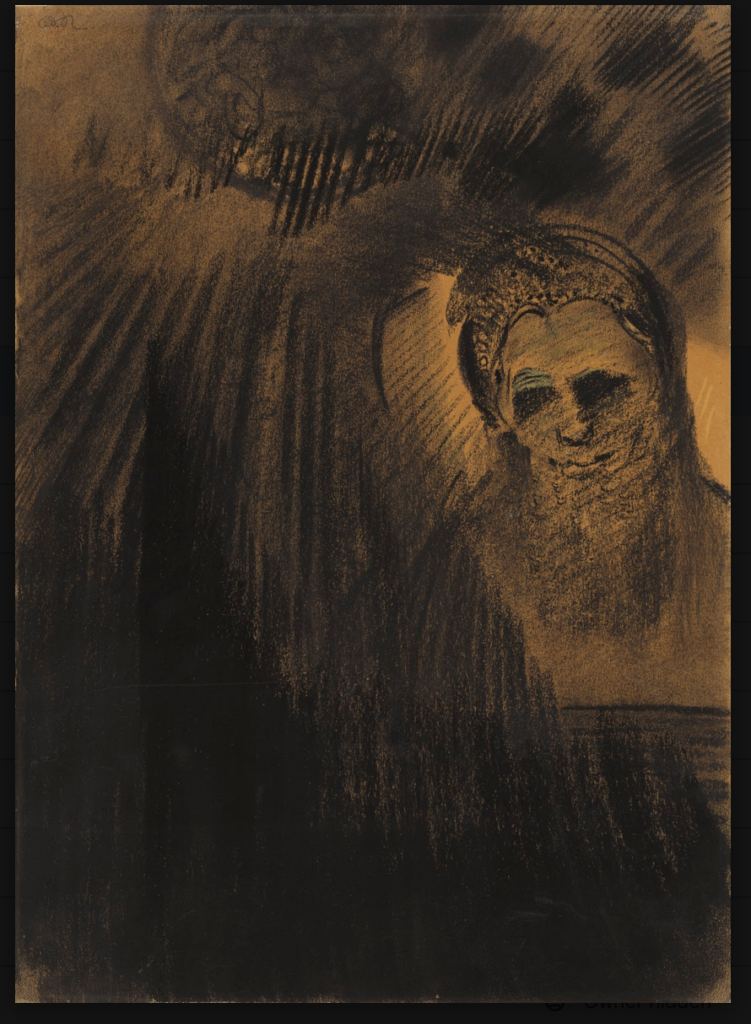
Odilon Redon “Apparition” About 1880 – 90, Charcoal, powdered charcoal, black chalk, and
black and yellow pastel with stumping on brown paper
The exhibition will explore Redon’s unusual visual world through four important aspects of his work: Noir, Lithography, Print Portfolios, and Color.In the 1870s and 1880s, Redon focused primarily on creating what he called noirs, drawings made in charcoal and other black media with equally shadowy subject matter. Redon used various shades of black as one would a full spectrum of color, finding new ways to engage with the interplay of light and darkness.
Featured among the noir drawings in the exhibition is the Museum’s recently acquired “Battle of the Bones,” inspired by a passage from a poem by Maurice Bouchor, depicting the aftermath of a fantastical duel between two skeletons. Redon framed the skeletons against a deep black charcoal background and expertly crafted the bones from blank reserves of tan paper.
At this time, Redon also began working in lithography, a printing process with a close affinity to drawing. Through the rich black ink of his lithographs Redon found another powerful way to express his vivid imagination.
In his striking lithograph “Light,” he presents an encounter with the surreal, as two small figures look through a window at the brightly lit profile of an enormous face, glimpsing the fantastic as it is illuminated through a frame.
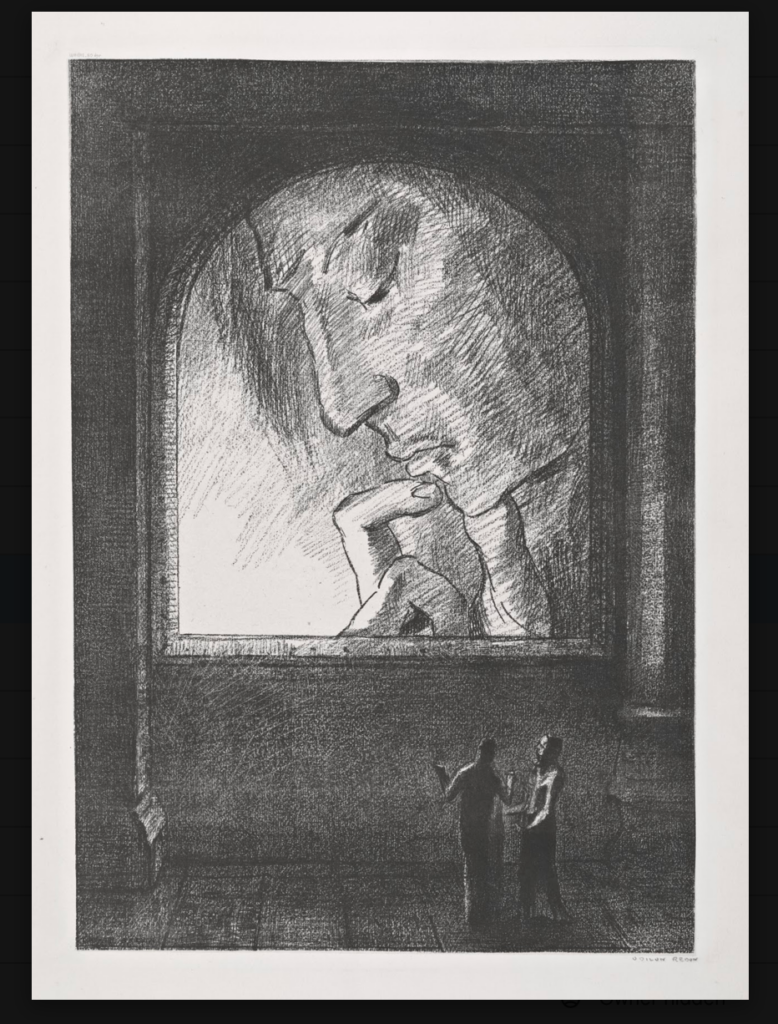
“Light” 1893. Odilon Redon (French, 1840 – 1916). Lithograph on chine appliqué
Printed by Becquet, Paris , Getty Research Institute
Over the course of his career, Redon created 11 print portfolios, groups of lithographs with a shared theme which often related directly to literary and religious texts. The exhibition features the first of his three portfolios inspired by Gustave Flaubert’s surreal novel “The Temptation of Saint Anthony,” which recounts the events of a single night as the saint is confronted by a series of terrifying visions. Based on a quote from the novel, the strange and playful print “Then There Appears a Singular Being, Having the Head of a Man on the Body of a Fish,” depicts a hybrid creature with a human head and a fish body floating in an ambiguous space. Rather than directly illustrating the texts, Redon used sources like Flaubert’s novel as inspiration for his evocative and enigmatic imagery.
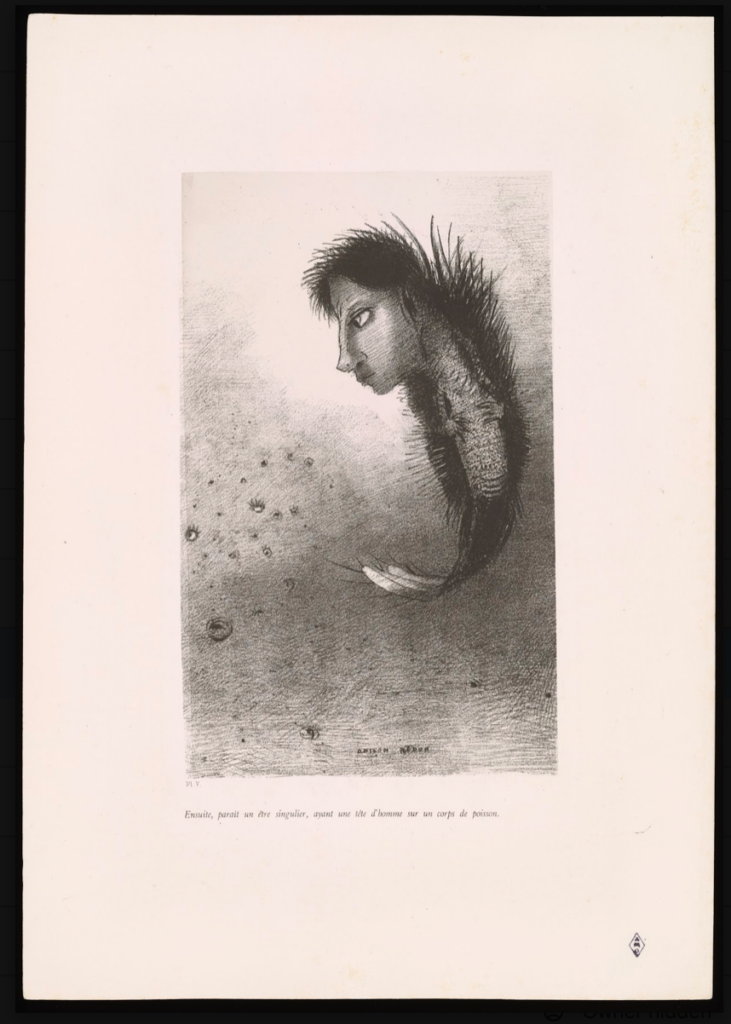
”Then There Appears a Singular Being, Having the Head of a Man on the Body of a Fish ” 1888. Odilon Redon – Lithograph on chine appliqué. Printed by Becquet, Paris. Published by Edmond Deman, Brussels
In the late 1890s, Redon shifted away from his signature noir aesthetic toward bold color. In pastel and oil paint he retained much of his signature symbolic imagery but also embraced new subjects that were better suited to vivid colors.
A highlight of the pastels in the exhibition is the radiant “Baronne de Domecy,” a portrait of the wife of Redon’s patron and friend Baron Robert de Domecy. Redon pictured the baroness lost in reverie, gazing out as if she removed from the material world. Her monochromatic face contrasts sharply with the luminous field of flowers that appears to float on the portrait’s surface, as if projecting her inner world.
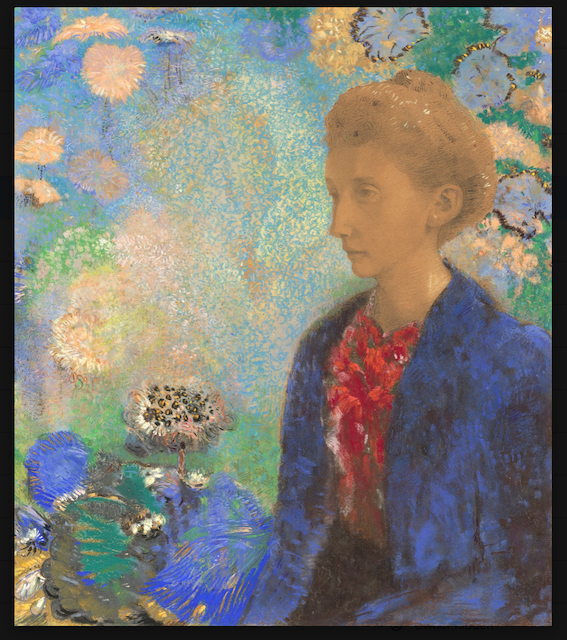
“Baronne de Domecy” About 1900 Odilon Redon
Pastel and graphite
“Odilon Redon used his art to offer new interpretations of the familiar, rendering literary subjects and the natural world in original ways,” said Danielle Canter, assistant curator of drawings at the Getty Museum.
“We hope visitors who experience Redon’s dreamlike world through the exhibition will find inspiration in the artist’s unique vision and boundless imagination.”
“Odilon Redon: Otherworldly Visions” is curated by Danielle Canter, assistant curator of drawings at the Getty Museum.Accompanying the exhibition is a publication introducing the remarkable work of Odilon Redon.
On Saturday, July 18 at 4:00 p.m., Getty will host “Odilon Redon Salon: Words and Music,” an afternoon concert and talk that will explore the connections between sound, literature, imagination, and the Symbolist art that influenced Redon’s work. Visitors can also take part in free printmaking sessions related to the exhibition on select Sundays in July and August.
The Getty Center is at 1200 Getty Center Drive, Los Angeles, California.
Admission to the Getty Center is always free, but a reservation is required for admission. Make reservations online or at (310) 440-7300.